1
This page was left intentionally blank
1
 2   Executive Summary

 3        "We must invest in a clean energy economy that will lead to new jobs, new
 4        businesses and reduce our dependence on foreign oil," said President Obama.
 5        "The steps I am announcing today help bring us closer to that goal. If we are to be
 6        a leader in the 21st century global economy, then we must lead the world in clean
 7        energy technology. Through American ingenuity and determination, we can and
 8        will succeed."
 9                      President Barack Obama
10        "Developing the next generation of biofuels is key to our effort to end our
11        dependence on foreign oil and address the climate crisis -- while creating millions
12        of new jobs that can't be outsourced," Secretary of Energy Steven Chu said. "With
13        American investment and ingenuity -- and resources grown right here at home -- we
14        can lead the way toward a new green energy economy."
15                      Secretary of Energy Steven Chu
16
17        Speaking at the May 5th, 2009 White House ceremony announcing $800M in new
18        biofuel research activities
19
20
21          The 2007 Energy Independence and Security Act (EISA) was enacted in response
22   to concerns about global energy security and supply. The Act contains provisions
23   designed to increase the availability of renewable energy that decreases greenhouse gas
24   (GHG) emissions while at the same time also establishing an aggressive Renewable Fuels
25   Standard (RFS). This new fuels standard mandates the production of 36 billion gallons of
26   renewable fuels by 2022 of which at least 21 billion gallons must be advanced biofuels
27   (i.e., non-corn ethanol). While cellulosic ethanol is expected to play a large role in
28   meeting the EISA goals, a number of next generation biofuels, particularly those with
29   higher-energy density than ethanol, show significant promise in helping to achieve the 21
30   billion gallon goal. Of these candidates, biofuels derived from algae, particularly
31   microalgae, have the potential to help the U.S. meet the new RFS while at the same time
32   moving the nation ever closer to energy independence.
33
34         To accelerate the deployment of biofuels created from algae, President Obama and
35   Secretary of Energy Steven Chu announced on May 5 th, 2009 the investment of $800M
36   new research on biofuels in the American Recovery and Renewal Act (ARRA). This
37   announcement included funds for the Department of Energy Biomass Program to invest
38   in the research, development, and deployment of commercial algal biofuel processes.
39
40        Microalgae are unicellular, photosynthetic microorganisms that are abundant in
41   fresh water, brackish water, and marine environments everywhere on earth. These
42   microscopic plant-like organisms are capable of utilizing CO 2 and sunlight to generate
43   the complex biomolecules necessary for their survival. A class of biomolecules
44   synthesized by many species is the neutral lipids, or triacylglycerols (TAGs). Under


                                                 i
45   certain conditions, some microalgae can accumulate significant amounts of lipids (more
46   than 50% of their cell dry weight).
47
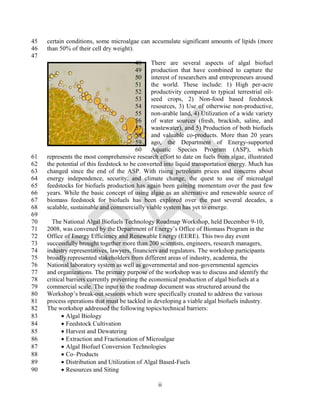
                                          48    There are several aspects of algal biofuel
                                          49    production that have combined to capture the
                                          50    interest of researchers and entrepreneurs around
                                          51    the world. These include: 1) High per-acre
                                          52    productivity compared to typical terrestrial oil-
                                          53    seed crops, 2) Non-food based feedstock
                                          54    resources, 3) Use of otherwise non-productive,
                                          55    non-arable land, 4) Utilization of a wide variety
                                          56    of water sources (fresh, brackish, saline, and
                                          57    wastewater), and 5) Production of both biofuels
                                          58    and valuable co-products. More than 20 years
                                          59    ago, the Department of Energy-supported
                                          60    Aquatic Species Program (ASP), which
61   represents the most comprehensive research effort to date on fuels from algae, illustrated
62   the potential of this feedstock to be converted into liquid transportation energy. Much has
63   changed since the end of the ASP. With rising petroleum prices and concerns about
64   energy independence, security, and climate change, the quest to use of microalgal
65   feedstocks for biofuels production has again been gaining momentum over the past few
66   years. While the basic concept of using algae as an alternative and renewable source of
67   biomass feedstock for biofuels has been explored over the past several decades, a
68   scalable, sustainable and commercially viable system has yet to emerge.
69
70     The National Algal Biofuels Technology Roadmap Workshop, held December 9-10,
71   2008, was convened by the Department of Energy‘s Office of Biomass Program in the
72   Office of Energy Efficiency and Renewable Energy (EERE). This two day event
73   successfully brought together more than 200 scientists, engineers, research managers,
74   industry representatives, lawyers, financiers and regulators. The workshop participants
75   broadly represented stakeholders from different areas of industry, academia, the
76   National laboratory system as well as governmental and non-governmental agencies
77   and organizations. The primary purpose of the workshop was to discuss and identify the
78   critical barriers currently preventing the economical production of algal biofuels at a
79   commercial scale. The input to the roadmap document was structured around the
80   Workshop‘s break-out sessions which were specifically created to address the various
81   process operations that must be tackled in developing a viable algal biofuels industry.
82   The workshop addressed the following topics/technical barriers:
83          Algal Biology
84          Feedstock Cultivation
85          Harvest and Dewatering
86          Extraction and Fractionation of Microalgae
87          Algal Biofuel Conversion Technologies
88          Co–Products
89          Distribution and Utilization of Algal Based-Fuels
90          Resources and Siting

                                                  ii
91               Corresponding Standards, Regulation and Policy
 92               Systems and Techno-Economic Analysis of Algal Biofuel Deployment
 93               Public-Private Partnerships
 94
 95         This document represents the output from the workshop and is intended to provide a
 96   comprehensive roadmap report that summarizes the state of algae-to-fuels technology and
 97   documents the techno-economic challenges that likely must be met before algal biofuel
 98   can be produced commercially. This document also seeks to explain the economic and
 99   environmental impacts of using algal biomass for the production of liquid transportation
100   fuels Based on the outcome of the workshop, the technical barriers identified involve
101   several scientific and engineering issues which together represent a significant challenge
102   to the development of biofuels from microalgae. Taking these barriers into consideration,
103   this roadmap also serves to make research and funding recommendations that will begin
104   to lay the groundwork for overcoming the technical barriers that currently prevent the
105   production of economically viable algal-based biofuels.
106
107         Viewpoints expressed during the DOE workshop and road mapping effort was that
108   many years of both basic and applied R&D will likely be needed to overcome the current
109   technical barriers before algal-based fuels can be produced sustainably and economically
110   enough to be cost-competitive with petroleum-based fuels. Since both research and
111   engineering improvements are absolutely critical components to implementing any
112   commercial-scale, algal-based fuel production facility, it is also clear that a
113   multidisciplinary research approach will be necessary to accelerate progress over the
114   short term (0-5 years). For example, the ability to quickly test and implement new and
115   innovative technologies in an integrated process setting will be a key component to the
116   success of any such effort. Such an approach will ultimately serve as the engine that not
117   only drives fundamental research and technology development but also demonstration
118   and commercialization. Based on the work that needs to be accomplished, the proposed
119   R&D activities will also require long-term coordinated support from relevant government
120   agencies and national laboratories, private sector, academia, and the participation from
121   virtually all interested stakeholders. Lastly, there is a need for a significant investment in
122   our colleges and universities, as well as field experts, to train the professional work force
123   that will be needed for developing the necessary infrastructure as well as the operation
124   and maintenance of a robust and domestic algal biofuels industry.
125
126


                                                   iii
127
128   Contents

129   Executive Summary ......................................................................................................................... iii
130   Contents .......................................................................................................................................... iv
131   1.       Introduction ............................................................................................................................ 1
132          About the Roadmap ................................................................................................................. 1
133          America’s Energy Challenges .................................................................................................. 2
134          The Algae-to-Biofuels Opportunity........................................................................................... 5
135             Microalgae as a Feedstock for Fuel Production ................................................................. 5
136             The Potential of Microalgal Oils .......................................................................................... 6
137             Integrating With Biorefinery Concept .................................................................................. 8
138          Investments So Far in Algal Biofuels Development................................................................. 8
139             Early Work to 1996 ............................................................................................................. 8
140             Research from 1996 to Present ....................................................................................... 11
141          Going Forward ....................................................................................................................... 13
142             Roadmapping a Strategy for Algal Biofuels Development & Deployment ....................... 13
143             Need for a Sizeable, Strategically Structured and Sustained Investment ........................ 13
144   2.       Algal Biology ........................................................................................................................ 15
145             Algae: Basic Biological Concepts ..................................................................................... 15
146             Algal Classification ........................................................................................................... 16
147             Photosynthesis/CO2 Fixation ............................................................................................ 17
148          Strain Isolation, Selection, and/or Screening ......................................................................... 17
149             Isolation and Characterization of Naturally Occurring Algae Species/Strains ................. 18
150             Role of Algal Culture Collections ...................................................................................... 20
151             References ....................................................................................................................... 21
152          Cell Biology: Physiology and Biochemistry ............................................................................ 21
153             Photosynthesis ................................................................................................................. 22
154             Metabolic Carbon Fluxes and Partitioning ........................................................................ 22
155             Metabolic Link between Starch and Lipid Metabolism ..................................................... 23
156             Lipid Synthesis and Regulation ........................................................................................ 24
157             References ....................................................................................................................... 27
158          Biohydrogen: Direct Biophotolysis and Oxygen Sensitivity of the Hydrogen-Evolving
159          Enzymes ................................................................................................................................ 29
160             Fermentative Hydrogen Production (Indirect Biophotolysis) ............................................ 31
161             References ....................................................................................................................... 32
162          Genomics and Systems Biology ............................................................................................ 33
163             Development of Algal Model Systems .............................................................................. 33
164             Sequencing and Annotation of Algal Genomes................................................................ 37
165             Establishment of an Integrated Systems Biology and Bioinformatics Framework to
166             Develop a Fundamental Understanding of Carbon Partitioning in Algae ......................... 39
167             Development & Adaptation of Genetic Tools and Deployment of Synthetic Biology
168             Systems for Metabolic Engineering of Model Algal Organisms ....................................... 40
169             References ....................................................................................................................... 44
170   3.       Algal Cultivation ................................................................................................................... 48
171          Introduction ............................................................................................................................ 48
172              Advantages of Algae as a Biofuel Crop ............................................................................ 48
173              Algal Bioreactor Designs .................................................................................................. 48
174              Addressing Feedstock Productivity .................................................................................. 49
175          Scale-Up Barriers .................................................................................................................. 49


                                                                               iv
176        References............................................................................................................................. 57
177   4.     Downstream Processing: Harvesting and Dewatering ........................................................ 59
178        Introduction ............................................................................................................................ 59
179        Processing Technologies ....................................................................................................... 59
180            Flocculation and Sedimentation ....................................................................................... 59
181            Flocculation and Dissolved Air Flotation .......................................................................... 60
182            Filtration ............................................................................................................................ 60
183            Centrifugation ................................................................................................................... 61
184            Other Techniques ............................................................................................................. 61
185            Drying ............................................................................................................................... 61
186        Systems Engineering ............................................................................................................. 61
187   5.     Extraction and Fractionation of Microalgae ......................................................................... 64
188        Introduction ............................................................................................................................ 64
189        Current Practices for Lipid Extraction/Fractionation .............................................................. 64
190            Nontraditional Extraction Approaches .............................................................................. 70
191        Challenges ............................................................................................................................. 71
192            Presence of Water Associated with the Biomass ............................................................. 71
193            Energy Consumption and Water Recycle ........................................................................ 71
194        Goals ...................................................................................................................................... 72
195        Missing Science Needed to Support the Development of New Extraction and Fractionation
196        Technologies.......................................................................................................................... 73
197            Algal Cell Wall Composition ............................................................................................. 73
198            Lipid Genesis, Chemistry, and Structure .......................................................................... 73
199            Development of Multitasking Extraction Processes ......................................................... 73
200        Conclusion ............................................................................................................................. 74
201        References............................................................................................................................. 74
202   6.     Algal Biofuel Conversion Technologies ............................................................................... 77
203        Introduction (Producing “Fit for Purpose” Algal Biofuels) ...................................................... 77
204        Direct Production of Biofuels from Algae ............................................................................... 78
205            Alcohols ............................................................................................................................ 78
206            Alkanes ............................................................................................................................. 79
207            Hydrogen .......................................................................................................................... 80
208        Processing of Whole Algae .................................................................................................... 81
209            Pyrolysis ........................................................................................................................... 81
210            Gasification ....................................................................................................................... 83
211            Anaerobic Digestion of Whole Algae ................................................................................ 84
212        Conversion of Algal Extracts .................................................................................................. 84
213            Transesterification ............................................................................................................ 85
214            Biochemical Catalysis ....................................................................................................... 86
215            Chemical Catalysis ........................................................................................................... 87
216            Supercritical Processing ................................................................................................... 88
217        Processing of Algal Remnants after Extraction ..................................................................... 90
218        References............................................................................................................................. 91
219   7.     Co-products ......................................................................................................................... 95
220        Introduction ............................................................................................................................ 95
221        Commercial Products from Microalgae ................................................................................. 96
222        Potential Options for the Recovery of Co-products ............................................................... 99
223        Crosscutting Areas / Interfaces............................................................................................ 105
224        References........................................................................................................................... 107
225   8.     Distribution and Utilization ................................................................................................. 110
226        Distribution ........................................................................................................................... 110

                                                                             v
227         Utilization ............................................................................................................................. 111
228             Algal Blendstocks to Replace Middle-Distillate Petroleum Products.............................. 112
229             Algal Blendstocks for Alcohol and Gasoline-Range Petroleum Products ...................... 112
230         Research Needs .................................................................................................................. 113
231         References........................................................................................................................... 113
232   9.     Resources and Siting ......................................................................................................... 114
233         Introduction .......................................................................................................................... 114
234         Resources Overview ............................................................................................................ 115
235             Climate............................................................................................................................ 115
236             Water .............................................................................................................................. 117
237             Carbon Dioxide ............................................................................................................... 120
238             Land ................................................................................................................................ 121
239         Integration with Water Treatment Facilities, Power Utilities, Other Industries .................... 123
240             Water Treatment Applications ........................................................................................ 123
241             Algae Production Techniques for Water Treatment Plants ............................................ 125
242             Summary of Potential Benefits of Algae Production with Wastewater Treatment ......... 127
243         Co-location of Algal Cultivation Facilities with CO2-Emitting Industries .............................. 128
244             Advantages of Co-location of Algae Production with Stationary Industrial CO 2 Sources131
245             Barriers to Co-location of Algae Production with Stationary Industrial CO 2 Sources ..... 131
246         Recommended Areas for Research and Policy Evaluations ............................................... 132
247         Conclusions and Recommendations ................................................................................... 133
248         Section 9 Appendix – Additional Figures ............................................................................. 135
249   10.    Corresponding Standards, Regulation, and Policy ............................................................ 144
250         Introduction .......................................................................................................................... 144
251             Rationale for Standards and Regulations Development ................................................ 144
252             Status of Standards and Regulations Relating to the Algal Biofuels Industry ................ 145
253             Standards and Regulations Issues ................................................................................. 145
254         Developing Standards ......................................................................................................... 146
255             Areas in Which Standards Are Needed .......................................................................... 146
256             Status of Algal Biofuels Industry Standards ................................................................... 147
257             Timeline for Completing Actions ..................................................................................... 148
258         Building a Regulatory Structure ........................................................................................... 149
259             The Case for Regulation ................................................................................................. 149
260             Status of Algal Biofuels Industry Regulation .................................................................. 150
261             Timeline for Completing Actions ..................................................................................... 151
262         Policy Framework for Algal Biofuels .................................................................................... 152
263             Policy Objectives ............................................................................................................ 152
264             Policy Options ................................................................................................................. 154
265   11.    Systems and Techno-Economic Analysis of Algal Biofuel Deployment ............................ 157
266         Introduction .......................................................................................................................... 157
267         Workshop Results and Discussion ...................................................................................... 158
268         Systems Analysis ................................................................................................................. 161
269         Algae Production Cost Uncertainties – Illustrative Example ............................................... 164
270         Algae Techno-Economic analyses: System Dynamics modeling ........................................ 168
271         Recommended Priorities and R&D Effort ............................................................................ 169
272         References........................................................................................................................... 171
273   12.    Public-Private Partnerships ............................................................................................... 175
274         Introduction .......................................................................................................................... 175
275         Building Successful Public-Private Partnerships ................................................................. 176
276         The Benefits of Algal Biofuels Public-Private Partnerships ................................................. 177
277         Partnership Environment in the Algal Biofuels Industry ...................................................... 178
278         Challenges for Algal Biofuels Public-Private Partnerships to Address ................................ 178

                                                                             vi
279             Algal Biology ................................................................................................................... 179
280             Algal Cultivation and Processing .................................................................................... 181
281             Conversion to Fuels “Fit for Use”, Distribution & Utilization ........................................... 181
282             Resources & Siting, Regulations & Policy, and Systems Analysis & Techno-Economic
283             Modeling ......................................................................................................................... 181
284          Various Roles Anticipated by Stakeholders ......................................................................... 182
285             Government .................................................................................................................... 182
286             Individual Companies within the Private Sector ............................................................. 183
287             Emerging Trade Organizations....................................................................................... 184
288             Academia ........................................................................................................................ 184
289          Partnership Models .............................................................................................................. 184
290             Models for Openness ..................................................................................................... 185
291             Models for Technology Commercialization .................................................................... 185
292             Models for Industry Growth ............................................................................................ 186
293             Models for Shared Investment........................................................................................ 186
294          Recommendations and Timeline ......................................................................................... 186
295   Appendix: ..................................................................................................................................... 190
296          Scenarios Illustrating Preliminary Consequence Assessment: ........................................... 190
297             Basis for Order-of-Magnitude Projections of CO2 Utilization with Algae Production ...... 195
298          References........................................................................................................................... 203
299
300
302
301


                                                                             vii
303
304   1.     Introduction

305   About the Roadmap
306   The framework for National Algal Biofuels Technology Roadmap was constructed at the
307   Algal Biofuels Technology Roadmap Workshop, held on December 9 and 10, 2008 at the
308   University of Maryland College Park. The Workshop was organized by the U.S.
309   Department of Energy (DOE) Office of Energy Efficiency and Renewable Energy‘s
310   Biomass Program to discuss and identify the critical barriers currently preventing the
311   development of a domestic, commercial-scale algal biofuels industry.

312   Microalgae offer great promise to contribute a significant (=< 100%) portion of the
313   renewable fuels that will be required to meet the U.S. biofuel production target of 36
314   billion gallons by 2022, as mandated in the Energy Independence and Security Act of
315   2007 under the Renewable Fuels Standard. In the longer term, biofuels derived from
316   algae represent an opportunity to dramatically impact the U.S. energy supply for
317   transportation fuels. The cultivation of algae at a commercial scale could provide
318   sufficient fuel feedstock to meet the transportation fuels needs of the entire United States,
319   while being completely compatible with the existing transportation fuel infrastructure
320   (refining, distribution, and utilization). Further, algal biofuels could prove sustainable for
321   generations – they consume CO2 as a nutrient, have a much higher yield potential than
322   other terrestrial biomass feedstocks, and can be grown with non-fresh water sources
323   without needing to use high-value arable land. However, despite their huge potential, the
324   state of technology for producing algal biofuels is regarded by many in the field to be in
325   its infancy. There is a general consensus that a considerable amount of research,
326   development, and demonstration (RD&D) needs to be carried out to provide the
327   fundamental understanding and scale-up technologies required before algal-based fuels
328   can be produced sustainably and economically enough to be cost-competitive with
329   petroleum-based fuels. For this reason, a major objective of the Workshop was to help
330   define the activities that will be needed to resolve the challenges associated with
331   commercial-scale algal biofuel production and lay the framework for an algal biofuels
332   technology roadmap.

333   The Algal Biofuels Technology Roadmap Workshop brought together the
334   interdisciplinary expertise needed to fully discuss the promise and challenges of a
335   commercial algal biofuels industry. The Workshop and the reporting process were
336   designed to be as inclusive and transparent as possible. More than 200 participants were
337   invited to attend the Workshop and broadly represented stakeholders from different areas
338   of industry, academia, the United States national laboratory system, as well as
339   governmental and non-governmental agencies and organizations. Over the course of the
340   two days, the Workshop produced a very stimulating look at the growing algal biofuels
341   industry and the opportunity to explore the science and engineering challenges that must
342   be overcome to realize the sustainable production of algal biofuels at commercial scale.
343   The Workshop participants drew on their experience and expertise during a series of


                                                    1
344   technical discussions spanning all aspects of enabling a sustainable commercial algal
345   biofuels industry. In these discussions throughout the Workshop, there was an underlying
346   overwhelming consensus for the continued development of algal biofuels; participants
347   agreed upon the need for DOE to coordinate with other federal agencies to support
348   fundamental and applied research, infrastructure development, technology deployment,
349   and information management at a national level, as well as to engage in the development
350   of supportive policy, regulation, and standards for the emerging algal biofuels industry.
351   These outcomes from the Workshop provided key inputs to the development of this Algal
352   Biofuels Technology Roadmap.

353   The Workshop participants were provided with several valuable existing resource
354   materials pertinent to algal biofuels in advance of the Workshop so as to ensure a uniform
355   level of awareness of these materials. These materials included seminal literature
356   references, general reviews and reports and are available at no cost to the general public
357   for download and review by visiting the DOE Algae Biofuels Technology Roadmap Web
358   site at http://www.orau.gov/algae2008/resources.htm. The available resources also
359   contained materials sorted by topics of the Workshop‘s break-out sessions.

360   Developed from the discussions held at the Workshop, this roadmap presents information
361   from a scientific, economic, and policy perspective that can support and guide R&D
362   investment in algal biofuels. While addressing the potential economic and environmental
363   benefits of using algal biomass for the production of liquid transportation fuels, the
364   roadmap describes the current status of algae R&D. In doing so, it lays the groundwork
365   for identifying the technical barriers that likely need to be overcome for algal biomass to
366   be used in the production of economically viable biofuels.
367
368   The roadmap is structured around the Workshop‘s break-out sessions—they were
369   specifically created to address the various aspects that must to be tackled in developing a
370   viable algal biofuels industry:
          Systems and Techno-Economic                    Algal Biology
           Analysis
          Algal Cultivation                              Processing (Harvesting and Dewatering)
          Extraction/Fractionation                       Conversion to Fuels
          Co-products                                    Distribution & Utilization
          Resources and Siting                           Standards, Regulation, and Policy
371
372   America’s Energy Challenges
373   As petroleum supplies diminish in the world, the United States becomes increasingly
374   dependent upon foreign sources of crude oil. The United States currently imports
375   approximately two-thirds of its petroleum and more than 60% of this petroleum is used
376   for transportation fuels. The rising energy demand in many rapidly developing countries
377   around the world is beginning to create intense competition for the world‘s dwindling
378   petroleum reserves. Furthermore, the combustion of petroleum-based fuels has created
379   serious concerns over global warming effects due to greenhouse gas (GHG) emissions.


                                                   2
380   In response to these global energy concerns and in an effort to move the U.S. toward
381   greater energy independence and security, President George Bush signed into law the
382   Energy Independence and Security Act of 2007 (EISA), which contains new standards
383   for vehicle fuel economy, as well as provisions that promote the use of renewable fuels,
384   energy efficiency, and new energy technology research and development. The new
385   energy legislation is designed to reduce the U.S. dependence on foreign oil by increasing
386   the production of domestic alternative fuels and establishing a very aggressive
387   Renewable Fuels Standard (RFS) (Table 1).
388   Table 1: EISA requirements under RFS
                           Renewable Fuels                            Mandated Production by Volume
      Corn Starch-Based Ethanol                                 15 billion gallons by 2015
      Biodiesel                                                 500 million gallons starting in 2009 and peaking
                                                                at 1 billion gallons by 2012
      Cellulosic Ethanol                                        100 million gallons in 2010, growing to 16 billion
                                                                gallons by 2022
      Other Advanced Biofuels                                   5 billion gallons by 2022
      (other than corn-based ethanol such as that produced
      from wood chips, agricultural waste or dedicated energy
      crops)
389
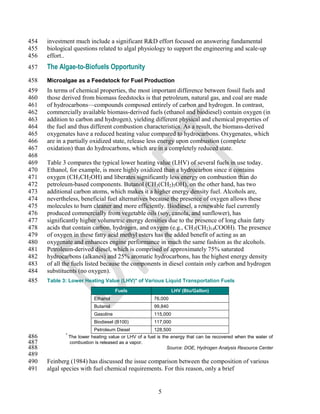
390   While cellulosic ethanol is expected to play a large role in meeting the EISA goals, it is
391   unlikely that the supply of cellulosic ethanol will meet the EISA requirement of 100
392   million gallons by 2012 since most small-scale demonstration plants are not scheduled to
393   begin production until the 2010-2011 timeframe.
394
395   Advanced biofuels also face significant challenges in meeting their targets set by EISA.
396   As required by EISA, advanced biofuels must produce GHG emissions across their
397   lifecycle that are at least 50% less than GHG emissions produced by petroleum-based
398   transportation fuels. Moreover, the development of biofuels from oil crops and waste
399   cooking oil/fats cannot realistically meet the demand for liquid transportation fuels
400   because conventional oil yields per hectare from oil crops would require unrealistic
401   acreages of land in excess of the total land area of the United States (Tyson et al., 2004).
402   Further, more than 90% of the vegetable oil produced in the U.S. is used in the food
403   products market, thereby severely limiting its use as a biofuel feedstock. Therein lies one
404   of the main drivers in the development of microalgal diesel fuels—microalgae promises
405   much higher productivities per unit area given its higher photosynthetic efficiency when
406   compared to conventional crops. Table 2 contains data which demonstrates that potential
407   oil yields from algae are also significantly higher than the yields of oilseed crops. Under
408   the current yield scenarios, the potential oil yields from certain algae are projected to be
409   at least 60 times higher than from soybeans per acre of land on an annual basis—
410   approximately 15 times more productive than jatropha and approximately 5 times that of
411   oil palm (Rodolfi et al., 2009). With these features of higher growth rates and increased
412   oil yields, algae have the potential to replace a significant amount of the current U.S.
413   diesel fuel usage while using only a fraction of the land equivalent what would be
414   required from terrestrial crops.
415


                                                          3
a
416   Table 2: Comparison of oil yields from biomass feedstocks
                                       Crop                   Oil Yield (Gallons/Acre/Yr)
                               Soybean                   48
                               Camelina                  62
                               Sunflower                 102
                               Jatropha                  202
                               Oil palm                  635
                                                                       b
                               Algae                     1,000-4,000
                         a
417                          Adapted from Chisti (2007)
418                      b
                             Estimated yields, this report
419
420   Although a number of other proposed advanced biofuels show significant potential in
421   helping to achieve the 21 billion gallon EISA mandate, biofuels derived from algal
422   biomass feedstocks show considerable promise as a potential major contributor to the
423   displacement of petroleum-based fuels. There are several aspects of algal biofuel
424   production that have combined to capture the interest of researchers and entrepreneurs
425   around the world:
426         Unlike other oil crops, algae grow rapidly and many
                                                                       Advantages of Algal Biomass
427          are exceedingly rich in lipid oil (oil levels of 20% to
428          50% are quite common).                                    High per-acre productivity
429         Using algae to produce feedstocks for biofuels            Non-food resource
430          production will not compromise the production of          Use of otherwise non-
431          food and other products derived from terrestrial           productive, non-arable land
432          crops.                                                    Utilization of a wide variety of
433         The cultivation of algae does not entail land conflict     water sources
434          for doing agriculture for food production.                Reduced GHG release into
435         The water used to grow algae can include waste             the atmosphere
436          water and non-potable saline water that cannot be         Production of biofuels and co-
437          used by conventional agriculture or for domestic           products
438          use.
439         Algae have a tremendous technical potential for recycling CO2-rich flue gases
440          from coal burning power plants as well as from natural gas recovery operations.
441         An algal biorefinery could potentially integrate several different conversion
442          technologies to produce biofuels including biodiesel, green diesel, green gasoline,
443          aviation fuel, ethanol, and methane as well as valuable co-products including oils,
444          protein, and carbohydrates.
445
446   While the basic concept of using algae as an alternative and renewable source of biomass
447   feedstock for biofuels has been explored in the past, a scalable, commercially viable
448   system has not emerged. Past research investments have been intermittent and short-term
449   thus insufficient to enable the development of an algae-based biofuels technology. Given
450   recent and dramatic advances in relevant fields, in particular biology, and the fact that
451   realizing the strategic potential of this feedstock will require critical engineering
452   innovations and science breakthroughs, from understanding algal mass culture to
453   downstream processing, a more substantial and sustained investment is paramount. This


                                                               4
454   investment much include a significant R&D effort focused on answering fundamental
455   biological questions related to algal physiology to support the engineering and scale-up
456   effort..
457   The Algae-to-Biofuels Opportunity
458   Microalgae as a Feedstock for Fuel Production
459   In terms of chemical properties, the most important difference between fossil fuels and
460   those derived from biomass feedstocks is that petroleum, natural gas, and coal are made
461   of hydrocarbons—compounds composed entirely of carbon and hydrogen. In contrast,
462   commercially available biomass-derived fuels (ethanol and biodiesel) contain oxygen (in
463   addition to carbon and hydrogen), yielding different physical and chemical properties of
464   the fuel and thus different combustion characteristics. As a result, the biomass-derived
465   oxygenates have a reduced heating value compared to hydrocarbons. Oxygenates, which
466   are in a partially oxidized state, release less energy upon combustion (complete
467   oxidation) than do hydrocarbons, which are in a completely reduced state.
468
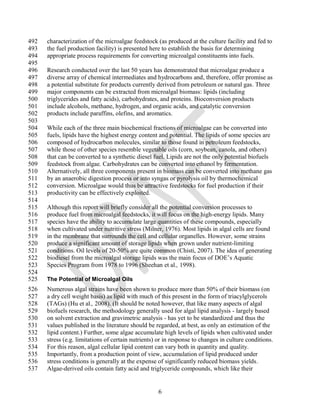
469   Table 3 compares the typical lower heating value (LHV) of several fuels in use today.
470   Ethanol, for example, is more highly oxidized than a hydrocarbon since it contains
471   oxygen (CH3CH2OH) and liberates significantly less energy on combustion than do
472   petroleum-based components. Butanol (CH3(CH2)3OH), on the other hand, has two
473   additional carbon atoms, which makes it a higher energy density fuel. Alcohols are,
474   nevertheless, beneficial fuel alternatives because the presence of oxygen allows these
475   molecules to burn cleaner and more efficiently. Biodiesel, a renewable fuel currently
476   produced commercially from vegetable oils (soy, canola, and sunflower), has
477   significantly higher volumetric energy densities due to the presence of long chain fatty
478   acids that contain carbon, hydrogen, and oxygen (e.g., CH3(CH2)14COOH). The presence
479   of oxygen in these fatty acid methyl esters has the added benefit of acting as an
480   oxygenate and enhances engine performance in much the same fashion as the alcohols.
481   Petroleum-derived diesel, which is comprised of approximately 75% saturated
482   hydrocarbons (alkanes) and 25% aromatic hydrocarbons, has the highest energy density
483   of all the fuels listed because the components in diesel contain only carbon and hydrogen
484   substituents (no oxygen).
485   Table 3: Lower Heating Value (LHV)* of Various Liquid Transportation Fuels
                                       Fuels                      LHV (Btu/Gallon)
                            Ethanol                     76,000
                            Butanol                     99,840
                            Gasoline                    115,000
                            Biodiesel (B100)            117,000
                            Petroleum Diesel            128,500
             *
486              The lower heating value or LHV of a fuel is the energy that can be recovered when the water of
487              combustion is released as a vapor.
488                                                            Source: DOE, Hydrogen Analysis Resource Center
489
490   Feinberg (1984) has discussed the issue comparison between the composition of various
491   algal species with fuel chemical requirements. For this reason, only a brief


                                                          5
492   characterization of the microalgae feedstock (as produced at the culture facility and fed to
493   the fuel production facility) is presented here to establish the basis for determining
494   appropriate process requirements for converting microalgal constituents into fuels.
495
496   Research conducted over the last 50 years has demonstrated that microalgae produce a
497   diverse array of chemical intermediates and hydrocarbons and, therefore, offer promise as
498   a potential substitute for products currently derived from petroleum or natural gas. Three
499   major components can be extracted from microalgal biomass: lipids (including
500   triglycerides and fatty acids), carbohydrates, and proteins. Bioconversion products
501   include alcohols, methane, hydrogen, and organic acids, and catalytic conversion
502   products include paraffins, olefins, and aromatics.
503
504   While each of the three main biochemical fractions of microalgae can be converted into
505   fuels, lipids have the highest energy content and potential. The lipids of some species are
506   composed of hydrocarbon molecules, similar to those found in petroleum feedstocks,
507   while those of other species resemble vegetable oils (corn, soybean, canola, and others)
508   that can be converted to a synthetic diesel fuel. Lipids are not the only potential biofuels
509   feedstock from algae. Carbohydrates can be converted into ethanol by fermentation.
510   Alternatively, all three components present in biomass can be converted into methane gas
511   by an anaerobic digestion process or into syngas or pyrolysis oil by thermochemical
512   conversion. Microalgae would thus be attractive feedstocks for fuel production if their
513   productivity can be effectively exploited.
514
515   Although this report will briefly consider all the potential conversion processes to
516   produce fuel from microalgal feedstocks, it will focus on the high-energy lipids. Many
517   species have the ability to accumulate large quantities of these compounds, especially
518   when cultivated under nutritive stress (Milner, 1976). Most lipids in algal cells are found
519   in the membrane that surrounds the cell and cellular organelles. However, some strains
520   produce a significant amount of storage lipids when grown under nutrient-limiting
521   conditions. Oil levels of 20-50% are quite common (Chisti, 2007). The idea of generating
522   biodiesel from the microalgal storage lipids was the main focus of DOE‘s Aquatic
523   Species Program from 1978 to 1996 (Sheehan et al., 1998).
524
525   The Potential of Microalgal Oils
526   Numerous algal strains have been shown to produce more than 50% of their biomass (on
527   a dry cell weight basis) as lipid with much of this present in the form of triacylglycerols
528   (TAGs) (Hu et al., 2008). (It should be noted however, that like many aspects of algal
529   biofuels research, the methodology generally used for algal lipid analysis - largely based
530   on solvent extraction and gravimetric analysis - has yet to be standardized and thus the
531   values published in the literature should be regarded, at best, as only an estimation of the
532   lipid content.) Further, some algae accumulate high levels of lipids when cultivated under
533   stress (e.g. limitations of certain nutrients) or in response to changes in culture conditions.
534   For this reason, algal cellular lipid content can vary both in quantity and quality.
535   Importantly, from a production point of view, accumulation of lipid produced under
536   stress conditions is generally at the expense of significantly reduced biomass yields.
537   Algae-derived oils contain fatty acid and triglyceride compounds, which like their


                                                    6
538   terrestrial seed oil counterparts, can be converted into biodiesel (via transesterification to
539   yield fatty acid methyl esters) (Fukuda et al., 2001), and green diesel, green jet fuel, and
540   green gasoline (produced by a combination of hydroprocessing and catalytic cracking to
541   yield alkanes of various carbon chain lengths) (Kalnes et al., 2007).
542   Given that scalable algal biofuels are not yet attainable, applying a modest estimate of the
543   potential productivity of oil from algae at 1,200 gallons/acre/year on the area of land
544   equivalent to that used to produce the 2007 U.S. soybean crop (67 million acres) yields a
545   figure greater than 100% of the petroleum diesel consumed annually in the U.S. Had the
546   oil from the entire 2007 soybean crop been converted to biodiesel, on the other hand, it
547   would have provided only 2.8 billion gallons of fuel. (Source: Soy Stats™, American
548   Soybean Association). This amount of biodiesel would displace just 6% of the
549   approximately 44 billion gallons of petroleum on-road diesel used annually in the U.S.
550   Further, as a figure of merit (see Appendix), algae require approximately 2 kg of CO2 for
551   every kg biomass generated, therefore, this technology has the potential to recycle CO2
552   emissions from power plants and other fixed sources of CO2.
553
554   Improvements in either area productivity (gm/m2/day) or lipid content (gm/dry cell
555   weight) would significantly reduce the land area needed ultimately to produce this
556   quantity of biofuel. The algal residue that remains after removal of the lipid component
557   (i.e., largely carbohydrate and protein) could be used for the generation of energy
558   (biopower), more liquid fuels through fermentation (ethanol, biobutanol, etc.), or gaseous
559   (methane) fuels through anaerobic digestion, or serve as a feedstock for the generation of
560   higher-value co-products. In the future, an algal-based biorefinery could potentially
561   integrate several different conversion technologies to produce many biofuels as well as
562   valuable co-products including oils, protein, and carbohydrates.
563
564   With concerns about petroleum supplies and costs as energy demands grow worldwide,
565   energy independence, security, and global warming, the potential use of microalgal
566   feedstocks for biofuels production, specifically lipids derived from them, has gained
567   significant momentum over the past few years. It has been reported that the use of
568   vegetable oil and fat-based feedstocks, which are widely used in world food markets,
569   cannot realistically satisfy the ever-increasing demand for transportation fuels, nor are
570   they likely to displace any significant portion of the U.S. petroleum fuel usage (Tyson et
571   al., 2004). Algal oils do, however, have that potential because their oil yield/acre can be 5
572   to 60 times higher than that of terrestrial oil crops (see Table 2).
573
574   In addition to the production of energy-rich lipids, algae can also be regarded as an
575   alternative source of carbohydrates. For example, some algae and cyanobacteria can
576   accumulate large quantities of storage polysaccharides as a product of photosynthesis.
577   These include starch, glycogen, and chrysolaminarin, three different polymers of glucose.
578   Additionally, the main structural elements of algal cell walls have been shown to be
579   composed of polysaccharides such as cellulose, mannans, xylans, and sulfated glycans.
580   Algal-derived polysaccharides can be hydrolyzed (chemically or enzymatically) into
581   sugars that can be fermented to ethanol.
582


                                                    7
583   Integrating With Biorefinery Concept
584   While the conversion of solar energy into renewable liquid fuels and other products from
585   algal lipid feedstocks is technically feasible (Chisti, 2007), currently such biofuels cannot
586   be produced economically enough to be cost-competitive with fossil fuels. A significant
587   basic science and applied engineering R&D effort is required before the vision and
588   potential of algae for biofuels can be fully realized. It is, however, conceivable that in the
589   not too distant future, algae farms could become an integral part of a biorefinery concept
590   that incorporates other advanced technologies to produce a variety of biofuels such as
591   cellulosic ethanol, biodiesel, renewable ―green‖ diesel, gasoline, jet fuel, and a wide
592   range of co-products. This biorefinery could be integrated, at least initially, with a fossil
593   fuel-based power plant. The CO2 generated by this plant and from an integrated ethanol
594   plant would serve as a rich source of nutrients for the growth of algae, as well as serve to
595   mitigate the release of CO2 by recycling it.

596   After extraction of the algal oils, the residue could be used as a starting feedstock to drive
597   ethanol production (through the use of algal-derived sugars) or fed back into the power
598   plant to be burned as a fuel source. To round out the biorefinery, a biodiesel plant or
599   petroleum refinery (or both) would convert the algal lipids into the most cost-effective
600   fuel depending on the economic situation. Ultimately, substantial R&D is needed to
601   develop an algae-to-biofuels production system that can become an integrated component
602   in a biorefinery that operates at high efficiency with minimal inputs at a low cost.
603
604   For these and other reasons, algae hold tremendous potential for the long-term biofuels
605   strategy for transportation energy within the United States. Corn ethanol, though it poses
606   longer-term sustainability challenges, can be used in the near term since the needed
607   technologies and biomass production are readily available and it can help establish and
608   exercise an ethanol-based biofuels economy. In the near to mid-term, cellulosic biofuels,
609   starting with ethanol, present tremendous potential for replacing up to 30% of the U.S.
610   gasoline usage, and cellulosic ethanol follows naturally from starch ethanol. Moving
611   further out, other advanced biofuels from cellulosic biomass may provide reduced
612   distribution costs and higher energy densities. Finally, in still longer term (perhaps 10
613   years), biofuels from algae present an opportunity at the greatest scale and with very
614   attractive sustainability characteristics.
615
616   Investments So Far in Algal Biofuels Development
617   Early Work to 1996
618   Proposals to use algae as a means of producing energy date back to the late 1950s when
619   Meier (1955) and Oswald and Golueke (1960) suggested the utilization of the
620   carbohydrate fraction of algal cells for the production of methane gas via anaerobic
621   digestion. Not until the energy price surges of the 1970s did the possibility of using algae
622   as a fuel source receive renewed attention. A detailed engineering analysis by Benemann
623   et al., (1978) indicated that algal systems could produce methane gas at prices
624   competitive with projected costs for fossil fuels. The discovery that many species of
625   microalgae can produce large amounts of lipid as cellular oil droplets under certain


                                                    8
626   growth conditions dates back to the 1940s. Various reports during the 1950s and 1960s
627   indicated that starvation for key nutrients, such as nitrogen or silicon, could lead to this
628   phenomenon. The concept of utilizing these lipid stores as a source of energy only gained
629   serious attention during the oil embargo of the early 1970s, ultimately becoming the
630   major push of DOE‘s Aquatic Species Program.
631
632   The Aquatic Species Program represents the most comprehensive research effort to date
633   on fuels from algae. The program lasted from 1978 until 1996 and supported research
634   primarily at DOE‘s NREL (formerly the Solar Energy Research Institute). The Aquatic
635   Species Program also funded research at many academic institutions through
636   subcontracts. Approximately $25 million (Sheehan, 1998) was invested during the 18-
637   year program. During the early years, the emphasis was on using algae to produce
638   hydrogen, but the focus changed to liquid fuels (biodiesel) in the early 1980s. Advances
639   were made through algal strain isolation and characterization, studies of algal physiology
640   and biochemistry, genetic engineering, process development, and demonstration-scale
641   algal mass culture. Techno-economic analyses and resource assessments were also
642   important aspects of the program. In 1998, a comprehensive overview of the project was
643   completed (Sheehan et al., 1998). Some of the highlights are described briefly below.
644
645   The Aquatic Species Program researchers collected more than 3,000 strains of microalgae
646   over a seven-year period from various sites in the Western, Northwestern, and
647   Southeastern U.S. representing a diversity of aquatic environments and water types.
648   Many of the strains were isolated from shallow, inland saline habitats that typically
649   undergo substantial swings in temperature and salinity. The isolates were screened for
650   their tolerance to variations in salinity, pH, and temperature, and also for their ability to
651   produce neutral lipids. The collection was narrowed to the 300 most promising strains,
652   primarily green algae (Chlorophyceae) and diatoms (Bacillariophyceae).
653
654   After promising microalgae were identified, further studies examined the ability of many
655   strains to induce lipid accumulation under conditions of nutrient stress. Although nutrient
656   deficiency actually reduces the overall rate of oil production in a culture (because of the
657   concomitant decrease in the cell growth rate), studying this response led to valuable
658   insights into the mechanisms of lipid biosynthesis. Under inducing conditions, some
659   species in the collection were shown to accumulate as much as 60% of their dry weight in
660   the form of lipid, primarily TAGs. Cyclotella cryptica, a diatom that is a attractive lipid
661   producer, was the focus of many of the biochemical studies. In this species, growth under
662   conditions of insufficient silicon (a component of the cell wall) is a trigger for increased
663   oil production. A key enzyme is acetyl-CoA carboxylase (ACCase), which catalyzes the
664   first step in the biosynthesis of fatty acids used for TAG synthesis. ACCase activity was
665   found to increase under the nutrient stress conditions (Roessler, 1988), suggesting that it
666   may play a role as a ―spigot‖ controlling lipid synthesis, and thus the enzyme was
667   extensively characterized (Roessler, 1990). Additional studies focused on storage
668   carbohydrate production, as biosynthesis of these compounds competes for fixed carbon
669   units that might otherwise be used for lipid formation. Enzymes involved in the
670   biosynthesis of the storage carbohydrate chrysolaminarin in C. cryptica were


                                                   9
671   characterized (Roessler, 1987 and 1988) with the hope of eventually turning down the
672   flow of carbon through these pathways.
673
674   Metabolic engineering, which involves the modification of an organism at the genetic
675   level to achieve changes in cellular metabolism, has proven successful for enhanced
676   production of many compounds in industrial strains. Importantly, the genomics
677   revolution has accelerated progress in metabolic engineering for many organisms. For
678   this reason, metabolic engineering of microalgae has become increasingly accessible and
679   could theoretically result in strains that produce more oil or produce it under different
680   conditions (e.g., obviating the need for nutrient stress). Research during the latter years of
681   the Aquatic Species Program focused on the metabolic engineering of green algae and
682   diatoms that involved the development of basic genetic tools as well as actual pathway
683   modifications.
684
685   The first successful transformation of microalgae with potential for biodiesel production
686   was achieved in 1994 with the diatoms C. cryptica and Navicula saprophila (Dunahay et
687   al., 1995). A second major accomplishment was the isolation and characterization of the
688   gene from C. cryptica encoding the ACCase enzyme (Roessler and Ohlrogge, 1993), the
689   first example of an ACCase gene from a photosynthetic organism. A key gene involved
690   in carbohydrate biosynthesis was also isolated (US patent 5,928,932; Jarvis and Roessler,
691   1999).
692
693   Initial attempts at metabolic engineering using these tools were successful in altering the
694   genes‘ expression levels, but no effect was seen on lipid production in these preliminary
695   experiments (Sheehan et al., 1998). Termination of the Aquatic Species Program in 1996
696   prevented further development of these potentially promising paths to commercially
697   viable strains for oil production.
698
699   During the course of the Aquatic Species Program research, it became clear that novel
700   solutions would be needed not only for biological productivity, but also for various
701   problematic process steps. Cost-effective methods of harvesting and dewatering algal
702   biomass and lipid extraction, purification, and conversion to fuel are critical to successful
703   commercialization of the technology. Harvesting is the process of collecting small
704   microalgal cells from the dilute suspension of a growing culture—a process step that is
705   highly energy and capital intensive. Among various techniques, harvesting via
706   flocculation was deemed particularly encouraging (Sheehan et al., 1998). Extraction of
707   oil droplets from the cells and purification of the oil are also cost-intensive steps. The
708   Aquatic Species Program focused on solvent systems, but failed to fully address the
709   scale, cost, and environmental issues associated with such methods. Conversion of algal
710   oils to ethyl- or methyl-esters (biodiesel) was successfully demonstrated in the Aquatic
711   Species Program and shown to be one of the less challenging aspects of the technology.
712   In addition, other biofuel process options (e.g., conversion of lipids to gasoline) were
713   evaluated (Milne et al., 1990), but no further fuel characterization, scale-up, or engine
714   testing was carried out.
715


                                                   10
716   Under Aquatic Species Program subcontracts, demonstration-scale outdoor microalgal
717   cultivation was conducted in California, Hawaii, and New Mexico (Sheehan et al., 1998).
718   Of particular note was the Outdoor Test Facility (OTF) in Roswell, N.M., operated by
719   Microbial Products, Inc. (Weissman et al., 1989). This facility utilized two 1,000 m2
720   outdoor, shallow (10-20 cm deep), paddlewheel-mixed raceway ponds, plus several
721   smaller ponds for inocula production. The raceway design was based on the ―high rate
722   pond‖ system developed at UC Berkeley. The systems were successful in that long-term,
723   stable production of algal biomass was demonstrated, and the efficiency of CO 2
724   utilization (bubbled through the algae culture) was shown to be more than 90% with
725   careful pH control. Low nighttime and winter temperatures limited productivity in the
726   Roswell area, but overall biomass productivity averaged around 10 g/m2/day with
727   occasional periods approaching 50 g/m2/day. One serious problem encountered was that
728   the desired starting strain was often outgrown by faster reproducing, but lower oil
729   producing, strains from the wild.
730
731   Several resource assessments were conducted under the Aquatic Species Program.
732   Studies focused on suitable land, saline water, and CO2 resources (power plants)
733   primarily in desert regions of the Southwest United States. Sufficient resources were
734   identified for the production of many billions of gallons of fuel, suggesting that the
735   technology could have the potential to have a significant impact on U.S. petroleum
736   consumption. However, the costs of these resources can vary widely depending upon
737   such factors as land leveling requirements, depth of aquifers, distance from CO2 point
738   sources, and other issues. Detailed techno-economic analyses underlined the necessity for
739   very low-cost culture systems such as unlined open ponds. In addition, biological
740   productivity was shown to have the single largest influence on fuel cost. Different cost
741   analyses led to differing conclusions on fuel cost, but even with optimistic assumptions
742   about CO2 credits and productivity improvements, estimated costs for unextracted algal
743   oil were determined to range from $59-$186/barrel (Sheehan et al., 1998). It was
744   concluded that algal biofuels would never be cost competitive with petroleum, which was
745   trading at less than $20/barrel in 1995. DOE estimated at that time that the cost of
746   petroleum would remain relatively flat over the next 20 years. (Although, as we now
747   know, the energy landscape has changed dramatically in the intervening 14 years.)

748   Overall, the Aquatic Species Program was successful in demonstrating the feasibility of
749   algal culture as a source of oil and resulted in important advances in the technology.
750   However, it also became clear that significant barriers would need to be overcome in
751   order to achieve an economically feasible process. In particular, the work highlighted the
752   need to understand and optimize the biological mechanisms of algal lipid accumulation
753   and to find creative, cost-effective solutions for the culture and process engineering
754   challenges. Detailed results from the Aquatic Species Program research investment are
755   available to the public in more than 100 electronic documents on the NREL Web site at
756   www.nrel.gov/publications .
757
758   Research from 1996 to Present
759   Since the end of DOE‘s Aquatic Species Program in 1996, federal funding for algal
760   research in general has been limited and intermittent. Federal funding is split between


                                                  11
761   DOE and the Department of Defense (DoD). Recent initiatives such as a major DARPA
762   (Defense Advanced Research Projects Agency) solicitation Air Force Office of Scientific
763   Research (AFOSR) algal bio-jet program and several DOE Small Business Innovative
764   Research (SBIR) request for proposals suggest that funding levels are beginning to
765   increase. State funding programs and research support from private industry also make up
766   a significant proportion of research funding. An ever-increasing level of research focus
767   on algal biofuels has taken place at a number of U.S. national labs, including NREL,
768   Sandia National Laboratories, National Energy Technology Laboratory, Los Alamos
769   National Laboratory, and Pacific Northwest National Laboratory. Private investment in
770   biofuels, in general, and algal biofuels, in particular, has been increasing at a dramatic
771   pace over the last few years.
772
773   Not only in algae, investment in the clean fuels sector in general has been booming, with
774   a major increase in cleantech capital investment during the past five years. Since 1999,
775   investment in cleantech has increased almost five fold. The venture firms are looking at
776   biomass, solar, and wind technologies, and in some instances, are investing in the
777   construction of actual facilities for the production of fuels and electricity (Krauss, 2007).
778   In the first three quarters of calendar year 2007, 168 deals were signed with a combined
779   value of $2.6 billion (Gongloff, 2007). The total investment in cleantech in 2006 was
780   between $1.8 billion, and $2.3 billion, depending on the study (Gongloff, 2007; Krauss,
781   2007). The Wall Street Journal (2007) reported that 180 deals with a total value of $1.8
782   billion were completed in 2006, an average value of $10 million per deal. In early 2007,
783   the average deal value was $15 million, illustrating the increasing magnitude of
784   investments that venture firms are completing.
785
786   With the increase in interest worldwide amongst the investment community in clean
787   technologies, microalgae production has also received interest from the private sector.
788   Energy companies, both large and small, are investing in demonstration plants, feedstock
789   development, and process improvement. Many of these companies became interested in
790   algae during the rapid rise in cleantech investment from 2004 to 2006 and as algae‘s
791   advantages, such as its growth on traditionally underutilized land, production of high
792   energy lipids, and high yield per land area, became more widely known. When tied with
793   energy security and energy independence, the opportunity for algae-to-biofuels is
794   significant, and the investment community is responding.
795
796   The investment community‘s focus is not always on utilization of the lipids. Some
797   companies have identified niches based on the production of ethanol from algal biomass.
798   Commercial entities are exploring all aspects of the algae-to-fuels process, including
799   technologies based both on lipid conversion and the conversion of other algae
800   components. Algae have been used to produce high value, small quantity products for
801   decades, and new companies are looking to expand algae‘s impact.
802
803   In summary, the >150 algal biofuels companies in existence today worldwide are
804   attempting to help make the algae-to-fuels concept a reality. Further, large existing
805   companies with either market interest derived from their current business revenues (e.g.
806   energy) or with know-how and technology potentially relevant to algal biofuels are


                                                   12
807   beginning to show interest in algae as well. What‘s not known, of course, is which
808   entities will undertake the major funding investments needed to realize sustainable,
809   saleable algal biofuels.
810   Going Forward
811   Roadmapping a Strategy for Algal Biofuels Development & Deployment
812   The current state of knowledge regarding the economics of producing algal biofuels are
813   woefully inadequate to motivate targeted investment on a focused set of specific
814   challenges. Furthermore, because no algal biofuels production beyond the research scale
815   has ever occurred, detailed life cycle analysis (LCA) of algal biofuels production has not
816   been possible. For this reason, investment in algal biofuels research and development is
817   needed to identify and reduce risk. This supports private investments aimed at producing
818   algal biofuels at a commercial scale. In contrast, development of cellulosic biofuels
819   benefits from direct agricultural and process engineering lineage to the long-standing
820   agricultural enterprise of growing corn (a grass) for food (and recently, for conversion to
821   starch ethanol). There is no parallel agricultural enterprise equivalent for cultivating algae
822   at a similar scale. In short, the science of algae cultivation (algaculture), agronomy-for-
823   algae, if you will, does not exist. It is thus clear that a significant basic science and
824   applied engineering R&D effort including a rigorous techno-economic and LCA will be
825   required to fully realize the vision and potential of algae. The techno-economic analysis
826   can track the status of each contributing technology as per established benchmarks and
827   help identify opportunities for cost reduction. Additionally, the pervasive
828   interdependency of various processes and infrastructure in developing a cost-competitive
829   algae-to-biofuels supply chain necessitates systems analysis to ensure these entities work
830   together as an efficient system.

831   Thus a combination of systems, techno-economic, and life cycle analyses are critically
832   needed to gain greater understanding for informed decision making so that investments
833   can be targeted and optimized to greater positive effect. See section 11, Systems and
834   Techno-Economic Analyses of Algal Biofuel Deployment (page 157) for detailed
835   discussion and specifics.

836
837   Need for a Sizeable, Strategically Structured and Sustained Investment
838   In the years following the termination of the Aquatic Species Program, a small but
839   growing body of work has been reported in peer-reviewed journals dealing with topics
840   ranging from photobioreactor design to lipid metabolism, genetic manipulation, and
841   genomic analysis. The total body of work in the past years is relatively small, reflecting a
842   fairly low level of research funding. There is a large gap between the current reality of
843   commercial microalgae production technology and the goal of producing a microalgae
844   biomass with high oil content suitable for conversion to biofuels at a large scale.
845
846   One of the major unanimous conclusions of the Workshop was that a great deal of
847   RD&D is still necessary to make the algae-to-fuels process a reality and to engage the
848   private sector more aggressively, the associated level of risk must be reduced. The
849   Workshop participants agreed that the obvious first step toward achieving sustainable,


                                                   13
850   scalable biofuels from algae is long-term and sustained investment in research and
851   development, whether at DOE national laboratories, universities, and/or in the private
852   sector. Ultimately, a sizable and strategically structured investment to tackle the RD&D
853   challenges of algal biofuels is needed to advance the knowledge and experience of the
854   nation‘s research community, which can then support the commercialization activities led
855   by venture-backed entrepreneurs, as well as existing business and technology leaders.
856
857   In addition, the Workshop participants identified the need for significant investment in
858   our colleges and universities to train the professional work force for the new bioeconomy,
859   including scalable algal biofuels. Over the past few years, U.S. academic laboratories
860   interested in various aspects of algae-to-biofuels research have largely experienced
861   inadequate levels of funding. Since the end of the DOE-sponsored Aquatic Species
862   Program in 1996, there has been no significant or sustained mechanism for funding
863   academic work in the development of algae-based biofuels (excluding biohydrogen from
864   algae). More specifically, what‘s needed in algal biology is a new generation of applied
865   biologists and engineers to design, build, and maintain large-scale systems to cultivate,
866   harvest, and process algal biomass at scale. University graduate research in modern
867   molecular biology needs funding to produce molecular biologists with skills in systems
868   biology (e.g., genomics, proteomics, and metabolomics) as applied to algal biology to
869   carry out the fundamental biology R&D to support this effort.
870
871   Further, the existing funding landscape is fractured, with most of the funding spread
872   across a variety of federal agencies (DoD, DOE, Environmental Protection Agency), state
873   governments, private industry, congressionally directed research, and internal
874   institutional funds. The disconnect between the various small funding efforts and the
875   absence of a centralized effort in this area has been a large source of frustration for the
876   academic research community. The Workshop participants felt that funding agencies with
877   varying missions need to work together to enable the development of partnerships that
878   span not only basic and applied research arenas, but the various disciplines needed to
879   tackle the diverse challenges algal biofuels present. A single federal agency coordinating
880   studies in the field or making investments strategic enough can acquire a long-term
881   leadership role and help tie in all the efforts across the nation toward the development of
882   algal biofuels.
883
884   See section 12, Public-Private Partnerships for continued discussion and
885   recommendations.
886


                                                  14
887
888   2.     Algal Biology

889   Algae: Basic Biological Concepts
890   The term ―algae‖ refers to a large group of simple plant-like photosynthetic organisms.
891   Algae are typically subdivided into two major categories based on their relative size.
892   Microalgae are defined as microscopic photosynthetic, free-living organisms that thrive
893   in diverse ecological aquatic habitats such as freshwater, brackish (<3.5% salt), marine
894   (3.5% salt), and hypersaline (>3.5% salt) environments within a wide range of
895   temperature and pH (Falkowski and Raven 1997). Unicellular microalgae are easily
896   distinguished from their larger counterparts, the macroalgae or ―seaweeds,‖ which have
897   cells organized into structures resembling leaves, stems, and roots of higher plants.
898   Microalgae can be subdivided into two broad categories: the prokaryotic cyanobacteria
899   and the true eukaryotic algae. Cyanobacteria, often referred to as the blue-green algae,
900   have been included traditionally as ―algae,‖ but these organisms are clearly
901   photosynthetic ―prokaryotes‖—bacterial organisms that lack a defined nucleus. Because
902   cyanobacteria do not typically produce much lipid (Hu et al. 2008), they are not a focus
903   for this discussion. Nonetheless, as we will demonstrate below, there are reasons to
904   consider cyanobacteria for certain aspects of research relevant for biofuel production.
905
906   Microscopic algae were among the first life forms to appear on our planet (Falkowski et
907   al., 2004). They are responsible for fixing massive amounts of CO2 while producing and
908   sustaining the atmospheric oxygen that supports the majority of life on Earth (Falkowski
909   and Raven, 1997). Microalgae play a significant role in global productivity capacity, with
910   some strains capable of doubling their cell numbers several times per day. By some
911   estimates, microalgae, though making up only 0.2% of global photosynthetic biomass,
912   have been found to account for approximately 50% of the global organic carbon fixation
913   (Field et al., 1998) and contribute approximately 40% to 50% of the oxygen in the
914   atmosphere.
915
916   The biochemical mechanism of photosynthesis in microalgae is similar to that found in
917   all plants. However, unlike their terrestrial counterparts, microalgae are particularly
918   efficient converters of solar energy due to their simple structure. Free of the need to
919   generate support and reproductive structures, and with a ready supply of water and
920   nutrients, the microalgal cell can devote the majority of the energy it traps into biomass
921   growth. Under the limitations of current technology, algae can convert up to 15% of the
922   photosynthetically available solar irradiation (PAR), or roughly 6% of the total incident
923   radiation, into new cell mass (Benemann et al., 1978). In contrast, terrestrial crops
924   generally have lower photosynthetic conversion efficiencies. For example, the
925   photosynthetic efficiencies for sugar cane, the most productive terrestrial crop, are no
926   better than 3.5% to 4% (Odum 1971). But it is not only photosynthetic efficiency that
927   makes algae attractive candidates for biofuel production, but also because, unlike
928   terrestrial plants which produce specialized oil bearing seeds, every algal cell can be a
929   lipid factory, greatly increasing the amount of oil that can be produced per acre. As a
930   result, microalgae are a relevant target for scientific studies for biomass energy


                                                  15
931   production, biofuels production, and utilizing the excessive amounts of CO2 currently
932   being released into the atmosphere through the heavy reliance on fossil fuels.
933
934   Algal Classification
935   The biodiversity of microalgae is enormous with tens of thousands of species being
936   described and as many as 10 million extant (Metting, 1996). Microalgae have been
937   isolated from diverse ecosystems such as freshwater, brackish, marine, hyper-saline,
938   snow, and even hot springs, which require special adaptations in metabolism for survival.
939   Furthermore, microalgae inhabit soil and biofilms, and are even found in symbiotic
940   association with other organisms.
941
942   As a group, cyanobacteria hold important practical implications as transformers of solar
943   energy. They range from simple, tiny unicellular organisms to multicellular colonies,
944   from simple to branched filaments. The unicellular cyanobacterium Synechocystis sp.
945   PCC6803 was the first photosynthetic organism whose genome was completely
946   sequenced (Kaneko et al., 1996). It continues to be an extremely versatile and easy model
947   with which to study the genetic systems of photosynthetic organisms. Cyanobacteria are
948   not generally known to produce large quantities of lipids, though they have been shown
949   to produce storage carbon in the form of starch or glycogen. Cyanobacteria are,
950   nevertheless, important as potential production strains for a variety of chemical
951   intermediates and fuels. For example, a recent report describes the production and
952   secretion of sucrose by photosynthetic prokaryotes (US 20080124767). In addition,
953   cyanobacteria have been engineered to produce ethanol through a photosynthetic process
954   (Deng and Coleman, 1998).
955
956   Eukaryotic microalgae, on the other hand, are not a well-studied group from a
957   biotechnological point of view. Among the species that are believed to exist, only a few
958   thousand strains are kept in culture collections throughout the world, a few hundred are
959   being investigated for their chemical content and just a handful are cultivated on an
960   industrial scale (Chisti, 2007).
961
962   Algae can be further classified into at least 12 major divisions. Within those major
963   divisions, some common classes of algae include the green algae (Chlorophyceae),
964   diatoms (Bacillariophyceae), yellow-green algae (Xanthophyceae), golden algae
965   (Chrysophyceae), red algae (Rhodophyceae), brown algae (Phaeophyceae) and
966   picoplankton (Prasinophyceae and Eustigmatophyceae). Examples of each of these
967   classes are known to produce high levels of lipids; these include Chromonas danica,
968   Phaeodactylum tricornutum, Nitzschia palea, Monallantus salina, Nannochloropsis sp.,
969   and Isochrysis sp (Chisti, 2007). Several additional divisions and classes of unicellular
970   algae have been described and details of their structure and biology are available (van den
971   Hoek et al., 1995).
972
973   The commercial application of microalgal biotechnology began to develop in the middle
974   of the last century. Today there are numerous commercial applications involving
975   microalgae. Microalgal mass cultures have applications in the production of human
976   nutritional supplements and specialty animal feeds (Becker 2004) and play a crucial role


                                                  16
977   in aquaculture and wastewater treatment. They are cultivated as a source of highly
 978   valuable molecules such as polyunsaturated fatty acids (PUFAs) (Ward and Singh 2005)
 979   and pigments such as β-carotene and astaxanthin (Pulz and Gross, 2004).
 980
 981   Photosynthesis/CO2 Fixation
 982   Photosynthesis is a process whereby certain varieties of bacterial species, eukaryotic
 983   algae, and higher plants convert the potential of light energy into chemical energy.
 984   Carbon, in the form of CO2 is recycled directly from the atmosphere generating biomass
 985   and oxygen in the process. In eukaryotic algae, photosynthesis takes place in specialized
 986   organelles called chloroplasts. Cyanobacteria are prokaryotes and do not possess
 987   chloroplasts or any other such organelles. In these organisms, photosynthesis takes place
 988   inside a membrane-bound sac known as a thylakoid. Cyanobacteria are widely believed
 989   to be the ancestor of the chloroplast, taken up by a protozoan billions of years ago and
 990   evolving into an endosymbiont. Photosynthesis is generally performed in two separate
 991   steps, known as the light and dark reactions. In the photosynthetic light reactions, photons
 992   of light are absorbed directly by chlorophyll and a variety of other accessory pigments to
 993   excite electrons to a higher energy state. In a series of reactions, the energy is converted
 994   into ATP and NADPH splitting water in the process and releasing oxygen as a by-
 995   product. In the light independent process (i.e., dark reaction), CO2 from the atmosphere is
 996   converted (―fixed‖) into sugar using ATP and NADPH generated during the light
 997   reaction.
 998
 999   There are generally two processes whereby algae fix CO2: the C3 and C4 pathways Most
1000   algae and plants use the C3 pathway in which CO2 is first incorporated into a 3-carbon
1001   compound known as 3-phosphoglycerate. The enzyme that catalyzes this reaction,
1002   ribulose-bisphosphate carboxylase (RuBisCo), is also the enzyme involved in the uptake
1003   of CO2. The three carbon compound generated during the process enters the Calvin cycle
1004   leading to sugar formation.
1005
1006   Marine diatoms are responsible for up to 20% of the global CO2 fixation. Marine diatoms
1007   use the alternative C4 pathway, and, as a result, generally have enhanced photosynthetic
1008   efficiencies over C3 pathway organisms (Kheshgi et al., 2000). These organisms
1009   concentrate CO2 around Rubisco, thereby diminishing photorespiration, and the
1010   concomitant loss of energy. It is thought that this characteristic is responsible for the
1011   ecological significance of diatoms (Reinfelder et al. 2000), though it is not clear if this
1012   will provide a real advantage for diatoms cultivated in the presence of sufficient CO2.
1013
1014   Strain Isolation, Selection, and/or Screening
1015   Currently, a number of microalgal strains are available from culture collections such as
1016   UTEX (The Culture Collection of Algae at the University of Texas at Austin, Texas),
1017   with about 3,000 strains, and CCMP (The Provasoli-Guillard National Center for Culture
1018   of Marine Phytoplankton at the Bigelow Laboratory for Ocean Sciences in West
1019   Boothbay Harbor, Maine), with more than 2,500 strains. However, because many of the
1020   strains in these collections have been cultivated now for several decades, these strains
1021   may have lost part of their original properties such as mating capabilities or versatility


                                                   17
1022   regarding nutrient requirements (de la Jara et al, 2003). To obtain versatile and robust
1023   strains that can be used for mass culture in biofuels applications, it is, therefore, essential
1024   to consider the isolation of new, native strains directly from unique environments. For
1025   both direct breeding as well as for metabolic engineering approaches to improved
1026   biofuels production, it is vital to isolate a large variety of microalgae for assembly into a
1027   culture collection serving as a bioresource for further biofuels research.
1028
1029   The goals of isolation and screening efforts are to identify and maintain promising algal
1030   specimens for cultivation and strain development. However, because it is not yet known
1031   how algae will be cultivated on a mass scale, new strains should be isolated from a wide
1032   variety of environments to provide the largest range in metabolic versatility possible.
1033   Further, it is recommended that the isolated strains be screened to develop baseline data
1034   on the effects of regional environmental variability on cultivars.
1035
1036   Isolation and Characterization of Naturally Occurring Algae Species/Strains
1037   Algae occur in a variety of natural aqueous habitats ranging from freshwater, brackish
1038   waters, marine, and hyper-saline environments to soil as well as symbiotic associations
1039   with other organisms (Round, 1981). At this time most commercial microalgae
1040   production facilities use open raceway pond technologies (e.g., Earthrise and Cyanotech
1041   Corp) (Chisti, 2007) and rely on natural strain succession to maximize biomass
1042   production throughout the year. Therefore, sampling and isolation activities for new
1043   strains have to account for temporal succession of microalgae in natural habitats. Further,
1044   any large-scale sampling and isolation efforts should be coordinated to ensure broadest
1045   coverage of environments and to avoid duplication of efforts.
1046
1047   For isolation of new strains from natural habitats traditional cultivation techniques may
1048   be used including enrichment cultures (Andersen & Kawachi, 2005). However,
1049   traditional methods take weeks to months for isolation of unialgal strains. Also, as many
1050   colonies are obtained from single cells the strains are often already clonal cultures. For
1051   large-scale sampling and isolation efforts, high-throughput automated isolation
1052   techniques involving fluorescence activated cell sorting (FACS) have proven to be
1053   extremely useful (Sieraki et. al, 2005).
1054
1055   Natural Habitats: Marine, Freshwater, Brackish/Saline, Wastewater, And Extreme
1056   Environments
1057   In addition to sampling from a variety of ecosystems, it is proposed that sampling
1058   strategies not only account for spatial distribution but also for the temporal succession
1059   brought about by seasonal variations of algae in their habitats. In addition, within an
1060   aqueous habitat some algae are typically found either in the planktonic (free floating) or
1061   benthic (attached) environments. Planktonic algae may be used in suspended mass
1062   cultures whereas benthic algae may find application in biofilm based production
1063   facilities. Thus, it is recommended to include sampling of both planktonic and benthic
1064   algae within the context of this roadmap.
1065
1066
1067   Identification of Criteria for Screening


                                                     18
1068   The ideal screen would cover three major areas: growth physiology, metabolite
1069   production, and strain robustness. The term ―growth physiology‖ encompasses a number
1070   of parameters such as maximum specific growth rate, maximum cell density, tolerance to
1071   environmental variables (temperature, pH, salinity, oxygen levels, CO 2 levels), and
1072   variability of in situ versus laboratory performance. Because all these parameters require
1073   significant experimental effort, it would be very helpful to develop automated systems
1074   that would provide information regarding all parameters simultaneously. Screening for
1075   metabolite production has to include not only the metabolite composition and content, but
1076   also the productivity of cells regarding metabolites useful for biofuels generation. Rapid
1077   oil analyses of strains could greatly facilitate this work. An ideal analytical method would
1078   allow for distinction between neutral and polar lipids, and would also provide fatty acid
1079   profiles.
1080
1081   At this time, bottleneck for screening large numbers of microalgae stems from a lack of
1082   high-throughput methodologies that would allow simultaneous screening for multiple
1083   phenotypes, such as growth rates and metabolite productivities. In terms of biofuel
1084   production, it would be beneficial to be able to screen in high throughput fashion for lipid
1085   content.
1086
1087   To improve the economics of algal biofuel production, other valuable co-products must
1088   be generated; this would require determining cellular composition regarding proteins,
1089   lipids, and carbohydrates. Further, many strains also excrete metabolites into the growth
1090   medium. These have been largely ignored, but they might prove to be valuable co-
1091   products, at least in systems that do not suffer from contamination. New approaches are
1092   necessary to develop screening methods for extracellular materials.
1093   For mass culture of a given algal strain, it is also important to consider the strains
1094   robustness, which includes parameters such as culture consistency, resilience, community
1095   stability, and susceptibility to predators present in a given environment. Previous studies
1096   revealed that microalgae strains tested in the laboratory do not necessarily perform
1097   similarly in outdoor mass cultures (Sheehan et al., 1998). To determine a strain‘s
1098   robustness, small-scale simulations of mass culture conditions will need to be performed.
1099   The development of small-scale but high-throughput screening technologies will be
1100   essential to enable testing of hundreds to thousands of different algal isolates.
1101
1102   Development of Novel Concepts and Approaches for Strain Screening
1103   Solvent extraction is the most common method for determination of lipid content in algal
1104   biomass, and it requires both a significant quantity of biomass and effort. Fluorescent
1105   methods using lipid soluble dyes have also been described, and though these methods
1106   require much less biomass (as little as a single cell), it has not yet been established if
1107   these methods are valid across a wide range of algal strains. Further improvements in
1108   analytical methodology could be made through the development of solid-state screening
1109   methods.
1110
1111   Development of Strain Databases


                                                   19
1112   Currently, no database(s) exists that would provide global information on the
1113   characteristics of currently available algal strains. Protection of intellectual property in
1114   private industry further exacerbates the flow of relevant strain data. Some minimal
1115   growth information is available from existing culture collections, but it is very difficult, if
1116   not impossible, to obtain more detailed information on growth, metabolites, and
1117   robustness of particular existing strains. To accelerate R&D of algae-based biofuels
1118   production system, it is recommended that a central strain, open access repository be
1119   created (major algae culture depositories may be potential sites).
1120
1121   Role of Algal Culture Collections
1122   Culture collections are necessary to preserve the diversity of natural habitats, protect
1123   genetic material, and provide basic research resources. At present, only a few major algal
1124   collection centers exist in the United States and some other countries. Those responsible
1125   for culture maintenance already maintain thousands of different microalgal strains; they
1126   are experienced in strain cultivation and support the research and industrial community
1127   with their expertise in algae biology. The function of a culture collection often
1128   transcends simple depository functions. They may also support research on determining
1129   strain characteristics, cryopreservation, and phylogeny either by themselves or in
1130   connection with outside collaborators.
1131
1132   As the major culture collections by their nature already collect and document data on
1133   strains, such existing collections could be nuclei for the development of a national algae
1134   resource center. It could prove to be very helpful to have culture collection organizations
1135   responsible for the gathering and dissemination of detailed information regarding
1136   potentially valuable strains such as:
1137       1. Strain name (species, subspecies name, taxonomy, reference)
1138       2. Strain administration (number in collection, preservation)
1139       3. Environment & strain history (specific habitat, collector)
1140       4. Strain properties: Cytological, biochemical, molecular, & screening results
1141       5. Mutants
1142       6. Plasmids & Phages
1143       7. Growth conditions (media, temperature, pH) & germination conditions
1144       8. Biological interaction (symbiosis, pathogenicity, toxicity)
1145       9. Practical applications (general & industrial)
1146       10. Omics data (Genomics, Transcriptomics, Proteomics, or Metabolomics)
1147
1148   Participants in the workshop recommended that funding be provided to support and
1149   expand at least one or both of the existing major collections as open source collections
1150   and national algae centers to fulfill the need of the algal biofuels community. Possibly,
1151   the UTEX and the CCMP algae collections can be developed in such a way. It is
1152   expected that the data generated from a publically funded research program will be made
1153   available either free of charge or for a minimal user fee. Development and maintenance
1154   of such comprehensive open source databases will require a commitment to long-term
1155   and stable baseline funding.
1156


                                                     20
1157   References
1158
1159   Andersen R.A. & Kawachi M. 2005. Traditional Microalgae Isolation Techniques, In:
1160       Algal Culturing Techniques (Ed. Andersen R.A.), Chapter 6, 83-102
1161   Sieraki M., Poulton N., Chrosby N. 2005. Automated Isolation Techniques for
1162       Microalgae. In: Algal Culturing Techniques (Ed. Andersen R.A.), Chapter 7, 103-
1163       116
1164
1165   Cell Biology: Physiology and Biochemistry
1166   Microalgae are photosynthetic microorganisms capable of harvesting solar energy while
1167   converting CO2 and water to organic macromolecules (i.e. carbohydrates, proteins and
1168   lipids). Triacylglycerols (TAGs) are the main storage compound in many algae under
1169   stress conditions, such as high light or nutrient starvation. Certain algal species naturally
1170   accumulate large amounts of TAG (30-60% of dry weight) and exhibit photosynthetic
1171   efficiency and lipids/oil production potential at least an order of magnitude higher than
1172   terrestrial crop plants (Hu et al., 2008).
1173
1174   The major pathway for the formation of TAG in plants and algae involves de novo fatty
1175   acid synthesis in the stroma of plastids and subsequent incorporation of the fatty acid into
1176   the glycerol backbone, leading to TAG via three sequential acyl transfers from acyl CoA
1177   in the endoplasmic reticulum (ER) (Fig. 3). In algae, the de novo synthesis of fatty acids
1178   occurs primarily in the chloroplast. The committed step in fatty acid synthesis is the
1179   conversion of acetyl CoA to malonyl CoA, catalyzed by acetyl CoA carboxylase
1180   (ACCase). Overall, the pathway produces a 16- or 18-carbon fatty acid or both. These are
1181   then used as the precursors for the synthesis of cellular and organelle membranes as well
1182   as for the synthesis of neutral storage lipids, mainly TAGs. Triacylglycerol biosynthesis
1183   in algae has been proposed to occur via the direct glycerol pathway. Fatty acids produced
1184   in the chloroplast are sequentially transferred from CoA to positions 1 and 2 of glycerol-
1185   3-phosphate, resulting in formation of the central metabolite phosphatidic acid (PA)
1186   (Ohlrogge and Browse 1995). Dephosphorylation of PA catalyzed by a specific
1187   phosphatase releases diacylglycerol (DAG). In the final step of TAG synthesis, a third
1188   fatty acid is transferred to the vacant position 3 of DAG, and this reaction is catalyzed by
1189   diacylglycerol acyltransferase, an enzymatic reaction that is unique to TAG biosynthesis.
1190   PA and DAG can also be used directly as a substrate for synthesis of polar lipids, such as
1191   phosphatidylcholine (PC) and galactolipids. The acyltransferases involved in TAG
1192   synthesis may exhibit preferences for specific acyl CoA molecules, and thus may play an
1193   important role in determining the final acyl composition of TAG.
1194
1195   The aforementioned pathway (Kennedy Pathway) is believed to be the major pathway to
1196   accumulate TAG in plants and algae. However, the regulation of synthesis of fatty acids
1197   and TAG in algae is poorly understood at the physiological, biochemical and molecular
1198   biological levels. As a result, the lipid yields obtained from algal mass culture efforts
1199   performed to date fall short of the high values (50-60%) observed in the laboratory,
1200   adding to the problem of achieving economic algal oil production (Hu et al., 2008;
1201   Sheehan et al., 1998). Moreover, the alternate pathways to convert membrane lipids


                                                     21
1202   and/or carbohydrates to TAG have been recently demonstrated in plants and yeast in an
1203   acyl CoA-independent way (Arabolaza et al., 2008; Dahlqvist et al., 2000; Stahl et al.,
1204   2004) (see below). Such pathways have not yet been studied in algae.
1205
1206   Photosynthesis
1207   There is little agreement on the theoretical maximum productivity of algae, though values
1208   in the 100-200 g-1 m-2 day-1 have been presented (references). Part of the difficulty here
1209   lies with the assumptions made for parameters such as light transmittance in culture,
1210   reflection, and absorption. Another problem shows up in calculations of photobioreactor
1211   productivity in which the area of the reactors themselves, not the area of the land that
1212   they occupy is used for the calculation. The theoretical productivity is an important
1213   parameter, however because can be used to set achievable goals for both cultivation
1214   process design as well as strain improvement projects. Similar work has been carried out
1215   with plants (Zhu et al., 2007; Zhu et al., 2008), and, these approaches could be useful for
1216   similar studies with algae. Detailed study of photosynthesis in algae would not only be
1217   useful for increased biomass productivity, but could also be useful in manipulation of
1218   lipid productivity. The redox state of the electron transport chain, the energy content
1219   ATP/ADP ratio, the availability of ATP/NAD(P)H, and cytosolic pH are known to
1220   regulate gene expression and cellular metabolism in yeasts, plants and algae (Felle 1989;
1221   Pfannschmidt et al., 2001; Rolland et al., 2001; Ryu et al., 2004). It has also been shown
1222   that some algae increase lipid production under limited light regimes (Klyachko-Gurvich
1223   et al. 1999). However, the photosynthetic regulation of lipid synthesis in algae needs to
1224   be studied with respect to the aforementioned mechanisms.
1225
1226   Metabolic Carbon Fluxes and Partitioning
1227   Calculations based on the moderate assumptions of 25 g/m2/day and 50% lipid (See
1228   Appendix) suggest that annual oil production of over 5000 gal/acre/yr may be achievable
1229   in mass culture of microalgae. This oil yield, however, has never been demonstrated even
1230   at a laboratory level, in effect, reflecting the lack of a clear understanding of TAG
1231   synthesis, metabolic carbon fluxes and partitioning.
1232
1233   Metabolic flux analysis is a rapidly developing field concerned with the quantification
1234   and understanding of metabolism at the systems level. In microbial systems, powerful
1235   methods have been developed for the reconstruction of metabolic networks from genomic
1236   and transcriptonomic data, pathway analysis, and predictive modeling. Partitioning of
1237   carbon dominates intracellular fluxes in both photosynthetic and heterotrophic plants and
1238   algae, and has vast influence on both growth and development. Recently, much progress
1239   has occurred in elucidating the structures of the biosynthetic and degradative pathways
1240   that link the major and minor pools of intracellular intermediates to cellular polymers, in
1241   providing insight into particular fluxes such as those of the pentose phosphate pathway,
1242   and into general phenomena, such as substrate- or futile-cycles and compartmentation
1243   (Lytovchenko et al., 2007; Schwender et al., 2004). In most cases, the regulatory
1244   properties of these pathways have been elucidated, and the enzymes involved have been
1245   investigated. However, carbon fluxes and partitioning into lipid is less understood, and
1246   critical research on how algal cells control the flux of photosynthetically fixed carbon and
1247   its partitioning into various groups of major macromolecules (i.e., carbohydrates, proteins


                                                   22
1248   and lipids) are needed. A fundamental understanding of ‗global‘ regulatory networks that
1249   control the partitioning of carbon between lipids and alternative storage products will be
1250   absolutely essential for metabolic engineering of algal cells for over-production of lipids.
1251
1252   Metabolic Link between Starch and Lipid Metabolism
1253   Starch is a common carbon and energy storage compound in plants and algae and shares
1254   the same precursors with the storage lipid TAG (Fig. 1). Therefore, TAG and starch may
1255   be inter-convertible. In young Arabidopsis seeds and Brassica embryos, starch was
1256   transiently accumulated and starch metabolism was most active before the oil
1257   accumulation phase (Kang and Rawsthorne 1994; Ruuska et al., 2002), indicating starch
1258   can be an important storage compound and its synthesis precedes oil accumulation. More
1259   recently, studies of higher plants showed that when starch synthesis was impaired or
1260   inhibited, the plant embryos or seeds accumulate 40% less oil (Periappuram et al., 2000;
1261   Vigeolas et al., 2004). While these results provide a clear indication that starch
1262   (carbohydrates) synthesis is linked to oil synthesis, the nature of the interaction is
1263   unknown. In algae, such interaction is also indicated by studies on the diatom Cyclotella
1264   cryptica (Roessler 1988) and some green algae. Therefore, it could be fruitful to initiate
1265   research on the metabolic link between starch and lipid metabolism. In this respect, de
1266   novo starch synthesis, degradation and interaction with lipid metabolism in algae need to
1267   be studied.


                                                    23
CO2                    Glc6P

               Starch
                           AGPPase                                        Central
        Starch synthase              Glc6P                3-PGA                       3-PGA
                        Amylases                                          Metabolic
                                                                                                   Mitochondria
                                                         Pyruvate
                                                         PDH            COPathway
                                                                          2
                                                                                      Pyruvate      Oxaloacetate
                                                           Acetyl-CoA
         Chloroplast
                                                     ACCase                                          TCA cycle
                                                                                      Acetyl-CoA
                                                     KAS I
                                                     KAS II
                 Glycolipids                         SAD

                           Galactolipase?                  C16-C18 CoA


                                                         Phosphatidic acid

           GDAT?
                                                                                      ER
                             Diacylglycerol (DAG)
                                               Acetyl-
                                                                Phospholipids
                                               CoA
                                             DAGT        PDAT?


                                   Triacylglycerol

                                   (Neutral lipids)
                                     Lipid Body
1268
       Figure 1: Major pathways for the fatty acid and TAG synthesis in plants and algae
               3-PGA: 3-phosphoglycerate; Accase: acetyl CoA carboxylase; ACP: acyl carrier protein;
               AGPPase: ADP glucose pyrophosphorylase; ER: Endoplasmic reticulum; GDAT: putative
               glycolipids: DAG acyltransferase; Glc6P: glucose-6-phosphate; KAS: 3-ketoacyl-ACP;
               PDAT: Phospholipids: DAG acyltransferase; PDH: pyruvate dehydrogenase (putative
               pathways were proposed in dashed lines).

1269
1270   Lipid Synthesis and Regulation
1271   Primary Pathway for Lipid Synthesis
1272   The major pathway (Kennedy Pathway) for the formation of TAG involves de novo fatty
1273   acid synthesis in the stroma of plastids and subsequent incorporation of the fatty acid into
1274   the glycerol backbone, leading to TAG via three sequential acyl transfers from acyl CoA
1275   in the endoplasmic reticulum (ER) (Fig. 1). At the biochemical level, however,


                                                                         24
1276   information about fatty acid and TAG synthetic pathways in algae is still fragmentary.
1277   We lack, for example, critical knowledge regarding both the regulatory and structural
1278   genes involved in these pathways and the potential interactions between pathways.
1279   Because fatty acids are common precursors for the synthesis of both membrane lipids and
1280   TAG, how the algal cell coordinates the distribution of the precursors to the two distinct
1281   destinations or the inter-conversion between the two types of lipids needs to be
1282   elucidated. Assuming that the ability to control the fate of fatty acids varies among algal
1283   taxonomic groups or even between isolates or strains of the same species, the basal
1284   lipid/TAG content may, in effect, represent an intrinsic property of individual species or
1285   strains. If this proves to be true, it will be a challenge to extrapolate information learned
1286   about lipid biosynthesis and regulation in laboratory strains to production strains.
1287   Similarly, it will be difficult to use information regarding lipid biosynthesis in plants to
1288   develop hypotheses for strain improvement in algae. As an example, the annotation of
1289   genes involved in lipid metabolism in the green alga Chlamydomonas reinhardtii has
1290   revealed that algal lipid metabolism may be different from that in plants, as indicated by
1291   the presence and/or absence of certain pathways and by the size of the gene families that
1292   relate to various activities (Riekhof et al., 2005). Thus, de novo fatty acid and lipid
1293   synthesis need to be studied in order to identify key genes/enzymes and new pathways, if
1294   any, involved in lipid metabolism in algae.
1295
1296   Alternative Pathways to Storage Lipids
1297   Microalgae may possess multiple pathways for TAG synthesis and the relative
1298   contribution of individual pathways to overall TAG formation depends on environmental
1299   or culture conditions. As noted above, alternate pathways to convert membrane lipids
1300   and/or carbohydrates to TAG have been demonstrated in plants and yeast (Arabolaza et
1301   al., 2008; Dahlqvist et al., 2000; Stahl et al., 2004). For example, an acyl-CoA
1302   independent pathway for TAG synthesis is mediated by a phospholipid: DGAT
1303   acyltransferase (PDAT) that use phospholipids as acyl donors and DAG as an acceptor
1304   (Arabolaza et al., 2008; Dahlqvist et al., 2000; Stahl et al., 2004). In addition, the
1305   thylakoids of chloroplasts are the main intracellular membranes of algae, and their lipid
1306   composition dominates the extracts obtained from cells under favorable growth
1307   conditions. The algal chloroplasts have monogalactosyldiacylglycerol (MGDG) as their
1308   main lipid (~50%), with smaller amounts of digalactosyldiacylglycerol (DGDG, ~20%)
1309   and sulfoquinovosyldiacylglycerol (SQDG, ~15%) and phosphatidyglycerol (PG, ~15%)
1310   (Hardwood 1998). Under stress conditions, as the degradation of chloroplasts occurs, the
1311   fate of the abundant glycoglycerolipids remains unclear. . It has been proposed that a
1312   house-keeping pathway produces a basal/minimum level of TAG under favorable
1313   growing conditions, whereas alternative pathways that convert starch, excess membrane
1314   lipids, and other components into TAG play an important role for cell survival under
1315   stress. It has been further hypothesized that the chloroplast may be the major site for
1316   alterative pathways of TAG synthesis and is involved in biogenesis of cytosolic lipid
1317   bodies. To address the above hypothesis, studies that compare oleaginous algae (such as
1318   Haematococcus pluvialis and Pseudochlorococcum sp.) and the non-oleaginous algae
1319   (such as Chlamydomonas reinhardtii) are needed to elucidate four distinct pathways of
1320   TAG synthesis: 1) de-novo Kennedy Pathway, 2) TAG formation from starch reserves, 3)


                                                    25
1321   pathway to convert membrane phospholipid into TAG; and 4) pathway to convert
1322   membrane glycolipids into TAG.
1323   Currently there are few algal species for which near-full genome information has become
1324   or will shortly become available, including Chlamydomonas reinhardtti, Chlorella
1325   NC64A, Dunaliella salina, Cyanidioshyzon merolae, Ostreococcus tauri, Thalassiosira
1326   pseudonana and Phaeodactylum tricornutum (http://www.jgi.doe.gov/genome-
1327   projects/pages/projects.jsf). A large-scale EST sequencing for oleaginous algae (such as
1328   Pseudochlorococcum sp. and Haematococcus pluvialis) under different cultural
1329   conditions will give us better knowledge on genes differentially expressed under different
1330   oil production conditions, and together with cDNA microarray and/or proteomic studies,
1331   will provide information about photosynthetic carbon partitioning and lipid synthesis in
1332   algae. Based on such information, metabolic engineering through genetic manipulation
1333   represents yet another promising strategy for the production of algal oils. The available
1334   approaches may include random and targeted mutagenesis and gene transformation.
1335   Cloning and transforming genes that influence the synthesis of lipids or improve
1336   robustness in growth performance in selected algal strains proven amenable to mass
1337   culture will enhance the overall performance and sustainable production of TAG or other
1338   lipids.
1339
1340   Organelle Interactions
1341   The chloroplast boundary consists of two envelope membranes controlling the exchange
1342   of metabolites between the plastid and the extraplastidic compartments of the cell. The
1343   plastid internal matrix (stroma) is the primary location for fatty acid biosynthesis in
1344   plants and algae. Fatty acids can be assembled into glycerolipids at the envelope
1345   membranes of plastids or they can be exported and assembled into lipids at the ER to
1346   provide building blocks for extraplastidic membranes. Some of these glycerolipids,
1347   assembled at the ER, return to the plastid where they are remodeled into the plastid
1348   typical glycerolipids. As a result of this cooperation of different subcellular membrane
1349   systems, a rich complement of lipid trafficking phenomena contributes to the biogenesis
1350   of chloroplasts (Benning 2008). Considerable progress has been made in recent years
1351   towards a better mechanistic understanding of lipid transport across plastid envelopes in
1352   bacteria and plants. Such work is necessary in algae to better understand the interaction
1353   among organelles related to lipid formation and lipid trafficking phenomena.
1354
1355   Oxidative Stress and Storage Lipids
1356   Under environmental stress (such as nutrient starvation), the algal cell quickly stops
1357   division and accumulates TAG as the main storage compound. Synthesis of TAG and
1358   deposition of TAG into cytosolic lipid bodies may be, with few exceptions, the default
1359   pathway in algae under environmental stress conditions. In addition to the obvious
1360   physiological role of TAG serving as carbon and energy storage, particularly in aged
1361   algal cells or under stress, the TAG synthesis pathway may play more active and diverse
1362   roles in the stress response. The de novo TAG synthesis pathway serves as an electron
1363   sink under photo-oxidative stress. Under stress, excess electrons that accumulate in the
1364   photosynthetic electron transport chain may induce over-production of reactive oxygen
1365   species, which may in turn cause inhibition of photosynthesis and damage to membrane
1366   lipids, proteins and other macromolecules. The formation of a C18 fatty acid consumes


                                                   26
1367   approximately 24 NADPH derived from the electron transport chain, which is twice that
1368   required for synthesis of a carbohydrate or protein molecule of the same mass, and thus
1369   relaxes the over-reduced electron transport chain under high light or other stress
1370   conditions. The TAG synthesis pathway is usually coordinated with secondary carotenoid
1371   synthesis in algae (Rabbani et al., 1998; Zhekisheva et al., 2002). The molecules (e.g. b-
1372   carotene, lutein or astaxanthin) produced in the carotenoid pathway are sequestered into
1373   cytosolic lipid bodies. The peripheral distribution of carotenoid-rich lipid bodies serves as
1374   a ‗sunscreen‘ to prevent or reduce excess light striking the chloroplast under stress. TAG
1375   synthesis may also utilize phosphatidylcholine, phatidylethanolamine and galactolipids or
1376   toxic fatty acids excluded from the membrane system as acyl donors, thereby serving as a
1377   mechanism to detoxify membrane lipids and deposit them in the form of TAG. The exact
1378   relationship between oxidative stress, cell division and storage lipid formation in algae
1379   requires further study.
1380
1381   Lipid Body Formation and Relationship to Other Organelles
1382   Despite the economic importance of microalgae as source of a wide range of lipophilic
1383   products, including vitamins, hydrocarbons and very long-chain ω-3 and ω -6 fatty acids,
1384   such as EPA and DHA, there have been relatively few studies on lipid bodies in algae
1385   compared with plants and fungi. In those cases where lipid-body accumulation in algae
1386   has been studied, cytosolic TAG-rich droplets ranging from 1–8 m in size were
1387   observed. The proposal that lipid bodies in microalgae are not mere carbon stores but that
1388   they are more centrally involved in membrane lipid turnover is echoed by recent findings
1389   from higher plants—studies that also imply lipid-body TAG is metabolically active in
1390   seeds and other organs (Murphy 2001). The study of lipid-body biogenesis in plants has
1391   focused largely on the role of oleosins. This is understandable in view of their exclusive
1392   localization on lipid-body surfaces, their apparently widespread distribution and their
1393   great abundance in many lipid-storing seeds. Nevertheless, there are now significant
1394   doubts about the role of oleosins in the biogenesis of plant lipid bodies. Rather, it is
1395   suggested, in the light of currently available evidence, oleosins may be primarily
1396   associated with the stabilization of storage lipid bodies during the severe hydrodynamic
1397   stresses involved in dehydration and rehydration in many types of seeds (Murphy 2001).
1398   Lipid bodies may dock with different regions of the ER and plasma membranes, or with
1399   other organelles such as mitochondria and glyoxysomes/peroxisomes, in order to load or
1400   discharge their lipid cargo. In oil-producing microorganisms, as rapid lipid body
1401   accumulation occurs, a close relationship is often found between neutral lipids like TAG
1402   and the membrane phospho- and glyco- lipids. This relationship may be both metabolic,
1403   with acyl and glycerol moieties exchanging between the different lipid classes, and
1404   spatial, with growing evidence of direct physical continuities between lipid bodies and
1405   bilayer membranes. In order to understand lipid metabolism in algae, the
1406   pathways/mechanisms for lipid biogenesis and composition, and the structure and
1407   function of lipid bodies and their interactions with other organelles related to storage lipid
1408   formation require further study.
1409
1410   References
1411


                                                    27
1412   Arabolaza A, Rodriguez E, Altabe S et al., (2008) Multiple pathways for triacylglycerol
1413       biosynthesis in Streptomyces coelicolor. Appl. Environ. Microbiol. 74:2573-2582
1414   Benning C (2008) A role for lipid trafficking in chloroplast biogenesis. Prog. Lipid Res.
1415       47:381-389
1416   Chisti 2007 Biotechnology Advances 25:294-306 (2007).
1417   de la Jara et al. J. App. Physiol. 15: 433-438 (2003)
1418   Dahlqvist A, Stahl U, Lenman M et al., (2000) Phospholipid : diacylglycerol
1419       acyltransferase: An enzyme that catalyzes the acyl-CoA-independent formation of
1420       triacylglycerol in yeast and plants. Proc. Natl. Acad. Sci. U. S. A. 97:6487-6492
1421   Falkowski, P.G.; Raven, J.A. (1997). Aquatic photosynthesis. Malden, MA: Blackwell
1422       Science
1423   Felle H (1989) pH as a second messenger in plants . In: Second Messengers in Plant
1424       Growth and Development ( Boss, W.F. & Morre, D.J. , eds) . New York:. Alan R.
1425       Liss, Inc., pp. 145–166.
1426   Hardwood JL (1998) Membrane lipids in algae. In Siegenthaler PA and Murata N (eds):
1427       Lipids in Photosynthesis: Structure, Function and Genetics, pp. 53-64 (Kluwer, the
1428       Netherlands).
1429   Hu Q, Sommerfeld M, Jarvis E et al., (2008) Microalgal triacylglycerols as feedstocks for
1430       biofuel production: perspectives and advances. Plant J. 54:621-639
1431   Kang F, Rawsthorne S (1994) Starch and Fatty-Acid Synthesis in Plastids from
1432       Developing Embryos of Oilseed Rape (Brassica-Napus L). Plant J. 6:795-805
1433   Klyachko-Gurvich, G. L., L. N. Tsoglin. J. Doucha, J. Kopetskii, I. B. Shebalina, and V.
1434       E. Semenko. 1999. Desaturation of fatty acids as an adaptive response to shirts in
1435       light intensity. Physiologia Plantarum 107: 240-249.
1436   Lytovchenko A, Sonnewald U, Fernie AR (2007) The complex network of non-cellulosic
1437       carbohydrate metabolism. 10:227-235
1438   Metting, F. B. 1996. Biodiversity and application of microalgae. J. Ind. Microbiol.
1439       17:477-489.
1440   Murphy DJ (2001) The biogenesis and functions of lipid bodies in animals, plants and
1441       microorganisms. Prog. Lipid Res. 40:325-438
1442   Ohlrogge J, Browse J (1995) Lipid biosynthesis. Plant Cell 7:957-970
1443   Periappuram C, Steinhauer L, Barton DL et al., (2000) The plastidic phosphoglucomutase
1444       from Arabidopsis. A reversible enzyme reaction with an important role in metabolic
1445       control. Plant Physiol. 122:1193-1199
1446   Pfannschmidt T, Allen JF, Oelmuller R (2001) Principles of redox control in
1447       photosynthesis gene expression. Physiol. Plant. 112:1-9
1448   Pulz, O.; Gross, W. (2004). ―Valuable products from biotechnology of microalgae.‖
1449       Applied Microbiology and Biotechnology. (65); pp. 625-648
1450   Rabbani S, Beyer P, Von Lintig J et al., (1998) Induced beta-carotene synthesis driven by
1451       triacylglycerol deposition in the unicellular alga Dunaliella bardawil. Plant Physiol.
1452       116:1239-1248
1453   Reinfelder et al. 2000 Nature 407:996-999.
1454   Riekhof WR, Sears BB, Benning C (2005) Annotation of genes involved in glycerolipid
1455       biosynthesis in Chlamydomonas reinhardtii: Discovery of the betaine lipid synthase
1456       BTA1Cr. Eukaryot. Cell 4:242-252


                                                  28
1457   Roessler PG (1988) Effects of Silicon Deficiency on Lipid-Composition and Metabolism
1458      in the Diatom Cyclotella-Cryptica. J. Phycol. 24:394-400
1459   Rolland F, Winderickx J, Thevelein JM (2001) Glucose-sensing mechanisms in
1460      eukaryotic cells. Trends Biochem.Sci. 26:310-317
1461   The Ecology of Algae by Round, F.E (1981) London: Cambridge University Press
1462   Ruuska SA, Girke T, Benning C et al., (2002) Contrapuntal networks of gene expression
1463      during Arabidopsis seed filling. Plant Cell 14:1191-1206
1464   Ryu JY, Song JY, Lee JM et al., (2004) Glucose-induced expression of carotenoid
1465      biosynthesis genes in the dark is mediated by cytosolic pH in the cyanobacterium
1466      Synechocystis sp. PCC 6803. J. Biol. Chem. 279:25320-25325
1467   Schwender J, Ohlrogge J, Shachar-Hill Y (2004) Understanding flux in plant metabolic
1468      networks. Curr. Opin. Plant Biol. 7:309-317
1469   Sheehan J, Dunahay T, Benemann J et al., (1998) US Department of Energy‘s Office of
1470      Fuels Development, July 1998. A Look Back at the US Department of Energy‘s
1471      Aquatic Species Program – Biodiesel from Algae, Close Out Report TP-580-24190.
1472      Golden, CO: National Renewable Energy Laboratory.
1473   Stahl U, Carlsson AS, Lenman M et al., (2004) Cloning and functional characterization
1474      of a Phospholipid: Diacylglycerol acyltransferase from Arabidopsis. Plant Physiol.
1475      135:1324-1335
1476   Vigeolas H, Mohlmann T, Martini N et al., (2004) Embryo-specific reduction of ADP-
1477      Glc pyrophosphorylase leads to an inhibition of starch synthesis and a delay in oil
1478      accumulation in developing seeds of oilseed rape. Plant Physiol. 136:2676-2686
1479   Zhekisheva M, Boussiba S, Khozin-Goldberg I et al., (2002) Accumulation of oleic acid
1480      in Haematococcus pluvialis (Chlorophyceae) under nitrogen starvation or high light is
1481      correlated with that of astaxanthin esters. J. Phycol. 38:325-331
1482   Zhu XG, de Sturler E, Long SP (2007) Optimizing the distribution of resources between
1483      enzymes of carbon metabolism can dramatically increase photosynthetic rate: A
1484      numerical simulation using an evolutionary algorithm. Plant Physiol. 145:513-526
1485   Zhu XG, Long SP, Ort DR (2008) What is the maximum efficiency with which
1486      photosynthesis can convert solar energy into biomass? Curr. Opin. Biotechnol.
1487      19:153-159
1488
1489   Biohydrogen: Direct Biophotolysis and Oxygen Sensitivity of the Hydrogen-
1490   Evolving Enzymes
1491   Certain photosynthetic microbes, including algae and cyanobacteria, can produce H2 from
1492   the world‘s most plentiful resources in the following reactions: 2H2O + light energy →
1493   O2 + 4H+ + 4e- → O2 + 2H2. Two distinct light-driven H2-photoproduction pathways
1494   have been described in green algae, and there is evidence for a third, light-independent,
1495   fermentative H2 pathway coupled to starch degradation. All pathways have the reduction
1496   of ferredoxin (FD, Figure 2) in common as the primary electron-donor to a hydrogenase.
1497   Hydrogenases are enzymes that can reduce protons and release molecular H 2. The major
1498   types of enzymes contain either iron ([FeFe] hydrogenases, which generally are H2-
1499   evolving) or both nickel and iron ([NiFe] hydrogenases, which are generally H 2-uptake
1500   enzymes) in their active sites. More information about these O 2-sensitive enzymes are
1501   available (Ghirardi et al., 2007). The light-driven pathways can either use water as the


                                                  29
1502   substrate (employing both photosystems II and I) or NADH from the glycolytic
1503   breakdown of stored carbohydrate (employing only photosystem I) to product H 2. Rather
1504   than utilizing light-driven reduction of FD, the dark, fermentative pathway may involve a
1505   pyruvate-ferredoxin-oxidoreductase (PFOR) enzyme, similar to those found in many
1506   anaerobic systems.


1507
1508   Figure 2: Three different pathways for H2 production
1509          Two are driven by light and the third occurs in the dark. Either water or starch can be the
1510          electron donor. Carbon is fixed under normal photosynthesis with water as the donor, but
1511          the electron acceptor is switched at the level of ferredoxin (FD) from CO 2 to protons
1512          under conditions that lead to H2 production. (Drawing courtesy of Prof. M. Posewitz,
1513          Colorado School of Mines for the drawing).
1514
1515   Four biological challenges limiting biohydrogen production in algae have been identified
1516   as (Seibert et al., 2007) (a) the O2 sensitivity of hydrogenases, (b) competition for
1517   photosynthetic reductant at the level of ferredoxin, (c) regulatory issues associated with
1518   the over production of ATP, and (d) inefficiencies in the utilization of solar light energy
1519   at sunlight intensities. Many laboratories around the world are addressing these
1520   challenges by (a) engineering hydrogenases to improve the enzyme‘s tolerance to the
1521   presence of O2 (Cohen et al., 2005), (b) identifying metabolic pathways that compete
1522   with hydrogenases for photosynthetic reductant by genomics approaches, and engineering
1523   their down-regulation during H2 production, (c) engineering the photosynthetic
1524   membrane to significantly decrease the efficiency of photosynthetic-electron-transport-
1525   coupled ATP production (not depicted in Figure 2; ATP is required for carbon fixation
1526   but for not H2 production), and (d) engineering the photosynthetic antenna pigment
1527   content to maximize the amount of solar light that can be used effectively in a
1528   photobioreactor (Polle et al., 2003). If all of the research challenges can be over come,


                                                      30
1529   H2-cost projections developed by the US Department of Energy suggest that biohydrogen
1530   could compete with gasoline at about $2.50 a kg (a gallon of gasoline contains the energy
1531   equivalent of about a kg of H2)
1532
1533   Recently, researchers have begun to re-examining the prospects for using cyanobacteria
1534   to produce H2. These studies are making use of bidirectional, [NiFe] hydrogenases that
1535   are found in some of these organisms rather than nitrogenases. While many of the same
1536   challenges identified in eukaryotic algae are also inherent in cyanobacteria, the
1537   advantages of working with these prokaryotic organisms are that they are more easily
1538   engineered than algae and have more O2-tolerant hydrogenases (Ghirardi et al., 2009). On
1539   the other hand, the [FeFe] hydrogenases, found in algae, are better catalysts than the
1540   [NiFe] hydrogenases found in cyanobacteria (citation).
1541
1542   Other future areas of investigation that researchers are staring to examine, include the
1543   application of biological knowledge of photosynthesis and hydrogenase
1544   structure/function to developing biohybrid systems (those employing biological and
1545   synthetic components) and, ultimately, totally artificial photosynthetic systems that
1546   mimic the fuel-producing processes of photosynthetic organisms.
1547
1548   Fermentative Hydrogen Production (Indirect Biophotolysis)
1549   Both algae and cyanobacteria carry out oxygenic photosynthesis. The former stores starch
1550   and the latter stores glycogen as the main carbon sink. To circumvent the inhibition of
1551   hydrogenase by O2, another option for H2 production is to take advantage of the
1552   fermentation pathways that exist in both microbes for H2 production at night, using the
1553   carbon reserves produced during the day. In cyanobacteria, fermentation is constitutive,
1554   accounting for their ability to adapt quickly to changing environmental conditions. All
1555   cyanobacteria examined thus far employ the Embden-Meyerhof-Parnas (EMP) pathway
1556   for degradation of glucose to pyruvate. From here several cyanobacteria were found to
1557   couple reductant to pyruvate-ferredoxin oxidoreductase, which reduces ferredoxin for
1558   subsequent H2 production via either nitrogenases or hydrogenases (Stal and Moezelaar,
1559   1997). This temporal separation of H2 production from photosynthesis has been
1560   demonstrated in the unicellular cyanobacteria Cyanothece sp. ATCC 51142 (Toepel et
1561   al., 2008) and Oscillatoria (Stal and Krumbein, 1987) using nitrogenase as the catalyst.
1562   Using hydrogenase as the catalyst, the unicellular non-N2-fixing cyanobacterium
1563   Gloeocapsa alpicola evolves H2 in the resulting from the fermentation of stored glycogen
1564   (Serebryakova et al., 1998). Similarly under non-N2 fixing condition, the hydrogenase
1565   from Cyanothece PCC 7822 produces H2 in the dark and also excretes typical
1566   fermentation by-products including acetate, formate, and CO2. (van der Oost et al. , 1989)
1567
1568   It is well established that dark fermentation suffers from low H 2 molar yield (less than 4
1569   moles of H2 per mol hexose) (Turner et al., 2008). This is due to the production of
1570   organic waste by-products described above along with ethanol. In order to fully realize
1571   the potential of H2 production via indirect biophotolysis, several challenges must be
1572   addressed: (a) improve photosynthetic efficiency to increase the yield of carbohydrate
1573   accumulation; (b) remove or down-regulate competing fermentative pathway thus
1574   directing more of the cellular flux toward H2 production; and (c) express multiple (both


                                                    31
1575   [FeFe] and [NiFe])hydrogenases in green algae and cyanobacteria so that electrons from
1576   both ferredoxin (Fd) and NAD(P)H can serve as electron donor to support H2 production.
1577
1578   References
1579
1580   Cohen, J., K. Kim, M. Posewitz, M.L. Ghirardi, K. Schulten, M. Seibert and P. King,
1581       ―Finding Gas Diffusion Pathways in Proteins: Application to O2 and H2 Transport in
1582       CpI [FeFe]-Hydrogenase and the Role of Packing Defects‖, Structure 13:1321-1329,
1583       2005.
1584   Ghirardi, M.L., A. Dubini, J. Yu and P.C. Maness, ―Photobiological Hydrogen-Producing
1585       Systems‖, Chemical Society Reviews 38: 52-61, 2009.
1586   Ghirardi, M.L., M.C. Posewitz, P.C. Maness, A. Dubini, J. Yu and M. Seibert,
1587       ―Hydrogenases and Hydrogen Photoproduction in Oxygenic Photosynthetic
1588       Organisms‖, Annual Review Plant Biology 58:71-91, 2007.
1589   Kosourov, S.N. and M. Seibert, ―Hydrogen Photoproduction by Nutrient-Deprived
1590       Chlamydomonas reinhardtii Cells Immobilized within Thin Alginate Films under
1591       Aerobic and Anaerobic Conditions‖, Biotechnology and Bioengineering 102:50-58,
1592       2009.
1593   Kruse, O., J. Rupprecht, K.P. Bader, S. Thomas-Hall, P.M. Schenk, G. Ginazzi and B.
1594       Hankamer, ―Improved Photobiological H2 Production in Engineered Green Algal
1595       Cells‖, Journal Biological Chemistry 280:34170-34177.
1596   Laurinavichene, T.V., S.N. Kosourov, M.L. Ghirardi, M. Seibert and A.A. Tsygankov,
1597       ―Prolongation of H2 Photoproduction by Immobilized, Sulfur-Limited
1598       Chlamydomonas reinhardtii Cultures‖, Journal Biotechnology 134:275-277, 2008.
1599   Melis, A., L. Zhang, M. Forestier, M.L. Ghirardi and M. Seibert, ―Sustained
1600       Photobiological Hydrogen Gas Production upon Reversible Inactivation of Oxygen
1601       Evolution in the Green Alga Chlamydomonas reinhardtii‖, Plant Physiology
1602       122:127-135, 2000.
1603   Polle, J.E.W., S. Kanakagiri and A. Melis, ―tla1, a DNA Insertional Transformant of the
1604       Green Alga Chlamydomonas reinhardtii with a Truncated Light-Harvesting
1605       Chlorophyll Antenna Size‖, Planta 217:49-59, 2003.
1606   Seibert, M., P. King, M.C. Posewitz, A. Melis, and M.L. Ghirardi "Photosynthetic Water-
1607       Splitting for Hydrogen Production," in Bioenergy (J. Wall, C. Harwood, and A.
1608       Demain, Eds.) ASM Press, Washington DC, pp. 273-291, 2008.
1609   Serebryakova, L.T., M. Sheremetieva, and A.A. Tsygankov, ―Reversible hydrogenase
1610       activity of Gloeocapsa alpicola in continuous culture‖, FEMS Microbiol. Lett.
1611       166:89-94, 1998.
1612   Stal, L.J., and W.E. Krumbein, ―Temporal separation of nitrogen fixation and
1613       photosynthesis in the filamentous non-heterocystous cyanobacterium Oscillatoria
1614       sp.‖, Arch Microbiol. 149:76-80, 1987.
1615   Stal, L.J., and R. Moezelaar,. ―Fermentation in cyanobacteria‖, FEMS Microbiol. Rev.
1616       21:179-211, 1997.
1617   Toepel, J., E. Welsh, T.S. Summerfield, H.B. Pakrasi, and L.A. Sherman, ―Differential
1618       transcriptional analysis of the cyanobacterium Cyanothece sp. strain ATCC 51142
1619       during light-dark and continuous-light growth‖, J. Bacteriol. 190:3904-3913, 2008.


                                                 32
1620   Turner, J., G. Sverdrup, M.K. Mann, P.C. Maness, B. Kroposki, M. Ghirardi, R.J. Evans,
1621      and D.Blake, ―Renewable hydrogen production‖, Intl. J. Energy Res. 32:379-407,
1622      2008.
1623   van der Oost et al. Archives of Microbiology 152:415-419 (1989).
1624
1625   Genomics and Systems Biology
1626   Currently, there is a lack of understanding of the fundamental processes involved in the
1627   synthesis and regulation of lipid and other potential fuel products in microalgae.
1628   Proposing to develop large scale algal culturing technology for biofuels production
1629   without this understanding is analogous to establishing agriculture without knowing how
1630   plants grow. In the case of algal biofuels, gaining this information should require a much
1631   shorter time frame than that for agricultural development because high-throughput
1632   analysis tools including genomics, transcriptomics, proteomics, metabolomics, and
1633   lipidomics can be applied, enabling detailed analyses of multiple aspects of cellular
1634   metabolism simultaneously.
1635
1636   Development of Algal Model Systems
1637   Criteria for Choosing Algal Model Systems
1638   There are two general types of model system to consider: one would involve species or
1639   strains amenable to providing information on the basic cellular processes and regulation
1640   involved in synthesis of fuel precursors, and the other would involve species or strains
1641   with characteristics useful for large-scale growth. Species with sequenced genomes and
1642   transgenic capabilities are the most amenable to investigating cellular processes, since the
1643   basic tools are in place, however it was shown in the Aquatic Species Program (ASP) that
1644   not all strains that grow well in the laboratory are suitable for large-scale culturing.
1645   Adapting the lessons learned on laboratory model species to species already known to be
1646   capable of growing in large scale might be easier, but as noted above, we cannot be
1647   certain that laboratory strains and productions strains will be sufficiently related to allow
1648   for lessons in the former to be applied to the latter.
1649
1650   Fuel/intermediate to be produced (H2, lipids, CHO, ethanol, co- products, etc.). One
1651   consideration in choosing model systems is the type of fuel or co-product to be produced.
1652   Possible fuel types could include H2, lipids, isoprenoids, carbohydrates, alcohols (either
1653   directly or through biomass conversion), or methane (via anaerobic digestion). Co-
1654   products could include pharmaceuticals (therapeutic proteins, secondary metabolites),
1655   food supplements, or materials for nanotechnology in the case of the silica cell wall of
1656   diatoms (See Section 7). Discussions at the Workshop revealed that some
1657   commercialization strategies focused on the non-fuel co-product as the path to
1658   profitability. While this strategy may be successful, one can assume that the DOE will
1659   only be willing to support such an effort if the path to production of significant quantities
1660   of algal biofuel is clearly delineated. With decisions made about fuel product and
1661   additional co-products, a reasonable first approach to identify model species optimal for
1662   production of a desired fuel by surveying the literature or environment for species that
1663   naturally make abundant amounts of it. In such a strain, cellular metabolism is already


                                                    33
1664   geared towards production, which simplifies characterization and possible development
1665   for production.
1666
1667   Secretion of products/intermediates. The ability of an algal species to secrete fuel
1668   precursors may be attractive because it could reduce or avoid the cell harvesting step.
1669   However, there may be practical problems. If the desired product is volatile, then
1670   collection of the atmosphere above the culture may be required to isolate it, which will
1671   necessitate the use of closed photobioreactors (PBRs). An example of this is the Algenol
1672   process making use of engineered cyanobacteria to convert photosynthetically derived
1673   sugars to ethanol. Also to be considered is whether secretion actually makes the product
1674   more readily available. For example, although there are algae known to secrete lipids
1675   (e.g. Botryococcus braunii), they still are associated with the cells in a lipid biofilm
1676   matrix, and thus are not free to form an organic hydrocarbon phase in solution.
1677   (Bannerjee et al., 2002) Even if sustainable secretion could be achieved it is not clear
1678   what the effect of a lipid emulsion in an algal culture would be. For example, an
1679   abundance of exported lipids could unfavorably alter fluidics properties or provide a
1680   carbon source favoring growth of contaminants. Finally, secretion of either intermediates
1681   or products into the growth medium could make these compounds available to
1682   contaminating microbes for catabolism. Pilot-scale experimentation and further metabolic
1683   engineering is required to evaluate possible advantages and disadvantages of secretion.
1684
1685   Characteristics pertaining to process demands. Culture stability over long periods will
1686   be a key to low cost production of biofuel, but very little is known about the
1687   characteristics of culture robustness. Certainly rapid growth is important both for overall
1688   productivity but also for the ability to compete with contaminating strains. Other traits
1689   like the ability to grow to high cell density in continuous culture may allow a strain to be
1690   maintained while at the same time reducing the amount of water to be processed daily
1691   (See Section 9). Resistance to predators and to viruses could also be a useful phenotype.
1692   Finally the ability to flocculate without addition of chemical flocculating agents could
1693   reduce the costs of harvest as long as it could be controlled to avoid settling in the
1694   cultivation system.
1695
1696   Capability of heterotrophic or mixotrophic growth. Heterotrophic or mixotrophic
1697   growth capabilities may be attractive attributes of algal strains. In some species, addition
1698   of supplemental carbon results in increased lipid accumulation (Xu, Miao et al., 2006),
1699   even under mixotrophic conditions where the substrate is not known to be transported
1700   into the cell (Ceron Garcia, Garcia Camacho et al., 2006). If the carbon source can be
1701   utilized by the cell, a potential advantage is growth in both light and dark periods. It is
1702   not clear what the relative amount of fuel precursor production under photosynthetic and
1703   heterotrophic conditions will be, but this can be determined. A potentially serious
1704   disadvantage of addition of external carbon sources is the possibility of increased
1705   contamination by undesired microbes living off the carbon source.
1706
1707   Survey the phylogenetic tree to expand number of potential candidates. Unicellular
1708   microalgae are the product of over 3 billion years of evolution, and are highly diverse
1709   (Falkowski, Katz et al., 2004). Multiple endosymbiotic events have occurred during the


                                                    34
1710   evolution of microalgae, and these are likely to have significant effects on metabolic
1711   pathways and regulation of fuel precursor synthesis. For example, fatty acid synthesis,
1712   which occurs in the chloroplast, is at least partly regulated by nuclear-encoded gene
1713   products, and there are fundamental differences in the interaction between the nucleus
1714   and chloroplast in algae with different extents of endosymbiosis (Wilhelm, Buchel et al.,
1715   2006). Continued exploration of the evolutionary diversity of algae is important to
1716   identify species that are adept at making fuel precursors and those with high productivity
1717   under various environmental conditions.
1718
1719   Choice of the number of algal model systems to study. Given the phylogenetic
1720   diversity of microalgae, a large number of model systems could be studied. However, in a
1721   practical sense, the number to be studied in depth should be limited because a critical
1722   mass of researchers is required on a given species to make progress. In addition to the
1723   requirement for making fuel precursors, other factors related to what model species to
1724   study include ease of application of molecular and biochemical techniques, and
1725   transgenic capabilities. Having a sequenced genomic is critical, but lack of genome
1726   sequence at the outset should not be considered a barrier, considering that new
1727   sequencing technologies can generate a eukaryotic genome‘s worth of data in a week. It
1728   must be noted though, that the genomic data are only as useful as the annotation, so it
1729   will be important to provide sufficient resources to allow for detailed analysis of the data.
1730
1731   Cyanobacteria
1732   Cyanobacteria generally do not accumulate storage lipids but they can be prolific
1733   carbohydrate and secondary metabolite producers, grow readily, and both fix atmospheric
1734   nitrogen and produce hydrogen. Moreover, they can be genetically manipulated, making
1735   them attractive organisms for biofuels production. A recent transgenic approach has
1736   enabled cyanobacterial cellulose and sucrose secretion (Nobles and Brown 2008), and
1737   previous work enabled ethanol production (Deng and Coleman 1999).
1738
1739   Cyanobacteria (blue-green algae) have many advantages over land plants, e.g., higher
1740   solar conversion efficiencies, much smaller land footprint, shorter growth cycle, and the
1741   ability to biosynthesize fuels and relevant biocatalysts. A significant advantage of
1742   cyanobacteria over green algae is that they are much easier to manipulate genetically,
1743   therefore allowing systematic genetic analysis and engineering of metabolic pathways.
1744   The model cyanobacterium Synechocystis sp. PCC 6803 has the potential to become a
1745   platform organism for the study of carbon metabolism toward production of hydrocarbon
1746   fuels and intermediates. The genome of this strain was sequenced over a decade ago, as
1747   the first among photosynthetic organisms. Many photosynthesis and carbon metabolism
1748   mutants have been generated, and high-throughput analytical techniques have been
1749   applied to the study of its transcriptome, proteome, and metabolome. However, a
1750   comprehensive understanding of carbon metabolism and regulation is not yet available,
1751   hindering the development of genetic engineering strategy for biofuel production.
1752
1753   In order to redirect carbon to a fuel production pathway, it will be necessary to remove
1754   the normal carbon sinks, and to understand the consequences at cellular and molecular
1755   levels. The important carbon storage compounds (sinks) in this cyanobacterium include


                                                    35
1756   glycogen, glucosylglycerol, sucrose, and polyhydroxybutyrate. Glycogen accumulates
1757   under normal growth conditions. Glucosylglycerol accumulates under salt stress. Sucrose
1758   accumulates when glycogen and GG sinks are not available, especially under salt stress.
1759   PHB accumulates under N depleting conditions. A systems biology approach on various
1760   carbon sink mutants will greatly advance our understanding of carbon metabolism and
1761   developing ―designer organism‖ for biofuel production. The knowledge gained from
1762   cyanobacterial genetic analysis will also guide the development of biofuel production
1763   from green algae.
1764
1765   Several other cyanobacterial strains also have excellent genetic systems and are studied
1766   for the production of renewable fuels. For example, Synechococcus 7002 and Anabaena
1767   7120 are studied for their hydrogen production potential. The latter is a filamentous
1768   strain that can form heterocysts, cells with specialized structure and metabolism for
1769   nitrogen fixation. Nitrogenase produces hydrogen as a by-product. Heterocysts are
1770   essentially anaerobic thus provide an environment for the nitrogenase and/or an oxygen-
1771   sensitive hydrogenase to operate. Synechococcus 7002 was also studied for ethanol
1772   production.
1773
1774   Eukaryotic Algae
1775   Some eukaryotic algae are already fairly well-established model systems for biofuels
1776   production. They have a reasonable number of researchers working on them, have
1777   sequenced genomes, and have transgenic capabilities.
1778
1779   Green algae. Chlamydomonas reinhardtii is the most well-studied eukaryotic algae, and
1780   in addition to a sequenced genome and well developed transgenic capabilities, can be
1781   sexually crossed. It is not an abundant lipid producer, but can still serve as a model
1782   system for understanding the fundamentals of lipid synthesis and regulation. A possible
1783   serious drawback of C. reinhardtii is the fact that foreign genes introduced into the
1784   nucleus are silenced (Cerutti, Johnson et al., 1997) – hence no stable nuclear transgenic
1785   capability is yet possible. Chloroplast transformants are stable, and chloroplast protein
1786   expression systems are well developed, but since most genes are located in the nucleus,
1787   lack of stable nuclear expression is a barrier to analysis.
1788
1789   Chlorella is another well-studied class of green algae, and some species are abundant
1790   lipid producers. In C. protothecoides, addition of an external carbon source induces
1791   heterotrophic growth, which increases both growth rate and lipid production, resulting in
1792   greater than 50% dry weight lipid (Xu, Miao et al., 2006). The genome sequence of
1793   Chlorella NC64A was recently completed (http://genome.jgi-
1794   psf.org/ChlNC64A_1/ChlNC64A_1.home.html), and several species of Chlorella have
1795   been transformed (Leon and Fernandez 2007).
1796
1797   Dunaliella salina has several useful characteristics for large-scale biofuels production. It
1798   produces abundant lipids (Weldy and Huesemann), and because it has outstanding salt
1799   tolerance (from 0.1 M to near saturation), it can be grown under extreme conditions that
1800   should reduce the growth of possible contaminating organisms. The genome sequence of


                                                    36
1801   D. salina is currently being determined (est. size 130 Mbp), and transgenic strains have
1802   been reported (Li, Xue et al., 2007).
1803
1804   Diatoms. Diatoms were a major focus in the Aquatic Species Program, because as a class
1805   they tend to accumulate high amounts of lipid suitable for biofuels production
1806   (http://www.nrel.gov/docs/legosti/fy98/24190.pdf). Diatoms are highly successful and
1807   adaptable in an ecological sense and are responsible for 20% of the total global carbon
1808   fixation. A distinguishing feature of diatoms is their silica cell walls, and their
1809   requirement for silicon as a nutrient for growth. Silicon limitation is one trigger for lipid
1810   accumulation in diatoms. This is advantageous for studying the lipid induction response,
1811   because silicon metabolism is not tightly coupled with the metabolism of other nutrients
1812   or involved in cellular macromolecule synthesis, therefore the silicon starvation induction
1813   response is simplified relative to other nutrient limitations. Two diatom genome
1814   sequences are complete (Thalassiosira pseudonana and Phaeodactylum tricornutum),
1815   and four more are underway (http://www.jgi.doe.gov/). None of the sequencing projects
1816   has focused on biofuels. Transgenic techniques are well established for several diatom
1817   species (Dunahay T.G., Jarvis E.E. et al., 1995; Apt K.E., Kroth-Pancic P.G. et al., 1996;
1818   Fischer, Robl et al., 1999; Zaslavskaia L.A., Lippmeier J.C. et al., 2000), and regulatable
1819   gene expression control elements have been identified (Poulsen N. and Kröger N. 2005).
1820   With the development of robust gene silencing approaches and possibly homologous
1821   recombination, the gene manipulation toolkit for diatoms will be fairly complete.
1822
1823   Sequencing and Annotation of Algal Genomes
1824   The Value of Genome Sequences
1825   Sequenced genomes are an essential information source for the interpretation of
1826   transcriptomic and proteomic data. Especially with the development of more powerful
1827   pyrosequencing methods, in which costs have been substantially reduced while more
1828   coverage is obtained in a shorter period of time, obtaining a genome sequence should be
1829   considered a necessity for any species to be developed for biofuels research or
1830   production.
1831
1832   Criteria for Selection/Prioritization of Organisms for Genome Sequencing & Annotation
1833    Many of the same criteria cited above for the selection of model organisms pertain to
1834   strains chosen for genome sequencing. There are, however, additional criteria specific to
1835   sequencing projects.
1836
1837   Genome size and repeat structure. Genome size in microalgae can vary substantially,
1838   even in closely related species (Connolly, Oliver et al., 2008), and one reason for the
1839   variation is likely to be the accumulation of repeated sequences in the larger genomes
1840   (Hawkins, Kim et al., 2006). Even though new sequencing technologies readily enable
1841   accumulation of data for large genomes, assembly of such data (especially with short read
1842   lengths) can be more challenging in repeat-laden genomes; therefore, there will always be
1843   advantages to sequencing smaller genomes. Manipulation of smaller genomes should be
1844   simplified as well, since fewer copies of a given gene may be present.
1845


                                                    37
1846   Need to study diverse species (i.e., primary and secondary endosymbionts). Phyto-
1847   plankton are distributed among at least eight major divisions or phyla, and represent a
1848   complex series of primary and secondary endosymbioses (Falkowski, Katz et al., 2004).
1849   It is likely that the different symbioses have affected communication between the plastid
1850   and nucleus (Wilhelm, Buchel et al., 2006), which could impact the regulation and
1851   processes of fuel precursor production. A genomic survey of representatives from all
1852   major algal classes is desirable, and a special focus on classes or individual species
1853   within classes that make abundant fuel precursors is essential.
1854
1855   Species to be considered for algal genomics include Chlorella sp., Dunaliella sp.,
1856   Nannochloropsis sp., Scenedesmus sp., Chlorococcum sp., Peudochlorococcum sp., and a
1857   variety of diatom species.
1858
1859   Coordination with the Biological and Environmental Research (BER) Microbial
1860   Sequencing Program at the Joint Genome Institute
1861   The advent of reasonable-cost high throughput sequencers and low cost commercially
1862   available sequencing services brings into question the need for coordination with
1863   established sequencing facilities such as JGI. Although JGI provides a tremendous
1864   service, because of high demand from diverse projects, access to sequencing is limited by
1865   one‘s queue position in the pipeline. Alternative approaches could be considered, for
1866   example, support of a stand-alone facility dedicated only to sequencing of algal biofuels
1867   candidate species.
1868
1869   Bioinformatics: Development of Streamlined Methods
1870   Bioinformatics analysis of sequenced genomes, especially at the basic level of gene
1871   annotation, is essential to make sequence data usable, and if not properly done, can
1872   represent the largest stumbling block to achieving that goal. Quality standards and
1873   appropriate training should be established to ensure consistent and useful annotation. This
1874   could include the requirement of using a particular sequencing approach that provides
1875   sufficient coverage of ESTs to ensure accurate gene modeling. A stand-alone facility for
1876   sequencing and bioinformatics would facilitate high quality data production and analysis.
1877
1878   Comparative Analysis between Diverse and Closely Related Species
1879   A benefit of comparing diverse species is that genes involved in the core production of a
1880   given type of biofuel precursor should be conserved between species and thus be more
1881   easily identifiable. However, genetic drift could complicate identification of certain types
1882   of genes that have low conservation. Comparison of organisms that specialize in
1883   production of different types of fuel precursors could enable identification of the genes
1884   involved by their presence or absence in the different species. Comparing closely related
1885   species that may make slightly different fuel precursors, or accumulate them to different
1886   levels, could be advantageous, since even though the overall gene content may be highly
1887   conserved, subtle differences in gene sequence could enable identification of the cause
1888   for the different phenotypes.
1889
1890   Identification of Species for Sequencing Efforts


                                                    38
1891   Although sequencing of large numbers of candidate biofuels algal species is possible,
1892   excess data will result in incomplete interpretation and inefficient progress. It is
1893   recommended that a master plan for genome analysis of species be developed, with an
1894   initial focus on a small number of currently studied species. With these baseline data in
1895   place, the effort can branch out with a survey of major algal classes, and then species
1896   with specific desirable characteristics within the classes (the latter two can overlap). The
1897   information gained with each strain will provide the framework needed to facilitate the
1898   analysis of all subsequent strains.
1899
1900   Establishment of an Integrated Systems Biology and Bioinformatics Framework to
1901   Develop a Fundamental Understanding of Carbon Partitioning in Algae
1902   Identification of important traits: Funnel-through systems analysis
1903   Based on the criteria described above for strain selection, species will be analyzed using
1904   high throughput analysis approaches to determine the underlying cellular processes and
1905   regulation involved in producing the attributes of the strain. High throughput approaches
1906   enable in depth analyses to be performed in a whole cell context. Due to experimental
1907   variability, the highest potential can be realized by performing the various analyses on
1908   extracts from the same culture, and involving researchers from different laboratories in
1909   the process. To ensure the highest reproducibility in comparison between species, a
1910   standardized set of analysis approaches should be decided upon and implemented.
1911
1912   Transcriptomics
1913   New, high-throughput sequencing technologies enable comprehensive coverage of
1914   transcripts, and quantification of their relative abundances. Most transcriptomic
1915   approaches evaluate mRNA levels, however small RNAs play major regulatory roles in
1916   eukaryotes (Bartel 2004; Cerutti and Casas-Mollano 2005), and have been identified in
1917   microalgae (Zhao, Li et al., 2007) and should be considered in investigations of gene
1918   expression regulation, especially with regard to translational regulation.
1919
1920   Proteomics
1921   The cellular complement of protein reflects its metabolic potential. Mass-spectrometry-
1922   based proteomic analysis enables robust evaluation of soluble and membrane-associated
1923   proteins, and not only enables protein identification, but quantification and determination
1924   of whether post-translational modifications are present (Domon and Aebersold 2006;
1925   Tanner, Shen et al., 2007; Castellana, Payne et al., 2008). After annotation, protein
1926   databases on algal biofuel species should be established.
1927
1928   Metabolomics
1929   The metabolome is the collection of small molecular weight compounds in a cell that are
1930   involved in growth, maintenance, and function. Because the chemical nature of
1931   metabolites varies more than for mRNA and proteins, different metabolomic analysis
1932   tools, including LC/MS, GC/MS, and NMR (Dunn, Bailey et al., 2005), have to be
1933   applied. There is a distinction between metabolomics, which involves identification and
1934   analysis of metabolites, and metabonomics which is the quantitative measurement of the
1935   dynamic multiparametric metabolic response of living systems to pathophysiological


                                                    39
1936   stimuli or genetic modification (Nicholson, Lindon et al., 1999). In terms of algal
1937   biofuels research, the latter may be more important.
1938
1939   Lipidomics
1940   Lipid analysis is done using mass spectrometry based approaches (Han and Gross 2005;
1941   Dettmer, Aronov et al., 2007). Quantitative comparison of lipid type and abundance are
1942   critical components of lipid-based biofuels approaches.
1943
1944   Integrated data analysis
1945   To extract the most information from the ―omic‖ approaches, an integrated analysis of
1946   data from each applied technique is desirable. For example, mRNA translatability is a
1947   significant regulatory step in gene expression, and determination of whether regulatory
1948   mechanisms are in place to control translation of mRNA into protein, requires a
1949   comparison of relative changes in transcript and protein. Enzymes have different rates of
1950   function that can be affected by feedback or posttranslational modification, therefore
1951   comparison of metabolite concentration in conjunction with protein level is required to
1952   determine the overall effect of protein induction on cellular metabolism.
1953
1954   Infrastructure and Investment
1955   To maximize efficiency and reproducibility in analysis, it is recommended that a core
1956   ―omics‖ facility dedicated to algal biofuels be established, where standardized equipment
1957   and procedures are used. Such a facility could serve as a central resource for algal
1958   biofuels researchers and be used for training programs to develop the next generation of
1959   trained experts.
1960
1961   Development & Adaptation of Genetic Tools and Deployment of Synthetic Biology
1962   Systems for Metabolic Engineering of Model Algal Organisms
1963   Introduction
1964   Development of algal biofuel technology will draw on past efforts in agronomy, plant
1965   breeding, genetics, molecular biology, and industrial biotechnology. Because it is clear
1966   that biological productivity is a key driver for economic viability (see Section 11), the
1967   ability to improve on native strains is a critical element in this research effort.
1968
1969   Develop a critical mass of expertise
1970   Genetic manipulation approaches have been developed for microalgae, and the
1971   approaches are well defined conceptually. However, in a practical sense, the development
1972   of microalgal transformation systems requires a critical mass of researchers, takes a long
1973   time, and can be a risky endeavor for personnel at particular stages in career development
1974   (e.g. graduate students). Unless sufficient qualified researchers are interested in
1975   developing genetic manipulation tools for a particular species, the development of these
1976   tools will be slow. One solution would be to establish a center devoted to developing
1977   genetic manipulation tools for all candidate algal biofuel species. This would enable the
1978   coordinated development of tools for multiple species. As much as possible, tools should
1979   be developed that have application across multiple species, to reduce the development
1980   time for a particular species.
1981


                                                   40
1982   Genetic Toolbox
1983   The ability of cells to grow on agar plates. One overarching requirement for genetic
1984   manipulation is the ability of a strain to grow on agar plates, because this is the usual way
1985   in which clonal populations of manipulated cells are isolated. Fortunately, most
1986   environmental strain isolation procedures involve plating, which automatically selects for
1987   that ability; however some modification of the procedure may be necessary, such as
1988   embedding cells in agar.
1989
1990   Identification of selectable markers, and development of universal transformation
1991   vectors. The fundamental basis of genetic manipulation is the ability to introduce DNA
1992   into the cell, and select for cells in which the DNA is present. Typically, this is
1993   accomplished by introducing an antibiotic resistance gene (Hasnain, Manavathu et al.,
1994   1985; Dunahay T.G., Jarvis E.E. et al., 1995), however complementation of mutants has
1995   also been achieved (Kindle, Schnell et al., 1989; Debuchy, Purton et al., 1989).
1996   Considerations of which antibiotic to use include whether the antibiotic is sensitive to
1997   light, and whether its potency is modulated by the salinity of the growth medium. Several
1998   markers have been developed for microalgae, including resistance to neomycin /
1999   kanamycin (Hasnain, Manavathu et al., 1985; Dunahay T.G., Jarvis E.E. et al., 1995),
2000   zeocin (Apt K.E., Kroth-Pancic P.G. et al., 1996; Hallmann and Rappel 1999), and
2001   nourseothricin (Poulsen, Chesley et al., 2006).
2002
2003   The mechanism of resistance can be an important factor. For example, zeocin resistance
2004   requires stoichiometric binding of the antibiotic by the resistance protein, whereas
2005   nourseothricin is inactivated enzymatically. A direct comparison of the two has shown
2006   that the nourseothricin system generates larger numbers of transformants (Poulsen,
2007   Chesley et al., 2006), presumably because requirements for expression levels of the gene
2008   are lower.
2009
2010   Sophisticated metabolic engineering could require introduction of multiple selectable
2011   markers. Most current markers are derived from bacterially-derived genes, but in other
2012   unicellular eukaryotes, markers based on resistance generated by conserved ribosomal
2013   protein mutations have also been successful (Del Pozo, Abarca et al., 1993; Nelson,
2014   Saveriede et al., 1994). One caveat is that the mutated gene may need to be expressed at a
2015   higher level than the native gene (Nelson, Saveriede et al., 1994), or to completely
2016   replace the native gene in order to generate the phenotypic effect.
2017
2018   Once an appropriate antibiotic is identified, constructs need to be made to place the
2019   resistance gene under control of expression elements that function in the species of
2020   interest. This typically involves using control elements from a highly expressed gene in
2021   that species, however, there are examples of control elements that work across
2022   evolutionarily diverse species (Dunahay T.G., Jarvis E.E. et al., 1995). This is highly
2023   desirable since isolation of control elements is time consuming. One goal of the
2024   development of transformation vectors for algal biofuels applications should be generate
2025   those that function in multiple species.
2026


                                                    41
2027   Transformation methods (Nuclear and chloroplast). A commonly successful method
2028   for introducing DNA into alga cells is the bolistic approach (Armaleo, Ye et al., 1990),
2029   which is useful for both nuclear and chloroplast transformation (Boynton, Gillham et al.,
2030   1988; Dunahay T.G., Jarvis E.E. et al., 1995). Other successful methods include
2031   electroporation (Shimogawara, Fujiwara et al., 1998), or vortexing with glass beads
2032   (Kindle, Richards et al., 1991) or silicon carbide whiskers (Dunahay 1993). The
2033   fundamental challenge to introducing DNA into a cell is the nature of the cell wall –
2034   hence, in certain species approaches may be limited. If methods exist to remove the cell
2035   wall, then chemically based methods of transformation could be attempted.
2036
2037   Sexual crossing (breeding). With the exception of Chlamydomonas, classical genetic
2038   approaches are not well developed in microalgae, but this methodology could be
2039   extremely important for following reasons:
2040        Some diatoms can be propagated vegetatively only for a limited number of
2041          generations and must be crossed periodically to maintain culture viability
2042        Breeding of desired characteristics from a number of phenotypic variants can
2043          allow for strain development without resorting to GM algae.
2044        Algal strains contain multiple copies of their genome and so recessive genotypes
2045          (like gene knockouts), may not be manifested by an altered phenotype unless that
2046          genotype is allowed to ―breed true‖ though a series of sexual crosses.
2047
2048   Homologous recombination/ gene replacement vs. random insertion. DNA
2049   introduced into the nucleus of microalgal cells generally integrates randomly into the
2050   genome (Dunahay T.G., Jarvis E.E. et al., 1995). Gene replacement via homologous
2051   recombination can be more desirable because it is one method to overcome phenotypic
2052   dominance issues when a copy or copies of a wild type gene is/are present in addition to a
2053   modified gene. In addition, homologous recombination can be used to knockout genes.
2054   Obtaining successful homologous recombination has not always been straightforward;
2055   however, successful approaches include the addition of long flanking regions to the gene
2056   of interest (Deng and Capecchi 1992), use of single stranded DNA (Zorin, Hegemann et
2057   al., 2005), or co-introduction of recombinase genes (Reiss, Klemm et al., 1996).
2058
2059   Identification of useful gene expression control elements (constitutive and
2060   inducible). A useful aspect of a genetic manipulation toolkit is the use of gene expression
2061   control elements that drive expression to different mRNA accumulation levels.
2062   Frequently, transgenes are overexpressed by using very strong control elements,
2063   however, considering the need for balance in cellular metabolism, intermediate, slightly
2064   elevated, or reduced levels of expression may be desirable. Control element strength can
2065   be evaluated by monitoring mRNA levels by quantitative PCR or high throughput
2066   transcriptomics, and usually these control elements impart the same control over
2067   synthetic gene constructs using them. In addition, inducible and repressible promoters
2068   that can be actuated by simple manipulations are desirable, because they allow control
2069   over the timing of expression of a gene. The nitrate reductase promoter has proven useful
2070   in this regard in microalgae, because it is induced with nitrate in the growth medium, and
2071   repressed with ammonium (Poulsen N. and Kröger N. 2005). Identification of other
2072   inducible or repressible control elements would be useful.


                                                   42
2073
2074   Downregulation approaches: RNA interference (RNAi). RNAi is a useful tool to
2075   downregulate gene expression. RNAi operates through double stranded RNAs that are cut
2076   down to small size and used to target suppression of expression of specific genes by base
2077   pairing. RNAi can inhibit transcription (Storz, Altuvia et al., 2005) and control translation
2078   by either cleaving specific mRNAs or sequestering them away from the ribosome
2079   (Valencia-Sanchez, Liu et al., 2006). Two general types of RNAi vectors can be
2080   constructed, one containing an inverted repeat sequence from the gene to be silenced, and
2081   another in which bidirectional transcription generates the double stranded RNA. In a
2082   practical sense, selecting for functional RNAi can be problematic. Even on vectors
2083   containing both a selectable marker and an RNAi construct, only a small percentage of
2084   selected transformants will have functional RNAi, which necessitates extensive screening
2085   (Rohr, Sarkar et al., 2004). One solution to this problem was developed in C. reinhardtii
2086   where the selection process was based on functional RNAi (Rohr, Sarkar et al., 2004).
2087   This approach requires that the transformed cell can transport tryptophan (Rohr, Sarkar et
2088   al., 2004).
2089
2090   Protein tagging technologies. Tagging proteins with fluorescent markers is useful in
2091   determining their intracellular location and can provide at least semi-quantitative
2092   evaluation of their abundance in a simple measurement. This information could be useful
2093   in monitoring intracellular metabolic processes associated with biofuel precursor
2094   production. Green fluorescent protein and its derivatives are the most widely used and
2095   versatile protein tag, but others have demonstrated utility and some possible advantages
2096   (Gaietta, Deerinck et al., 2002; Regoes and Hehl 2005).
2097
2098   Isolation and Characterization of Mutant Species/Strains
2099   The generation and characterization of mutants is a powerful approach to understand
2100   gene function and potentially generate strains with desirable characteristics.
2101
2102   Nondirected mutagenesis approaches. As long as an appropriate screening process is
2103   developed, spontaneous mutants arising from errors in DNA replication can be identified;
2104   however, this approach is limited by the low frequency of naturally occurring mutations,
2105   which necessitates a large amount of screening. Mutants are more readily generated by
2106   standard chemical or UV-based mutagenesis approaches. Drawbacks of this approach
2107   include the introduction of multiple mutations in a genome and the difficulty in
2108   identifying the locus of the mutations which requires a full resequencing of the entire
2109   genome.
2110
2111   Directed mutagenesis approaches. Targeted or tagged mutagenesis offer the advantage
2112   of simplified identification of the mutated gene since the gene is known at the outset, or
2113   the mutated gene incorporates an easily-identifiable foreign piece of DNA. Targeted
2114   approaches rely on homologous recombination (if the native gene is to be entirely
2115   replaced) or can involve changes in expression or modification of a modified copy of that
2116   gene that inserts elsewhere into the genome. Tagging can be accomplished by introducing
2117   a selectable marker randomly into the genome (Adams, Colombo et al., 2005), or through
2118   the use of transposons (Miller and Kirk 1999).


                                                    43
2119
2120   Screening approaches. Any mutagenesis approach requires an appropriate screening
2121   technique to enrich for and isolate mutants. This can include either a requirement for
2122   mutants to grow under certain conditions (e.g., in the presence of an antibiotic), or to
2123   exhibit a characteristic phenotypic change that is easily assayed. For the latter, changes in
2124   fluorescence properties, eg., reduced chlorophyll fluorescence (Polle, Kanakagiri et al.,
2125   2002) or increased neutral lipid accumulation via Nile red staining (Cooksey, Guckert et
2126   al., 1987) can be good screening criteria.
2127
2128   Given a well-developed screening approach, iterative selection could be used to generate
2129   algal strains with the desired properties but without the need to generate GM algae—
2130   something which may be desirable for large-scale algal production.
2131
2132   Directed evolution of enzymes/proteins. Especially with core cellular metabolic
2133   processes, a substantial amount of regulation occurs at the protein level, including
2134   allosteric activation and metabolic feedback. Indeed, this level of regulation integrates the
2135   proteome with the metabolome. Although time consuming, approaches to modify
2136   proteins by genetic engineering so that they function more efficiently or have other
2137   favorably altered characteristics could be valuable for the development of algal biofuels
2138   technology, although the current state of transformation efficiency in algae would likely
2139   demand that the directed evolution take place in a more amenable host.
2140
2141   Gentically Modified Organisms (GMO)
2142   There is a great deal of uncertainty regarding the need for or the wisdom of deploying
2143   genetically modified algae (GM algae, here defined as algal strains carrying coding
2144   sequences obtained from a foreign species). From the beginning of development of
2145   genetic engineering methodologies, it has been deemed worthwhile to build in safeguards
2146   to prevent release of genetically modified organisms (GMOs) to avoid disruption of
2147   ecosystems. The stringency of these safeguards varied with the size of perceived risk,
2148   and have been relaxed over the ensuing years in recognition that in most cases the risk
2149   was quite low. GM algae represent a novel situation, in consideration of plans for large
2150   scale deployment as well as an understanding of the basic biology that will inform such
2151   aspects as lateral gene transfer, potential for toxin production, or potential for large scale
2152   blooms and subsequent anoxic zone formation. Without a clear ability to judge these and
2153   other risks, it is likely that regulatory agencies will closely scrutinize the deployment of
2154   GM algae (See Section 10). Despite this uncertainty regarding the development of GM
2155   algae as production strains, development of genetic tools for this work is critical. In the
2156   first place, the desire for rapid commercialization of algal biofuels demands that all
2157   relevant approaches be tested in parallel. Secondarily, the data generated in the genetic
2158   manipulation of algal strains may provide the clues necessary to generate a comparable
2159   strain obtained through means that do not require use of foreign coding sequences.
2160
2161   References
2162


                                                    44
2163   Adams, J. E., S. L. Colombo, et al., (2005). "A mutant of Chlamydomonas reinhardtii
2164      that cannot acclimate to low CO2 conditions has an insertion in the Hdh1 gene."
2165      Function. Plant Biol. 32: 55-66.
2166   Apt K.E., Kroth-Pancic P.G., et al., (1996). "Stable nuclear transformation of the diatom
2167      Phaeodactylum tricornutum." Molecular and General Genetics 252: 572-579.
2168   Armaleo, D., G. N. Ye, et al., (1990). "Biolistic nuclear transformation of Saccharomyces
2169      cerevisiae and other fungi." Curr. Genet. 17: 97-103.
2170   Banerjee et al. 2002 Botryococcus braunii: a renewable source of hydrocarbons and other
2171      chemicals. Crit Rev Biotechnol 22:245-279.
2172   Bartel, D. P. (2004). "MicroRNAs: Genomics, biogenesis, mechanism, and function."
2173      Cell 116: 281-297.
2174   Boynton, J. E., N. W. Gillham, et al., (1988). "Chloroplast transformation in
2175      Chlamydomonas reinhardtii with high-velocity microprojectiles." Science 240: 1534-
2176      1538.
2177   Castellana, N. E., S. H. Payne, et al., (2008). "Discovery and revision of Arabidopsis
2178      genes by proteogenomics." Proc Natl Acad Sci USA 105: 21034-21038.
2179   Ceron Garcia, M., F. Garcia Camacho, et al., (2006). "Mixotrophic production of marine
2180      microalga Phaeodactylum tricornutum on various carbon sources." J. Microbiol.
2181      Biotechnol. 16: 689-694.
2182   Cerutti, H. and J. A. Casas-Mollano (2005). "On the origin and functions of RNA-
2183      mediated silencing: from protists to man." Curr. Genet. 50: 81-99.
2184   Cerutti, H., A. M. Johnson, et al., (1997). "Epigenetic silencing of a foreign gene in
2185      nuclear transformants of Chlamydomonas." Plant Cell 9: 925-945.
2186   Connolly, J. A., M. J. Oliver, et al., (2008). "Correlated evolution of genome size and cell
2187      volume in diatoms (Bacillariophyceae)." J. Phycol. 44: 124-131.
2188   Cooksey, K. E., J. B. Guckert, et al., (1987). "Fluorometric determination of the neutral
2189      lipid content of microalgal cells using Nile red." J. Microb. Meth. 6: 333-345.
2190   Debuchy, R., S. Purton, et al., (1989). "The arginosuccinate lyase gene of
2191      Chlamydomonas reinhardtii - an important tool for nuclear transformation and for
2192      correlating the genetic and molecular maps of the Arg7 locus." EMBO J. 8: 2803-
2193      2809.
2194   Del Pozo, L., D. Abarca, et al., (1993). "Two different genes from Schwanniomyces
2195      occidentalis determine ribosomal resistance to cycloheximide." Eur. J. Biochem. 213:
2196      849-857.
2197   Deng, C. and M. Capecchi (1992). "Reexamination of gene targeting frequency as a
2198      function of the extend of homology between the targeting vector and the target
2199      locus." Mol. Cell. Biol. 12: 3365-3371.
2200   Deng, M. D. and J. R. Coleman (1999). "Ethanol synthesis by genetic engineering in
2201      cyanobacteria." Appl. Environ. Microbiol. 65: 523-528.
2202   Dettmer, K., P. A. Aronov, et al., (2007). "Mass spectrometry-based metabolomics."
2203      Mass Spec. Rev. 26: 51-78.
2204   Domon, B. and R. Aebersold (2006). "Review - Mass spectrometry and protein analysis."
2205      Science 312: 212-217.
2206   Dunahay T.G., Jarvis E.E., et al., (1995). "Genetic transformation of the diatoms
2207      Cyclotella cryptica and Navicula saprophila." Journal of Phycology 31: 1004-1012.


                                                   45
2208   Dunahay, T. G. (1993). "Transformation of Chlamydomonas reinhardtii with silicon-
2209       carbide whiskers." Biotechniques 15: 452.
2210   Dunn, W. B., N. J. C. Bailey, et al., (2005). "Measuring the metabolome: current
2211       analytical technologies." Analyst 130: 606-625.
2212   Falkowski, P. G., M. E. Katz, et al., (2004). "The evolution of modern eukaryotic
2213       phytoplankton." Science 305: 354-360.
2214   Fischer, H., I. Robl, et al., (1999). "Targeting and covalent modification of cell wall and
2215       membrane proteins heterologously expressed in the diatom Cylindrotheca fusiformis
2216       (Bacillariophyceae)." Journal of Phycology 35(1): 113-120.
2217   Gaietta, G., T. J. Deerinck, et al., (2002). "Multicolor and electron microscopic imaging
2218       of connexin trafficking." Science 296: 503-507.
2219   Hallmann, A. and A. Rappel (1999). "Genetic engineering of the multicellular green alga
2220       Volvox: a modified and multiplied bacterial antibiotic resistance gene as a dominant
2221       selectable marker." Plant J. 17: 99-109.
2222   Han, X. L. and R. W. Gross (2005). "Shotgun lipidomics: multidimensional MS analysis
2223       of cellular lipidomes." Exp. Rev. Proteom. 2: 253-264.
2224   Hasnain, S. E., E. K. Manavathu, et al., (1985). "DNA-mediated transformation of
2225       Chlamydomonas reinhardtii cells - use of aminoglycoside 3' phosphotransferase as a
2226       selectable marker." Mol. Cell. Biol. 5: 3647-3650.
2227   Hawkins, J. S., H. Kim, et al., (2006). "Differential lineage-specific amplification of
2228       transposable elements is responsible for genome size variation in Gossypium."
2229       Genome Res. 16: 1252-1261.
2230   Kindle, K. L., K. L. Richards, et al., (1991). "Engineering the chloroplast genome -
2231       techniques and capabilities for chloroplast transformation in Chlamydomonas
2232       reinhardtii." Proc Natl Acad Sci USA 88: 1721-1725.
2233   Kindle, K. L., R. A. Schnell, et al., (1989). "Stable nuclear transformation of
2234       Chlamydomonas using the Chlamydomonas gene for nitrate reductase." J. Cell Biol.
2235       109: 2589-2601.
2236   Leon, R. and E. Fernandez (2007). "Nuclear transformation of eukaryotic microalgae -
2237       Historical overview, achievements and problems." Adv. Exp. Med. Biol. 616: 1-11.
2238   Li, H., L. Xue, et al., (2007). "The nitrate reductase gene-switch: A system for regulated
2239       expression in transformed cells of Dunaliella salina." Gene 403: 132-142.
2240   Miller, S. M. and D. L. Kirk (1999). "glsA, a Volvox gene required for asymmetric
2241       division and germ cell specification, encodes a chaperone-like protein." Development
2242       126: 649-658.
2243   Nelson, J. A. E., P. B. Saveriede, et al., (1994). "The CRY1 gene in Chlamydomonas
2244       reinhardtii: Structure and use as a dominant selectable marker for nuclear
2245       transformation." Mol. Cell. Biol. 14: 4011-4019.
2246   Nicholson, J. K., J. C. Lindon, et al., (1999). "'Metabonomics': understanding the
2247       metabolic responses of living systems to pathophysiological stimuli via multivariate
2248       statistical analysis of biological NMR spectroscopic data." Xenobiotica 29: 1181-
2249       1189.
2250   Nobles, D. R. and R. M. Brown (2008). "Transgenic expression of Gluconacetobacter
2251       xylinus strain ATCC 53582 cellulose synthase genes in the cyanobacterium
2252       Synechococcus leopoliensis strain UTCC 100." Cellulose 15: 691-701.


                                                   46
2253   Polle, J. E. W., S. Kanakagiri, et al., (2002). "Truncated chlorophyll antenna size of the
2254       photosystems - a practical method to improve microalgal productivity and hydrogen
2255       production in mass culture." Int. J. Hydrogen Energy 27: 1257-1264.
2256   Poulsen, N., P. M. Chesley, et al., (2006). "Molecular genetic manipulation of the diatom
2257       Thalassiosira pseudonana." J. Phycol. 42: 1059-1065.
2258   Poulsen N. and Kröger N. (2005). "A new molecular tool for transgenic diatoms - Control
2259       of mRNA and protein biosynthesis by an inducible promoter-terminator cassette."
2260       FEBS Journal 272: 3413-3423.
2261   Regoes, A. and A. B. Hehl (2005). "SNAP-tag mediated live cell labeling as an
2262       alternative to GFP in anaerobic organisms." Biotechniques 39: 809.
2263   Reiss, B., M. Klemm, et al., (1996). "RecA protein stimulates homologous recombination
2264       in plants." Proc. Natl. Acad. Sci. USA 93: 3094-3098.
2265   Rohr, J., N. Sarkar, et al., (2004). "Tandem inverted repeat system for selection of
2266       effective transgenic RNAi strains in Chlamydomonas." The Plant Journal 40: 611-
2267       621.
2268   Shimogawara, K., S. Fujiwara, et al., (1998). "High-efficiency transformation of
2269       Chlamydomonas reinhardtii by electroporation." Genetics 148: 1821-1828.
2270   Storz, G., S. Altuvia, et al., (2005). "An abundance of RNA regulators." Ann. Rev.
2271       Biochem. 74: 199-217.
2272   Tanner, S., Z. X. Shen, et al., (2007). "Improving gene annotation using peptide mass
2273       spectrometry." Genome Res. 17: 231-239.
2274   Valencia-Sanchez, M. A., J. D. Liu, et al., (2006). "Control of translation and mRNA
2275       degradation by miRNAs and siRNAs." Genes Dev. 20: 515-524.
2276   Weldy, C. S. and M. Huesemann "Lipid production by Dunaliella salina in batch culture:
2277       Effects of nitrogen limitation and light intensity." U.S. Dept. Energy J.Undergrad.
2278       Res.
2279       http://www.scied.science.doe.gov/scied/JUR_v7/pdfs/Lipid%20Production%20b
2280       y%20Dunaliella.pdf: 115-122.
2281   Wilhelm, C., C. Buchel, et al., (2006). "The regulation of carbon and nutrient assimilation
2282       in diatoms is significantly different from green algae." Protist 157: 91-124.
2283   Xu, H., X. Miao, et al., (2006). "High quality biodiesel production from a microalga
2284       Chlorella protothecoides by heterotrophic growth in fermenters." J. Biotechnol. 126:
2285       499-507.
2286   Zaslavskaia L.A., Lippmeier J.C., et al., (2000). "Transformation of the diatom
2287       Phaeodactylum tricornutum with a variety of selectable marker and reporter genes."
2288       Journal of Phycology 36: 379-386.
2289   Zhao, T., G. L. Li, et al., (2007). "A complex system of small RNAs in the unicellular
2290       green alga Chlamydomonas reinhardtii." Genes Dev. 21: 1190-1203.
2291   Zorin, B., P. Hegemann, et al., (2005). "Nuclear-gene targeting by using single-stranded
2292       DNA avoids illegitimate recombination in Chlamydomonas reinhardtii." Euc. Cell 4:
2293       1264-1277.
2294
2295


                                                   47
2296   3.     Algal Cultivation

2297   Introduction
2298   Advantages of Algae as a Biofuel Crop
2299   Microalgal cultivation affords the promise of
2300   renewable production of liquid transportation
2301   fuels with dramatically lower net carbon
2302   emissions than petroleum-based fuels.
2303   Although current production costs for algal
2304   biomass are not competitive with petroleum-
2305   derived fuel prices (Benemann and Oswald,
2306   1996; Chisti, 2007), as noted above, microalgae
2307   have a number of compelling characteristics
2308   that argue for their development over other
2309   biofuel crops:
2310   Given the absence of economic impacts on food
2311   production and the large net CO2 emissions
2312   predicted for scaling up other biofuel crops
2313   (Fargione et al., 2008), the use of microalgae Figure 3: Microalgal production raceway in
                                                      southeast New Mexico. Courtesy of the CEHMM,
2314   for renewable transportation fuel appears very Carlsbad, NM, www.cehmm.org
2315   promising.
2316
2317   There are however, challenging technical, economic and regulatory barriers that must be
2318   addressed to support the development of a large-scale algal biofuel industry. Indeed,
2319   despite advances and over 50 years of pilot-scale algal research (Burlew, 1953), relevant
2320   information is so scarce that a recent review of nine alternative energy options fails to
2321   mention algal biomass (Jacobson, 2009). The most important fundamental limitation to
2322   overall algal productivity is the light-to-biomass conversion rate discussed in section 2,
2323   Algal Biology.
2324
2325   Algal Bioreactor Designs
2326   It is too early to determine whether closed, open (see Figure 3) or hybrid designs will
2327   ultimately prevail, so it seems prudent to support cultivation R&D projects that are
2328   closely associated with ongoing TE analysis, as highlighted in the Introduction and
2329   discussed in detail in Section 11. While it is true that capital costs for photobioreactor
2330   construction are currently higher than for open ponds, it is important to acknowledge the
2331   advantages and disadvantages of both systems. Traditionally, photobioreactors have
2332   suffered from problems of scalability especially in terms of mixing and gas exchange
2333   (both CO2 and O2). They may require periodic cleaning because of biofilm formation
2334   and though they will lose much less water than open ponds due to evaporation, they will
2335   not receive the benefit of evaporative cooling and so temperature maintenance may be
2336   more of a problem. Though they are unlikely to be sterilizable, they can be cleaned and
2337   disinfected and so culture maintenance is likely to be superior to that of open ponds over
2338   long periods. Photobioreactors can also provide a higher surface to volume ratio and so it


                                                   48
2339   likely that they can support higher volumetric cell densities (though not areal
2340   productivities) reducing the amount of water that must be processed and thus the cost of
2341   harvest. Many of the disadvantages listed above are being addressed (mainly by algal
2342   biofuel companies) through improved material usage and improved engineering designs.
2343   Though TE analyses for both open pond and photobioreactor systems have been
2344   published or presented (See Section 11), much of the information used is either out of
2345   date, based on assumptions, or based on proprietary information. As a result, it remains
2346   to be seen which system will be superior at scale over long periods of operation. There
2347   seems to be a general agreement that photobioreactors could play a critical role as
2348   breeder/feeder systems linked to open raceways, providing high cell density unialgal
2349   inocula for production ponds (Ben-Amotz, 1995) or a series of linked turbidostats or
2350   chemostats (Benson et al., 2007).
2351
2352   Addressing Feedstock Productivity
2353   Feedstock productivity can be defined as the quantity of desired product per unit area per
2354   time. It is important to note that feedstock productivity may NOT scale directly with total
2355   biomass productivity depending on cultivation methods (Bennemann and Oswald, 1996).
2356
2357   One approach to algal cultivation for biofuel production is to develop, grow and maintain
2358   highly productive strains to maximize the concentration of the desired chemical feedstock
2359   (e.g. TAGs) in harvested material. However, monocultures are inherently difficult to
2360   maintain and will require significant investment in methods for detection and
2361   management of competitors, predators and pathogens. At the other extreme, another
2362   approach is to cultivate a more stable, mixed or natural assemblage of organisms (i.e., an
2363   ecosystem) in an attempt to maximize total harvested biomass. This model would require
2364   a downstream biorefinery capacity to process simple and complex carbohydrates, protein,
2365   and lipids into a variety of useful products. The cultivation enterprise must accomplish
2366   these tasks while balancing daily and seasonal variations in light intensity and
2367   temperature. Nutrients, including CO2, must also be managed in a way that balances
2368   productivity and pathogen sensitivity with the plasticity of algal physiological adaptation.
2369   For example, the cost-benefit analysis of supplemental CO2 in large-scale algal
2370   cultivation has yet to consider the intricacies of biological carbon concentration
2371   mechanisms (Wang and Spalding, 2006).
2372
2373   Other algal cultivation options are being discussed including off-shore cultivation,
2374   heterotrophic/mixotrophic cultures, and the use of algal mat cultivation schemes. Of these
2375   options, only the heterotrophic options have received much attention (e.g., the dark
2376   fermentation process under development by Solazyme).
2377   Scale-Up Barriers
2378   The inherent difficulties of scaling up from laboratory to commercial operations present
2379   both technical and economic barriers to success. Because of the pervasiveness of issues
2380   related to scale, it was suggested at the Workshop that an investment in ―open source‖
2381   test bed facilities for public sector R&D may provide an opportunity for this sort of
2382   research to be carried out.
2383


                                                   49
2384   Nutrient sources and water treatment/recycling are technically trivial and inexpensive at
2385   small scales and yet represent major technical and economic problems at commercial
2386   scales. Tapping into existing agricultural or municipal waste streams will lower nutrient
2387   costs but could introduce unacceptable pathogens or other chemical compounds or heavy
2388   metals into the biomass stream (Hoffman et al., 2008; Wilson et al., 2009). Little is
2389   known about artificial pond ecology or pathology, and investigation in these areas will be
2390   critically important for the development of cultivation risk mitigation and remediation
2391   strategies. Large-scale culture stability requires a combination of fundamental research
2392   and laborious, empirical, optimization research. Finally, regulatory issues need to be
2393   coordinated with multiple regulatory agencies at both the federal and state level (see
2394   Section 10, Corresponding Standards, Regulation, and Policy). In particular, procedures
2395   for environmental risk assessment and review/approval for use of genetically modified
2396   algae need to be established and standardized. Also water management, agricultural and
2397   environmental concerns are not coordinated across multiple agencies.
2398
2399   Beyond these general concerns, four broad areas of R&D needs emerged from the
2400   Workshop that must be addressed for economically viable, commercial-scale algal
2401   cultivation:
2402       i) Culture stability;
2403       ii) Standardized metrics for system-level productivity analysis;
2404       iii) Nutrient source scaling, sustainability and management; and
2405       iv) Water conservation, management, and recycling requirements.
2406
2407   These barriers are discussed below with recommendations for each.
2408

2409   i) Stability of Large-Scale Cultures
2410   Issues
2411   Systems for large-scale production of biofuels from algae must be developed on scales
2412   that are orders of magnitude larger than all current worldwide algal culturing facilities
2413   combined. Perhaps the most worrisome component of the large-scale algae cultivation
2414   enterprise is the fact that algal predators and pathogens are both pervasive and little
2415   understood ((Becker, 1994; Honda et al., 1999; Cheng et al., 2004; Brussaard, 2004 ).
2416   Fungal and viral pathogens are well-known although current understanding of their
2417   diversity or host ranges is embryonic. Wilson et al., (2009) point out that conservative
2418   estimates suggest there may be between 40,000 and several million phytoplankton
2419   species against only 150 formal descriptions of phycoviruses. Chytrid fungi have been
2420   known to cause the collapse of industrial algal cultivation ponds (Hoffman et al., 2008)
2421   but very little is known about host specificity and even less is known about host
2422   resistance mechanisms.
2423
2424   Questions raised at the Workshop concerning this threat to large-scale algal cultures
2425   included:
2426          Are agricultural or municipal waste streams—a potentially significant source of
2427           nutrients for algal cultivation—actually a major liability because of significant
2428           reservoirs of algal pathogens and predators?


                                                   50
2429          To what extent will local ―weedy‖ phytoplankton invade and take over
2430           photobioreactors and raceways?
2431          What prevention or treatment measures might limit such take-overs?
2432
2433   Roadmap Recommendations
2434   Methods for automated or semi-automated biological and chemical monitoring in
2435   production settings will be essential for assessing the health and compositional dynamics
2436   of algal ponds. The methods must be sensitive, selective, and inexpensive, as well as
2437   potentially provide for real time monitoring. ―Environmental‖ DNA sequence analysis
2438   can contribute to the development of PCR-based (Zhu et al., 2005; Boutte et al., 2006;
2439   Viprey et al., 2008) or flow-cytometry-based taxonomic assays (e.g. TSA-FISH, (Marie
2440   et al., 2005). It bears repeating that monocultures are expensive to establish and maintain
2441   as predation, infection, and competition from ―weedy‖ species is inevitable. Continuous
2442   monitoring will be critical since seasonal variation in competitors, predators and
2443   pathogens is expected (Hoffman et al., 2008; Wilson et al., 2009).
2444
2445   Also developing an understanding of pond speciation and ecology dynamics will be
2446   critical. Early detection schemes for invasive species, predators and pathogens will be the
2447   key to the success of remedial actions and for determining when decontamination and
2448   subsequent restart procedures represent the only alternative. This information will also
2449   inform efforts at developing robust, competitive production strains. The frequency of
2450   contamination events that equire decontamination/restarts will be an important parameter
2451   in the cost of production because of productivity lossed during down time, and because of
2452   the potential need to either discard or treat the contaminated culture prior to water
2453   recycle. The development of chemical treatments, physiological adaptations and/or
2454   genetic modifications to production strains that afford a growth advantage over
2455   competitors and pathogen resistance must also be a priority. Dynamic pond monitoring
2456   will be important for both wild-type and
2457   genetically modified algae, whose
2458   competitiveness in the field cannot be
2459   accurately predicted. Thus, a significant
2460   investment towards basic research in multi-
2461   trophic, molecular-level algal ecology will
2462   be an essential component of the
2463   investment portfolio required for
2464   developing the potential of algae.

2465   ii) Overall System Productivity
2466   Issues
2467   According to Oswald and Benemann
2468   (1996), there are four major areas of
2469   concern related to system productivity:
2470          species control;                         Final stages of viral infection in the
2471          low-cost harvesting;                        marine phytoplankton, Pavlova
2472          production of biomass with high             virescens.            (Wilson et al., 2009)
2473           lipid content; and


                                                   51
2474          very high productivities near the efficiency limits of photosynthesis.
2475
2476   The issue of species control was addressed above, and low-cost harvesting is discussed in
2477   Section 4. This discussion will focus on the issue of CO2 supplementation in context of
2478   large-scale cultivation productivity, followed by lipid content and production efficiency.
2479
2480   Addressing global warming and the need for international efforts to control GHG
2481   emissions provides both motivation and opportunity for microalgae science. From a
2482   productivity standpoint, supplemental CO2 has long been known to increase the growth
2483   rate, yet this area is receiving new attention due to the search for renewable, sustainable
2484   fuels in the context of growing incentives for carbon sequestration technologies. These
2485   new approaches are split between using microalgae to scrub CO2 from emission gasses
2486   (Rosenberg et al., 2008; Douskova et al., 2009) and approaches based on better
2487   understanding of biological CO2 concentration mechanisms from ambient air (Lapointe et
2488   al., 2008; Spalding 2008). There would appear to be ample justification to support R&D
2489   on both approaches, as siting requirements for efficient microalgal cultivation may rarely
2490   coincide with high-volume point sources of CO2 (Section 9). The cost of CO2
2491   transportation and the volatile market for carbon credits will be a major challenge for
2492   techno-economic feasibility studies, and diverging business models are already apparent
2493   on these issues.
2494
2495   Research at the interface between basic algal biology, and cultivation science and
2496   engineering must yield significant improvements in productivity while at the same time
2497   lower the cost of production. Utilization of existing and new knowledge related to
2498   physiological regulation of lipid accumulation with scalable cultivation schemes should
2499   lead to enhancements in productivity. Long ago, nitrogen nutrition was known to affect
2500   lipid accumulation in phytoplankton (Ketchum and Redfield, 1938; Shifrin and Chisholm
2501   1981; Benemann and Oswald, 1996; Sheehan et al., 1998). More recent data suggest that
2502   high salt and high light stress of some marine phytoplankton may also result in increases
2503   of lipid content (Azachi et al., 2002). Finally, prospects for genetic engineering
2504   approaches to increasing the flux of carbon into lipid and pure hydrocarbon metabolites
2505   in microalgae are high.
2506
2507   Roadmap Recommendations
2508   Fluorescent and Nuclear Magnetic Resonance-based methods for rapid lipid content
2509   screening in microalgae have been developed and applied to many different types of
2510   phytoplankton with mixed results (Cooksey et al., 1987; Reed et al., 1999; Eltgroth et al.,
2511   2005; Gao et al., 2008). These tools as well as others such as Near Infra Red
2512   spectroscopy need to be more rigorously studied, automated, and adapted for rapid,
2513   inexpensive high throughput pond monitoring. The synthesis of new non-toxic,
2514   permeable, fluorescent indicators other than Nile Red should be encouraged. For
2515   example, derivatives of the Bodipy molecule with higher lipophilicity or lower quantum
2516   yields in aqueous solvent may prove to be more reliable indicators of microalgal lipid
2517   contents (Gocze and Freeman, 1994).
2518


                                                   52
2519   Along these lines, there is an immediate need to standardize productivity models and
2520   establish protocols for measurement of yields, rates, densities, metabolites, and
2521   normalization. Along with standards, coordinated research amongst analytical chemists,
2522   physiologists, biochemists and genetic, chemical, civil and mechanical engineers is
2523   needed for rapid progress. Some national and international efforts toward generating
2524   quality assurance policy standards early on in the development of an algal biofuel
2525   industry will likely pay large dividends.
2526
2527   Finally, there is a critical need to ensure that R&D teams are closely coordinating with
2528   TE assessment teams. The economic viability of the microalgal cultivation enterprise is a
2529   very interdependent equation involving multiple interfaces with technical research,
2530   integration and optimization research, and the changing world of regulatory and incentive
2531   policies (e.g. carbon credits).
2532

2533   iii) Nutrient Sources, Sustainability, and Management
2534   Issues
2535   The Workshop participants discussed several issues about nutrient supply for algal
2536   cultivation as they have a sizeable impact on cost, sustainability, and production siting.
2537   The primary focus was on the major nutrients nitrogen, phosphorous, iron, and silicon
2538   (for the case of diatoms) because they represent the biggest impacts on cost and
2539   sustainability. Phosphorous appears to be an especially contentious issue as there have
2540   been calculations that the world‘s supply of phosphate is in danger of running out within
2541   the century (reference). Requirements for additional nutrients, such as sulfur, trace
2542   metals, vitamins, etc. must be considered, but vary depending upon the specific strain and
2543   water source chosen. Strain selection (section 2, Algal Biology) should take nutrient
2544   requirements into account. The use of carbon-based nutrients (e.g., sugars) for
2545   heterotrophic growth systems was also outside the scope of this discussion but will
2546   ultimately affect the economics of such systems.
2547
2548   Microalgae have a high inorganic and protein content relative to terrestrial plants, and
2549   thus a high requirement for key inorganic nutrients. Nitrogen, phosphorous, and iron
2550   additions represent a somewhat significant operating cost, accounting for 6-8 cents per
2551   gallon of algal fuel in 1987 U.S. dollars (Benemann and Oswald, 1996). This calculation
2552   takes into account a 50% rate of nutrient recycle. Note that commodity prices of this sort
2553   can fluctuate wildly. Nitrogen is typically supplied in one of three forms: ammonia,
2554   nitrate, or urea. The best form of nitrogen is a function of relative costs and the specific
2555   strain‘s biology. Because synthetic nitrogen fixation processes utilize fossil fuels
2556   (particularly natural gas), costs are tied to fossil fuel prices, and the very large required
2557   energy inputs need to be accounted for in life cycle analyses. It is tempting to consider
2558   the use of nitrogen-fixing cyanobacteria as a way to provide nitrogen biologically,
2559   perhaps in co-culture with the eukaryotic algae that synthesize oil. However, such a
2560   scheme will certainly have some impact on overall productivity levels as photosynthetic
2561   energy will be diverted from carbon fixation to nitrogen fixation, which may or may not
2562   be compensated for by the ―free‖ nitrogen (citation). Note also that flue gas fed to algal


                                                    53
2563   cultures may provide some of the nitrogen and sulfur needed from NO x and SOx
2564   (citation).
2565
2566   Additionally, careful control of nutrient levels is critical. Limitation of a key nutrient will
2567   have serious impacts on biomass productivity, but it may be desirable to use nutrient
2568   limitation (e.g., nitrogen, phosphorous, or silicon) as a means to induce oil accumulation
2569   in the cells (Sheehan et al., 1998). Too much of a particular nutrient may prove toxic.
2570   Also, unused nutrients in the culture medium pose a problem for waste water discharge.
2571   Although economics dictate that the bulk of water derived from the harvesting step must
2572   be returned to the cultivation system (where remaining nutrients can feed subsequent
2573   algal growth), a certain amount of ―blowdown‖ water must be removed to prevent salt
2574   buildup. If this blowdown water contains substantial nitrogen and phosphorous, disposal
2575   will be a problem due to concerns over eutrophication of surface waters.
2576
2577   Finding inexpensive sources of nutrients will be important. Reagent grade sources of
2578   nutrients could easily take the price of a gallon of algal oil above $100 per gallon.
2579   Agricultural or commodity grade nutrients are more applicable, but their costs are still
2580   significant. Therefore, utilizing the nutrient content of municipal, agricultural, or
2581   industrial waste streams is a very attractive alternative. Currently, algae are used in some
2582   wastewater treatment facilities because of their ability to provide oxygen for the bacterial
2583   breakdown of organic materials and to sequester nitrogen and phosphorous into biomass
2584   for water clean-up. What makes this scenario particularly attractive is that the wastewater
2585   treatment component becomes the primary economic driver, with the oil-rich algae being
2586   simply a useful co-product. Utilizing agricultural run-off also poses economic benefits by
2587   preventing eutrophication. A potential problem with this approach, however, is the
2588   impact on facility siting. Wastewater treatment facilities, for example, tend to be near
2589   metropolitan areas with high land prices and limited land availability, and it is not
2590   practical to transport wastewater over long distances. Further research into the
2591   availability and compatibility of wastewater resources is warranted. Note also that this
2592   discussion ties into the Standards, Regulation, and Policy discussion in Section 10, as
2593   pathogen and heavy metal loads in wastewater could pose serious issues, particularly for
2594   disposal of blowdown water and utilization of biomass residues.
2595
2596   Another approach to reducing nutrient costs is to pursue a diligent recycle. The final fuel
2597   product of microalgae contains no nitrogen, phosphorous, or iron; these nutrients end up
2598   primarily in the spent algal biomass after oil extraction. If the protein content of the algae
2599   is used for animal feed, then the nitrogen will be lost to the system. If whole biomass is
2600   used as feed, all of the nutrients are lost. From an economic perspective, this is not a
2601   problem assuming that the value of animal feed exceeds the cost of nutrients, but from a
2602   sustainability perspective (especially considering the finite nature of the phosphate
2603   supply), nutrient recycle may prove to be more valuable than animal feed. Alernatively, it
2604   may be necessary to expand the limits of analysis to include recycling of nutrients from
2605   animal waste. But if the biomass residues are, for example, treated by anaerobic
2606   digestion to produce biogas, then most of the nutrients will remain in the digestor sludge
2607   and can be returned to the growth system (Benemann and Oswald, 1996). The processes
2608   through which these nutrients are re-mobilized and made available for algal growth are


                                                     54
2609   not well understood. This may be particularly problematic for recycling of silicon, which
2610   is a component of the diatom cell walls.
2611
2612   Roadmap Recommendations
2613   Nutrient sourcing and the control of nutrient levels are vitally important factors for
2614   cultivation economics, productivity, and sustainability issues; therefore, this topic is
2615   recommended as a research priority for longer-term, government-sponsored research that
2616   is not being done in the private sector. The research priorities in this area include:
2617        TE and LCA to understand the cost, energy, and sustainability implications of
2618           various nutrient sources and recycle scenarios;
2619        Studies to explore the mechanisms of nutrient recycle, e.g., from anaerobic
2620           digestion sludges; and
2621        Geographic Information System (GIS) analyses of wastewater resources to
2622           understand availability, compatibility with cultivation sites, and potential impact
2623           of such sources on algal biofuels production.
2624

2625   iv) Water Management, Conservation, and Recycling
2626   Issues
2627   One of the main advantages of using algae for biofuels production is their ability to thrive
2628   in water unsuitable for land crops, including saline water from aquifers and seawater. At
2629   the same time, however, water management poses some of the largest issues for algal
2630   biofuels. If not addressed properly, water can easily become a ―show-stopper‖ either
2631   because of real economic or sustainability problems or because of loss of public support
2632   due to perceived problems. With large cultivation systems, water demands will be
2633   enormous. For example, a hypothetical 1 hectare (ha), 20 cm deep open pond will require
2634   530,000 gallons to fill. In desert areas, evaporative losses can exceed 0.5 cm per day
2635   (Weissman and Tillet, 1989), which is a loss of 13,000 gallons per day from the 1 ha
2636   pond. Of course, the water used to fill the pond can be saline, brackish, produced water
2637   from oil wells, municipal wastewater, or other low-quality water stream. However, the
2638   water being lost to evaporation is fresh water, and continually making up the volume with
2639   low-quality water will concentrate salts, toxics, and other materials in the culture. This
2640   can be prevented by adding fresh water—a costly and often unsustainable option—or by
2641   disposing of a portion of the pond volume each day as ―blowdown.‖ The amount of
2642   blowdown required for salinity control is dependent upon the acceptable salt level in the
2643   culture and the salinity of the replacement water.
2644
2645   Conservation of water can be addressed to some extent through facility design and siting.
2646   An advantage of enclosed photobioreactors over open ponds is a reduced rate of
2647   evaporation. The added cost of such systems must be balanced against the cost savings
2648   and sustainability analysis for water usage for a given location. Note, however, that
2649   evaporation plays a critical role in temperature maintenance through evaporative cooling
2650   under hot conditions. Closed systems that spray water on the surfaces or employ cooling
2651   towers to keep cultures cool will lose some if not all of the water savings of such systems
2652   under these conditions. A critical part of the analysis that goes into siting an algal facility


                                                     55
2653   will be to analyze the ―pan evaporation‖ rates at specific sites to weigh in conjunction
2654   with water cost and availability (see Section 9).
2655
2656   Water recycle is essential, but the amount that can be recycled is strain-, water-, process-
2657   and location-dependent. An actively growing algal culture can easily double its biomass
2658   on a daily basis, meaning that half the culture volume must be processed daily. This is an
2659   enormous amount of water (260,000 gallons per day in the 1 ha example above). To
2660   contain costs, it is desirable to recycle most of that water back to the culture. However,
2661   accumulated salts, chemical flocculants used in harvesting, or biological inhibitors
2662   produced by the strains themselves could impair growth if recycled to the culture.
2663
2664   Treatment may be essential for water entering and exiting the process. Incoming water
2665   (surface water, groundwater, wastewater, or seawater) may be suitable as is, or may
2666   require decontamination, disinfection, or other remediation before use. Treatment (e.g.,
2667   desalination, activated charcoal filtration, etc.) of the recycled stream would likely be
2668   cost prohibitive. The blowdown water exiting the process will also most likely require
2669   extensive treatment. Disposal of the spent water, which could contain salts, residual
2670   nitrogen and phosphorous fertilizer, accumulated toxics, heavy metals (e.g., from flue
2671   gas), flocculants, and residual live algal cells, could be a serious problem. Surface
2672   disposal and reinjection into wells may be an option as regulated by EPA and already
2673   practiced by oil industry, however, live cells could adversely affect biodiversity of
2674   neighboring ecosystems or result in the dissemination of genetically modified organisms.
2675   However, sterilization of blowdown water would be a very costly and energy-intensive
2676   proposition.
2677
2678   Roadmap Recommendations
2679   Because of the importance of issues surrounding the use of water, Workshop participants
2680   agreed that government-sponsored research in this area is warranted. Recommendations
2681   included the following efforts:
2682        GIS analysis of water resources, including saline aquifers, and their proximity to
2683          utilizable cultivation sites that may have lower pan evaporation rates
2684        Studies aimed at understanding the long-term effects of drawing down saline
2685          aquifers, including the geology of these aquifers and associations with freshwater
2686          systems
2687        Analysis and definition of the regulatory landscape surrounding discharge of
2688          water containing various levels of salt, flocculants, toxics (including heavy
2689          metals), and live cells
2690        Research at universities and/or private sector to develop cultivation systems with
2691          minimal water consumption. This could include reducing evaporative cooling
2692          loads through such means as selecting thermotolerant strains of algae.
2693        Research on water recycle and methods to maximize recycle (and minimize
2694          blowdown), while effectively managing the accumulation of salt and other
2695          inhibitors
2696


                                                    56
2697   References
2698
2699   Azachi, M., A. Sadka, M. Fisher, P. Goldshlag, I. Gokhman and A. Zamir (2002). "Salt
2700       induction of fatty acid elongase and membrane lipid modifications in the extreme
2701       halotolerant alga Dunaliella salina." Plant Physiology 129(3): 1320-1329.
2702   Becker, E. W. (1994). Microalgae: Biotechnology and Microbiology. Cambridge,
2703       Cambridge University Press.
2704   Ben-Amotz, A. (1995). "New mode of Dunaliella biotechnology: two phase growth for
2705       beta-carotene production." J. Appl. Physiol. 7: 65-68.
2706   Benemann, J. R. and W. J. Oswald (1996). Final Report to US DOE NETL. Systems and
2707       economic analysis of microalgae ponds for conversion of CO2 to biomass. . D. o.
2708       Energy.
2709   Benson, B. C., M. T. Gutierrez-Wing and K. A. Rusch (2007). "The development of a
2710       mechanistic model to investigate the impacts of the light dynamics on algal
2711       productivity in a Hydraulically Integrated Serial Turbidostat Algal Reactor
2712       (HISTAR)." Aquaculture Engineering 36(2): 198-211.
2713   Boutte, C., S. Grubisic, P. Balthasart and A. Wilmotte (2006). "Testing of primers for the
2714       study of cyanobacterial molecular diversity by DGGE." Journal of Microbiological
2715       Methods 65(3): 542-550.
2716   Brussaard, C. P. D. (2004 ). "Viral control of phytoplankton populations: a review ." J.
2717       Eukaryot. Microbiol. 51: 125-138.
2718   Burlew, J. S. (1953). Algal culture: from laboratory to pilot plant. J. S. Burlew.
2719       Washington, D.C. , Carnegie Institution of Washington. 600: 1-357.
2720   Cheng, S. H., S. Aoki, M. Maeda and A. Hino (2004). "Competition between the rotifer
2721       Brachionus rotundiformis and the ciliate Euplotes vannus fed on two different algae."
2722       Aquaculture Engineering 241(1-4): 331-343.
2723   Chisti, Y. (2007). "Biodiesel from microalgae." Biotechnology Advances 25: 294-306.
2724   Cooksey, K. E., J. B. Guckert, S. A. Williams and P. R. Callis (1987).
2725       "FLUOROMETRIC-DETERMINATION OF THE NEUTRAL LIPID-CONTENT
2726       OF MICROALGAL CELLS USING NILE RED." Journal of Microbiological
2727       Methods 6(6): 333-345.
2728   Douskova, I., J. Doucha, K. Livansky, J. Machat, P. Novak, D. Umysova, V. Zachleder
2729       and M. Vitova (2009). "Simultaneous flue gas bioremediation and reduction of
2730       microalgal biomass production costs." Applied Microbiology and Biotechnology
2731       82(1): 179-185.
2732   Eltgroth, M. L., R. L. Watwood and G. V. Wolfe (2005). "Production and cellular
2733       localization of neutral long-chain lipids in the haptophyte algae Isochrysis galbana
2734       and Emiliania huxleyi." Journal of Phycology 41(5): 1000-1009.
2735   Fargione, J., J. Hill, D. Tilman, S. Polasky and P. Hawthorne (2008). "Land Clearing and
2736       the Biofuel Carbon Debt." Science 319(5867): 1235-1238.
2737   Gao, C. F., W. Xiong, Y. L. Zhang, W. Q. Yuan and Q. Y. Wu (2008). "Rapid
2738       quantitation of lipid in microalgae by time-domain nuclear magnetic resonance."
2739       Journal of Microbiological Methods 75(3): 437-440.
2740   Gocze, P. M. and D. A. Freeman (1994). "Factors underlying the variability of lipid
2741       droplet fluorescence in MA-10 Lydig tumor cells." Cytometry 17: 151-158.


                                                   57
2742   Hoffman, Y., C. Aflalo, A. Zarka, J. Gutman, T. Y. James and S. Boussiba (2008).
2743      "Isolation and characterization of a novel chytrid species (phylum
2744      Blastocladiomycota), parasitic on the green alga Haermatococcus." Mycological
2745      Research 112: 70-81.
2746   Honda, D., T. Yokochi, T. Nakahara, S. Raghukumar, A. Nakagiri, K. Schaumann and T.
2747      Higashihara (1999). "Molecular phylogeny of labyrinthulids and thraustochytrids
2748      based on the sequencing of 18S ribosomal RNA gene." Journal of Eukaryotic
2749      Microbiology 46(6): 637-647.
2750   Jacobson, M. Z. (2009). "Review of solutions to global warming, air pollution, and
2751      energy security." Energy & Environmental Science 2: 148-173.
2752   Ketchum, B. H. and A. C. Redfield (1938). "A method for maintaining a continuous
2753      supply of marine diatoms by culture." Biological Bulletin 75(1): 165-169.
2754   Lapointe, M., T. D. B. MacKenzie and D. Morse (2008). "An external delta-carbonic
2755      anhydrase in a free-living marine dinoflagellate may circumvent diffusion-limited
2756      carbon acquisition." PLANT PHYSIOLOGY 147(3): 1427-1436.
2757   Marie, D., N. Simon and D. Vaulot (2005). Phytoplankton cell counting by flow
2758      cytometry. Algal Culturing Techniques. R. A. Anderson. San Diego, CA, Academic
2759      Press: 253-268.
2760   Reed, D. C., M. A. Brzezinski, D. A. Coury, W. M. Graham and R. L. Petty (1999).
2761      "Neutral lipids in macroalgal spores and their role in swimming." Marine Biology
2762      133(4): 737-744.
2763   Rosenberg, J. N., G. A. Oyler, L. Wilkinson and M. J. Betenbaugh (2008). "A green light
2764      for engineered algae: redirecting metabolism to fuel a biotechnology revolution."
2765      Current Opinion in Biotechnology 19(5): 430-436.
2766   Sheehan, J., T. Dunahay, J. Benemann and P. Roessler. (1998). "A look back at the U.S.
2767      Department of Energy's Aquatic Species Program-Biodiesel from Algae." Retrieved
2768      June 29, 2007, from www.nrel.gov/docs/fy04osti/34796.pdf.
2769   Shifrin, N. S. and S. W. Chisholm (1981). "PHYTOPLANKTON LIPIDS -
2770      INTERSPECIFIC DIFFERENCES AND EFFECTS OF NITRATE, SILICATE AND
2771      LIGHT-DARK CYCLES." Journal of Phycology 17(4): 374-384.
2772   Spalding, M. H. (2008). Microalgal carbon-dioxide-concentrating mechanisms:
2773      Chlamydomonas inorganic carbon transporters.
2774   Viprey, M., L. Guillou, M. Ferreol and D. Vaulot (2008). "Wide genetic diversity of
2775      picoplanktonic green algae (Chloroplastida) in the Mediterranean Sea uncovered by a
2776      phylum-biased PCR approach." Environmental Microbiology 10(7): 1804-1822.
2777   Wang, Y. and M. H. Spalding (2006). "An inorganic carbon transport system responsible
2778      for acclimation specific to air levels of CO2 in Chlamydomonas reinhardtii." Proc.
2779      Natl. Acad. Sci. USA 103: 10110-10115.
2780   Weissman, J. C. and D. M. Tillet (1989). Design and operation of an outdoor microalgae
2781      test facility. . D. o. Energy.
2782   Wilson, W. H., J. L. Van Etten and M. J. Allen (2009). The Phycodnaviridae: The Story
2783      of How Tiny Giants Rule the World. Lesser Known Large Dsdna Viruses. Berlin,
2784      Springer-Verlag Berlin. 328: 1-42.
2785   Zhu, F., R. Massana, F. Not, D. Marie and D. Vaulot (2005). "Mapping of picoeucaryotes
2786      in marine ecosystems with quantitative PCR of the 18S rRNA gene." Fems
2787      Microbiology Ecology 52(1): 79-92.


                                                 58
2788
2789   4.     Downstream Processing: Harvesting and Dewatering

2790   Introduction
2791   Conversion of algae in ponds or bioreactors to liquid transportation fuels requires
2792   processing steps such as harvesting, dewatering, and extraction of fuel precursors (e.g.,
2793   lipids and carbohydrates). Cultures with as low as 0.02-0.07% algae (~ 1gm
2794   algae/5000 gm water) in ponds must be concentrated to slurries containing at least 1%
2795   algae or more given known processing strategies. The final slurry concentration will
2796   depend on the extraction methods employed and will impact energy input. Energy costs
2797   climb steeply above that achievable through mechanical dewatering as the desired
2798   percentage of dry mass increases. Final slurry concentration also impacts plant location
2799   because of transportation, and water quality and recycling issues. A feasible algae-to-fuel
2800   strategy, therefore, must consider the energy costs and siting issues associated with
2801   harvesting and dewatering. Addressing these issues require careful analysis of
2802   engineering designs, combined with appropriate R&D efforts of specific processing
2803   technologies to support those designs as well as a fundamental understanding of how
2804   algal biology can impact harvesting and dewatering strategies.
2805
2806   Processing Technologies
2807   Flocculation and Sedimentation
2808   Microalgae remain in suspension in well-managed high growth rate cultures due to their
2809   small size (1 to 30 m). This facilitates the transport of cells to the photoactive zone
2810   through pond or bioreactor circulation. Their small sizes, however, make harvesting more
2811   difficult. Flocculation leading to sedimentation occurs naturally in many older cultures.
2812   In managed cultures, some form of forced flocculation usually involving chemical
2813   additives is required to promote sedimentation at harvest.
2814
2815   Chemical additives that bind algae or otherwise affect the physiochemical interaction
2816   between algae are known to promote flocculation. Alum, lime, cellulose, salts,
2817   polyacrylamide polymers, surfactants, chitosan, and other man-made fibers are some
2818   chemical additives that have been studied. Manipulating suspension pH with and without
2819   additives is also effective. Bioflocculation where algae are co-cultured with another
2820   organism that promotes sedimentation has also been considered. Sedimentation may
2821   produce slurries with up to 1% algae and over 80% algae recovery.
2822
2823   Optimizing flocculant type, mixtures, concentrations, and chemistry to maximize algae
2824   recovery will very likely depend on strain selection, understanding of the mechanisms of
2825   algae-flocculant interactions, and on empirical determinations in particular processes. It is
2826   possible to imagine selecting/designing strains to aggregate on cue or designed with a
2827   particular flocculant interaction in mind. Culture manipulation techniques, therefore, may
2828   be useful for promoting flocculation. Future research in flocculation chemistry must take
2829   into account the following:


                                                    59
2830
2831         Flocculant recovery techniques are required to minimize cost and control water
2832          effluent purity.
2833         The effect of residual flocculent in recycled water on culture health and stability
2834          and lipid production must be understood and controlled. Likewise, the presence of
2835          flocculent in further downstream extraction and fuel conversion processes must be
2836          understood and controlled.
2837         The environmental impact of flocculent in released water effluent, and fuel
2838          conversion and use must be considered.
2839         Finally, optimized sedimentation tank designs with integration into further
2840          downstream dewatering techniques with water recycling and flocculate recovery
2841          are required.
2842
2843   Flocculation and Dissolved Air Flotation
2844   Flocculation and Dissolved Air Flotation (DAF) was established for sewage treatment
2845   and later studied in algae harvesting. Flocculants are added to increase the size of the
2846   algae aggregates, and then air is bubbled through the suspension causing the algal clusters
2847   to float to the surface. The algae-rich top layer is scraped off to a slurry tank for further
2848   processing. Suspensions with up to 1% algae with 98% algae recovery have been
2849   achieved.
2850
2851   All of the issues arising from the use of flocculants in sedimentation (e.g., floc
2852   optimization, water and algae purity, and flocculant reclamation) are also encountered in
2853   flocculation and DAF. In addition to flocculant efficiency, recovery is largely dependent
2854   on bubble size and distribution through the suspension. DAF facilities require optimized
2855   integration with any engineered design for further downstream processing.
2856
2857   Filtration
2858   Filtration without prior flocculation can be used to harvest and dewater algae. Most
2859   strains considered for energy feedstocks have cell diameters less than 10 m, which
2860   increases the challenge of filtering. Recovery rates are as high as 80% with slurry
2861   concentrations of 1.5-3% algae content.
2862
2863   Filtration is conceptually simple, but potentially very expensive, and can be optimized
2864   through further understanding of several issues:
2865
2866         The filter pore size is critically important as it is defined by the size of the algae
2867          species and algae aggregation rate. Small algae pass through larger pores
2868          decreasing filter efficiency. Decreasing pore size, however, leads to blinding, the
2869          blocking of filter pores and reduction of filtering rates. Culture purity becomes
2870          important as a distribution of microorganism size will affect filtration efficiency
2871          and blinding rates.
2872         Filter material also influences filtration and recovery efficiency. Materials can be
2873          used that optimize filtration and the ability to remove the algae later. For instance,


                                                    60
2874            filter materials with controlled hydrophobicity and/or algae affinity can be
2875            developed. Durability and blinding are also issues.
2876           Filtration design is an important variable with both static and dynamic filtering
2877            operations. Moving filters have been used in drum and cylinder press designs.
2878            Power costs will certainly influence design.
2879           Finally, and important step is recovering the algal biomass from the filter.
2880            Washing the filter is one practice, but doing so leads to a re-dilution of the
2881            product. Filtration designs should consider minimal or no washing requirements.
2882
2883   Centrifugation
2884   Centrifugation is widely used in industrial suspension separations and has been
2885   investigated in algal harvesting. Different configurations and collection designs have
2886   been tested with up to 20% algae content and recoveries in excess of 90% achieved. The
2887   efficiency is dependent on species selection (as related to size). Centrifugation
2888   technologies must consider large initial capital equipment investments and operating
2889   costs and high throughput processing of large quantities of water and algae. The current
2890   level of technology makes this approach cost prohibitive for most of the envisioned large-
2891   scale algae biorefineries; thus significant cost and energy savings must be realized before
2892   any widespread implementation of this approach can be carried out.
2893
2894   Other Techniques
2895   A number of other techniques at various stages of R&D have been proposed to harvest
2896   and dewater algae. These include but are not limited to the use of organisms growing on
2897   immobilized substrates where the amount of initial water is controlled and the growth
2898   substrate easily removed; acoustic focusing to concentrate algae at nodes; the
2899   manipulation of electric fields; and bioharvesting where fuel precursors are harvested
2900   from higher organisms (e.g., shrimp and tilapia) grown with algae.
2901
2902   Drying
2903   While flocculation, sedimentation, and DAF can achieve slurry concentrations up to 3%
2904   algae and centrifugation and belt filter presses up to 20%, drying is required to achieve
2905   higher dry mass concentrations. Because drying generally requires heat, methane drum
2906   dryers and other oven-type dryers have been used. However, the costs climb steeply with
2907   incremental temperature and/or time increases. Air-drying is possible in low-humidity
2908   climates, but will be require extra space and considerable time. Solutions involving either
2909   solar and wind energy are also possible.
2910   Systems Engineering
2911   While specific process technologies have been studied, given the importance as well as
2912   current cost and achievable scale of harvesting and dewatering, breakthroughs are needed
2913   in each. Further, new strategies should be developed to combine and integrate these
2914   processes into a pilot-scale or demonstration facility that takes an algae culture and
2915   converts it into a slurry of a specific concentration. This has yet to be accomplished and
2916   remains a significant challenge. Given the lack of obvious solutions, the energy
2917   requirements of these processes are not only largely unknown but unbounded. This has
2918   important implications for plant design in that simple questions like, ―What percentage of


                                                   61
2919   the total plant energy requirements or what percentage of that made available by algae
2920   must be directed toward harvesting and dewatering?‖ cannot be answered. Ultimately, a
2921   unit operations analysis of energy input for a range of dry weight content based on
2922   extraction needs is required with consideration of capital equipment investments,
2923   operations, maintenance, and depreciation.
2924
2925   We do know that the cost of harvesting and dewatering will depend on the final algae
2926   concentration needed for the chosen extraction method. The cost will likely be a
2927   significant fraction of the total energy cost of any algae-to-fuel process and a significant
2928   fraction of the total amount of energy available from algae. A quick and preliminary
2929   energy balance shown below provides food for thought regarding harvesting and
2930   dewatering technologies.
2931
2932   A Preliminary Look at Energy Balance
2933   The energy content of most algae cells is of the order of 5 watt-hours/gram if the energy
2934   content of lipids, carbohydrates, and proteins and the typical percentage of each in algae
2935   are considered. It is possible to estimate the energy requirements in watt-hours/gram of
2936   algae for harvesting, de-watering, and drying as a function of the volume percentage of
2937   algae in the harvested biomass. The example illustrated in Figure 4 depicts energy needs
2938   for flocculation and sedimentation followed by a belt filter press and then a methane
2939   burning drum dryer. The likely operating curve would start with pond water having an
2940   algae concentration of 0.10 to 0.15 volume %. Flocculation and settling would increase
2941   this to approximately 0.7 volume %, and a gentle belt filter press would increase this
2942   further to 2 volume %, the maximum consistency which would be pumpable to and
2943   through the lysing and extraction operations.
2944
2945    The energy requirements for flocculation and sedimentation and the belt filter press are
2946   expected to be minimal (dewatering curve). However, the analysis does not include the
2947   cost of the flocculant (and energy required in its production) or the cost of flocculant
2948   recovery and water clean-up. Energy in the drum dryer is based on the latent heat of
2949   vaporization of water and is calculated at 0.54 watt-hours/gram. Further, the water lost to
2950   evaporation in the drum dryer is not insignificant in terms of both amount and
2951   importance, yet not included in this preliminary analysis. The drying energy curve does
2952   not include any inefficiency in the production or application of this energy, and therefore,
2953   represents the minimum theoretical energy required for drying. Nonetheless, this analysis
2954   shows that any harvesting/extraction scheme involving dry algae is energy prohibitive,
2955   requiring at least 60% of the energy content of algae. There is thus a need to develop
2956   strains of algae with much higher energy content than available today.


                                                    62
2957
2958   Figure 4: Approximate energy curve for harvesting, dewatering, and drying considering a
2959   process of flocculation, sedimentation, belt filter pressing, and drum oven heating.
2960        The status line across the top shows the likely pond concentration, the consistency (volume
2961        percentage of algae) achievable by flocculation and settling, the consistency achievable by
2962        the belt filter press, and the region of dryness requiring thermal energy input. The point at
2963        which the floc is no longer pumpable is shown.
2964


                                                          63
2965
2966   5.     Extraction and Fractionation of Microalgae

2967   Introduction
2968   A wide variety of biomass feedstocks have been identified as suitable candidates for
2969   fractionation and conversion into biofuels. Feedstock sources range from agricultural and
2970   forestry residues, food crops such as soybeans and corn, municipal solid wastes (MSW),
2971   energy crops, transgenic species, biosolids, and manures (DOE&USDA 2005). Starch-
2972   based feedstocks have been converted into biofuels at the commodities level with
2973   terrestrial cellulosic feedstocks following on a rapid course for deployment. However,
2974   while many terrestrial feedstocks have defined routes for extraction and recovery of
2975   sugars and/or oils prior to their conversion into finished fuels, algal biomass suffers from
2976   a lack of well-defined and demonstrated industrial-scale methods of extraction and
2977   fractionation.
2978
2979   Microalgae‘s potential to produce high levels of lipids, carbohydrates and protein further
2980   complicates the extraction schemes for biofuels. Identifying the particular biological
2981   component for extraction depends heavily on the algal species and growth status, which
2982   is highly characterized for higher plants as compared to microalgae. Other challenges
2983   include difficulties in harvesting: while many feedstocks can be removed from their
2984   terrestrial environment at total solids >40%; by comparison, as discussed above algae
2985   require a high degree of concentration before extraction can begin. While extraction
2986   methods used for terrestrial oilseed plants have been proposed for microalgae, most are
2987   ineffective and have little utility.
2988
2989   The microalgae differ from traditional biomass feedstocks in several respects, such as in
2990   cell wall chemistry, the presence of large amounts of bulk water, smaller cell size, and the
2991   lack of standardized agronomic methods for harvesting or extraction; these differences
2992   identify some of the missing information required to extract and fractionate high-energy
2993   polymers from microalgae for biofuel production. To address the shortfall of relevant
2994   information a comprehensive research program needs to address barriers to algal-based
2995   biofuel development and begin to fund research groups to address these informational
2996   shortfalls. This section addresses the assumptions and potential scenarios for algal-based
2997   biofuels; review the existing technologies for extraction and fractionation of algal
2998   biopolymers, identifies gaps in the missing information, and lastly, discusses
2999   government‘s role and potential path forward toward algal-based biofuels.
3000   Current Practices for Lipid Extraction/Fractionation
3001   The basis for lipid extraction from algal biomass is largely in the realm of laboratory
3002   scale processes that serve analytical rather than biofuel production goals. However, the
3003   dynamics of extraction in aqueous phase systems serves as a starting place for both
3004   continuous and industrial scale extraction operations.
3005
3006   Organic Co-Solvent Mixtures: The Origins of Two Solvent Systems


                                                    64
3007   The concept of like dissolves like is the basis behind the earliest and well-known co-
3008   solvent extraction procedure of Bligh and Dyer, 1959. The method exposes the lipid (i.e.
3009   analyte) containing tissue to a miscible co-solvent mixture comprised of an alcohol
3010   (methanol) and an organic (chloroform). In this sense, methanol and chloroform combine
3011   to form a co-mixture solvent that favorably interacts (in terms of the four types of
3012   interactions mentioned previously) with the lipids, thus leading to their dissolution into
3013   the co-solvent. After the extraction reaction has been run to completion, water (which is
3014   not miscible with chloroform) is added to the co-solvent mixture until a two phase system
3015   develops in which water and chloroform separate into two immiscible layers. At this
3016   point the methanol and lipid molecules partition into the respective phases. As methanol
3017   is more ―like‖ water (i.e., in terms of polarity) the great majority of methanol molecules
3018   partition into the water phase. As the lipid molecules are more ―like‖ chloroform, the
3019   great majority of lipid molecules partition into the chloroform phase. More precisely, the
3020   molecular interactions between the water and methanol are stronger than they are
3021   between the methanol and chloroform while the interactions between the lipid and
3022   chloroform molecules are stronger than the interactions between the lipids and
3023   water/methanol solvent.
3024
3025   There is also the issue that chloroform will extract more than just the saphonifiable lipids
3026   (i.e. the unsaponifiable lipids such as pigments, proteins, amino acids, and other lipid and
3027   non-lipid contaminants (Fajardo et al 2007). Consequently, other combinations of co-
3028   solvents have been proposed for the extraction of lipids: hexane/isopropanol for tissue
3029   (Hara et. al.1978); DMSO/petroleum ether for yeast (Park et. al. 2007); Hexane/ethanol
3030   for microalgae (Cartens et. al. 1996); and hexane/isopropanol for microalgae (Nagle et.
3031   al. 1990). The hexane system has been promoted because the hexane and alcohol will
3032   readily separate into two separate phases when water is added, thereby improving
3033   downstream separations.
3034
3035   Similarly, less volatile and toxic alcohols (ethanol, isopropanol) have been nominated in
3036   place of methanol because they are less toxic. One example is the hexane/ethanol
3037   extraction co-solvent system (Molina et. al. 1994). In other cases, single alcohol (1-
3038   butanol, ethanol) solvents have been tried (Nagle et. al. 1990). In these applications, the
3039   alcohol is first added as the extracting solvent. Separation is then achieved by adding
3040   both hexane and water in proportions that create a two phase system (hexane and an
3041   aqueous hydroalcoholic) that partitions the extracted lipids into the nonpolar hexane
3042   (Fajardo et. al. 2007). In general, applications using pure alcohol (ethanol, 1-butanol)
3043   performed similarly; if not slightly better, than alcohol/hexane mixtures, but never more
3044   than 90% of the Bligh and Dyer co-solvent method. More, pure alcohol solutions of
3045   greater carbon length (i.e. butanol) have not compared well against the hexane/ethanol
3046   co-solvent system.
3047
3048   These results suggest that the two effects most important when selecting a co-solvent
3049   system to extract lipids are:
3050   (1) the ability of a more polar co-solvent to disrupt the cell membrane and thus make is
3051   sufficiently porous and


                                                    65
3052   (2) the ability of a second less polar co-solvent to better match the polarity of the lipids
3053   being extracted.
3054   Also, if one wishes to avoid the use of elevated temperature and pressure to push the
3055   solvent into contact with the analyte (at the cost of a very high input of energy), a prior
3056   step to physically disrupt the cell membrane is useful.
3057
3058   Application of OrganicTwo-Solvent Systems for Lipid Extraction from Microalgae
3059   Iverson et al., (2001) found that the Bligh and Dyer method grossly underestimated the
3060   lipid content in samples of marine tissue that contained more than 2% lipids but worked
3061   well for samples that contained less than 2% lipids. This suggests that when designing
3062   co-solvent systems to extract the entire range of lipids, one should be aware that while the
3063   use of more polar solvents will improve the range of lipids extracted, they may also
3064   decrease the carrying capacity of the solvent because, in general, solvents that extract
3065   polar lipids are not miscible with relatively high ratios of nonpolar lipids. The sequence
3066   of solvent addition can also affect extraction (Lewis et. al. 2000). Starting from freeze
3067   dried biomass, Lewis and coworkers demonstrated that the extraction of lipids was
3068   significantly more efficient when solvents were added in order of increasing polarity (i.e.
3069   chloroform, methanol, and then water). They explained their results in terms of initial
3070   contact of the biomass with nonpolar solvents weakening the association between the
3071   lipids and cell structure, prior to their dissolution in the monophasic system of water,
3072   chloroform, and methanol. These important results have a key impact on liquid phase
3073   extraction systems applied to ―wet‖ biomass because they suggest that the water will
3074   form a solvent shell around the lipids, making it more difficult for less polar solvents
3075   such as chloroform to contact, solubilize, and extract the lipids. It is also noteworthy that
3076   the extraction efficiency was not improved (when water was added first) despite the
3077   addition agitation in the form of sonication, or the addition an additional methanol.
3078
3079   Direct Transesterification of Lipids into FAMES Using Organic Solvent Systems
3080   The original work on lipid extraction, as defined above, was almost exclusively applied
3081   for the investigation of fatty acids in tissues. As such, the lipids were first extracted,
3082   purified, and then transesterified to fatty acid methyl esters before being characterized by
3083   gas chromatography (GC). As discussed above, these approaches were limited by
3084   incomplete recoveries owing to multiple factors such as low solvent carrying capacity
3085   and solvent-lipid polarity mismatch. To address this issue, Lepage and Roy, 1984
3086   proposed the direct transesterification of human milk and adipose tissue without prior
3087   extraction or purification for improved recovery of fatty acids. In general, this approach
3088   suggested that a one-step reaction that added the alcohol (e.g., methanol) and acid
3089   catalyst (e.g., acetyl chloride) directly to the biomass sample and followed with heating at
3090   100C for 1 hour under sealed cap would increase fatty acid concentrations measured (as
3091   compared to Bligh and Dyer co-solvent system), give relatively high recoveries of
3092   volatile medium chain triglycerides, and eliminate the need to use antioxidants to protect
3093   unsaturated lipids. Rodriguez-Ruiz et al., (1998) applied this method to microalgal
3094   biomass and modified the approach to include hexane in the reaction phase in order to
3095   avoid a final purification step. Moreover, Rodriguez-Ruiz and coworkers found that the
3096   entire reaction could be shortened to 10 minutes if the mixture was incubated at 100C
3097   under a sealed cap. Finally, Carvalho and Malcata (2005) found that when applying direct


                                                     66
3098   transesterification using an acid catalyst (i.e. acetyl chloride), the efficiency of the
3099   reaction is increased when a second ―less polar‖ solvent such as diethyl ether or toluene
3100   was mixed with the methanol to modify the polarity of the reaction medium. In general
3101   these findings suggest that the effectiveness of the second co-solvent (i.e. reaction
3102   medium) depends upon its ability to solubilize the target lipids coupled with its
3103   miscibility with methanol.
3104
3105   The co-solvent system, however, remains largely a bench scale method that is difficult to
3106   scale up into an industrial process due to the actual toxicity of methanol and chloroform
3107   and the low carrying capacity of the solvent (i.e., it is only efficient on biomass samples
3108   containing less than 2% w/w lipids). Accordingly, single solvent systems at elevated
3109   temperature and pressure have gained favor for two principle reasons: (A) the elevated
3110   temperature and pressure increase the rate of mass transfer and degree of solvent access
3111   to all pores within the biomass matrix, and (B) the elevated pressures can reduce the
3112   dielectric constant of an otherwise immiscible solvent (and by analogy the polarity) to
3113   values that match the polarity of the lipids (Herrero et. al. 1996). Consequently, the issue
3114   of solvent access to the material being extracted is as important as the miscibility of the
3115   analyte in the solvent. This observation is a key driving force behind the consideration of
3116   solvent extraction systems at elevated temperature and pressure.
3117
3118   Temperature and pressure are two non-chemical parameters that increase solvation power
3119   of a particular solvent. The use of higher temperatures is assumed to increase the capacity
3120   of solvents to solubilize analytes because the thermal energy increase provided by the
3121   increase in temperature can overcome the cohesive (solute-solute) and adhesive (solute-
3122   matrix) interactions (e.g. by decreasing the activation energy required for the desorption
3123   process). Increased pressure facilitates increased transport of the solvent to the analytes
3124   that are trapped in pores. Pressure also helps to force the solvent into matrices that would
3125   normally not be contacted by solvents under atmospheric conditions. Despite these
3126   advantages, however, the application of pressure and temperature increase process energy
3127   and operating costs. These costs increases dramatically if water is present, and so the
3128   application of these process parameters favor the use of completely dried biomass.
3129
3130    Mechanical Disruption (i.e., Cell Rupture)
3131   To be successful, any extracting solvent must be able to (1) penetrate through the matrix
3132   enclosing the lipid material, (2) physically contact the lipid material, and (3) solvate the
3133   lipid. As such the development of any extraction process must also account for the fact
3134   that the tissue structure may present formidable barriers to solvent access. This generally
3135   requires that the native structure of the biomass must be mechanically disrupted prior to
3136   employment of a mixture of co-solvents, in order to favor the continuous penetration of
3137   persistent biomembrane-enclosed regions. Mechanical means are initially employed to
3138   disrupt the cell membrane prior to the application of the extraction solvents. The most
3139   common of these are (i) lyophilization followed by grinding in a pestle and mortar, (ii)
3140   grinding cells while frozen in liquid nitrogen, and (iii) other more intensive
3141   homogenization techniques such as bead beating, multi-pass homogenizers, and extreme
3142   ultrasonication. Efficient extraction requires that the solvent be able to fully penetrate the
3143   biomass matrix in order to contact the target analytes (i.e. lipids) wherever they are


                                                     67
3144   stored, and that the solvent‘s polarity must match that of the target analyte(s) (i.e. lipid).
3145   As such, this suggests mechanical disruption offsets the need to use elevated temperature
3146   and pressure processes that force the solvent into contact with the analyte.
3147
3148   Subcritical Water Extraction
3149   Subcritical water extraction is based on the use of water, at temperatures just below the
3150   critical temperature, and pressure high enough to keep the liquid state (Ayala et. al.
3151   2001). The technique, originally termed ―pressurized hot water extraction‖, was initially
3152   applied to whole biomass hemicellulose and a pretreatment prior to its use as a
3153   fermentation substrate (Mok et. al. 1992). More recently, however, it has been applied for
3154   the selective extraction of essential oils from plant matter (Eikani et. al. 2007), the
3155   extraction of functional ingredients from microalgae (Herrero et. al 2006), and saponins
3156   from oil-seeds (Guclu-Ustundag et. al. 2007). The basic premise to subcritical water
3157   extraction is that water, under these conditions, becomes less polar and organic
3158   compounds are more soluble than at room temperature. There is also the added benefit of
3159   solvent access into the biomass matrix that occurs at the higher temperatures as discussed
3160   above. In addition, as the water is cooled back down to room temperature, products
3161   miscible at the high temperature and pressure become immiscible at lower temperatures
3162   and are easily separated. Some of the more important advantages described for subcritical
3163   water extraction include shorter extract times, higher quality of extracts, lower costs of
3164   the extracting agent, and environmental compatibility (Herrero et. al. 2006). With respect
3165   to microalgae, however, whether grown phototrophically or heterotrophically, one of the
3166   more attractive aspects is the use of water as the solvent, thereby eliminating the need for
3167   the dewatering step. A major constraint, however, as with accelerated solvent extraction,
3168   is difficulty designing a system at large scale and the high-energy load required to heat
3169   the system up to subcritical temperatures. Large-scale design will require a significant
3170   cooling system to cool the product down to room temperature to avoid product
3171   degradation as well, generating significant additional energy use challenges.
3172
3173    Accelerated Solvent Extraction
3174   Accelerated solvent extraction (ASE) was first proposed in the mid 1990‘s by Richter et
3175   al.,(1996). Accelerated solvent extraction uses organic solvents at high pressure and
3176   temperatures above their boiling point (Richter et. al. 1996). The solvents used are those
3177   normally used for standard liquid extraction techniques for Soxhlet or sonication. In
3178   general, a solid sample is enclosed in a sample cartridge that is filled with an extraction
3179   fluid and used to statically extract the sample under elevated temperature (50 – 200C)
3180   and pressure (500 – 3000 psi) conditions for short time periods (5 – 10 min). Compressed
3181   gas is used to purge the sample extract from the cell into a collection vessel. ASE is
3182   applicable to solid and semi-solid samples that can be retained in the cell during the
3183   extraction phase (using a solvent front pumped through the sample at the appropriate
3184   temperature and pressure). It has been proposed for the extraction of liquid extracts
3185   (Richter et. al 1996, Denery et. al. 2004), and lipids from microalgae (Schafer 1998). In
3186   addition to improving yields and dramatically reducing extraction time, ASE can also be
3187   applied to remove co-extractable material from various processes, to selectively extract
3188   polar compounds from lipid rich samples, and to fractionate lipids from biological
3189   samples. Various absorbents can also be added to the extraction cell in order to improve


                                                     68
3190   the purity of the final sample (Dionex 2007). For example, the addition of alumina
3191   (Al2O3 activated by placing in a drying oven at 350C for 15 hour). In most cases, ASE
3192   can be an efficient technique assuming the extracting solvent, sample-solvent ratio,
3193   extraction temperature and time have been optimized. For example, Denery et al.,
3194   examined these factors to optimize the extraction of carotenoids from Dunaliella salina
3195   and showed that higher or equal extraction efficiencies (compared to traditional solvent
3196   technology) could be achieved with the use of less solvent and shorter extraction times.
3197   What remains unclear is the effectiveness of such an approach at large scale in terms of
3198   how to handle large amounts of biomass as well as the energy cost. The latter is also
3199   noteworthy in the context that accelerated solvent extraction by definition uses non
3200   aqueous solvents and therefore must use dried biomass, a step that also requires the input
3201   of energy.
3202
3203   Supercritical Methanol or CO2
3204   Although supercritical fluid extraction is technically a solvent extraction technique, it has
3205   been separated from the discussion on solvent extraction above because supercritical
3206   fluids are a unique type of solvent. Supercritical fluid extraction is relatively recent
3207   extraction technique based upon the enhanced solvating power of fluids when above their
3208   critical point (Luque de Castro et. al. 1994). Its usefulness for extraction is due to the
3209   combination of gas-like mass transfer properties and liquid-like solvating properties with
3210   diffusion coefficients greater than those of a liquid (Luque de Castro et al. 1999). The
3211   majority of applications have used CO2 because of its preferred critical properties (i.e.
3212   moderate critical temperature of 31.1C and pressure of 72.9 ATM), low toxicity, and
3213   chemical inertness, but other fluids used have included ethane, water, methanol, ethane,
3214   nitrous oxide, sulfur hexafluoride as well as n-butane and pentane (Herrero et. al. 2006).
3215   The process requires a dry sample that is placed into a cell that can be filled with the gas
3216   before being pressurized above its critical point. The temperature and pressure above the
3217   critical point can be adjusted as can the time of the extraction. Super critical extraction is
3218   often employed in batch mode, but the process can also be operated continuously. One of
3219   the more attractive points to supercritical fluid extraction is that after the extraction
3220   reaction has been completed, and the extracted material dissolved into the supercritical
3221   fluid, the solvent and product can be easily separated downstream once the temperature
3222   and pressure are lowed to atmospheric conditions. In this case, the fluid returns to its
3223   original gaseous state while the extracted product remains as a liquid or solid.
3224
3225   Supercritical fluid extraction has been applied for the extraction of essential oils from
3226   plants, as well as functional ingredients and lipids from microalgae (Herrero et. al. 2006).
3227   Lipids have been selectively extracted from macroalgae at temperatures between 40 to
3228   50C and pressures of 241 to 379 bar (Chueng 1999). Despite the range of products
3229   extracted from microalgae its application to the extraction of lipids for the production of
3230   biofuels is limited by both the high energy costs and difficulties with scale up.
3231
3232   ―Milking‖
3233   Hejazi et al. (2002) proposed the two-phase system of aqueous and organic phases for the
3234   selective extraction of carotenoids from the microalgae Dunaliella salina. There
3235   observations were that solvents with lower hydrophobicity reach critical concentrations


                                                    69
3236   more easily, and in the process break down the cell membrane. By using solvents of
3237   higher hydrophobicity the effect of the solvent on the membrane could be decreased and
3238   the extraction efficiency for both chlorophyll and -carotene decreased as well. By
3239   applying a measurement of solvent hydrophobicity based on the partition coefficient of
3240   the solvent in a two-phase system of octanol and water, screening viability and activity
3241   tests of Dunaliella salina in the presence of different organic phases indicated that cells
3242   remained viable and active in the presence of organic solvents with a log Poctanol > 6 and
3243   that -carotene can be extracted more easily than chlorophyll by biocompatible solvents.
3244   This work has served as the basis for the development of technology that proposes to use
3245   solvents such as decane and dodecane in the presence of live microalgal cells that have
3246   been concentrated for the extraction of triglycerides without loss of cell viability and
3247   extraction of membrane bound free fatty acids. Conceptually, the cells can be returned to
3248   their original bioreactor for continued growth and production of triglycerides for biofuels
3249   production. The ―Cell milking‖ technique, as described in this as context, has gained
3250   some attention in terms of patents and small-scale pilot applications by private
3251   companies. However, long-term testing of cell viability in the context of continual
3252   production remains to be done. If successful, this method does offer the possibility of
3253   selectively extracting lipids suitable for biofuels and excluding the extraction of lipids
3254   that cannot be transesterified and pigments (such as chlorophyll) that can be difficult to
3255   separate from the desired lipids and create a very viscous and tarry final product.
3256
3257   Nontraditional Extraction Approaches
3258   In the existing marketplace, the number of companies producing algal-based products is
3259   quite modest. Even so, the business strategies of these companies often require extraction
3260   technologies to produce commercial products. Most of these companies focus on
3261   cultivating and producing green and blue-green algae for food supplements, beta-
3262   carotene, and related pigments for the nutraceuticals and food markets (Shahidi 2006).
3263   In many of these operations, the final product is the algal biomass itself. The algae are
3264   harvested, dried, and formulated into pellets, pills, or powders for consumption. Pigments
3265   and other nutraceuticals can be further extracted by grinding or ball milling the dried
3266   algae. In the future, using green solvents or supercritical extraction to increase the purity
3267   of the product may be the next step in product formulations. Commercially grown
3268   cyanobacteria are grown at large scale and are harvested using the cell itself as the
3269   finished product. Other methods for extraction and fractionation include the production of
3270   oils using heterotrophic algae. In this scenario, non-photosynthetic algae are grown using
3271   sugars as energy source and using standard industrial fermentation equipment, and the
3272   algae secrete oil into the fermentation media that can be recovered and later refined into a
3273   biofuel; this approach significantly reduces the capital and operating cost for an
3274   extraction process (e.g. Solazyme). The potential benefits of this approach are the use of
3275   standard fermentation systems, higher productivity compared to photosynthetic systems,
3276   ease of scale-up, avoidance of expensive extraction scheme(s), the ability to maintain the
3277   integrity of the fermentation catalyst and use of sugar-based feedstocks.
3278


                                                    70
3279   Challenges
3280   Presence of Water Associated with the Biomass
3281   The extraction process is affected by the choice of upstream and downstream unit
3282   operations and vice versa. The presence of water can cause problems on both at many
3283   scales. When present in the bulk solution, water can either promote the formation of
3284   emulsions in the presence of ruptured cells, or participate in side reactions. At the cellular
3285   level, intracellular water can prove to be a barrier between the solvent and the solute. In
3286   this context, the issue of solvent access to the material being extracted is as important as
3287   the miscibility of the analyte in the solvent. This is a principle motivation behind the
3288   application of extraction techniques at elevated temperatures and pressures.
3289
3290   Increasing the temperature helps to disrupt the solute-matrix interactions and to reduce
3291   the viscosity and surface tension of the water – thereby improving the contact between
3292   the solvent and the solute. Increased pressure facilitates enhancing the transport of the
3293   solvent to the analytes that have been trapped in pores. The pressure also helps to force
3294   the solvent into matrices that would normally not be contacted by solvents under
3295   atmospheric conditions. Consider for example, analytes in pores that have been sealed
3296   with water. While water might otherwise block access to an organic, at the elevated
3297   temperature, which reduces surface tension and reduces the polarity of water, the
3298   increased pressure will better force the solvent into the matrix where it can solubilize the
3299   analyte.
3300
3301   However, the cell wall needs to be understood in the context of the extraction process
3302   chosen. To use the emulsion technique, an algal strain that lacks a cell wall such that it is
3303   broken down during the centrifugation process must be used. If, however, a solvent
3304   extraction system that is based upon using dried biomass is designed, then microalgae
3305   without a cell wall would be problematic as most of the oil would be lost in the
3306   centrifugation step and the presence of emulsions would prove very problematic.
3307
3308   Energy Consumption and Water Recycle


3309
3310   Figure 5 Typical Energy Calculation for Algal Biofuels Production System
3311   Figure 5 shows a typical energy calculation for a production system that is scaled to
3312   produce over 3 million pounds of dried biomass per day. Assuming reasonable heats of


                                                    71
3313   combustion for lipid-free biomass, polar and neutral lipids, the total energy available is
3314   over 34 x 109 BTU per day. While this may seem significant, the value needs to be
3315   considered within the context of how much energy is used to produce, harvest, dewater,
3316   dry, and separate the final products. There is also the issue of the energy load of all the
3317   supporting operations. The breakout session at the DOE workshop set the following
3318   benchmarks: the extraction process, per day, should consume no more than 10% of the
3319   total energy load, as BTU, produced per day.
3320
3321
3322   Goals
3323   While much of the data and information needed to understand the relationship between
3324   water chemistry, cell lipid production, process economics, and algal cultivation are
3325   missing, specific characteristics of a ―successful extraction process‖ can be outlined.
3326   Based on process economic models for cellulosic ethanol, the primary drivers for a cost-
3327   competitive process is the product yield and both capital and operating costs (Mosier et.
3328   al. 2005). The extraction yield depends not only on the efficiency of the extraction
3329   process, but on the primary productivity of the algal cultivation system as well. It should
3330   be noted that early pioneer processes used for both algal cultivation and lipid
3331   extraction/fractionation will not be efficient or cost-effective and must evolve to enable
3332   greater efficiency and less operating costs. The higher-level goals represent an advanced
3333   design that will incorporate high yields of extracted lipids, low energy consumption,
3334   efficient water recycle, minimal waste and impact on the environment. These goals
3335   should be used to guide future R&D. In moving from today‘s lipid-based extraction
3336   systems the more cost effective solutions of the future, other components such as
3337   carbohydrates and proteins may need multi-step processes to reduce cost and avoid waste
3338   discharges from the extraction facility. Specific goals for an extraction processes are:
3339
3340      1. Developing a 1st generation extraction process that recovers >75% of the algal
3341         bioproduct (includes lipids, protein, and carbohydrate)
3342             a. Efficient in a water rich environment (~85% moisture after harvesting)
3343             b. Consumes no more than 15% of the energy in the final product
3344             c. Recycles water from the process back to the cultivation process without
3345                impacting growth (avoiding chemical imbalances)
3346      2. Developing nth generation extraction technology using ―green technologies that
3347         recover >90% of the algal lipids, proteins and carbohydrates.
3348             a. Allows for 95% conversion of extracted materials into fuels or quality
3349                byproducts.
3350             b. Uses only 10% of the total energy in the harvested biomass
3351             c. Meets the water recycle requirements
3352             d. Integrated with other unit processes such as algal biology and cultivation
3353      3. Minimal environmental impact
3354             a. Complete utilization of algal biomass (zero discharge)
3355             b. Limit/exclude discharges into air, water and soil from extraction process
3356


                                                    72
3357   Missing Science Needed to Support the Development of New Extraction and
3358   Fractionation Technologies
3359   Algal Cell Wall Composition
3360   Successful bioconversion of terrestrial cellulosic feedstocks requires advanced
3361   knowledge of how cultivation, plant growth, and harvesting affects the type, structure and
3362   amount of cellular carbohydrates. This knowledge is absolutely required for the
3363   development of efficient and effective conversion of cellulosic feedstocks into biofuels.
3364   To accomplish this goal, both new tools and capabilities have been adopted to address the
3365   lack of fundamental knowledge of terrestrial plant cell wall chemistry, carbohydrate
3366   deposition. The use of enhanced imaging and spectrophotometric tools to identify the
3367   structural components defining the cellular structure provides insights to barriers to both
3368   thermochemical pretreatment and enzymatic hydrolysis of the existing cell wall of
3369   terrestrial plants. Understanding the structural nature of cell wall chemistry is the goal for
3370   genomic control and production of feedstocks that have reduced recalcitrance to
3371   bioconversion and better yields in the field. This targeted approach to conversion has led
3372   to a better characterization of corn stover, the leading feedstock for DOE‘s 2012
3373   cellulosic ethanol cost targets. Having demonstrated success with increasing the
3374   understanding of terrestrial plants, these tools and approaches could be applied to algal
3375   species to better understand the chemistry and compositional analysis for algal cell wall,
3376   ultra-structure and lipid chemistry, as a function of growth and cultivation practices.
3377
3378   Lipid Genesis, Chemistry, and Structure
3379   As algal cells grow, the components for life are assembled and retooled as a function of
3380   growth. Knowledge of how lipids are produced, organized into cell membranes and other
3381   storage vessels, and how the controlling mechanisms affect the lipid composition will
3382   help in developing new extraction processes and understanding the effect of changes in
3383   lipid composition and cell wall structure through the cell cycle on the extraction
3384   processes. Can we modify the lipid composition to improve the efficiency of oil
3385   extraction? From the standpoint of algal biology, can we ―customize‖ algal production
3386   strains for specific lipid characteristics that allow for low-energy extraction processes?
3387
3388   Development of Multitasking Extraction Processes
3389   Algal lipids may be the first of several cellular components that will be fractionated from
3390   disrupted algal cells or removed through organic solvents. The ability to selectively
3391   remove desired components during the fractionation process is a hallmark for traditional
3392   petroleum refinery extraction processes. Using high temperatures and selective catalysts,
3393   a wide range of products and feedstocks are successfully removed from crude oil through
3394   selective processing. Algal-based biofuels would follow in the same vein, extraction and
3395   fractionation of multiple products in a minimal number of steps.
3396
3397   Early adopted extraction protocols may use organic solvent-based approaches.
3398   Ultimately, however, the development of ―green‖ extraction systems would be needed to
3399   avoid issues with organic solvents, such as toxicity and costly solvent recycle.
3400


                                                    73
3401   Conclusion
3402   Achieving significant petroleum displacement from biofuels using algal biomass requires
3403   an efficient and effective extraction/fractionation process that recovers lipids, proteins
3404   and carbohydrates from algal biomass, while preserving their potential for biofuels and
3405   other applications. There is wide gap between the existing technologies and an industrial-
3406   scale microalgal based biofuel process. There are large gaps in our knowledge needed to
3407   develop extraction/fractionation processes, such as cell wall composition, chemistry, and
3408   ultrastructure, the impact of high water content and chemistry on the extracted materials,
3409   and understanding the effect of cultivation and strain selection on the production of
3410   carbohydrates and lipids. Additionally, the need for demonstration facilities to provide
3411   standardized materials and to develop new tools and methods is critical to accelerate
3412   progress toward the goal for biofuel production from microalgae. Lastly, the development
3413   of algal-based biofuels can be accelerated by using many of the approaches, tools and
3414   governmental programs already established for cellulosic ethanol.
3415
3416   References
3417   Biomass as Feedstock for a Bioenergy and Bioproducts Industry: The Technical
3418   Feasibility of a Billion-Ton Annual Supply: April 2005 DOE and USDA publication
3419
3420   Bligh, E.G. and Dyer, W.J., A rapid method for total lipid extraction and purification.
3421   Canadian Journal of Biochemistry and Physiology, 1959. 37: p. 911 – 917
3422
3423   Fajardo, A.R., Cerdain, L.E., Medina, A.R., Fernandex, F.G.A., and Molina Grima, E.,
3424   Lipid extraction from the microalgae Phaeodactylum tricornutum. European Journal of
3425   Lipid Science and Technology, 2007. 109: p. 120 – 126
3426
3427   Hara, A. and Radin, N.S., Lipid extraction of tissues with a low-toxicity solvent.
3428   Analytical Biochemisry, 1978. 90: p. 420 – 426
3429
3430   Park, P. K., Kima, E. Y. and Chub, K. H. (2007). "Chemical disruption of yeast cells for
3431   the isolation of carotenoid pigments." 53(2): 148-152
3432
3433   [Cartens, M., Moina Grima, E., Robels Medina, A., Gimenez Gimenez, A. and Ibanez
3434   Gonzalez, J. (1996). "Eicosapentaenoic acid (20:5n-3) from the marine microalgae
3435   Phaeodactylum tricornutum." Journal of the American Oil Chemists‘ Society 73: 1025-
3436   1031]
3437
3438   [Nagle, N. and Lemke, P. (1990). "Production of methyl ester fuel from microalgae."
3439   Applied Biochemistry and Biotechnology 24/25: 355 – 361]
3440
3441   [Molina Grima, E., Robels Medina, A., Gimenez Gimenez, A., Sanchez, J.A., Garcia
3442   Camacho, F., and Garcia Sanchez, J.L., Comparison between extraction of lipids and
3443   fatty acids from microalgal biomass. Journal of the American Chemical Society, 1994.
3444   71(9): p. 955 - 959]


                                                   74
3445
3446   [Iverson, S.J., Lang, S.L.C., and Cooper, M.H., Comparison of the Bligh and Dyer and
3447   Folch Methods for Total Lipid Determination in a Broad Range of Marine Tissue. Lipids,
3448   2001. 36(11): p. 1283 - 1287.].
3449
3450   [Lewis, T., Nichols, P.D., and McMeekin, T.A., Evaluation of extraction methods for
3451   recovery of fatty acids from lipid-producing microheterotrophys. Journal of Microbial
3452   Methods, 2000. 43: p. 107 - 116.]
3453
3454   [Lepage, R. and Roy, C.C., Improved recovery of fatty acid through direct
3455   transesterification without prior extraction or purification. Journal of Lipid Research,
3456   1984. 25: p. 1391 - 1396.]
3457
3458   [Rodriguez-Ruiz, J., Belarbi, E.H., Sanchez, J.L.G., and Alonso, D.L., Rapid
3459   simultaneous lipid extraction and transesterification for fatty acid analysis. Biotechnology
3460   Techniques, 1998. 12(9): p. 689 - 691.]
3461
3462   Carvalho, A.P. and Malcata, F.X., Preparation of Fatty Acid Methyl Esters for Gas-
3463   Chromatographic Analysis of Marine Lipids: Insight Studies. Journal of Agricultural and
3464   Food Chemistry, 2005. 53: p. 5049 - 5059.]
3465
3466   [Herrero, M., Cifuentes, A., and Ibanez, E., Sub- and supercritical fluid extraction of
3467   functional ingredients from different natural sources: Plants, food-by-products, algae and
3468   microalgae. A review. Food Chemistry, 2006. 98: p. 136 – 148; Richter, B.E., Jones,
3469   B.A., Ezzell, J.L., Porter, N.L., Avdalovic, N., and Pohl, C., Accelerated solvent
3470   extraction: a technique for sample preparation. Analytical Chemistry, 1996. 68: p. 1033 -
3471   1039]
3472
3473   [Ayala, R. s. and Castro, L. (2001). "Continuous subcritical water extraction as a useful
3474   tool for isolation of edible essential oils." Food Chemistry 75: 109 – 113]
3475
3476   [Mok, W. S.-L. and Antal Jr., M. J. (1992). "Uncatalyzed solvolysis of whole biomass
3477   hemicellulose by hot compressed liquid water." Industrial & Engineering Chemistry
3478   Research 31(4): 1157 – 1161].
3479
3480   [Eikani, M. H., Golmohammad, F. and Rowshanzamir, S. (2007). "Subcritical water
3481   extraction of essential oils from coriander seeds (Coriandrum sativium L)." Journal of
3482   Food Engineering 80: 735 – 740]
3483
3484
3485   [Guclu-Ustundag, O., Balsevich, J. and Mazza, G. (2007). "Pressurized low polarity
3486   water extraction of sponins from cow cockle seed." Journal of Food Engineering 80: 619
3487   – 630]
3488


                                                    75
3489   [Richter, B. E., Jones, B. A., Ezzell, J. L., Porter, N. L., Avdalovic, N. and Pohl, C.
3490   (1996). "Accelerated solvent extraction: a technique for sample preparation." Analytical
3491   Chemistry 68: 1033 -1039]
3492
3493   [Denery, J. R., Dragull, K., Tang, C. S. and Li, Q. X. (2004). "Pressurized Fluid
3494   Extraction of carotenoids from Haematococcus pluvialis and Dunaliella salina and
3495   kavalactones from Piper methysticum." Analytica Chimica Acta 501 175 – 181]
3496
3497   [Schafer, K. (1998). "Accelerated solvent extraction of lipids for determining the fatty
3498   acid composition of biological material." Analytica Chimica Acta 358: 69 – 77]
3499
3500   [Dionex, C. (2007). "Accelerated solvent extraction techniques for in-line selective
3501   removal of interferences." Technical Note 210(LPN 1931): Sunnyvale, CA].
3502
3503   [Luque de Castro, M. D., Valcarcel, M. and Tena, M. T. (1994). Supercritical Fluid
3504   Extraction. Heidelberg, Springer Verlag]
3505
3506   [Luque de Castro, M. D., Jimenez-Carmona, M. M. and Fernandez-Perez, V. (1999).
3507   "Towards more rational techniques for the isolation of valuable essential oils from
3508   plants." Trends in Analytical Chemistry 18(11): 708 – 715].
3509
3510   [Chueng, P. C. K. (1999). "Temperature and pressure effects on supercritical carbon
3511   dioxide extraction of n-3 fatty acids from red seaweed." Food Chemistry 65: 399 – 403].
3512
3513   [Hejazi, M. A., de Lamarlie, C., Rocha, J. M. S., Vermue, M., Tramper, J. and Wijffels, R.
3514   H. (2002)
3515
3516   [Hejazi, M. A., de Lamarlie, C., Rocha, J. M. S., Vermue, M., Tramper, J. and Wijffels, R.
3517   H. (2002). "Selective extraction of carotenoids from the microalgae Dunaliella salina
3518   with retention of viability." Biotechnology and Bioengineering 79(1): 29 - 36: 29 – 36].
3519
3520   (Shahidi, F., (2006) Nutraceuticals and specialty lipids and their co-products CRS series
3521   Vol. 5. ,. Olaizola, M. Biomol Eng. 2003 Jul; 20 (4-6):459-66
3522
3523   Nathan Mosier a, Charles Wyman , Bruce Dale , Richard Elander ,Y.Y. Lee , Mark
3524   Holtzapple , Michael Ladisch Features of promising technologies for pretreatment of
3525   lignocellulosic biomass Biores. Tech. 96 (2005) 673–686).


                                                   76
3526
3527   6.       Algal Biofuel Conversion Technologies

3528   Introduction (Producing “Fit for Purpose” Algal Biofuels)
3529   Most of the preceding discussion in this roadmap has focused on making the
3530   technological advancements required to domestically produce large volumes of
3531   inexpensive, high-quality, algae-derived feedstocks that subsequently can be used to
3532   produce fuels. This step is of top priority since there is little hope for substantial
3533   displacement of imported petroleum without abundant, low-cost feedstocks.
3534   Nevertheless, the process step of converting an algal feedstock into a fuel that meets all
3535   customer requirements is not trivial and is equally essential for the successful deployment
3536   of algal biofuels.
3537
3538   Potentially viable fuels that can be produced from algae range from gaseous compounds
3539   like hydrogen and methane, to conventional liquid hydrocarbons and oxygenates, to
3540   pyrolysis oil and coke. The ultimate fuel targets for this effort, however, are liquid
3541   transportation fuels: gasoline, diesel, and jet fuel. These fuel classes were selected as the
3542   targets because 1) they are the primary products that are currently created from imported
3543   petroleum for the bulk of the transportation sector, 2) they have the potential to be
3544   compatible with the existing fuel-distribution infrastructure in the U.S., and 3) adequate
3545   specifications for these fuels already exist.
3546
3547   The primary objective of this section is to summarize a number of potentially viable
3548   strategies for converting algal biomass into domestically produced, renewable
3549   replacements for petroleum gasoline, diesel, and jet fuel. These replacement fuels must
3550   be suitable for their applications in order to enable their widespread use. When a fuel
3551   meets all customer requirements, it is referred to as ―fit for purpose.‖ While a successful
3552   fuel-conversion strategy will address the full range of desired fit-for-purpose properties
3553   (e.g., distillation range, ignition characteristics, energy density, etc.), these desired fuel
3554   characteristics are driven primarily by customer requirements and are discussed later in
3555   section 8, Distribution and Utilization. This section focuses on fuel conversion strategies
3556   from a variety of perspectives to establish the current state-of-the-art, as well as identify
3557   critical challenges and roadblocks.
3558
3559   Several guiding truths became evident during the DOE‘s Algal Technology Roadmap
3560   Workshop in terms of addressing the conversion of algal feedstocks to fuels; these are
3561   noted here to help establish a reasonable framework for the most promising concepts
3562   identified in this roadmap.
3563           First, the feedstock, conversion process, and final fuel specifications are highly
3564            interdependent and must be considered together if an optimal process is to be
3565            identified. As a result, accurate and detailed feedstock characterization (including
3566            both composition and variability) is essential, since this is an upstream boundary
3567            condition for the entire downstream fuel-conversion process.


                                                     77
3568         Second, lifecycle analysis of energy and carbon will be a key tool in selecting the
3569          preferred fuel conversion technologies from those discussed below.
3570         Third, the greatest challenge in algal fuel conversion is not likely to be how to
3571          convert lipids or carbohydrates to fuels most efficiently, but rather how best to use
3572          the algal remnants after the lipids or other desirable fuel precursors have been
3573          extracted. All of the petroleum feedstock that enters a conventional petroleum
3574          refinery must leave as marketable products, and this conservation law also must
3575          hold true for the algae biorefineries of the future if they are to achieve significant
3576          market penetration and displace fossil fuels.
3577
3578   A large number of potential pathways exist for the conversion from algal biomass to
3579   fuels, and these are discussed below. The pathways can be classified into the following
3580   three general categories:
3581   1) those that focus on the direct algal production of recoverable fuel molecules (e.g.,
3582   ethanol, hydrogen, methane, alkanes) from algae without the need for extraction;
3583   2) those that process whole algal biomass to yield fuel molecules; and
3584   3) those that process algal extracts (e.g., lipids, carbohydrates) to yield fuel molecules.
3585
3586   These technologies are primarily based on similar methods developed for the conversion
3587   of terrestrial plant-based oils and products into biofuels, although the compositional
3588   complexities of the output streams from algae must be dealt with effectively before these
3589   can be applied effectively. Pros and cons of these pathways within each of these
3590   categories are discussed below, and a summary of each fuel-conversion technology is
3591   given. Inputs, complexity, cost, and yields are provided (where known), and key barriers
3592   and R&D opportunities are listed.
3593
3594   Direct Production of Biofuels from Algae
3595   The direct production of biofuel from algal biomass has certain advantages in terms of
3596   process cost because it eliminates several process steps (e.g., extraction) and their
3597   associated costs in the overall fuel production process. These approaches are quite
3598   different from the usual algal biofuel processes that use algae to produce biological oils
3599   subsequently extracted and used as a feedstock for liquid fuel production, typically
3600   biodiesel. There are several biofuels that can be produced directly from algae, including
3601   alcohols, alkanes, and hydrogen.
3602
3603   Alcohols
3604   Algae, such as Chlorella vulgaris and Chlamydomonas perigranulata, are capable of
3605   producing ethanol and other alcohols through heterotrophic fermentation of starch (Hon-
3606   Nami, 2006; Hirayama et al., 1998). This can be accomplished through the production
3607   and storage of starch through photosynthesis within the algae, or by feeding the algae
3608   sugar directly, and subsequent anaerobic fermentation of these carbon sources to produce
3609   ethanol under dark conditions. If these alcohols can be extracted directly from the algal
3610   culture media, the process may be drastically less capital- and energy-intensive than
3611   competitive algal biofuel processes. The process would essentially eliminate the need to
3612   separate the biomass from water and extract and process the oils.


                                                    78
3613
3614   This process typically consists of closed photobioreactors utilizing sea-water with
3615   metabolically enhanced cyanobacteria that produce ethanol or other alcohols while being
3616   resistant to high temperature, high salinity, and high ethanol levels, which were previous
3617   barriers to commercial-scale volumes (Hirano et al., 1997). There have been reports of
3618   preliminary engineered systems, consisting of tubular photobioreactors (Hirano et al.,
3619   1997). One key aspect of the system is that a source of cheap carbon, such as a power
3620   plant, is typically used to supply CO2 to the bioreactors to accelerate the algae growth.
3621   One example of this process technology links sugar production to photosynthesis with
3622   enzymes within individual algae cells. There are claims that this process may consume
3623   more than 90% of the system's CO2 through photosynthesis, wherein the sugars are
3624   converted into ethanol (citation). The ethanol is secreted into the culture media and is
3625   collected in the headspace of the reactor and stored.
3626
3627   This technology is estimated to yield 4,000-6,000 gallons per acre per year, with potential
3628   increases up to 10,000 gallons per acre per year within the next 3-4 years with significant
3629   R&D. It is theoretically estimated that one ton of CO2 is converted into approximately
3630   60-70 gallons of ethanol with this technology (citation). With such yields, the price of
3631   captured CO2 becomes significant, and may require a price less than or equal to $10 per
3632   ton to remain cost competitive. Further breakthroughs that enable more efficient
3633   production systems and the development of new process technologies may be critical in
3634   terms of long-term commercial viability. Scaling of these systems to large-scale
3635   commercial biorefineries will also require significant advances in process engineering
3636   and systems engineering. Metabolic pathway engineering within these algae, enabled by
3637   metabolic flux analysis and modern genomics tools, may also be required to produce a
3638   commercially viable organism. This appears to be the approach taken by Algenol in their
3639   efforts to commercialize ethanol production through cultivation of an engineered strain of
3640   cyanobacterium.
3641
3642   In addition to ethanol, it is possible to use algae to produce other alcohols, such as
3643   methanol and butanol, using a similar process technology, although the recovery of
3644   heavier alcohols may prove problematic and will need further R&D. The larger alcohols
3645   have energy densities closer to that of gasoline but are not typically produced at the
3646   yields that are necessary for commercial viability.
3647
3648   Alkanes
3649   In addition to alcohols, alkanes may be produced directly by heterotrophic metabolic
3650   pathways using algae. These alkanes can theoretically be secreted and recovered directly
3651   without the need for dewatering and extraction, but more often are associated with the
3652   algae and thus must be recovered through dewatering and extraction (citation). Rather
3653   than growing algae in ponds or enclosed in plastic tubes that utilize sunlight and
3654   photosynthesis, algae can be grown inside closed reactors without sunlight. The algae are
3655   fed sugars, the cheap availability of which is a key consideration for cost-effective
3656   production of biofuels; these sugars are themselves available from renewable feedstocks
3657   such as lignocellulosic biomass, in a pressure and heat-controlled environment. This
3658   process can use different strains of algae to produce different types of alkanes; some


                                                   79
3659   algae produce a mix of hydrocarbons similar to light crude petroleum. These alkanes can
3660   be easily recovered if freely secreted into the culture media and, if so desired, further
3661   processed to make a wide range of fuels.
3662
3663   This process of growing the algae heterotrophically may present some advantages over
3664   typical photoautotrophic-based technologies. First, keeping the algae ―in the dark‖ causes
3665   them to produce more alkanes than they do in the presence of sunlight. While their
3666   photosynthetic processes are suppressed, other metabolic processes that convert sugar
3667   into alkanes can become active. Secondly, the growth rate of the algae can theoretically
3668   be orders of magnitude larger than traditional methods (citation). This is possible because
3669   instead of getting energy for growth from sunlight, the algae get concentrated energy
3670   from the sugars fed into the process. These higher cell concentrations reduce the amount
3671   of infrastructure needed to grow the algae, and enable more efficient dewatering, if,
3672   indeed, dewatering is necessary.
3673
3674   Using algae to convert cellulosic materials, such as switchgrass or wood chips, to oil may
3675   have an advantage over many other microorganisms under development for advanced
3676   biofuel production. When lignocellulosic biomass is pretreated to allow for enzymatic
3677   hydrolysis for production of sugars, many toxic byproducts are released including
3678   acetate, furans, and lignin monomers. In most other processes, these toxic compounds
3679   can to add process costs by requiring additional conditioning steps or by the
3680   concentration of biomass hydrolysate in the conversion step. Algae may prove to be
3681   more resistant to these compounds and allowing sugar conversion to occur more cheaply.
3682   Regardless of the source of sugars, however, there is limited availability and thus a zero
3683   sum game with other sugar-based biofuels. Only autotrophic algae provide an
3684   opportunity to increase the overall production of biofuels beyond that envisioned by the
3685   Renewable Fuel Standard.
3686
3687   Hydrogen
3688   The production of hydrogen derived
3689   from algae has received significant
3690   attention over several decades.
3691   Biological production of hydrogen
3692   (a.k.a. biohydrogen) technologies
3693   provide a wide range of approaches to
3694   generate hydrogen, including direct
3695   biophotolysis, indirect biophotolysis,
3696   photo-fermentations,
3697   and dark-fermentation (See Section 2).
3698
3699   There are several challenges that
3700   remain before biological hydrogen
3701   production can be considered a viable
                                                    Green algae grown in photobioreactors
3702   technology. These include the
                                                      for the production of hydrogen
3703   restriction of photosynthetic hydrogen
3704   production by accumulation of a


                                                   80
3705   proton gradient, competitive inhibition of photosynthetic hydrogen production by CO2,
3706   requirement for bicarbonate binding at photosystem II (PSII) for efficient photosynthetic
3707   activity, and competitive drainage of electrons by oxygen in algal hydrogen production.
3708
3709   The future of biological hydrogen production depends not only on research advances, i.e.
3710   improvement in efficiency through genetically engineered algae and/or the development
3711   of advanced photobioreactors, but also on economic considerations, social acceptance,
3712   and the development of a robust hydrogen infrastructure throughout the U.S.
3713
3714   Processing of Whole Algae
3715   In addition to the direct production of biofuels from algae, it is also possible to process
3716   whole algae into fuels instead of first extracting oils and post-processing. These methods
3717   benefit from reduced costs associated with the extraction process, and the added benefit
3718   of being amenable to processing a diverse consortium of algae, though at least some level
3719   of dewatering is still required. There are four major categories of conversion technologies
3720   that are capable of processing whole algae: pyrolysis, gasification, anaerobic digestion,
3721   and supercritical processing (Figure 6).
3722
3723   Pyrolysis
3724   Pyrolysis is the chemical decomposition of a condensed substance by heating. It does not
3725   involve reactions with oxygen or any other reagents but can frequently take place in their
3726   presence. The thermochemical treatment of the algae, or other biomass, can result in a
3727   wide range of products, depending on the reaction parameters. Liquid product yield
3728   tends to favor short residence times, fast heating rates, and moderate temperatures (Huber
3729   et al., 2006). Pyrolysis has one major advantage over other conversion methods, in that it
3730   is extremely fast, with reaction times of the order of seconds to minutes.
3731   Pyrolysis is being investigated for producing fuel from biomass sources other than algae.
3732   Although synthetic diesel fuel cannot yet be produced directly by pyrolysis of algae, an
3733   alternative liquid (bio-oil) that is upgradable can be produced. The bio-oil has an
3734   advantage that it can enter directly into the refinery stream and, with some hydrotreating
3735   and hydrocracking, produce a suitable feedstock for generating standard diesel fuel. Also,
3736   higher efficiency can be achieved by the so-called ―flash pyrolysis‖ technology, where
3737   finely divided feedstock is quickly heated to between 350 and 500oC for less than 2
3738   seconds. For flash pyrolysis, typical biomass must be ground into fine particles. This is
3739   one area algae have a major advantage over other biomass sources because it is already in
3740   fundamentally small units and has no fiber tissue to deal with. Several pilot plants for fast
3741   pyrolysis of biomass have been built in the past years in Germany, Brazil, and the U.S.,
3742   but bio-oil from pyrolysis is not a commercial product at the current time (Bridgwater,
3743   2004). Even with the increased interest in converting biomass into liquid transportation
3744   fuels, it appears fast pyrolysis to create bio-oil, especially from algae, is a relatively new
3745   process (Bridgwater, 2007).
3746


                                                    81
3747
3748      Figure 6: Schematic of the potential conversion routes for whole algae into biofuels
3749
3750   There are several reports on the pyrolysis of algae in the scientific literature (Demirbas,
3751   2006; Wu and Miao, 2003).
3752
3753   A significant roadblock in using pyrolysis for algae conversion is moisture content, and
3754   significant dehydration must be performed upstream for the process to work efficiently.
3755   It is unclear exactly how much more difficult it would be to convert algae into a bio-oil
3756   compared to other biomass sources due to uncertainties in the ability to dehydrate the
3757   feedstock; no comprehensive and detailed side-by-side comparison was found in the
3758   scientific literature. It appears that pyrolysis will not be cost-competitive over the short-
3759   term unless an inexpensive dewatering or extraction process is also developed.
3760   Additionally, since pyrolysis is already a relatively mature process technology, it is
3761   expected that incremental improvements will occur and a breakthrough in conversion
3762   efficiency appears unlikely.
3763
3764   While algal bio-oil may be similar to bio-oil from other biomass sources, it may have a
3765   different range of compounds and compositions depending on the type of algae and
3766   upstream processing conditions (Zhang et al., 1994). Another paper demonstrated that the
3767   bio-oil produced by pyrolysis of algae can be tailored by carefully controlling the algal
3768   growth conditions (Miao and Wu, 2004).
3769
3770   Unfortunately, there are also significant gaps in the information available about the
3771   specifications for converting algal bio-oil and the resulting products. The optimal
3772   residence time and temperature to produce different algal bio-oils from different
3773   feedstocks need to be carefully studied. Work also needs to be performed to understand
3774   the detailed molecular composition of the resulting bio-oils. Additionally, research on
3775   the catalytic conversion of the resulting algal bio-oil needs to be conducted. Another area


                                                     82
3776   of interest is the development of stabilizers for the viscosity of the bio-oil and acid
3777   neutralizing agents, so the bio-oil may be more easily transported throughout the
3778   upgrading process.
3779
3780   Gasification
3781   Gasification of the algal biomass may provide an extremely flexible way to produce
3782   different liquid fuels, primarily through Fischer-Tropsch Synthesis (FTS) or mixed
3783   alcohol synthesis of the resulting syngas. The synthesis of mixed alcohols using
3784   gasification of lignocellulose is relatively mature (Phillips, 2007; Yung et al.,), and it is
3785   reasonable to expect that once water content is adjusted for, the gasification of algae to
3786   these biofuels would be comparatively straightforward. FTS is also a relatively mature
3787   technology where the syngas components (CO, CO2, H2O, H2, and impurities) are
3788   cleaned and upgraded to usable liquid fuels through a water-gas shift and CO
3789   hydrogenation (Okabe et al., 2009; Srinivas et al., 2007; Balat, 2006).
3790
3791   Conversion of bio-syngas has several advantages to other methods. First and foremost, it
3792   is possible to create a wide variety of fuels with acceptable and known properties.
3793   Additionally, bio-syngas is a versatile feedstock and it can be used to produce a number
3794   of products, making the process more flexible. Another advantage is the possibility to
3795   integrate an algal feedstock into an existing thermochemical infrastructure. It may be
3796   possible to feed algae into a coal gasification plant to reduce the capital investment
3797   required, address the issue of availability for dedicated biomass plants, and improve the
3798   process efficiency through economy of scale. Additionally, since FTS is an exothermic
3799   process, it should be possible to use some of the heat for drying the algae during a
3800   harvesting/dewatering process with a regenerative heat exchanger.
3801
3802   The key roadblocks to using FTS for algae are thought to be similar to those for coal
3803   (Yang et al., 2005), with the exception of any upstream process steps that may be a
3804   source of contaminants which will need to be removed prior to reaching the FT catalyst.
3805   FTS tends to require production at a very large scale to make the process efficient overall.
3806   However, the most significant problem with FTS is the cost of clean-up and tar
3807   reforming. Tars are high molecular weight molecules that can develop during the
3808   gasification process. The tars must be removed because they cause coking of the
3809   synthesis catalyst and any other catalysts used in the syngas cleanup process. The four
3810   basic mechanisms to deal with tar-related problems are:
3811         Fluidized-bed gasification + catalytic reforming
3812         Fluidized-bed gasification + solvent tar removal
3813         Fluidized-bed gasification + subsequent thermal tar cracker
3814         Entrained-flow gasification at high temperature
3815   A demonstration plant for gasification of wood chips with catalytic cracking of the tar is
3816   currently being built in Finland in a joint venture of the Technical Research Centre of
3817   Finland (VTT), Neste Oil, and Stora Enso. A solvent tar removal demonstration was
3818   installed in a plant in Moissannes, France in 2006.
3819


                                                     83
3820   Tar formation can be minimized or avoided via entrained-flow gasification at high
3821   temperatures (Hallgren et al., 1994). While this technology requires sub-millimeter sized
3822   particles, algae may have a unique advantage in this process. Typically, it is difficult to
3823   reach such a small size with other biomass sources and doing so usually requires pre-
3824   treatment, but certain species of algae may not require pre-treatment due to their inherent
3825   small size. Another approach for tar-free syngas was demonstrated in a pilot plant in
3826   Freiberg, Germany built by Choren Industries GmbH. The pilot plant used two
3827   successive reactors. The first reactor was a low temperature gasifier that broke down the
3828   biomass into volatiles and solid char. The tar-rich gas was then passed through an
3829   entrained-flow gasifier where it was reacted with oxygen at high temperature. (Raffelt et
3830   al., 2006).
3831
3832   Even though FTS is a mature technology, there are still several areas that should be
3833   investigated and require R&D. First, it is necessary to determine the optimum conditions
3834   for indirect gasification of algae. It would be desirable to determine the feasibility of
3835   using the oxygen generated by algae for use in the gasifier to reduce or eliminate the need
3836   for a tar reformer. Also, it would be useful to leverage ongoing syngas-to-ethanol
3837   research using cellulosic sources for realization of algal biofuels.
3838
3839   Anaerobic Digestion of Whole Algae
3840   The production of biogas from the anaerobic digestion of macroalgae, such as Laminaria
3841   hyperbore and Laminaria saccharina, is an interesting mode of gaseous biofuel
3842   production, and one that receives scant attention in the United States (Hanssen et al.,
3843   1987). The use of this conversion technology eliminates several of the key obstacles that
3844   are responsible for the current high costs associated with algal biofuels, including drying,
3845   extraction, and fuel conversion, and as such may be a cost-effective methodology.
3846   Several studies have been carried out that demonstrate the potential of this approach. A
3847   recent study indicated that biogas production levels of 180.4 ml/g-d of biogas can be
3848   realized using a two-stage anaerobic digestion process with different strains of algae,
3849   with a methane concentration of 65% (Vergara-Fernandez et al., 2008). If this approach
3850   can be modified for the use of microalgae, it may be very effective for situations like,
3851   integrated wastewater treatment, where algae are grown under uncontrolled conditions
3852   using strains are not optimized for lipid production.
3853
3854   Conversion of Algal Extracts
3855   The conversion of extracts derived from algal sources is the typical mode of biofuel
3856   production from algae. There is an obvious and critical link between the type of
3857   extraction process used and the product composition, and as such a fundamental and
3858   exhaustive understanding of the different types of inputs to the conversion technologies
3859   must be in place. The most common type of algal extracts under consideration are lipid-
3860   based, e.g. triacylglycerides, which can be converted into biodiesel. Biochemical,
3861   chemical, and supercritical transesterification processes, as well as the anaerobic
3862   digestion and fermentation process steps that can be employed are also discussed (Figure
3863   10).
3864


                                                    84
3865
3866   Figure 7: Schematic of the various conversion strategies of algal extracts into biofuels
3867   Transesterification
3868   The transesterification reaction is employed to convert triacylglycerols extracted from
3869   algae to FAMEs (fatty acid methyl esters), which is simply a process of displacement of
3870   an alcohol group from an ester by another alcohol (Demirbas, 2009). Transesterification
3871   can be performed via catalytic or non-catalytic reaction systems using different heating
3872   systems that are required to initiate the reaction. This technology is relatively mature and
3873   has been demonstrated to be the ―gold standard‖ in the conversion of vegetable oils into
3874   biodiesel (Hossain et al., 2008). In addition to the classic base-catalyzed methanol
3875   approach, it has been shown that transesterification of algal oil can be achieved with
3876   ethanol and sodium ethanolate serving as the catalyst (Zhou and Boocock, 2006). The
3877   products of these reactions are typically separated by adding ether and salt water to the
3878   solution and mixing well. Finally, biodiesel is then separated from the ether by a
3879   vaporizer under a high vacuum.
3880
3881   Another route is found in acid-catalyzed transesterification reactions (Wahlen et al.,
3882   2008). The replacement of soluble bases by liquid acid catalysts such as H2SO4, HCl or
3883   H3PO4 is also considered an attractive alternative as the acidic catalysts are less sensitive
3884   to the presence of water and free acids, and therefore mitigate saponification and
3885   emulsification, thus enhancing product recovery (Ataya et al., 2008). Though acid
3886   catalysts have these advantages, they are not currently preferred due to their lower
3887   activity than the conventional transesterification alkaline catalysts. Higher temperatures
3888   and longer reaction times are, therefore, generally required as a result. In order to
3889   compensate for this, heteropolyacids (HPA), such as H3PW12O40/Nb2O5, have been
3890   shown to lower the required temperatures and decrease the reaction times (Alsalme et al.,
3891   2008; Cao et al., 2008). Recently, it was shown that HPA-catalyzed transesterification of
3892   vegetable oil achieves higher reaction rates than conventional mineral acids due to their


                                                    85
3893   higher acid strength (Xu et al., 2008). The apparent higher activity of certain HPAs with
3894   respect to polyoxometallates of higher strength resulted in lower pretreatment
3895   temperatures. One recommended research focus would be to further develop these
3896   homogeneous catalysts to tolerate the contaminants expected to be present in algal
3897   extracts.
3898
3899   In addition to alternative catalysts, there are other processing variants that appear
3900   promising. An alternative heating system that can be used to enhance the kinetics of
3901   transesterification involves the use of microwaves (Refaat and El Sheltawy, 2008). When
3902   the transesterification reaction is carried out in the presence of microwaves, the reaction
3903   is accelerated and requires shorter reaction times. As a result, a drastic reduction in the
3904   quantity of co-products and a short separation time are also obtained (Lertsathapornsuk et
3905   al., 2008). These preliminary results indicate that microwave processing may be cost-
3906   competitive with the more mature conversion processes currently available. In addition,
3907   catalysts may be used to enhance the impact of microwave irradiation (Yuan et al., 2009).
3908
3909   In the ultrasonic reactor method, ultrasonic waves cause the reaction mixture to produce
3910   and collapse bubbles constantly. This cavitation provides simultaneously the mixing and
3911   heating required to carry out the transesterification process (Armenta et al., 2007). Thus
3912   using an ultrasonic reactor for biodiesel production drastically reduces the reaction time,
3913   reaction temperatures, and energy input (Kalva, et al., 2009). Hence the process of
3914   transesterification can run inline rather than using the time-consuming batch process used
3915   in traditional base-catalyzed transesterification (Stavarache et al., 2007). It is estimated
3916   that industrial-scale ultrasonic devices allow for the processing of several thousand
3917   barrels per day, but will require further innovation to reach production levels sufficient
3918   for massive and scalable biofuel production.
3919
3920   Biochemical Catalysis
3921   Chemical processes give high conversion of triacylglycerols to their corresponding esters
3922   but have drawbacks such as being energy intensive, entail difficulty in removing the
3923   glycerol, and require removal of alkaline catalyst from the product and treatment of
3924   alkaline wastewater. Use of biocatalysts (lipases) in transesterification of triacylglycerols
3925   for biodiesel production addresses these problems and offers an environmentally more
3926   attractive option to the conventional processes (Svensson and Adlercreutz, 2008).
3927   Although enzymatic approaches have become increasingly attractive, they have not been
3928   demonstrated at large scale mainly due to the relatively high price of lipase and its short
3929   operational life caused by the negative effects of excessive methanol and co-product
3930   glycerol. These factors must be addressed before a commercially viable biochemical
3931   conversion process can be realized.
3932
3933   One critical area that needs to be addressed is the solvent and temperature tolerance of
3934   the enzymes in order to enable efficient biocatalytic processing. The presence of solvents
3935   is sometimes necessary to enhance the solubility of the triacylglycerols during the
3936   extraction process, and the enzymes used in the downstream conversion process must be
3937   able to function in the presence of these solvents to varying degrees to enable cost-
3938   effective biofuel production (Fang et al., 2006). There have been some recent reports of


                                                    86
3939   using a solvent engineering method to enhance the lipase-catalyzed methanolysis of
3940   triacylglycerols for biodiesel production (Su and Wei, 2008; Liao et al., 2003). In
3941   particular, it has been noted that a co-solvent mixture may be critical in defining the
3942   optimal reaction medium for the lipases. This work indicates that the use of this co-
3943   solvent mixture in the enzymatic biodiesel production has several advantages: (a) both
3944   the negative effects caused by excessive methanol and co-product glycerol can be
3945   eliminated completely; (b) high reaction rates and conversion can be obtained; (c) no
3946   catalyst regeneration steps are needed for lipase reuse; and (d) the operational stability of
3947   the catalyst is high. Again, as with other approaches, one of the most significant
3948   roadblocks to demonstrating the validity of this approach lies in the conversion of algal
3949   oil extracts at a commercial scale and at competitive prices.
3950
3951   To that end, much R&D is needed in the discovery, engineering, and optimization of
3952   enzymes that are capable of producing these reactions in a variety of environments and
3953   on different types of oil feedstocks (Lopez-Hernandez et al., 2005). Bioprospecting for
3954   the enzymes in extreme environments may produce novel enzymes with desired
3955   characteristics that are more suitable for industrial applications (Guncheva et al., 2008).
3956   Enzyme immobilization may also play a key role in developing an economic method of
3957   biocatalytic transesterification (Yamane et al., 1998). Other important issues that need
3958   further exploration are developing enzymes that can lyse the algal cell walls; optimizing
3959   specific enzyme activity to function using heterogeneous feedstocks; defining necessary
3960   enzyme reactions (cell wall deconstruction and autolysin); converting carbohydrates into
3961   sugars; catalyzing nucleic acid hydrolysis; and converting lipids into a suitable diesel
3962   surrogate.
3963
3964   Chemical Catalysis
3965   The transesterification catalysts presented above are very strong and relatively mature in
3966   the field of biofuel production. Although very effective and relatively economical, these
3967   catalysts still require purification and removal from the product stream, which increases
3968   the overall costs. One potential solution to this is the development of immobilized
3969   heterogeneous and/or homogeneous catalysts that are very efficient and inexpensive
3970   (McNeff et al., 2008). Acid and basic catalysts could be classified as Brönsted or Lewis
3971   catalysts, though in many cases, both types of sites could be present and it is not easy to
3972   evaluate the relative importance of the two types of sites in the overall reaction in terms
3973   of efficiency and cost. Lewis acid catalysts, such as AlCl3 or ZnCl2, have been proven as
3974   a viable means of converting triacylglycerols into fatty acid methyl esters. The presence
3975   of a co-solvent, such as tehtrahydrofuran, can play a vital role in achieving high
3976   conversion efficiencies of up to 98% (Soriano et al., 2009).
3977
3978   In another example, catalysts derived from the titanium compound possessing the general
3979   formula ATixMO, in which A represents a hydrogen atom or an alkaline metal atom, M a
3980   niobium atom or a tantalum atom, and x is an integer not greater than 7, were employed
3981   in vegetable oil transesterification. The catalysts obtained are stable and give high
3982   glycerol yield with high activities. A typical FAME yield of 91% and glycerol yield of
3983   91% were obtained in a fixed-bed reactor at 200°C and 35 bar, using HTiNbO3 as the
3984   catalyst. Vanadate metal compounds are stable, active catalysts during transesterification


                                                    87
3985   with TiVO4 being the most active (Cozzolino et al., 2006). This catalyst is also more
3986   active than HTiNbO3, producing the same yields with lower residence times. Double-
3987   metal cyanide Fe-Zn proved to be promising catalysts resulting in active
3988   transesterification of oil. These catalysts are Lewis acids, hydrophobic (at reaction
3989   temperatures of about 170°C), and insoluble. Moreover, they can be used even with oils
3990   containing significant amounts of free fatty acids and water, probably due to the
3991   hydrophobicity of their surface. The catalysts are active in the esterification reaction,
3992   reducing the concentration of free fatty acids in non-refined oil or in used oil. Other
3993   catalyst examples include MgO, CaO, and Al2O3.
3994
3995   One of the most difficult challenges is finding an ideal heterogeneous catalyst that has
3996   comparable activity in comparison to the homogenous catalyst at lower temperatures than
3997   the ones currently used (~220-240°C). At these temperatures, the process pressure is high
3998   (40-60 bar), which translates to very costly plant design and construction requirements.
3999   Many of the catalysts presented above seem to be good candidates for industrial process
4000   development but must resist poisoning and the leaching of active components. There
4001   remain significant fundamental studies and unanswered questions that must be completed
4002   before these catalysts are fully understood. One particular concern is the stability and
4003   longevity of the catalysts in a representative reaction environment.
4004
4005   Supercritical Processing
4006   Supercritical processing is a recent addition to the portfolio of techniques capable of
4007   simultaneously extracting and converting oils into biofuels (Demirbas, 2007).
4008   Supercritical fluid extraction of algal oil is far more efficient than traditional solvent
4009   separation methods, and this technique has been demonstrated to be extremely powerful
4010   in the extraction of other components within algae (Mendes, 2008). This supercritical
4011   transesterification approach can also be applied for algal oil extracts. Supercritical fluids
4012   are selective, thus providing high purity and product concentrations. Additionally, there
4013   are no organic solvent residues in the extract or spent biomass (Demirbas, 2009).
4014   Extraction is efficient at modest operating temperatures, for example, at less than 50°C,
4015   thus ensuring maximum product stability and quality. Additionally, supercritical fluids
4016   can be used on whole algae without dewatering, thereby increasing the efficiency of the
4017   process.
4018
4019   The supercritical extraction process can be coupled with a transesterification reaction
4020   scheme to enable a ―one pot‖ approach to biofuel production (Ani et al., 2008). Although
4021   it has been only demonstrated for the simultaneous extraction and transesterification of
4022   vegetable oils, it is envisioned as being applicable for the processing of algae. In this
4023   process variant, supercritical methanol or ethanol is employed as both the oil extraction
4024   medium and the catalyst for transesterification (Warabi et al., 2004). In the case of
4025   catalyst-free supercritical ethanol transesterification, it has been demonstrated that this
4026   process is capable of tolerating water, with a conversion yield similar to that of the
4027   anhydrous process in the conversion of vegetable oils. While the occurrence of water in
4028   the reaction medium appears as a factor in process efficiency, the decomposition of fatty
4029   acids is the main factor that limited the attainable ester content (Vieitez et al., 2009;
4030   Vieitez et al., 2008). Similar results have been observed for supercritical methanol


                                                     88
4031   processing of vegetable oils (Hawash et al., 2009). Because decomposition was a
4032   consequence of temperature and pressure conditions used in this study, further work
4033   should be focused on the effect of milder process conditions, in particular, lower reaction
4034   temperatures. In the case of combined extraction and transesterification of algae, further
4035   study will also be needed to avoid saponification. It also remains to be seen whether the
4036   processing of whole algae in this fashion is superior, in terms of yield, cost, and
4037   efficiency, to the transesterification of the algal oil extracts.
4038
4039   The economics of this supercritical transesterification process, at least in the case of
4040   vegetable oil processing, have been shown to be very favorable for large-scale
4041   deployment. One economic analysis has been conducted based on a supercritical process
4042   to produce biodiesel from vegetable oils in one step using alcohols (Anitescu et al.,
4043   2008). It was found that the processing cost of the proposed supercritical technology
4044   could be near half of that of the actual conventional transesterification methods (i.e.,
4045   $0.26/gal vs. $0.51/gal). It is, therefore, theoretically possible that if the other upstream
4046   algal processing costs could be mitigated through the addition of a transeterification
4047   conversion process, the overall algal biorefinery could become cost-competitive with
4048   fossil fuels. The clear immediate priority is to demonstrate that these supercritical process
4049   technologies can be applied in the processing of algae, either whole or its oil extract, with
4050   similar yields and efficiencies at a level that can be scaled to commercial production. In
4051   particular, it must be demonstrated that this process can tolerate the complex
4052   compositions that are found with raw, unprocessed algae and that there is no negative
4053   impact due to the presence of other small metabolites.
4054
4055   Conversion to Renewable Diesel, Gasoline, and Jet Fuel
4056
4057   All of the processes that take place in a modern petroleum refinery can be divided into
4058   two categories, separation and modification of the components in crude oil to yield an
4059   assortment of end products. The fuel products are a mixture of components that vary
4060   based on input stream and process steps, and they are better defined by their performance
4061   specifications than by the sum of specific molecules. As noted in Section 8, gasoline, jet
4062   fuel, and diesel are must meet a multitude of performance specifications that include
4063   volatility, initial and final boiling point, autoignition characteristics (as measured by
4064   octane number or cetane number), flash point, and cloud point. Although the predominant
4065   feedstock for the industry is crude oil, the oil industry has begun to cast a wider net and
4066   has spent a great deal of resources developing additional inputs such as oil shale and tar
4067   sands. It is worth noting that the petroleum industry began by developing a replacement
4068   for whale oil, and now it is apparent that it is beginning to return to biological feedstocks
4069   to keep the pipelines full.
4070   Gasoline, jet fuel, and diesel are generally described as ―renewable‖ or ―green‖ if it is
4071   derived from a biological feedstock—such as biomass or plant oil—but has essentially
4072   the same performance specifications as the petroleum based analog. A major
4073   characteristic of petroleum-derived fuels is high energy content which is a function of a
4074   near zero oxygen content. Typical biological molecules have very high oxygen contents
4075   as compared to crude oil. Conversion of biological feedstocks to renewable fuels,
4076   therefore is largely a process of eliminating oxygen and maximizing the final energy
4077   content. From a refinery‘s perspective, the ideal conversion process would make use of


                                                    89
4078   those operations already in place: thermal or catalytic cracking, catalytic hydrocracking
4079   and hydrotreating, and catalytic structural isomerization. In this way, the feedstock is
4080   considered fungible with petroleum, it can be used for the production of typical fuels
4081   without disruptive changes in processes or infrastructure
4082
4083   Various refiners and catalyst developers have already begun to explore the conversion of
4084   vegetable oils and waste animal fats into renewable fuels. Fatty acids are well suited to
4085   conversion to diesel and jet fuel with few processing steps. It is this process that
4086   provided the renewable jet fuel blends (derived from oils obtained from jatropha and
4087   algae) that have been used in recent commercial jet test flights. On the other hand,
4088   straight chain alkanes are poor starting materials for gasoline because they provide low
4089   octane numbers, demanding additional isomerization steps or high octane blendstocks.
4090   Algal lipids can be processed by hydrotreating (basically, a chemical reductive process).
4091   Hydrotreating will convert the carboxylic acid moiety to a mixture water, carbon dioxide,
4092   or carbon monoxide, and reduce double bonds to yield hydrocarbons. Glycerin will be
4093   converted to propane which can be used for s liquefied petroleum gas.
4094
4095   The primary barrier to utilizing algae oils to make renewable fuels is catalyst
4096   development. Catalysts in current use have been optimized for existing petroleum
4097   feedstocks and have the appropriate specificity and activity to carry out the expected
4098   reactions in a cost effective manner. It will be desirable to tune catalysts such that the
4099   attack on the oxygen bearing carbon atoms will minimize the amount of CO and CO2 lost
4100   as well as the amount of H2 used. Refinery catalysts have also been developed to
4101   function within a certain range of chemical components within the petroleum stream (e.g.
4102   metals and sulfur and nitrogen heteroatoms) without becoming poisoned. Crude algal oil
4103   may contain high levels of phosphorous from phospholipids, nitrogen from extracted
4104   proteins, and metals (especially magnesium) from chlorophyll. It will be necessary to
4105   optimize both the level of purification of algal lipid as well as the tolerance of the catalyst
4106   for the contaminants to arrive at the most cost effective process.
4107
4108   Processing of Algal Remnants after Extraction
4109   One other critical aspect in developing a conversion technology that derives benefit from
4110   every potential input is the conversion of algal remnants after conversion of algal
4111   feedstock into fuel. This includes the anaerobic digestion of algal remnants to produce
4112   biogas, as well as the fermentation of any recoverable polysaccharides into biofuels.
4113
4114   Anaerobic digestion can be effectively used as a means of producing biogas from algae
4115   and algal remnants after extraction (Ashare and Wilson, 1979). In particular, the organic
4116   fractions of the algae remaining after oil extraction are amenable to anaerobic digestion.
4117   In addition, once the algae has been harvested, little if any pretreatment is required. The
4118   biogas product typically contains 60% methane and 40% CO2 by volume. The liquid
4119   effluent contains soluble nitrogen from the original algal proteins; the nitrogen can be
4120   recovered in the form of ammonia for recycle to the culture. There will also likely be a
4121   high amount of polysachharides and other oligosaccharides present in the algal remnants
4122   that are well suited for traditional fermentation into ethanol and other biofuels.


                                                     90
4123
4124   References
4125
4126   Alsalme, Ali; Kozhevnikova, Elena F.; Kozhevnikov, Ivan V. Heteropoly acids as
4127      catalysts for liquid-phase esterification and transesterification. Applied Catalysis, A:
4128      General (2008), 349(1-2), 170-176.
4129   Ani, Asnida Yanti; Abdullah, Mohd Fauzi; Ishak, Mohd Azlan Mohd; Ismail, Khudzir.
4130      Supercritical methanol extraction: a one-step process to produce biodiesel. Preprints
4131      of Symposia - American Chemical Society, Division of Fuel Chemistry (2008), 53(2),
4132      865-866.
4133   Anitescu, George; Deshpande, Amit; Tavlarides, Lawrence L. Integrated Technology for
4134      Supercritical Biodiesel Production and Power Cogeneration. Energy & Fuels (2008),
4135      22(2), 1391-1399.
4136   Armenta, Roberto E.; Vinatoru, Mircea; Burja, Adam M.; Kralovec, Jaroslav A.; Barrow,
4137      Colin J. Transesterification of fish oil to produce fatty acid ethyl esters using
4138      ultrasonic energy. Journal of the American Oil Chemists' Society (2007), 84(11),
4139      1045-1052.
4140   Ataya, Fadi; Dube, Marc A.; Ternan, Marten. Variables Affecting the Induction Period
4141      during Acid-Catalyzed Transesterification of Canola Oil to FAME. Energy & Fuels
4142      (2008), 22(1), 679-685.
4143   Balat, Mustafa. Sustainable transportation fuels from biomass materials. Energy,
4144      Education, Science and Technology (2006), 17(1&2), 83-103.
4145   Cao, Fenghua; Chen, Yang; Zhai, Fengying; Li, Jing; Wang, Jianghua; Wang, Xiaohong;
4146      Wang, Shengtian; Zhu, Weimin. Biodiesel production from high acid value waste
4147      frying oil catalyzed by superacid heteropolyacid. Biotechnology and
4148      Bioengineering (2008), 101(1), 93-100.
4149   Cozzolino, M.; Tesser, R.; Di Serio, M.; Gaigneaux, E. M.; Eloy, P.; Santacesaria, E.
4150      Supported vanadium oxide nanoparticles: effect of preparation method, support and
4151      type of precursor on the catalytic performances in the ODH of methanol to
4152      formaldehyde. Studies in Surface Science and Catalysis (2006), 162(Scientific Bases
4153      for the Preparation of Heterogeneous Catalysts), 697-704.
4154   Demirbas, A. Production of Biodiesel from Algae Oils. Energy Sources, Part A:
4155      Recovery, Utilization, and Environmental Effects (2009), 31(2), 163-168.
4156   Demirbas, Ayhan. Biodiesel from waste cooking oil via base-catalytic and supercritical
4157      methanol transesterification. Energy Conversion and Management (2009), 50(4),
4158      923-927.
4159   Demirbas, Ayhan. Thermal degradation of fatty acids in biodiesel production by
4160      supercritical methanol. Energy Exploration & Exploitation (2007), 25(1), 63-70).
4161   Demirbas, Ayhan. Oily products from mosses and algae via pyrolysis. Energy Sources,
4162      Part A: Recovery, Utilization, and Environmental Effects (2006), 28(10), 933-940.
4163   Fang, Yaowei; Lu, Zhaoxin; Lv, Fengxia; Bie, Xiaomei; Liu, Shu; Ding, Zhongyang; Xu,
4164      Weifeng. A Newly Isolated Organic Solvent Tolerant Staphylococcus saprophyticus
4165      M36 Produced Organic Solvent-Stable Lipase. Current Microbiology (2006), 53(6),
4166      510-515.


                                                   91
4167   Guncheva, M.; Zhiryakova, D.; Radchenkova, N.; Kambourova, M. Acidolysis of
4168      tripalmitin with oleic acid catalyzed by a newly isolated thermostable lipase. Journal
4169      of the American Oil Chemists' Society (2008), 85(2), 129-132.
4170   Hallgren, Anders; Andersson, Lars A.; Bjerle, Ingemar. High temperature gasification of
4171      biomass in an atmospheric entrained flow reactor. Adv. Thermochem. Biomass
4172      Convers., [Ed. Rev. Pap. Int. Conf.], 3rd (1994), Meeting Date 1993, 338-49.
4173   Hanssen, Jon F.; Indergaard, Mentz; Oestgaard, Kjetill; Baevre, Olav Arne; Pedersen,
4174      Tor A.; Jensen, Arne. Anaerobic digestion of Laminaria spp. and Ascophyllum
4175      nodosum and application of end products. Biomass (1987), 14(1), 1-13.
4176   Hawash, S.; Kamal, N.; Zaher, F.; Kenawi, O.; El Diwani, G. Biodiesel fuel from
4177      Jatropha oil via non-catalytic supercritical methanol transesterification. Fuel (2009),
4178      88(3), 579-582.
4179   Hirano, Atsushi; Samejima, Yasutaka; Hon-Nami, Koyu; Kunito, Shunji; Hirayama,
4180      Shin; Ueda, Ryohei; Ogushi, Yasuyuki. CO2 fixation and ethanol production by
4181      fermentative microalgae. Outdoor cultivation in a 50-L tubular bioreactor and co-
4182      fermentation with propionate in dark. Making a Business from Biomass in Energy,
4183      Environment, Chemicals, Fibers and Materials, Proceedings of the Biomass
4184      Conference of the Americas, 3rd, Montreal, Aug. 24-29, 1997 (1997), 2, 1069-1076.
4185   Hirano, Atsushi; Ueda, Ryohei; Hirayama, Shin; Ogushi, Yasuyuki. CO 2 fixation and
4186      ethanol production with microalgal photosynthesis and intracellular anaerobic
4187      fermentation. Energy (Oxford) (1997), 22(2/3), 137-142.
4188   Hirayama, S.; Ueda, R.; Ogushi, Y.; Hirano, A.; Samejima, Y.; Hon-Nami, K.; Kunito, S.
4189      Ethanol production from CO2 by fermentative microalgae. Studies in Surface Science
4190      and Catalysis (1998), 114 (Advances in Chemical Conversions for Mitigating CO2),
4191      657-660.
4192   Hon-Nami, Koyu. A unique feature of hydrogen recovery in endogenous starch-to-
4193      alcohol fermentation of the marine microalga, Chlamydomonas perigranulata.
4194      Applied Biochemistry and Biotechnology (2006), 129-132, 808-828.
4195   Hossain, A. B. M. Sharif; Salleh, Aishah; Boyce, Amru Nasrulhaq; Chowdhury, Partha;
4196      Naqiuddin, Mohd. Biodiesel fuel production from algae as renewable energy.
4197      American Journal of Biochemistry and Biotechnology (2008), 4(3), 250-254.
4198   Kalva, Abhishek; Sivasankar, Thirugnanasambandam; Moholkar, Vijayanand S.
4199      Physical Mechanism of Ultrasound-Assisted Synthesis of Biodiesel. Industrial &
4200      Engineering Chemistry Research (2009), 48(1), 534-544.
4201   Lertsathapornsuk, V.; Pairintra, R.; Aryusuk, K.; Krisnangkura, K. Microwave assisted
4202      in continuous biodiesel production from waste frying palm oil and its performance in
4203      a 100 kW diesel generator. Fuel Processing Technology (2008), 89(12), 1330-
4204      1336.
4205   Liao, Hui-Fen; Tsai, Wei-Chuan; Chang, Shu-Wei; Shieh, Chwen-Jen. Application of
4206      solvent engineering to optimize lipase-catalyzed 1,3-diglyacylcerols by mixture
4207      response surface methodology. Biotechnology Letters (2003), 25(21), 1857-1861.
4208   Lopez-Hernandez, Arnoldo; Garcia, Hugo S.; Hill, Charles G., Jr. Lipase-catalyzed
4209      transesterification of medium-chain triacylglycerols and a fully hydrogenated soybean
4210      oil. Journal of Food Science (2005), 70(6), C365-C372.
4211   McNeff, Clayton V.; McNeff, Larry C.; Yan, Bingwen; Nowlan, Daniel T.; Rasmussen,
4212      Mark; Gyberg, Arlin E.; Krohn, Brian J.; Fedie, Ronald L.; Hoye, Thomas R. A


                                                  92
4213       continuous catalytic system for biodiesel production. Applied Catalysis, A: General
4214       (2008), 343(1-2), 39-48.
4215   Mendes, Rui L. Supercritical fluid extraction of active compounds from algae.
4216       Supercritical Fluid Extraction of Nutraceuticals and Bioactive Compounds (2008),
4217       189-213.
4218   Miao, Xiaoling; Wu, Qingyu. High yield bio-oil production from fast pyrolysis by
4219       metabolic controlling of Chlorella protothecoides. Journal of Biotechnology (2004),
4220       110(1), 85-93.
4221   Okabe, Kiyomi; Murata, Kazuhisa; Nakanishi, Masakazu; Ogi, Tomoko; Nurunnabi,
4222       Mohammad; Liu, Yangyong. Fischer-Tropsch Synthesis over Ru Catalysts by Using
4223       Syngas Derived from Woody Biomass. Catalysis Letters (2009), 128(1-2), 171-
4224       176.
4225   Phillips, S. D. Technoeconomic Analysis of a Lignocellulosic Biomass Indirect
4226       Gasification Process To Make Ethanol via Mixed Alcohols Synthesis. Industrial &
4227       Engineering Chemistry Research (2007), 46(26), 8887-8897.
4228   Raffelt, Klaus; Henrich, Edmund; Koegel, Andrea; Stahl, Ralph; Steinhardt, Joachim;
4229       Weirich, Friedhelm. The BTL2 process of biomass utilization entrained-flow
4230       gasification of pyrolyzed biomass slurries. Applied Biochemistry and Biotechnology
4231       (2006), 129-132, 153-164.
4232   Refaat, A. A.; El Sheltawy, S. T. Time factor in microwave-enhanced biodiesel
4233       production. WSEAS Transactions on Environment and Development (2008), 4(4),
4234       279-288.
4235   Soriano, Nestor U., Jr.; Venditti, Richard; Argyropoulos, Dimitris S. Biodiesel synthesis
4236       via homogeneous Lewis acid-catalyzed transesterification. Fuel (2009), 88(3),
4237       560-565.
4238   Srinivas, S.; Malik, Ranjan K.; Mahajani, Sanjay M. Fischer-Tropsch synthesis using bio-
4239       syngas and CO2. Energy for Sustainable Development (2007), 11(4), 66-71.
4240   Stavarache, Carmen; Vinatoru, M.; Maeda, Y.; Bandow, H. Ultrasonically driven
4241       continuous process for vegetable oil transesterification. Ultrasonics Sonochemistry
4242       (2007), 14(4), 413-417.
4243   Svensson, Julia; Adlercreutz, Patrick. Identification of triacylglycerols in the enzymatic
4244       transesterification of rapeseed and butter oil. European Journal of Lipid Science and
4245       Technology (2008), 110(11), 1007-1013).
4246   Su, Erzheng; Wei, Dongzhi. Improvement in lipase-catalyzed methanolysis of
4247       triacylglycerols for biodiesel production using a solvent engineering method.
4248       Journal of Molecular Catalysis B: Enzymatic (2008), 55(3-4), 118-125.
4249   Vergara-Fernandez, Alberto; Vargas, Gisela; Alarcon, Nelson; Velasco, Antonio.
4250       Evaluation of marine algae as a source of biogas in a two-stage anaerobic reactor
4251       system. Biomass and Bioenergy (2008), 32(4), 338-344.
4252   Vieitez, Ignacio; da Silva, Camila; Alckmin, Isabella; Borges, Gustavo R.; Corazza,
4253       Fernanda C.; Oliveira, J. Vladimir; Grompone, Maria A.; Jachmanian, Ivan. Effect of
4254       Temperature on the Continuous Synthesis of Soybean Esters under Supercritical
4255       Ethanol. Energy & Fuels (2009), 23(1), 558-563.
4256   Vieitez, Ignacio; da Silva, Camila; Borges, Gustavo R.; Corazza, Fernanda C.; Oliveira,
4257       J. Vladimir; Grompone, Maria A.; Jachmanian, Ivan. Continuous Production of


                                                  93
4258      Soybean Biodiesel in Supercritical Ethanol-Water Mixtures. Energy & Fuels (2008),
4259      22(4), 2805-2809.
4260   Wahlen, Bradley D.; Barney, Brett M.; Seefeldt, Lance C. Synthesis of Biodiesel from
4261      Mixed Feedstocks and Longer Chain Alcohols Using an Acid-Catalyzed Method.
4262      Energy & Fuels (2008), 22(6), 4223-4228.
4263   Warabi, Yuichiro; Kusdiana, Dadan; Saka, Shiro. Biodiesel fuel from vegetable oil by
4264      various supercritical alcohols. Applied Biochemistry and Biotechnology (2004), 113-
4265      116 793-801.
4266   Wu, Qingyu; Miao, Xiaoling. A renewable energy from pyrolysis of marine and
4267      freshwater algae. Recent Advances in Marine Biotechnology (2003), 9(Biomaterials
4268      and Bioprocessing), 111-125.
4269   Xu, Leilei; Wang, Yuanhong; Yang, Xia; Yu, Xiaodan; Guo, Yihang; Clark, James H.
4270      Preparation of mesoporous polyoxometalate-tantalum pentoxide composite catalyst
4271      and its application for biodiesel production by esterification and transesterification.
4272      Green Chemistry (2008), 10(7), 746-755.
4273   Yamane T; Iwasaki Y; Roxana R; Shimidzu N; Doisaki N Multiple intensified
4274      performance of an enzyme-catalyzed reaction in organic medium. Annals of the New
4275      York Academy of Sciences (1998), 864 171-9.
4276   Yang, Yong; Xiang, Hongwei; Zhang, Rongle; Zhong, Bing; Li, Yongwang. A highly
4277      active and stable Fe-Mn catalyst for slurry Fischer-Tropsch synthesis. Catalysis
4278      Today (2005), 106(1-4), 170-175.
4279   Yuan, H.; Yang, B. L.; Zhu, G. L. Synthesis of Biodiesel Using Microwave Absorption
4280      Catalysts. Energy & Fuels (2009), 23(1), 548-552.
4281   Yung, Matthew M.; Jablonski, Whitney S.; Magrini-Bair, Kimberly A. Review of
4282      Catalytic Conditioning of Biomass-Derived Syngas. Energy & Fuels ACS ASAP.
4283   Zhang, Bing; Wu, Qing-Yu; Sheng, Guo-Ying; Fu, Jia-Mo. Influences of bacterial
4284      degradation on gases generated by pyrolysis of heterotrophically yellowing algae.
4285      Chinese Science Bulletin (1994), 39(23), 2018-22).
4286   Zhou, Weiyang; Boocock, D. G. B. Phase distributions of alcohol, glycerol, and catalyst
4287      in the transesterification of soybean oil. Journal of the American Oil Chemists'
4288      Society (2006), 83(12), 1047-1052.
4289
4290


                                                  94
4291   7.     Co-products

4292   Introduction
4293   The amount of fossil-derived diesel used for transportation in the U.S. today is about 44
4294   billion gallons/year (Source: 2007 data from U.S. Energy Information Administration;
4295   www.eia.doe.gov). Based upon calculations assuming the moderate productivity of 25
4296   g/m2/day and 50% lipid (See Appendix) and assuming an 80% yield on biofuel from
4297   lipid, it would take 10 million acres (4 million hectares) of cultivation systems to displace
4298   this amount of fuel with algal biofuel, and it would result in the co-generation of about
4299   190 million tons of lipid-extracted biomass per year. The ―guiding truth‖ is that if
4300   biodiesel production is considered to be the primary goal, the generation of other co-
4301   products must be correspondingly low since their generation will inevitably compete for
4302   carbon, reductant, and energy from photosynthesis. Indeed, the concept of a biorefinery
4303   for utilization of every component of the biomass raw material must be considered as a
4304   means to enhance the economics of the process. This section will address these options
4305   and discuss how relatively few of these options will not readily saturate corresponding
4306   markets in the long term.
4307
4308   This section will also address within the context of the biorefinery the possibility of
4309   coupling biodiesel generation with CO2 mitigation (for carbon credits) and wastewater
4310   treatment (for nutrient removal) to provide additional benefits to the technology, without
4311   invoking competing co-products.
4312
4313   Using appropriate technologies, all primary components of algal biomass –
4314   carbohydrates, fats (oils), proteins and a variety of inorganic and complex organic
4315   molecules – can be converted into different products, either through chemical, enzymatic
4316   or microbial conversion means. The nature of the end products and of the technologies to
4317   be employed will be determined, primarily by the economics of the system, and they may
4318   vary from region to region according to the cost of the raw material (Willke and Vorlop,
4319   2004). Moreover, novel technologies with increased efficiencies and reduced
4320   environmental impacts may have to be developed to handle the large amount of waste
4321   that is predicted to be generated by the process. The topic of conversion of algal biomass
4322   to other biofuels has already been discussed (See Section 6); this section will focus on
4323   non-fuel co-products.


                                                    95
4324
4325   Figure 8: An Overview of the Biorefinery Concept
4326   Under the biorefinery concept (Figure 8), the production of industrial, high-value and
4327   high-volume chemicals from amino acids, glycerol, and nitrogen-containing components
4328   of algal biomass becomes feasible (Mooibroek et al., 2007) and must be considered in
4329   determining the economics of the process.
4330
4331   The use of terms such as ―high volume‖ or ―high value‖ can be extremely subjective, as a
4332   ―high value‖ product to a fine chemical producer might be well over several dollars/lb,
4333   but considerably under a dollar for a commodity producer. For the purposes of this report,
4334   a reasonably valued chemical is defined as one that will cost roughly $0.30 - $1.00/lb,
4335   and can be produced at a volume of roughly 100 - 500x106 lbs/yr.
4336
4337   Commercial Products from Microalgae
4338   A large number of different commercial products have been derived from microalgae. As
4339   summarized in Table 4, these include products for human and animal nutrition, poly-
4340   unsaturated fatty acids, anti-oxidants, coloring substances, fertilizers and soil
4341   conditioners, and a variety of specialty products such as bioflocculants, biodegradable
4342   polymers, cosmetics, pharmaceuticals, polysaccharides, and stable isotopes for research
4343   purposes.
4344
4345   By definition, these existing markets (and associated production plants and distribution
4346   channels) are for high-value products or co-products from algae, not commodity
4347   products. Yet the existing fossil fuels market is, and the future algal-based biofuels
4348   market (designed in part to supplant the fossil fuels market) must be commodities based
4349   to meet required volumes at price points acceptable to the consumer. With the possible
4350   exception of the existing market for microalgal biomass for animal nutrition and soil
4351   fertilizer, the biofuels markets will involve volumes (of biomass, product, etc.) and


                                                  96
4352   scales (sizes and numbers of commercial plants) that are significantly less than those
4353   associated with the existing high-value algae-derived products.
4354
4355   Therein lies a major conundrum associated with the nascent algal-derived biofuels
4356   market: in the long term, massive lipid production dominates; yet in the short term, co-
4357   products of higher value in the marketplace must be pursued in order to offset the costs of
4358   production of algal-derived biofuels. This situation, is anticipated to continue until 1) a
4359   sufficient number of the challenges outlined earlier in this roadmap for biofuel production
4360   will have been overcome and associated lifecycle costs reduced to realize sustainable
4361   biofuel production at volumes and pricepoints that meet consumer demands or 2) new co-
4362   products that are low cost and have very large potential markets are developed.
4363   i) Food and Feed
4364       Human Health Food Supplement: The consumption of microalgal biomass as a
4365         human health food supplement is currently restricted to only a few species, e.g.,
4366         Spirulina (Arthospira), Chlorella, Dunalliella, and to a lesser extent, Nostoc and
4367         Aphanizomenon (Radmer, 1996; Pulz and Gross, 2004; Spolaore et al., 2006).
4368         The production includes ca. 3,000 t/yr Spirulina; ca. 2,000 t/yr Chlorella; ca.
4369         1,200 t/yr Dunaliella; ca. 600 t/yr Nostoc; and ca. 500 t/yr Aphanizomenon. The
4370         market, currently at about 2.5 billion US$, is expected to grow in the future.
4371       Aquaculture: Microalgae are also used as feed in the aquaculture of mollusks,
4372         crustaceans (shrimp), and fish (Benemann, 1990; Malcolm et al., 1999). Most
4373         frequently used species are Chaetoceros, Chlorella, Dunaliella, Isochrysis,
4374         Nannochloropsis, Nitzschia, Pavlova, Phaeodactylum, Scenedesmus,
4375         Skeletonema, Spirulina, Tetraselmis, and Thalassiosira. Both the protein content
4376         and the level of unsaturated fatty acids determine the nutritional value of
4377         microalgal aquaculture feeds. The market size, currently at ~700 million US$, is
4378         expected to expand significantly.
4379       Animal Feed Additive: Microalgal biomass has also been used with good results
4380         (i.e., better immune response, fertility, appearance, weight gain, etc.) as a feed
4381         additive for cows, horses, pigs, poultry, and even dogs and cats. In poultry
4382         rations, microalgal biomass up to a level of 5-10% (wt) can be safely used as a
4383         partial replacement for conventional proteins (Spoalore et al., 2006). The main
4384         species used in animal feed are Spirulina, Chlorella and Scenesdesmus. The
4385         market for microalgal animal feeds, estimated to be about 300 million US$, is
4386         quickly growing.
4387   ii) Polyunsaturated Fatty Acids (PUFAs)
4388       Microalgae can also be cultured for their high content in PUFAs, which may be added
4389       to human food and animal feed for their health promoting properties (Benemann
4390       1990; Radmer 1994, 1996). The most commonly considered PUFAs are arachidonic
4391       acid (AA), docohexaenoic acid (DHA), γ-linolenic acid (GLA), and eicosapentaenoic
4392       acid (EPA). AA has been shown to be synthesized by Porphyridium, DHA by
4393       Crypthecodinium and Schizochytrium, GLA by Arthrospira, and EPA by
4394       Nannochloropsis, Phaeodactylum and Nitzschia (Spolaore et al., 2006). However,
4395       only DHA has been produced thus far on a commercial scale by microalgae. All other
4396       PUFAs are more cost-effectively produced from non-algal sources (e.g., GLA from


                                                   97
4397      evening primrose oil). Although small, the DHA oil market is quickly growing,
4398      having presently a retail value of 1.5 billion US$.
4399   iii) Anti-Oxidants
4400        A number of anti-oxidants, sold for the health food market, have also been produced
4401        by microalgae (Borowtizka 1986, Benemann 1990, Radmer 1996). The most
4402        prominent is β–carotene from Dunaliella salina, which is sold either as an extract or
4403        as a whole cell powder ranging in price from 300 to 3,000 US$ per kg (Spolaore et
4404        al., 2006). The market size for β–carotene is estimated to be greater than 280 million
4405        US$.
4406   iv) Coloring Agents
4407       Microalgae-produced coloring agents are used as natural dyes for food, cosmetics,
4408       and research, or as pigments in animal feed (Borowitzka 1986, Benemann 1990).
4409       Astaxanthin, a carotenoid produced by Hematococcus pluvialis, has been successfully
4410       used as a salmon feed to give the fish meat a pink color preferred by the consumers
4411       (Olaizola 2003; Spolarore et al., 2006). Astaxanthin, and the related carotenoids
4412       lutein and zeaxantin, have also been used in the feed of carp and even chicken (Puls
4413       and Gross, 2004; Spolaore et al., 2006). Phycobiliproteins, i.e., phycoerythrin and
4414       phycocyanin produced by the cyanobacterium Arthrospira and the rhodophyte
4415       Porphyridium, are used as food dyes, pigments in cosmetics, and as fluorescent
4416       reagents in clinical or research laboratories (Spolaore et al., 2006).
4417   v) Fertilizers
4418      Currently, macroalgae (i.e., seaweeds) are used as a plant fertilizer and to improve the
4419      water-binding capacity and mineral composition of depleted soils (Metting et al.,
4420      1990). Microalgal biomass could in principle serve the same purpose. Furthermore,
4421      plant growth regulators could be derived from microalgae (Metting and Pyne, 1986).
4422   vi) Other Specialty Products
4423       There are a number of specialty products and chemicals that can be obtained from
4424       microalgae. These include bioflocculants (Borowitzka 1986), biopolymers and
4425       biodegradable plastics (Philip et al., 2007; Wu et al., 2001), cosmetics (Spolaore et
4426       al., 2006), pharmaceuticals and bioactive compounds (Burja et al., 2001; Metting and
4427       Pyne, 1986; Olaizola 2003; Singh et al., 2005; Pulz and Gross 2004), polysaccharides
4428       (Benemann 1990; Borowitzka 1986; Pulz and Gross 2004), and stable isotopes for
4429       research (Benemann 1990, Radmer 1994; Pulz and Gross 2004). The market for these
4430       specialty products is likely to be very small due to their rather large cost.
4431


                                                    98
4432
4433   Table 4: Summary of microalgae commercial products market
         Commercial        Market Size              Sales Volume
                                                                                 Reference
            Product         (tons/yr)              (million $US/yr)
       BIOMASS
       Health Food       7,000             2,500                         Pulz&Gross (2004)
       Aquaculture                                                       Pulz&Gross (2004)
                         1,000             700
                                                                         Spolaore et al., (2006)
       Animal Feed                                                       Pulz&Gross (2004)
                                      300
       Additive
       POLY-UNSATURATED FATTY ACIDS (PUFAs)
       ARA                            20                                 Pulz&Gross (2004)
                                                                         Pulz&Gross (2004)
       DHA               <300              1,500
                                                                         Spolaore et al., (2006)
       PUFA Extracts                       10                            Pulz&Gross (2004)
       GLA                                                               Spolaore et al., (2006)
       EPA                                                               Spolaore et al., (2006)
       ANTI-OXIDANTS
                                                                         Pulz&Gross (2004)
       Beta-Carotene     1,200             >280
                                                                         Spolaore et al., (2006)
       Tocopherol CO2
                                           100-150                       Pulz&Gross (2004)
       Extract
       COLORING SUBSTANCES
                                                                         Pulz&Gross (2004)
       Astaxanthin       < 300 (biomass)   < 150
                                                                         Spolaore et al., (2006)
       Phycocyanin                         >10                           Pulz&Gross (2004)
       Phycoerythrin                       >2                            Pulz&Gross (2004)
       FERTILIZERS/SOIL CONDITIONERS
       Fertilizers, growth
                                                                         Pulz&Gross (2004)
       promoters, soil                     5,000
                                                                         Metting&Pyne (1986)
       conditioners
4434
4435   Potential Options for the Recovery of Co-products
4436   Co-products from microalgae, to be commercially viable and acceptable, must address
4437   one of these three criteria:
4438
4439       1. Identical to an existing chemical, fuel, or other product. In this instance, the only
4440          issue is price. The production cost of the new product must be equivalent to the
4441          material it replaces and to be competitive typically, it must be produced at a cost
4442          30% lower than the existing material (shutdown economics). This is a high bar
4443          but has been achieved for some chemicals and proteins/nutritional products.
4444       2. Identical in functional performance to an existing chemical, fuel or other product.
4445          Here price is a major factor, but the source of the material can often provide some
4446          advantage. This occurs with natural oils which manufacturers in many cases
4447          would prefer if the costs were comparable, or such replacements as algal proteins
4448          that can replace distiller‘s dried grains from corn dry grind ethanol processing.
4449          Price becomes less of an issue if the product can be labeled ―organic‖, and thus
4450          sold for a premium.


                                                      99
4451      3. New material with unique and useful functional performance characteristics. In
4452         this case, the issues are less related to costs and more to the functional
4453         performance and potentially enhanced performance of the new product.
4454


4455
4456   Figure 9: Overview of the five potential options for the recovery and use of co-products
4457   As shown in Figure 9, there are at least five different options for recovering economic
4458   value from the lipid-extracted microalgal biomass. These are:
4459         Option 1 – Maximum energy recovery from the lipid extracted biomass, with
4460          potential use of residuals as soil amendments
4461         Option 2 – Recovery of protein from the lipid-extracted biomass for use in food
4462          and feed
4463         Option 3 – Recovery and utilization of non-fuel lipids
4464         Option 4 – Recovery and utilization of carbohydrates from lipid-extracted
4465          biomass, and the glycerol from the transesterification of lipids to biodiesel
4466         Option 5 – Recovery/Extraction of fuel lipids only, with use of the residual
4467          biomass as soil fertilizer and conditioner
4468
4469   Each option, and the associated technologies and future research needs are discussed
4470   below.
4471
4472   Option 1. Maximum Energy Recovery from the Lipid-Extracted Biomass, with
4473             Potential Use of Residuals as Soil Amendments
4474
4475   Given the large amounts of lipid-extracted biomass residues that will likely be generated
4476   in future microalgal biofuels production systems, it may be difficult to identify large
4477   enough markets for potential co-products. Therefore, one option would be to convert as
4478   much of the lipid-extracted biomass into energy, which could then be either sold on the
4479   open market or used on-site in the various biorefinery operations.
4480
4481   The most promising energy recovery technology, both from a practical and economic
4482   perspective, is the anaerobic digestion of lipid extracted biomass. As reviewed in
4483   Huesemann and Benemann (2009), anaerobic digestion of whole (i.e., non-extracted)


                                                  100
4484   micro and macro-algal biomass has been successfully demonstrated, with reported
4485   methane yields of about 0.3 L per gram volatile solids. The economic value of the
4486   produced methane is equivalent to about $100 per ton of digested biomass, which is
4487   significant in terms of reducing the overall cost of liquid biofuels production. The
4488   residuals remaining after anaerobic digestion could either be recycled as nutrients for
4489   algal cultivation or could be sold as soil fertilizers and conditioners, as is currently
4490   already done for certain waste water treatment sludges (see
4491   http://www.unh.edu/p2/biodiesel/pdf/algae_salton_sea.pdf).
4492
4493   In addition to anaerobic digestion, thermochemical conversion technologies, such as
4494   pyrolysis, gasification, and combustion, could also be potentially considered for the
4495   recovery of energy from the lipid-extracted biomass (See Section 6). However, these
4496   technologies are still in the testing and development stage, and because of their large
4497   energy inputs (temperature and pressure), could have poor or even negative energy
4498   balances (Huesemann and Benemann, 2009). Nevertheless, the thermochemical
4499   conversion of lipid-extracted biomass has the potential advantage that the resulting
4500   nitrogen-containing gases (e.g., ammonia, nitrous oxides) could be recycled into the
4501   microalgal culture ponds, thereby reducing the expense for nitrogen fertilizers.
4502   Furthermore, the mineral-rich ash generated by these thermochemical processes could
4503   possibly be used for nutrient recycle or as a soil amendment.
4504
4505   The R&D needs for Option 1 are as follows:
4506
4507         Maximize the efficiency of the conversion of lipid-extracted biomass to energy by
4508          both anaerobic digestion and thermochemical processes. Identify appropriate
4509          catalysts and determine the optimal process conditions and the net energy
4510          balances.
4511         Better understand the characteristics of lipid-extracted microalgal biomass as a
4512          feedstock for thermochemical conversion and anaerobic digestion. Find out if
4513          certain species are better suited for use in these processes.
4514         Gain an increased understanding of nutrient recycling and recovery. Can the
4515          gaseous nutrients be directly recycled into culture ponds or is some pre-treatment
4516          needed?
4517         Better understand the fertilization potential of residual product. Can the residues
4518          from anaerobic digestion and the ash generated by thermochemical processes be
4519          safely used as soil fertilizers or conditioners?
4520
4521   Option 2. Recovery of Protein from the Lipid-Extracted Biomass for Use in Food
4522             and Feed
4523
4524   Following the extraction of lipids from the microalgal biomass for liquid biofuel
4525   production, the protein fraction from the residual biomass could be extracted and used as
4526   a food and feed supplement. As was pointed out above, the market for animal feed (cattle,
4527   pigs, poultry, fish, pets) is already very large and growing (estimated to rise to
4528   approximately 60 million tons per year for distillers dry grains plus soluble (DDGS))
4529   (Berger and Good. 2007). The current price for DDGS ranges from $110-150 per ton


                                                   101
4530   (http://www.ams.usda.gov/mnreports/sj_gr225.txt). Since protein is generally a key, and
4531   often limiting ingredient in animal feed, supplementation with microalgal proteins could
4532   be advantageous. Furthermore, human nutrition may also benefit from supplementation
4533   with microalgal proteins.
4534
4535   In addition, it may be possible to recover important enzymes such as cellulases or other
4536   industrial enzymes from the lipid-extracted biomass. However, this option would require
4537   the use of specially selected or engineered microalgal strains capable of producing these
4538   enzymes. The market for industrial enzymes, specifically cellulases for pretreating
4539   lignocellulosic feedstocks prior to fermentation to fuel ethanol, is potentially very large.
4540   Assuming that (a) microalgal cellulases could be provided at a cost of less than $0.20 per
4541   gallon ethanol, (b) approximately 100 grams of cellulase are needed per gallon of
4542   ethanol, and (c) at least 10.5 billion gallons of lignocellulosic ethanol will be produced by
4543   2020, the projected market for cellulases is potentially very large, i.e., 1 billion kg. It
4544   must be said that entry into the cellulase market is fraught with uncertainty based on
4545   market share for industrial enzymes controlled by a handful of companies. Desire to
4546   reduce ethanol production cost by production of enzymes on site and move towards
4547   consolidated biorprocess in which the enzymes are produced by the ethanologen
4548   eliminating the need to purchase enzymes from an external source.
4549
4550   The R&D needs for Option 2 are as follows:
4551
4552         Better knowledge of the market for food, feed, and industrial enzymes. What is
4553          the potential market size? Who are the competitors? What are the price
4554          constraints?
4555         Improved understanding of the protein/enzyme extraction and recovery process.
4556          What extraction process is most effective and compatible with end-product use?
4557         Quality requirements for food/feed protein. What is the effect of CO2 source (flue
4558          gas) on the quality of the protein (i.e., avoid problems of heavy metal toxicity)?
4559          Are there any other impurities in the protein fraction that could be cause of
4560          concern? What is the shelf-life of the protein? How does the type of microalgal
4561          species affect the quality of the food/feed protein, i.e., are certain species more
4562          suitable than others? To what extent are microalgal proteins assimilated by
4563          humans and animals and do they have beneficial effects? What are the regulatory
4564          requirements in terms of assuring the safety of microalgal proteins for
4565          human/animal consumption?
4566         Build molecular genetic tools for optimizing protein synthesis in microalgae. Can
4567          we increase the yield of the desired protein or enzyme fraction without
4568          jeopardizing lipid productivities?
4569         Better understanding of amino acid recycling. What tests can be done to ensure
4570          the continued quality of the protein, i.e. the amino acids?
4571         Assessment of additional opportunities for protein-based chemicals. Are there
4572          protein-based chemicals, e.g., glutamic acid, with large market potential other
4573          than industrial enzymes that could be recovered from the lipid-extracted
4574          microalgal biomass?
4575


                                                   102
4576   Option 3. Recovery and Utilization of Non-fuel Lipids
4577
4578   It is well known that microalgae can synthesize a variety of fatty acids with carbon
4579   numbers ranging from C10 to C24, depending on the algal species and culturing conditions
4580   (Hu et al., 2008). Since the generation of gasoline, jetfuel and diesel substitutes will
4581   require specific ranges of carbon chain length, it will be necessary to either separate the
4582   product into the appropriate range or rearrange the carbon chains through catalytic
4583   cracking and catalytic reforming. It may be worthwhile, however to separate specific
4584   lipids present in the algal oil that have utility as chemical feedstocks s for the
4585   manufacture of surfactants, bioplastics, and specialty products such as urethanes, epoxies,
4586   lubricants, etc.
4587
4588
4589   The R&D needs specific to Option 3 are stated below.
4590       Better knowledge of the market for surfactants, biodegradable plastics, and
4591         specialty chemicals. What is the potential market size? Who are the competitors?
4592         What are the price constraints?
4593       Improved understanding of the fatty acid composition of microalgae used for
4594         biofuels production. What is the fatty acid composition of the non-fuel fraction?
4595         Are there any impurities that could interfere with the manufacture of the desired
4596         co-products?
4597
4598   Option 4. Recovery and Utilization of Carbohydrates from Lipid-Extracted
4599             Biomass, and the Glycerol from the Transesterification of Lipids to
4600             Biodiesel
4601
4602   After the extraction of lipids, the residual microalgal biomass may contain sufficient
4603   levels of carbohydrates that could be converted through anaerobic dark fermentations to
4604   hydrogen, solvents (acetone, ethanol, butanol), and organic acids (formic, acetic,
4605   propionic, butyric, succinic, lactic) (Huesemann and Benemann, 2009; Kamm and
4606   Kamm, 2007; Kawaguchi et al., 2001). Hydrogen and ethanol could be used as biofuel,
4607   while butanol and organic acids could serve as renewable feedstocks for the chemicals
4608   industry. For example, butanol is a valuable C4 compound for chemical synthesis of a
4609   variety of products, including polymers that are currently produced from fossil oil-
4610   derived ethylene and propylene, thus butanol could serve as a renewable substitute
4611   (Zerlov et al., 2006). Similarly, succinate is an intermediate in the production of a variety
4612   of industrial surfactants, detergents, green solvents and biodegradable plastics (Kamm
4613   and Kamm, 2007). Lactic acid, which can be converted into polypropylene oxide, is the
4614   starting material for the production of polyester, polycarbonates and polyurethanes; it is
4615   also used in the industrial production of green solvents, and its applications include the
4616   pharmaceutical and agrochemical industries (Datta et al., 1995).
4617
4618   Glycerol, a byproduct of the transesterification of microalgal lipids to biodiesel, could
4619   also be anaerobically fermented to the above mentioned and other end products (Yazdani
4620   and Gonzalez, 2007). Furthermore, glycerol could be converted by certain bacteria to 1,3-
4621   propanediol, which is used in the formulation of a variety of industrial products such as


                                                   103
4622   polymers, adhesives, aliphatic polyesters, solvents, antifreeze, and paint (Yazdani and
4623   Gonzalez, 2007; Choi, 2008). Finally, glycerol could be used to generate electricity
4624   directly in biofuel cells (Yildiz and Kadirgan, 1994). Once again, the issue of scale enters
4625   in. Production of 1 billion gallons of biodiesel will result in the formation of more than
4626   400,000 tons of glycerol (http://www.biodieselmagazine.com/article.jsp?article_id=377).
4627   As the current production levels for biodiesel (700 million gallons in 2008) already has
4628   the market for glycerol saturated, additional capacity from algal lipids may find it
4629   exceedingly difficult to find uses.
4630
4631   It may also be possible to extract microalgal polysaccharides for use as emulsifiers in
4632   food and industrial applications (Mooibroek et al., 2007). Finally, microalgal
4633   carbohydrates could be recycled into pulp and paper streams, substituting for
4634   lignocellulosic materials derived from forestry resources.
4635
4636   As was the case with Option 3, this option will also require R&D efforts as discussed
4637   under section 2, Algal Biology; specifically, these are the development of high
4638   throughput technologies for the quantitative characterization of microalgal metabolites,
4639   including sugars and complex carbohydrates; and the development of genetic engineering
4640   tools to improve yields of desired products, including carbohydrates, if desired.
4641
4642   The R&D needs for Option 4 are as follows:
4643
4644         Better knowledge of the market for fermentation-derived solvents, acids, and
4645          other specialty chemicals. What is the potential market size? Who are the
4646          competitors? What are the price constraints?
4647         Improved understanding of the market value of using algal carbohydrates as
4648          industrial starches vs. refined products including fuels and chemicals
4649         Overcome knowledge gaps related to the fermentation of microalgal sugars. What
4650          are the conversion yields and economics? What type of carbohydrate is
4651          specifically amenable to fermentation? How competitive is the process with
4652          sugars derived from agriculture (e.g., corn) or agricultural wastes? How will
4653          impurities in the biomass feedstock (from flue gases?) impact the bioconversion
4654          of algal sugars to fuels and chemicals?
4655         Analysis of the impact of bioconversion of sugars on the complexity of
4656          biorefinery operations? How clean does the sugar stream have to be to be suitable
4657          as a fermentation feedstock?
4658         Availability of bioresource support services, such as easily accessible strain
4659          collections and data resources. This is really an overarching R&D need for Option
4660          4 to be applicable.
4661
4662   Option 5. Recovery (Extraction) of Fuel Lipids Only, with Use of the Residual
4663             Biomass as Soil Fertilizer and Conditioner
4664
4665   In case none of the above mentioned four options are economical, i.e., the recovery and
4666   use of energy, proteins, non-fuel lipids, and carbohydrates is not cost-effective, it is
4667   possible to revert to the most simple option (Option 5), which involves the extraction of


                                                   104
4668   only fuel lipids and the subsequent use of the biomass residues rich in nitrogen and
4669   organic matter as soil fertilizer and conditioners. As was mentioned above, the market for
4670   organic fertilizer is large and potentially growing.
4671
4672   The R&D needs for Option 5 are as follows:
4673
4674         Better knowledge of the market for soil fertilizers and conditioners derived from
4675          lipid-extracted biomass residues. What is the potential market size? Who are the
4676          competitors? What are the price constraints?
4677         Improved understanding of the fertilization and soil conditioning potential of the
4678          residual biomass. What are the effects on soil quality? Is pretreatment needed? Is
4679          regulatory approval required?
4680
4681   Crosscutting Areas / Interfaces
4682   There are a number of different interfaces with the other areas addressed in this roadmap
4683   that should be addressed. In order to determine which co-products will be valuable to a
4684   particular algal plant process, it is first necessary to have an understanding of the chosen
4685   process up until the point of lipid and co-product extraction.
4686
4687   One other option, that should be noted here, is that it could be feasible or more cost
4688   effective to extract the co-product from the algae first and then remove the lipids later in
4689   the process. This would need to be addressed before the process for lipid extraction is
4690   defined by the algal plant process model. For the purposes of the scope of this document,
4691   it is assumed that the lipids are the primary product and as such they would be extracted
4692   first. However, further studies founded on this perspective might be particularly useful
4693   and can appropriately be carried out by industrial entities—either alone or perhaps with
4694   government investment or partnership.
4695
4696   When addressing the issue of co-products, it is most important to have knowledge of
4697   algal composition and lipid extraction. A number of different products can already be
4698   produced using algae, but it is necessary to determine whether these same products can
4699   be produced from the residual biomass after lipid extraction. This issue interfaces with
4700   the issues concerning conversion technologies (i.e., transesterification or thermochemical
4701   conversion) because depending on the conversion method used, a particular co-product
4702   may not be feasible. After the composition of the algae is broken down and the lipids are
4703   extracted, the residual biomass composition (i.e., proteins, carbohydrates, and fats) may
4704   have structurally changed to the point where it is unusable for its intended purpose, for
4705   things such as animal feed or fertilizer.
4706
4707   This issue has been observed with the dry feedstocks and is known as ―brown intractable
4708   material.‖ After the carbohydrates are extracted from the feedstock (corn, corn stover,
4709   etc.) for the production of ethanol, if the correct conditions are not met, then the residual
4710   biomass composition is virtually unusable for value-added co-products. This material can
4711   be burned to produce little heat, but this is highly variable depending on the material that


                                                   105
4712   is left. This same problem could be faced after the lipid extraction from algae and
4713   therefore, needs to be addressed.
4714
4715   In order to determine whether co-products are a viable option for algal plants wishing to
4716   produce them in conjunction with the production of fuel from lipids, studies must first be
4717   conducted to determine whether co-products can actually be extracted from algae after
4718   the lipids are removed, which could potentially change a great deal depending on the
4719   conversion method. It must then be determined whether the extracted co-products can be
4720   produced cost competitively. Expectations for co-product revenues should be consistent
4721   with current market size for similar co-products. Two such product analysis studies,
4722   which were conducted by the DOE on sugars and lignin, produced a list of ―Top Ten
4723   Products‖ from sugars and from lignins (Bozell, J. J., Holladay, J. E., Johnson, D., White,
4724   J. F, 2007; Werpy, T. and G. Petersen, 2004). It is recommended that the same
4725   methodology from these two studies be used to determine a list of the top cost-
4726   competitive co-products derived from algae.
4727
4728   If it is possible to produce a cost-competitive co-product after removing the lipids, then
4729   issues related to siting and resources factor significantly into the discussion. The logistics
4730   related to the production and distribution of the chosen co-product(s) must be addressed
4731   in order to determine what the parameters are for scale-up production of the co-product.
4732   The stability/sustainability of the residual biomass could potentially be a barrier to the
4733   production of the co-product on a large scale, so a determination of whether the co-
4734   product can be produced, maintained, and then shipped is also a factor that needs to be
4735   addressed. After the process for the scale-up production of a co-product is determined, an
4736   assessment must then be made as to whether the co-product still remains cost
4737   competitive.
4738
4739   Some of the risks associated with the logistics of co-product production may be alleviated
4740   by taking advantage of the size and siting of the algae plant itself. A study should be
4741   conducted that relates to the potential benefits and advantages of the size and siting of the
4742   algal plant with regard to the residual biomass streams. If the sustainability of the
4743   produced co-product is limited, then a site close to the intended distribution might be
4744   necessary. For example, if a suitable source of animal feed with a short life span is
4745   produced, then the site of the algae plant should be located near the animals that will
4746   consume it.
4747
4748   There are also policy and regulatory implications and issues associated with the
4749   successful production and distribution of a cost-competitive co-product from algae. The
4750   issues of quality and safety should coincide with both the production of the co-product
4751   and the scale-up production, because if the co-product does not meet safety standards,
4752   then it will not be worthwhile to invest in its production. Health and safety codes must be
4753   maintained for any of the identified potential co-products from algae. If the residual
4754   biomass is being used for animal feed, food supplements, fertilizer, etc., then it must first
4755   be determined to be safe, whether this be by current standards of health and safety
4756   regulations for the applicable industry, or under new regulations specific to algal co-
4757   products. It is recommended that DOE, and other third parties like national labs,


                                                    106
4758   participate in the development of the quality standards and regulations relating to the
4759   development of algal biofuels (section 10, page 144). If biomass is produced that cannot
4760   be used as a valuable co-product, then the process for waste handling is also an area of
4761   concern that must be addressed.
4762
4763   The topic of co-products from algae interfaces both with the process steps before and
4764   after their extraction. It may not be possible to extract valuable, cost-competitive co-
4765   products from algae once the process for removing the lipids has occurred. If it is
4766   possible, then the issue becomes whether it is cost competitive to scale up the production
4767   of the co-product(s) after they have been removed from the residual biomass. Also, the
4768   issues relating to the quality of the co-products must be addressed in order to determine
4769   whether it is worthwhile to invest in the creating the co-product for market. These are key
4770   barriers that interface with other sections in this roadmap.
4771
4772   References
4773   Benemann, J.R., ―Microalgae Products and Production: An Overview‖, Developments in
4774      Industrial Microbiology, 31:247-256, 1990 (Journal of Industrial Microbiology,
4775      Suppl. No. 5).
4776   Berger, L.L. and D. L. Good. 2007. ―Distillers Dried Grains Plus Solubles Utilization by
4777      Livestock and Poultry,‖ in Corn-Based Ethanol in Illinois and the U.S. A Report from
4778      the Department of Agricultural and Consumer Economics, University of Illinois,
4779      Champaign-Urbana.
4780   Borowitzka, M.A., ―Microalgae as Sources of Fine Chemicals‖, Microbiological
4781      Sciences, 3(12):372-375, 1986.
4782   Bozell, J. J., Holladay, J. E., Johnson, D., White, J. F., Top Value Added Chemicals from
4783   Biomass. Volume II – Results of Screening for Potential Candidates from Biorefinery
4784      Lignin, U.S. Department of Energy, October 2007, Report PNNL-16983, available at:
4785      www.pnl.gov/main/publications/external/technical_reports/PNNL-16983.pdf.
4786   Burja, A.M., B. Banaigs, E. Abou-Mansour, J.G. Burgess, and P.C. Wright, ―Marine
4787      Cyanobacteria – A Prolific Source of Natural Products‖, Tetrahedon, 57:9347-9377,
4788      2001.
4789   Chew, T.L. and S. Bhatia, ―Catalytic processes towards the production of biofuels in a
4790      palm oil and oil palm biomass-based refinery‖, Bioresource Technology 99: 7911-
4791      7922, 2008.
4792   Choi, W.J., ―Glycerol-based Biorefinery for Fuels and Chemicals‖, Recent Pat.
4793      Biotechnol. 2: 173-180, 2008.
4794   Datta, R., S.P. Tsai, P. Bonsignore, S.H. Moon and J.R. Frank, ―Technological and
4795      Economic Potential of Poly(lactic acid) and Lactic Acid Derivatives”, FEMS
4796      Microbiological Review 16:221-231.
4797   Hu, Q., M. Sommerfeld, E. Jarvis, M. Ghirardi, M. Posewitz, M. Seibert, and A. Darzins,
4798      ―Microalgal Triacylglycerols as Feedstocks for Biofuel Production: Perspectives and
4799      Advances‖, The Plant Journal, 54: 621-639, 2008.
4800   Huesemann, M.H., and J.R. Benemann, ―Biofuels from microalgae: Review of products,
4801      processes, and potential, with special focus on Dunaliella sp.‖, In: The Alga
4802      Dunaliella: Biodiversity, Physiology, Genomics, and Biotechnology, A. Ben-Amotz,


                                                  107
4803       J.E.W. Polle, and D.V. Subba Rao, editors, Science Publishers, New Hampshire,
4804       2009.
4805   Kamm, B. and M. Kamm, ―Biorefineries – Multi Product Processes‖, Adv. Biochem.
4806       Engin./Biotechnol. 105:175-204, 2007.
4807   Kawaguchi H, K. Hashimoto, K. Hirata, and K. Miyamoto, ―H2 production from algal
4808       biomass by a mixed culture of Rhodobium marinum A-501 and Lactobacillus
4809       amylovorus‖, J. Biosciences Bioengineering 91:277-282, 2001.
4810   McCausland, M.A., M.R. Brown, S.M. Barrett, J.A. Diemar, and M.P. Heasman,
4811       ―Evaluation of Live Microalgae and Microalgal Pastes as Supplementary Food for
4812       Juvenile Pacific Oysters (Crassostrea gigas)‖, Aquaculture, 174:323-342, 1999.
4813   Metting, B., and J.W. Pyne, ―Biologically Active Compounds from Microalgae‖, Enzyme
4814       Microbial Technology, 8: 386-394, 1986.
4815   Metting, B., W.J. Zimmerman, I. Crouch, and J. van Staden, ―Agronomic Uses of
4816       Seaweed and Microalgae‖, In: Introduction to Applied Phycology, I. Akatsuka, editor,
4817       SPB Academic Publishing, The Hague, Netherlands, 1990, pp. 589-627.
4818   Mooibroek, H., N. Oosterhuis, M. Giuseppin, M. Toonen, H. Franssen, E. Scott, J.
4819       Sanders and A. Steinbüchel, ―Assessment of Technological Options and Economical
4820       Feasibility for Cyanophycin Biopolymer and High-Value Amino Acid Production‖,
4821       Applied Microbiology Biotechnology 77:257-267, 2007.
4822   Olaizola, M., ―Commercial Development of Microalgal Biotechnology: From the Test
4823       Tube to the Marketplace‖, Biomolecular Engineering, 20: 459-466, 2003.
4824   Philip, S., T. Keshavarz, and I. Roy, ―Polyhydroxyalkanoates: Biodegradable Polymers
4825       with a Range of Applications (Review)‖, Journal of Chemical Technology and
4826       Biotechnology, 82:233-247, 2007.
4827   Pulz, O., and W. Gross, ―Valuable Products from Biotechnology of Microalgae‖, Applied
4828       Microbiology and Biotechnology, 65:635-648, 2004.
4829   Radmer, R.J., and B.C. Parker, ―Commercial Applications of Algae: Opportunities and
4830       Constraints‖, Journal of Applied Phycology, 6:93-98, 1994.
4831   Radmer, R.J., ―Algal Diversity and Commercial Algal Products‖, BioScience, 46(4):263-
4832       270, 1996.
4833   Richmond A. and Z. Cheng-Wu, ―Optimization of a Plate Glass Reactor for Mass
4834       Production of Nannochloropsis sp. Outdoors‖, J. Biotechnol. 85:259-269, 2001.
4835   Singh, S., B.N. Kate, and U.C. Banerjee, ―Bioactive Compounds from Cyanobacteria and
4836       Microalgae: An Overview‖, Critical Reviews in Biotechnology, 25:73-95, 2005.
4837   Spolaore, P., C. Joannis-Cassan, E. Duran, and A. Isambert, ―Commercial Applications
4838       of Microalgae‖, Journal of Bioscience and Bioengineering, 101(2):87-96, 2006.
4839   Werpy, T. and G. Petersen, 2004, ―Top Value Added Chemicals from Biomass: Volume
4840       1 Results of Screening for Potential Candidates from Sugars and Synthesis Gas,‖
4841       National Renewable Energy Laboratory, Department of Energy (August, 2004).
4842   Willke, T.H. and K.D. Vorlop, 2004. ―Industrial Bioconversion of Renewable Resources
4843       as an Alternative to Conventional Chemistry‖, Applied Microbiology and
4844       Biotechnology 66, 131-142.
4845   Wu, G.F., Q.Y. Wu, and Z.Y. Shen, ―Accumulation of Poly-b-hydroxybutyrate in
4846       Cyanobacterium Synechocystis sp. PCC6803‖, Bioresource Technology, 76:85-90,
4847       2001.


                                                 108
4848   Yazdani, S.S. and R. Gonzalez, ―Anaerobic Fermentation of Glycerol: a Path to
4849      Economic Viability for the Biofuels Industry‖, Current Opinion Biotechnology
4850      18:213-219, 2007.
4851   Yildiz, G. and F. Kadirgan, ―Electrocatalytic Oxidation of Glycerol‖, J. Electrochem.Soc.
4852      141:723-730, 1994.
4853   Zerlov, V.V., O. Berezina, G.A. Velikodvorskaya, and W.H. Schwarz, ―Bacterial
4854      Acetone and Butanol Production by Industrial Fermentation in the Soviet Union: Use
4855      of Hydrolyzed Agricultural Waste for Biorefinery‖, Applied Microbiology and
4856      Biotechnology, 71:587-597, 2006.


                                                 109
4857
4858   8.     Distribution and Utilization

4859   The final two steps for successful large-scale production of algae-derived blendstocks
4860   and their penetration into existing petroleum-fuel markets are:
4861   1) cost-effective distribution from the point of production to refueling locations; and
4862   2) end-use that is clearly beneficial to the customer.
4863
4864   In considering distribution and utilization, several different issues arise depending on the
4865   biofuels‘ molecules (i.e., are they in the range of C4 to C10 molecules or diesel/jet fuel
4866   range hydrocarbons with C11 to C20 molecules); the fractional contribution of particular
4867   hydrocarbon species in the final fuel; and their degree of oxygenation of the fuel.
4868
4869   Distribution
4870   In general, the transportation from refinery to refueling stations of non-oxygenated
4871   hydrocarbon biofuels produced from algae do not pose any unique challenges as
4872   compared to fossil-derived fuels. Fuels that are blends, which include biodiesel (FAMEs)
4873   or hydrotreated algal oils, are readily compatible with current pipeline and tanker
4874   distribution systems. It is also anticipated that gasoline range fuels that include higher
4875   alcohols, such as butanol or other advanced (synthetic) pure hydrocarbons (e.g., those
4876   derived from isoprenoids), will not require significant distribution system modifications.
4877
4878   In contrast, the same cannot be said for all transportation biofuels. In particular, ethanol
4879   presents several challenges with respect to distribution and blending into finished
4880   gasoline blends. Ethanol is not directly compatible with existing pipeline equipment and
4881   practices. Early trials of shipping ethanol containing gasoline blends in pipelines revealed
4882   a potential for accelerated corrosion of the pipelines. Additional tests are being conducted
4883   to learn how to avoid the potential accelerated corrosion. Further, petroleum product
4884   pipelines do not originate near the ethanol production facilities. Finally, it is well known
4885   that the ethanol in ethanol-gasoline blends can be extracted out of the gasoline phase if
4886   the blend comes in contact with an aqueous phase. This phenomenon is referred to as a
4887   low ―water tolerance‖ and it is problematic since tanks and vessels used to store and
4888   blend petroleum products typically have an aqueous phase at the bottom of the
4889   tank/vessel. For this and other reasons discussed in this report, algae hold tremendous
4890   potential for the long-term biofuels strategy for transportation energy within the United
4891   States. And while, in the longer term (10 years), biofuels from algae present an
4892   opportunity at the greatest scale with very attractive sustainability characteristics and
4893   concurrent opportunities for both co-product development and utilization of existing
4894   petrochemical infrastructure (from refining to distribution), the longer investment
4895   timeframe required for algae fits nicely with a strategic biofuels portfolio which also
4896   includes starch ethanol now, cellulosic ethanol soon followed by other cellulosic biofuels
4897   shortly thereafter, and finally algal biofuels in the longer term but at the greatest scale.
4898
4899


                                                   110
4900   Utilization
4901   The last remaining hurdle to creating a marketable new fuel after it has been successfully
4902   delivered to the refueling location is that the fuel must meet regulatory and customer
4903   requirements. As mentioned in section 6, Algal Biofuel Conversion Technologies, such a
4904   fuel is said to be ―fit for purpose.‖ Many physical and chemical properties are important
4905   in determining whether a fuel is fit for purpose; some of these are energy density,
4906   oxidative and biological stability, lubricity, cold-weather performance, elastomer
4907   compatibility, corrosivity, emissions (regulated and unregulated), viscosity, distillation
4908   curve, ignition quality, flash point, low-temperature heat release, metal content,
4909   odor/taste thresholds, water tolerance, specific heat, latent heat, toxicity, environmental
4910   fate, and sulfur and phosphorus content. Petroleum refiners have shown remarkable
4911   flexibility in producing fit for purpose fuels from feedstocks ranging from light crude to
4912   heavy crude to oil shales to tar sands to gasified coal to chicken fat and are thus among
4913   the stakeholders in reducing the uncertainty about the suitability of algal lipids as a
4914   feedstock for fuel production..
4915
4916   Typically, compliance with specifications promulgated by organizations such as ASTM
4917   International ensures that a fuel is fit for purpose (ASTM, 2008a; ASTM, 2008b; and
4918   ASTM, 2008c). Failure of a fuel to comply with even one of the many allowable property
4919   ranges within the prevailing specification can lead to severe problems in the field. Some
4920   notable examples included: elastomer-compatibility issues that led to fuel-system leaks
4921   when blending of ethanol with gasoline was initiated; cold-weather performance
4922   problems that crippled fleets when blending biodiesel with diesel was initiated in
4923   Minnesota in the winter; and prohibiting or limiting the use of the oxygenated gasoline
4924   additive MTBE in 25 states because it has contaminated drinking-water supplies
4925   (USEPA, 2007). In addition to meeting fuel standard specifications, algal biofuels, as
4926   with all transportation fuels, must meet Environmental Protection Agency regulations on
4927   combustion engine emissions.
4928
4929   The Workshop discussions on utilization issues surfaced another guiding truth that it is
4930   unreasonable to expect new specifications to be developed for algal fuels in the near term
4931   (i.e., at least not until significant market penetration has occurred); hence, producers of
4932   algal fuels should strive to meet prevailing petroleum-fuel specifications. Nevertheless,
4933   researchers should be continually re-evaluating the conversion process to seek algae-
4934   derived compounds with improved performance, handling, and environmental
4935   characteristics relative to their petroleum-derived hydrocarbon counterparts. If significant
4936   benefits can be demonstrated, new specifications can be developed (e.g., [ASTM, 2008d;
4937   and ASTM, 2008e]).
4938
4939   The discussion below is divided into separate sections that deal with algal blendstocks to
4940   replace gasoline-boiling-range and middle-distillate-range petroleum products,
4941   respectively. These classifications were selected because the compounds comprising
4942   them are largely distinct and non-overlapping. Within each of these classifications,
4943   hydrocarbon compounds and oxygenated compounds are treated separately, since their
4944   production processes and in-use characteristics are generally different.


                                                   111
4945
4946   Algal Blendstocks to Replace Middle-Distillate Petroleum Products
4947   Petroleum ―middle distillates‖ are typically used to create diesel and jet fuels. The
4948   primary algae-derived blendstocks that are suitable for use in this product range are
4949   biodiesel (oxygenated molecules) and renewable diesel (hydrocarbon molecules). The
4950   known and anticipated end-use problem areas for each are briefly surveyed below.
4951
4952   Oxygenates: Biodiesel
4953   Biodiesel is defined as ―mono-alkyl esters of long chain fatty acids derived from
4954   vegetable oils or animal fats‖ (ASTM, 2008d). Biodiesel has been demonstrated to be a
4955   viable fuel for compression-ignition engines, both when used as a blend with petroleum-
4956   derived diesel and when used in its neat form (i.e., 100% esters) (Graboski, 1998). The
4957   primary end-use issues for plant-derived biodiesel are: lower oxidative stability than
4958   petroleum diesel, higher emissions of nitrogen oxides (NO x), and cold-weather
4959   performance problems (Knothe, 2008). The oxidative-stability and cold-weather
4960   performance issues of biodiesel preclude it from use as a jet fuel. The anticipated issues
4961   with algae-derived biodiesel are similar, with added potential difficulties including: 1)
4962   contamination of the esters with chlorophyll, metals, toxins, or catalyst poisons (e.g.,
4963   sulfur, phosphorus) from the algal biomass and/or growth medium; 2) undesired
4964   performance effects due to different chemical compositions; and 3) end-product
4965   variability.
4966
4967   Hydrocarbons: Renewable Diesel and Synthetic Paraffinic Kerosene
4968   The hydrocarbon analog to biodiesel is renewable diesel, which is a non-oxygenated,
4969   paraffinic fuel produced by hydrotreating bio-derived fats or oils in a refinery (e.g.,
4970   [Aatola, et al., 2008]). Algal lipids can be used to produce renewable diesel or synthetic
4971   paraffinic kerosene (SPK), a blendstock for jet fuel. These blendstocks do not have
4972   oxidative-stability problems as severe as those of biodiesel, and renewable diesel actually
4973   tends to decrease engine-out NOx emissions. Nevertheless, unless they are heavily
4974   isomerized (i.e., transformed from straight- to branched-chain paraffins), renewable
4975   diesel and SPK will have comparable cold-weather performance problems as those
4976   experienced with biodiesel. Also, as was the case with algal biodiesel, contaminants and
4977   end-product variability are concerns.
4978
4979   Algal Blendstocks for Alcohol and Gasoline-Range Petroleum Products
4980   While much of the attention paid to algae is focused on producing lipids and the
4981   subsequent conversion of the lipids to diesel-range blending components (discussed
4982   above), algae are already capable of producing alcohol (ethanol) directly, and there are
4983   several other potential gasoline-range products that could be produced by algae-based
4984   technology/biorefineries. Petroleum products in the alcohols and gasoline range provide
4985   the major volume of fuels used by transportation vehicles and small combustion engines
4986   in the United States. Ethanol or butanols are the most common biofuels currently being
4987   considered for use in gasoline, and these alcohols can be produced from fermentation of
4988   starches and other carbohydrates contained in algae. Additionally, the hydro-treating of
4989   bio-derived fats or oils in a refinery will typically yield a modest amount gasoline
4990   boiling-range hydrocarbon molecules. Refiners refer to this material as ―hydro-cracked


                                                  112
4991   naphtha.‖ This naphtha tends to have a very low blending octane, and would normally be
4992   ―reformed‖ in a catalytic reformer within the refinery to increase its blending octane
4993   value prior to use in a gasoline blend.
4994
4995   Research Needs
4996   The primary research efforts required to enable optimal algae-derived blendstock
4997   utilization are relatively independent of whether oxygenates or hydrocarbons are
4998   produced. These efforts are: 1) characterization studies to quantify contaminants and end-
4999   product variability depending on the production process; 2) engine performance and
5000   emissions testing for early identification of undesired characteristics; and 3) tailoring the
5001   algal fatty-acid profile to mitigate fit-for-purpose issues and to ultimately enhance value
5002   relative to corresponding petroleum products.
5003
5004   References
5005   Aatola, H., Larmi, M., Sarjovaara, T., and Mikkonen, S., "Hydrotreated Vegetable Oil
5006      (HVO) as a Renewable Diesel Fuel: Trade-off between NOx, Particulate Emission,
5007      and Fuel Consumption of a Heavy Duty Engine," SAE Paper 2008-01-2500, SAE
5008      Trans. 117, Sect. 3, 2008.
5009   ASTM International, "Standard Specification for Diesel Fuel Oils," ASTM International
5010      Report: ASTM D 975, 2008a.
5011   ASTM International, "Standard Specification for Automotive Spark-Ignition Engine
5012      Fuel," ASTM International Report: ASTM D 4814, 2008b.
5013   ASTM International, "Standard Specification for Aviation Turbine Fuels," ASTM
5014      International Report: ASTM D 1655, 2008c.
5015      http://www.epa.gov/otaq/consumer/fuels/mtbe/mtbe.htm.
5016   ASTM International, "Standard Specification for Biodiesel Fuel Blend Stock (B100) for
5017      Middle Distillate Fuels," ASTM International Report: ASTM D 6751, 2008d.
5018   ASTM International, "Standard Specification for Diesel Fuel Oil, Biodiesel Blend (B6 to
5019      B20)," ASTM International Report: ASTM D 7467, 2008e.
5020   Graboski, M.S. and McCormick, R.L., "Combustion of Fat and Vegetable Oil Derived
5021      Fuels in Diesel Engines," Progress in Energy and Combustion Science 24, pp. 125-
5022      164, 1998.
5023   Knothe, G., "'Designer' Biodiesel: Optimizing Fatty Ester Composition to Improve Fuel
5024      Properties," Energy & Fuels 22, pp. 1358-1364, 2008.
5025   USEPA, "State Actions Banning MTBE (Statewide)," U.S. Environmental Protection
5026      Agency Report: EPA420-B-07-013, 2007. Online source,


                                                   113
5027
5028   9.     Resources and Siting

5029   Introduction
5030   Successfully developing and scaling algal biofuels production, as with any biomass-based
5031   technology and industry, is highly dependent on siting and resources. Critical
5032   requirements, such as suitable land and climate, sustainable water resources, CO 2 and
5033   other nutrients must be appropriately aligned in terms of their geo-location,
5034   characteristics, availability, and affordability. Technical and economic success concurrent
5035   with minimal adverse environmental impact necessitates the matching of both, the siting
5036   and resource factors to the required growth conditions of the particular algae species
5037   being cultivated and the engineered growth system designs being developed and
5038   deployed.
5039
5040   Assessments of the resource requirements and availability for large-scale autotrophic
5041   algal cultivation were conducted during the Aquatic Species Program [e.g., Maxwell,
5042   et.al., (1985)], primarily in the Southwest region of the United States. Many of the
5043   findings of this and other earlier assessments still hold true today. Sufficient resources
5044   were identified by Maxewell, et.al. (1985) for the production of many billions of gallons
5045   of fuel, suggesting that algae have the potential to significantly impact U.S. petroleum
5046   consumption. However, the costs of these resources can vary widely depending upon
5047   such factors as land leveling requirements, depth of aquifers, distance from CO2 point
5048   sources, and others. Figure 9-1 provides a simple high-level illustration of the major
5049   resource and environmental parameters that pertain to the inputs of climate, water, and
5050   land. These parameters are of greatest importance to siting, design, production efficiency,
5051   and costs. For each parameter, a variety of conditions may be more or less cost-effective
5052   to siting and operation of algal biomass production.
5053
5054   In this section an overview of the critical resources for algal growth systems, specifically
5055   climate, water, carbon dioxide, and land, is presented. This is followed by in-depth
5056   discussion of algae biomass production relative to wastewater treatment and to CO2
5057   sequestration, both of which determine relevant siting opportunities for algal biofuel
5058   production. Analysis of current algal-based wastewater treatment techniques showing
5059   potential technical considerations for co-producing algal biofuel, such as recycling of
5060   wastewater is included. Similarly, the challenges associated with algae production from
5061   CO2 emitters are outlined.
5062
5063   Finally, the focus of this section is on siting and resource issues associated with algae
5064   biomass production based on autotrophic growth using energy from sunlight and the need
5065   for inorganic carbon and other key nutrients. It should be noted that heterotrophic algae
5066   that do not require light energy can be cultivated in waste treatment facilities or in closed
5067   industrial bioreactors in many locations throughout the country, and thus for the use of
5068   algae in this approach, an entirely different set of siting and resource criteria come into
5069   play. However, the affordable scale-up and successful commercial expansion via
5070   heterotrophic algae still requires an organic carbon feedstock – sugars - that ultimately


                                                   114
5071   links back to a photosynthetic origin (see Appendix Figure A-1). Given that the use of
5072   sugars from cane, beets, and other sugar crops or from the hydrolysis of starch grain
5073   crops retains the problematic linkage of biofuel production with competing food markets,
5074   the preferred source of sugars or other appropriate organic carbon feedstocks for use with
5075   heterotrophic algae would be based on the successful deconstruction of lignocellulosic
5076   materials given their scale-up potential. Obtaining these sugars for conversion to fuels is
5077   being undertaken and reported elsewhere (e.g., DOE 2006). For that reason, the siting
5078   and resource issues for heterotrophic algal production will not be further addressed in this
5079   section.
5080
5081


5082
5083   Figure 9-1. Land, water, climate, CO2, and other nutrients represent key siting and
5084         resource elements for algae biofuel production. Additional resources include power,
5085         energy, materials, capital, labor, and other inputs associated with establishing
5086         facilities infrastructure and conducting operations and maintenance. Source:
5087         Maxwell, et.al. (1985)

5088   Resources Overview
5089   Climate
5090   Various climate elements affect algae production. As illustrated in Figure 9-1, these
5091   include solar radiation, temperature, precipitation, evaporation, and severe weather.
5092   Closed photo-bioreactors are less sensitive to climate variability than open ponds due to
5093   the more controlled environment that closed systems can provide. Of all the key climate
5094   elements, temperature, availability of sunlight and the length of growing season will most
5095   directly affect productivity, whereas precipitation, evaporation, and severe weather will
5096   affect water supply and quality. These factors are discussed in more detail in the
5097   Appendix.
5098
5099   Equally important for algae growth with both open and closed cultivation systems is the
5100   availability of abundant sunlight. The majority of the country is suitable for algae
5101   production from the standpoint of having sufficiently high solar radiation (with parts of
5102   Hawaii, California, Arizona, New Mexico, Texas, and Florida being most promising).


                                                   115
5103   Some northern areas, such as Minnesota, Wisconsin, Michigan, and New England would
5104   have very low productivity in the winter months. Growth of algae is technically feasible
5105   in all parts of the U.S., but the availability of adequate sunlight and the suitability of
5106   climate and temperature are key siting and resource factors that will determine economic
5107   feasibility. Additional factors could conceivably mitigate what might otherwise appear to
5108   be uneconomical resource conditions, however, this would require systems that would
5109   likely be closed and highly integrated with co-located industries providing synergistic
5110   opportunities for utilizing waste heat and energy and are thus not analyzed at length here.
5111   Such analyses would need to include assessment of the monthly or seasonal solar
5112   radiation, ambient temperature ranges, and establish minimum economically-feasible
5113   operational requirement values for the winter months.
5114
5115   Various species of microalgae of interest for biofuel feedstock production grow under a
5116   wide range of temperatures. High annual production for a given species, however, will
5117   require that suitable climatic conditions exist for a major part of the year (Maxwell et al.
5118   1985). Therefore, a critical climate issue for open pond systems is the length of
5119   economically viable growing season for the particular strains of algae being cultivated.
5120   The analog for this with more conventional terrestrial crops is the length of time between
5121   the last killing frost in the spring and the first killing frost in the fall, although this
5122   terrestrial crop definition does not precisely apply to algae. Like terrestrial crops,
5123   however, the primary factors for determining a growing season length does correlate with
5124   latitude and altitude. Areas with relatively long growing seasons (240 days or more) are
5125   the lower elevation regions of the lower latitude states of Hawaii, Florida, and parts of
5126   Louisiana, Georgia, Texas, Arizona, and California. Thorough analysis (preferably on a
5127   state-by-state basis), supplied with detailed data is needed to assess the areas most
5128   suitable for open pond systems based on this climate factor. It is encouraging that
5129   researchers today are not only concerned with finding algae with high oil yield, but also
5130   with algae that grow well under severe climate conditions, particularly extreme
5131   temperature.
5132
5133   Precipitation affects water availability (both surface and groundwater) at a given location
5134   within a given watershed region. Areas with higher annual average precipitation (more
5135   than 40 inches), represented by specific regions of Hawaii, the Northwest, and the
5136   Southeast United States, are very desirable for algae production from the standpoint of
5137   long-term availability and sustainability of water supply. Evaporation increases water
5138   requirements for an open algae growth system, making it a critical factor to consider
5139   when choosing locations for open pond farming. Evaporation is a less important criterion
5140   for selecting locations of closed photobioreactors, although evaporative cooling is often
5141   considered as means to address increased culture temperatures associated with
5142   photobioreactors. Southwestern states and Hawaii have the highest evaporation rates in
5143   the country, with more than 60 inches annually. A thorough evaluation of this climate
5144   factor will contribute to the assessment of water requirements, implications for
5145   sustainable production scale-up, and overall economics. Severe weather events, such as
5146   heavy rain and flooding, hail storms, dust storms, tornadoes, and hurricanes pose serious
5147   concerns in regions of the Central states, Southwest, Southeast, and coastal areas. These
5148   weather events can contaminate an open pond environment or cause physical damage to


                                                   116
5149   both open and closed systems, and needs to be taken into account when looking at
5150   prospects for algae production in inland and coastal regions of the United States.
5151
5152   Water
5153   One of the major benefits of growing algae is that, unlike terrestrial agriculture, algal
5154   culture can utilize impaired water (water with few competing uses), such as saline and
5155   brackish water, or ―co-produced water‖ from oil, natural gas, and coal-bed methane
5156   wells. For open pond systems with high rates of evaporation, however, salinity will tend
5157   to increase over time meaning that it is likely that some non-saline make-up water will be
5158   required, or some form of desalination treatment applied, to maintain water chemistry
5159   within range limits that are suitable for algal growth. Alternatively, open algal ponds
5160   may have to periodically be drained and re-filled, or staged as a cascading sequence of
5161   increasingly saline ponds with different algae species and growth conditions, to maintain
5162   water chemistry required for successful algal cultivation. Implementing water
5163   desalination would impose additional capital, energy, and operational costs. Disposal of
5164   high salt content effluent or solid by-products, from pond drainage and replacement, or
5165   from desalination operations, also becomes an environmental problem for inland
5166   locations. Some salt by-products may have commercial value, depending on the
5167   chemistry. Water balance and management, along with associated salt build-up and
5168   management issues, from both a resource perspective and an algal cultivation
5169   perspective, are important areas for future research, modeling, and field assessment.
5170
5171   In 2000, total U.S. freshwater and saline-water withdrawals were estimated at 408,000
5172   million gallons per day (Mgal/d), as shown in Figures 9-2 and 9-3. Saline water
5173   (seawater) withdrawals were about 15% of the total, as illustrated in Figure 9-3. Almost
5174   all saline water, more than 96%, is used by the thermoelectric-power industry to cool
5175   electricity-generating equipment. Naturally, the coastal states make the most use of saline
5176   water with California, Florida, and Maryland accounting for 50% of all saline water
5177   withdrawals. Saline groundwater is used by geothermal power plants in Nevada (78.7
5178   Mgal/d), California (32.9 Mgal/d), and Utah (0.87 Mgal/d), as well as by the
5179   thermoelectric power plants in Hawaii (1,200 Mgal/d). Saline groundwater withdrawals
5180   are not included in the groundwater withdrawals shown in the graph on the right side in
5181   Figure 9-3 (USGS 2000).
5182


                                                  117
5183
5184


5185
5186   Figure 9-2. Estimated fresh water use in the United States by sector in the years 1980 and
5187         2000. Source: Hutson, et.al. (2004).
5188
5189   Figure 9-3 indicates a growing withdrawal of water between 1950 and 1980. Between
5190   1980 and 1990, the withdrawal dropped and remained fairly constant. The recent trend
5191   may indicate that fresh water sources in the U.S. is approaching full allocation as well as
5192   emphasis towards conservation. Future expansion of fresh water supplies for non-
5193   agricultural use is expected to come from the desalination of saline or brackish water
5194   sources and from the treatment and reuse of wastewater (DOE 2006b).
5195


5196
5197   Figure 9-3. Estimated surface and ground water use in the United States during the years
5198         1950-2000. Source: Hutson, et.al. (2004).
5199
5200   When considering the water resources needed for the future development and expansion
5201   of algal biofuel production, the use of non-fresh water sources will need to be
5202   emphasized in the face of the growing competition and demands on limited sustainable
5203   fresh water supplies (DOE 2006b; Pate, et.al., 2007; NAS 2007; Hightower, et.al, 2008).
5204   Climate change is also recognized as a factor that could affect all sectors of water


                                                   118
5205   resources supply and management in the future (USGS 2009). Integrating algae
5206   production with wastewater treatment, discussed later in this section, leverages water that
5207   is potentially available.
5208
5209   The unique ability of many species of algae to grow in non-fresh water over a range of
5210   salinities means that, in addition to coastal and possible off-shore areas, other inland parts
5211   of the country can be targeted for algae production where brackish or saline groundwater
5212   supplies may be both ample and unused or underutilized. Data on brackish and saline
5213   groundwater resources is very outdated. An improved knowledge base is needed to better
5214   define the spatial distribution, depth, quantity, physical and chemical characteristics, and
5215   sustainable withdrawal rates for these non-fresh ground water resources, and to predict
5216   the effects of its extraction on the environment (Alley 2003). Saline groundwater
5217   resources, particularly deeper aquifers that are largely unregulated by state engineers and
5218   water authorities, are also increasingly being looked at as a source of water for treatment
5219   and use to meet growing needs for other industrial, commercial, and residential
5220   development in water sparse regions of the country, such as high population growth areas
5221   of the Southwest (Clark 2009).
5222
5223   Depth to groundwater is pertinent to the economics of resource development. Along with
5224   geological data, depth information determines the cost of drilling and operating
5225   (including energy input requirements for pumping) a well in a given location [Maxwell et
5226   al. (1985)]. Locations closer to the surface would provide a cost effective way for algae
5227   production. The locations and depths of saline aquifers in the United States is based on
5228   data from 1965, the last time this sort of survey was taken, therefore newer and more up-
5229   to-date information needs to be collected to improve our understanding of this resource in
5230   support of more detailed algae siting analyses. Produced water from petroleum, natural
5231   gas, and coal bed methane wells is an additional underutilized water resource that can
5232   range in quality from nearly fresh to hyper-saline.
5233
5234   Location, depth, potential yield, recharge rate, sustainability of supply, and quality
5235   (chemical components and characteristics) are critical in assessing non-fresh groundwater
5236   aquifer resource availability and suitability for algae production. Some of this
5237   information is available for major aquifers. However, if these aquifers are spread over
5238   large geographic areas, detailed analysis is difficult. Data on small, local aquifers may be
5239   available through state agencies and private engineering companies, but a significant
5240   effort would be required to identify, collect, and analyze this information.
5241
5242   Water use and consumption for algae-based biofuels will clearly be dependent on the
5243   type of growth systems used (open vs. closed vs. combination) and site-specific details of
5244   climate, solar insolation, weather conditions (cloud cover, wind, humidity, etc.). Another
5245   complicating factor will be the degree of salinity of the water used for cultivation.
5246
5247   Beyond evaporative water loss associated with algae cultivation (See Appendix), which
5248   can be expected to be significantly reduced if closed or hybrid systems are used, it will
5249   also be important to consider water use for the overall value chain from algal cultivation
5250   through harvesting and post-processing into fuels and other products. Along the way,


                                                    119
5251   additional water will be used and consumed, and may well also be saved, reclaimed, and
5252   recycled, depending on systems and processes details.
5253
5254   In summary, water utilization for algal biomass and downstream production of biofuels,
5255   both in terms of overall input supply needs and consumption, warrants closer attention
5256   and assessment to better understand and refine water use requirements. There is
5257   considerable untapped potential for utilizing brackish, saline, and co-produced water, and
5258   analysis and experiments are both needed to leverage those resources.
5259
5260   Carbon Dioxide
5261   Optimal algae growth occurs in a CO2 enriched environment. Dedicated algae production
5262   could provide excellent opportunity for the utilization of fossil carbon emissions and
5263   serve as a complement to subsurface sequestration.
5264
5265   The largest anthropogenic source of CO2 emissions in the United States is the combustion
5266   of fossil fuels used in power generation, transportation, industrial processes, and
5267   residential and commercial buildings. About 6 billion metric tons of CO 2 are emitted
5268   annually from these sources in the United States with power generation (mainly coal)
5269   alone representing 40% of the total, or more than 2 billion metric tons per year (EIA
5270   2008). If half of current U.S. power plant emissions, or 1-billion metric tons of CO2 per
5271   year, could be effectively captured and used for algae biomass growth, the result could be
5272   the annual production of an estimated 200 to 600 million gallons of algal-based biofuels,
5273   as further discussed in the Systems and Techno Economic Analysis section of this report.
5274   This volume of diesel-equivalent fuel represents on the order of 50% to 150% of current
5275   U.S. use of diesel fuel for transportation.
5276
5277   Not all CO2 emissions are suitable for capture and use with algae production although
5278   CO2 could be captured from large stationary emission sources, such as power plants and
5279   industrial facilities. Table 9-1 provides more information on the major CO2 sources in the
5280   United States. The concept of co-locating these facilities with an algae farm (discussed
5281   later in length) provides an effective approach to recycle the CO 2 into a useable liquid
5282   fuel. Applications separating CO2 in large industrial plants, including natural gas
5283   treatment plants and ammonia production facilities, are already in operation today (Rubin
5284   2005). Algae will only utilize CO2 during daylight hours when photosynthesis is active
5285   with the rate of effective CO2 uptake varying with the algae species, biomass growth rate,
5286   and details of growth system and incident light conditions. Therefore, the requirements
5287   for CO2 supply to enhance algae production, and the matching of CO2 source availability
5288   with algal cultivation facilities, is not a simple issue. In addition, it will be necessary to
5289   provide a CO2 source that is suitably free of materials that would be toxic to algae. For
5290   example, excessive amount of sulfur compounds typically found in coal-fired flue gas
5291   will be toxic to algae cultivation. Detailed analysis of industrial CO2 emissions from
5292   point sources would provide a more refined estimate of this resource availability for algae
5293   production. Utilization of CO2 by algae is further illustrated in the Systems and Techno-
5294   Economic Analysis section of this report.
5295


                                                    120
Table 9-1. Major stationary CO2 sources in the United States [NATCARB
       (2008)]


                                             CO2 EMISSIONS                Number of
                  CATEGORY                Million Metric Ton/Year          Sources
                 Ag Processing                      6.3                      140
                 Cement Plants                      86.3                     112
              Electricity Generation              2,702.5                   3,002
                 Ethanol Plants                     41.3                     163
                    Fertilizer                      7.0                        13
                    Industrial                     141.9                     665
                      Other                         3.6                        53
              Petroleum and Natural
                  Gas Processing                    90.2                     475
               Refineries/Chemical                 196.9                     173
                      Total                       3,276.1                   4,796
5296
5297   Land
5298   Land availability is important for algae production because either open ponds or closed
5299   systems would require relatively large areas for implementation. Land availability is
5300   influenced by many physical, social, economic, legal, and political factors. Large surface
5301   area is required for algal production systems because of the limits on available sunlight
5302   energy and the photosynthesis-based conversion efficiency for algae biomass production.
5303   Despite having higher photosynthetic efficiencies than terrestrial plants, algae will be
5304   constrained by a practical upper limit on the amount of biomass growth that can be
5305   achieved per unit of illuminated surface. Also contributing to overall limitations of
5306   productivity per unit of surface area is the fact that algal cells nearest the illuminated
5307   surface absorb the light and shade their neighbors farther from the light source. Algal
5308   productivity is measured in terms of biomass produced per day per unit of available
5309   surface area (typically in units of grams/meter2/day or tons/acre/year of dry-weight-
5310   equivalent biomass). Even at levels of productivity that would stretch the limits of an
5311   aggressive R&D program (e.g., annual average of 60 g/m2/day with 50 % oil content on a
5312   dry weight basis), such systems will require 500 acres of land to produce 10 million
5313   gal/yr of oil feedstock, as discussed further in the Systems and Techno-Economics
5314   section of this report.
5315
5316   To put land requirements for biofuel production in perspective, the amount of cropland
5317   that would be required to replace half of the 64 billion gallons/year of petroleum
5318   currently used in the U.S. (which includes 44 billion gallons of petroleum diesel for
5319   transportation) would require unrealistically and unsustainably large cultivation areas
5320   using conventional oilseed crops. Soybeans, with an average oil yield of about 50-gal per
5321   acre, would require a land area equivalent to approximately 1 million miles 2 or roughly
5322   1.5 times the current amount of U.S. cropland (as illustrated by the larger rectangle in
5323   Figure 9-5). Based on the higher yields possible with algae, the equivalent volume of oil
5324   feedstock could potentially be produced with only 10,000 miles2 of land area, as


                                                  121
5325   illustrated by the contrasting land footprint areas shown in the rectangles in Figure 9-4.
5326   This is illustrated further in the Systems and Techno-Economics section of this report.
5327


5328
5329   Figure 9-4. Land requirement. The amount of land required to replace 50% of the current
5330         petroleum distillate consumption using soybean (gray) and algae (green). Adapted
5331         from Bryan, et.al. (2008)
5332   Millions of acres of relatively low productivity/low value land exists in the United States
5333   (USDA, 2006; USDA, 2009), including pasture, grassland, and relatively barren desert
5334   land). For a realistic appraisal of land for algae production (i.e., land that could actually
5335   be suitable and available for siting algae production facilities), several characteristics
5336   need to be considered. Physical characteristics, such as topography and soil, could limit
5337   the land available for open pond algae farming. Topography would be a limiting factor
5338   for these systems because the installation of large shallow ponds requires relatively flat
5339   terrain. Areas with more than 5% slope can be effectively eliminated from consideration
5340   for site development not only due to the intrinsic needs of the technology, but also due to
5341   the increased costs of site development. These considerations can significantly reduce the
5342   land area available for algae development. Soils, and particularly their porosity /
5343   permeability characteristics, affect the construction costs and design of open systems by
5344   virtue of the need for pond lining or sealing.
5345
5346   Land ownership information provides valuable insights on which policies and parties
5347   could affect project development. Publicly and privately owned lands are subject to
5348   variable use, lease, and purchase requirements. Much of the land in the West is
5349   government owned, which means that environmental assessments and/or environmental
5350   impact statements would be required as part of the approval process. Indian reservations
5351   also comprise a significant portion of this land. In effect, land ownership represents
5352   political constraints on land availability (Maxwell 1985).
5353


                                                   122
5354   Land use and land value affect the land affordability. By reviewing historical economic
5355   analyses for lipid production to date, the cost of land is either not considered or relatively
5356   small compared to other capital cost, as discussed in the Systems and Techno-Economics
5357   section of this report. Land in high demand is therefore not desirable and not targeted for
5358   algae growth. Sensitive environmental or cultural land constraints will also reduce the
5359   overall land availability [Maxwell (1985)]. Examples of this type of constraint include
5360   parks, monuments, wildlife areas, archaeological sites, and historical monuments. On the
5361   other hand, some land cover characteristics could present excellent opportunities for
5362   algae farming. Land cover categories such as barren and scrubland cover a large portion
5363   of the West and may provide an area free from other food based agriculture where algae
5364   growth systems could be sited.
5365
5366   Integration with Water Treatment Facilities, Power Utilities, Other Industries
5367   This subsection addresses the technical and economic challenges water and power
5368   utilities should consider with co-production of algae biomass. Both wastewater sources
5369   and industrial sources of CO2 that could be utilized for algae production are numerous
5370   and widely distributed in the U.S. Nevertheless, most barriers to algae production by
5371   utilities are common to all potential algae producers.
5372
5373   Water Treatment Applications
5374   Figure 9-5 shows national-level point sources for wastewater treatment facilities and
5375   feedlot operations. These represent the potential sites for algae operations. Two main
5376   types algae production facility are envisioned: dedicated facilities, with the main purpose
5377   of biomass production, and wastewater treatment facilities, which produce algal biomass
5378   as a consequence of the wastewater treatment. A subset of wastewater treatment facilities
5379   is evaporation facilities, which are used to dispose of wastewater or brines. The roles of
5380   these facility types in the development of an algae biofuels industry are discussed below.
5381


                                                    123
5382
5383   Figure 9-5. Map of major wastewater treatment facilities and confined animal feedlot
5384         operations in the United States that could provide wastewater and nutrients for co-
5385         located algae production.
5386   Algae can be useful in the treatment of waters polluted with organic matter, excess
5387   nutrients (e.g., nitrogen, phosphorus, potassium), metals, synthetic organic compounds,
5388   and potentially endocrine disrupting compounds (Oswald 1988, Woertz et al. 2009, Aksu
5389   1998, Borde et al. 2002). Algae-based treatment facilities are typically less expensive to
5390   build and to operate than conventional mechanical treatment facilities. For example,
5391   high-productivity algae ponds have a total cost that is about 70% less than activated
5392   sludge, which is the leading water treatment technology used in the U.S. (Downing et al.,
5393   2002). This cost savings, coupled with the tremendous need for expanded and improved
5394   wastewater treatment in the U.S. (USEPA 2008) and throughout the world, provides a
5395   practical opportunity to instal algae production facilities in conjunction with wastewater
5396   treatment..
5397
5398   The major classes of wastewaters to be treated are municipal, organic industrial (e.g.,
5399   food processing), organic agricultural (e.g., confined animal facilities), and eutrophic
5400   waters with low organic content but high nutrient content (e.g., agricultural drainage,
5401   lakes and rivers). Despite an abundance of wastewater and waste nutrients, recylcing will
5402   be needed to have substantial impact on GHG abatement or to operate affordably and
5403   sustainably. Importation of wastes and/or wastewater will still be needed in dedicated
5404   algae treatment facilities (Brune et al., 2009) and on-site wastewater treatment would still
5405   occur as a consequence of this waste importation.
5406


                                                   124
5407   Algae Production Techniques for Water Treatment Plants
5408   Integration of algae production with wastewater treatment is illustrated schematically in
5409   Figure 9-6. Existing algae-based treatment facilities use relatively deep ponds (1-6 m).
5410   The great depths contribute to low algae productivity, but high productivity is not crucial
5411   to the treatment goals of these facilities (removal of organic matter and pathogens only).
5412   Ponds for more advanced treatment, including nutrient removal, need high algae
5413   productivities (as does feedstock production). These productive systems use shallow
5414   reactors, either high rate ponds (~30 cm) or algal turf scrubbers1 (~1 cm). Closed
5415   photobioreactors are not emphasized in this wastewater treatment discussion since they
5416   are likely to be economical only when also producing high-value products (>$100/kg
5417   biomass), which is unlikely when wastewater contaminants are present.
5418
5419   Biofixation of CO2 by waste-grown algae has been demonstrated. In fact,
5420   supplementation of wastewater with CO2 eliminates the carbon limitation that is typical
5421   in wastewater treatment ponds, resulting in accelerated treatment and nearly complete
5422   nutrient removal (Woertz et al., 2009; Fulton and Lundquist, in preparation). The use of
5423   flue gas as a CO2 source for algae production has been successful (as discussed elsewhere
5424   in this document), but it has not been demonstrated for wastewater treatment.
5425
5426   As with other algae production systems, harvesting is a crucial step in wastewater
5427   treatment systems. The standard method is chemical addition for
5428   coagulation/flocculation, followed by algae separation in dissolved air flotation units or
5429   sedimentation clarifiers. The cost of chemical addition ($0.10-$0.17 per m3 treated) is
5430   high for biofuel production (Maglion 2008). Non-chemical flocculation processes
5431   (bioflocculation and autoflocculation) are far less costly, but research is needed to
5432   improve the reliability of these processes (as discussed elsewhere in this report).
5433
5434   Mechanical treatment technologies have short hydraulic residence times and
5435   consequently activated sludge (the leading process) is not able to effectively treat high
5436   storm-related flows. Pond facilities with residence times of days are able to accumulate
5437   high flows, buffering their adverse effect on effluent quality and preventing the discharge
5438   of partially treated wastewater.
5439
5440   As noted above, the major types of wastewaters available for combined algae production
5441   and water treatment are those contaminated with organic matter and nutrients (e.g.,
5442   municipal and industrial sources) and wastewaters mainly contaminated with inorganic
5443   nutrients (e.g., agricultural drainage, rivers, and lakes).
5444
5445   Treatment of Organic Wastewaters for Algae Production
5446   Organic-rich wastewaters usually also contain nutrients, requiring two treatment
5447   mechanisms. Algae are similar to plants in that they both produce oxygen and assimilate
5448   nutrients. These reactions are also the best-known mechanisms of wastewater treatment
5449   by algae. The dissolved oxygen algae release is used by treatment bacteria to oxidize

       1
           The productivity of algal turf scrubbers, in particular, must be reported in terms of organic matter since the turf scrubbers
           entrap silt and precipitates leading to over-estimates of productivity based on total solids production.


                                                                      125
5450   waste organic matter, as noted in the diagram in Figure 9-6. The ability of algae to
5451   assimilate dissolved nutrients down to trace concentrations is most useful in water
5452   treatment if the nutrient-rich algae are then also removed from the water.
5453
5454   Less well-known are the ability of algal systems to provide natural disinfection and
5455   remove trace contaminants. Disinfection is promoted via the production of oxygen
5456   radicals in the presence of sunlight, dissolved oxygen, and naturally occurring organic
5457   catalysts (Sinton et al. 2002, Kohn et al. 2007). Heavy metals may be removed by
5458   adsorption to algal cells, which will be a benefit as long as the resulting metals
5459   concentrations in the algae biomass are not excessive or inhibitive for later use in the
5460   processing of fuel and other co-products. Finally, the interaction of algae and bacteria in
5461   wastewater cultures leads to degradation of a wide variety of synthetic organic
5462   compounds such as phenol and acetonitrile (Borde et al. 2003, Muñoz et al. 2005). The
5463   removal of newly discovered trace contaminants (e.g., endocrine disrupting compounds
5464   such as human hormones and antibiotics from animal facilities) is an area in need of
5465   study.
5466


5467
5468   Figure 9-6. Integration of algae production with wastewater treatment for nutrient removal
5469         and biomass production (Lundquist, 2008).
5470
5471   Mechanical treatment technologies typically hold the wastewater for less than 12 hours,
5472   whereas pond technologies hold the wastewater for at least several days and in an
5473   environment similar to many natural receiving waters. The bioaccumulation of trace


                                                   126
5474   contaminants that would occur in the receiving waters, eventually harming higher
5475   organisms, might be prevented to a great extend by pond treatment followed by algae
5476   harvesting. The processing of the algal biomass for fuel and other co-products would
5477   presumably destroy and neutralize the contaminants, but further investigation is needed to
5478   confirm this. Metal contaminants can cause problems with themochemical processing
5479   steps for fuel production, and would almost certainly need to be removed prior to some
5480   forms of fuel processing. These potentials should be investigated, as they would be a
5481   significant advantage for the algae-producing technologies.
5482
5483   Treatment of Inorganic Wastewaters for Algae Production
5484   In addition to the ability of algae systems to treat organic-rich wastewaters, their ability
5485   to treat organic-depleted but otherwise nutrient-rich wastewaters such as agricultural
5486   drainage or eutrophic water bodies (e.g., Salton Sea, Calif.) will expand the opportunities
5487   for algae production systems. Treatment of nutrient-rich waters is likely to occur in more
5488   rural settings than treatment of municipal wastewaters, potentially leading to greater land
5489   availability and savings in land costs.
5490
5491   For algae-based treatment of organic-depleted wastewaters, CO2 addition or atmospheric
5492   absorption is essential since inorganic carbon generation from decomposition of organic
5493   matter is not significant. Treatment of agricultural drainage with algal turf scrubbers
5494   without CO2-addition and high rate ponds with CO2 addition has been demonstrated in
5495   California‘s Central Valley and elsewhere (Craggs et al. 1996, Mulbry et al. 2008,
5496   Lundquist et al. 2004).
5497
5498   High rate ponds might be used as part of the evaporation process thereby creating an
5499   algal product while performing the service of water evaporation. Evaporation ponds are
5500   currently used to dispose of agricultural drainage, oil field produced water, mine
5501   drainage, etc. As with any evaporation pond system, hazards to wildlife from toxic
5502   compounds (e.g., selenium, chromium) must be carefully evaluated.
5503
5504   Finally, algae cultivation in evaporation ponds would create a product in conjunction
5505   with the water disposal service. Ponds are used for evaporative disposal in closed
5506   hydrologic basins or where saline waters cannot be discharged to receiving waters due to
5507   regulatory salinity limits. Algae production could be quite high in the early, less-saline
5508   stages of an evaporation pond system.
5509
5510   Summary of Potential Benefits of Algae Production with Wastewater Treatment
5511   Although algae-based wastewater treatment requires many-times more land area than
5512   mechanical treatment technologies, in suitable climates algae-based treatment has the
5513   following advantages:
5514         Early opportunity to develop large-scale algae production infrastructure
5515         Development of skilled algae production workforce
5516         Wastewater treatment revenue that offsets algae production costs
5517         Lower capital and O&M costs than conventional wastewater treatment


                                                   127
5518         Lower energy intensity than conventional wastewater treatment
5519         Potential for complete nutrient recycling
5520         Potential to be integrated with power plant or other CO 2 emitting industry
5521          operations
5522
5523   Co-location of Algal Cultivation Facilities with CO2-Emitting Industries
5524   This subsection includes findings from discussions held at the DOE Algae Biofuels
5525   Roadmap Workshop break-out sessions, and additional input sought from major electric
5526   utilities through later meetings and conference calls. These follow-on efforts were
5527   coordinated with the Electric Power Research Institute (EPRI), and included several large
5528   municipal electric utilities. The topics of discussion included the value proposition,
5529   desired outcomes, integration opportunities and challenges, market drivers, technical and
5530   market challenges, constraints on large-scale development, co-products, and the
5531   recommended role of the federal government. Findings from these interviews and
5532   conference calls were integrated with the workshop inputs in developing this subsection.
5533
5534   A particularly promising aspect of algal cultivation for production of biofuels is the
5535   ability of algae to metabolize CO2 and store carbon released from fossil-fuel burning
5536   power plants and other CO2-emitting industrial sources. This provides both a source of
5537   carbon for enhance algal growth, and a means for capturing CO 2 before it is released to
5538   the atmosphere. This combination of potential net greenhouse gas (GHG) emissions
5539   reduction through enhanced algal growth for production of biofuels makes co-location of
5540   algal cultivation with industrial CO2 sources a promising area for further research.
5541
5542   While the information in this subsection focuses on fossil-fired power plants, it is also
5543   relevant to other CO2-intensive industries (e.g., cement manufacturing, fossil fuel
5544   extraction/refining, fermentation-based industries, some geothermal power production,
5545   etc.). The emissions from many of these facilities have higher CO2 concentrations
5546   compared to power plant flue gas, which typically ranges from about 5% to about 15%,
5547   depending on the type of plant and fuel used. This higher concentration would affect the
5548   sizing and operations of algae production facilities—an aspect that could be incorporated
5549   into engineering models described in more detail in the Systems and Techno-Economic
5550   Assessment section of this report.
5551
5552   An important policy question to consider is the value of CO2 absorption by algae in any
5553   carbon-credit or cap and trade framework, in that the carbon may ultimately be reused
5554   and re-released to the atmosphere when algal-derived fuels are used for transportation.
5555   While re-use of the carbon can be expected to result in a net reduction of overall GHG
5556   emissions, the process of capturing flue-gas CO2 to make transportation fuels may not
5557   rigorously be considered carbon sequestration. The regulatory implications of this will
5558   need to be addressed before utilities and fuel companies are likely to widely adopt algal
5559   cultivation co-located with industrial CO2 sources.
5560


                                                  128
5561   Figure 9-7 illustrates the distribution of various types of industrial CO2 sources in the
5562   United States. A quantitative breakdown is also listed in Table 9-1. Stationary industrial
5563   sources of CO2 are widely distributed throughout the United States. Table 9-1 notes that
5564   fossil-fired power plants represent the majority of CO2 emissions from stationary
5565   sources. A number of large coal-burning power plants in the southern tier of states
5566   provide ample sources for algal growth on a large scale. Figure 9-8 illustrates the
5567   concept of utilizing power plant flue gas for algae production. To put the nationwide
5568   CO2 resource from stationary emitter sources into perspective, capturing around 20% of
5569   the 6 Gt of CO2 released into the atmosphere from stationary sources by algae for
5570   conversion to fuels would be enough to replace nearly all of the distillate fuels used
5571   annually in the United States (further discussion in the Systems and Techno-Economic
5572   Analysis section of this report). This is based upon an estimated 300 pounds of algal oil
5573   per ton of CO2 consumed during algal biomass production (at 30% lipid algal content by
5574   weight), which at about 7.7 lbs/gallon yields about 40 gallons per ton; or 40 billion
5575   gallons per Gt of CO2. Thus, while it will not be practical to use algal cultivation to
5576   absorb all CO2 emissions from US stationary sources, the CO2 resources available can
5577   yield very large quantities of algal oils and ultimately transportation fuels.
5578
5579   Results of discussions at the workshop break-out sessions and subsequent discussions
5580   with EPRI and several electric utility companies identified a number of advantages and
5581   barriers to co-location of algal cultivation facilities with industrial CO2 sources, as well as
5582   recommendations on areas for research and regulatory/policy evaluations. An overriding
5583   theme of the discussions was that electric utilities primarily view algae cultivation as a
5584   means of CO2 capture as opposed to a method for producing biofuels and co-products.
5585   Thus, electric utilities will need to partner with algae cultivation/technology companies
5586   and fuel refiners/distributers with very different business models and goals for algae
5587   production in order for this type of co-location to be widely commercialized.
5588


                                                    129
5589
5590


5591
5592   Figure 9-7. Select Large Stationary Sources of CO2
5593


5594


                                                  130
5595   Figure 9-8. Illustration of integration of algae cultivation with electric power generation for
5596         enhanced algal biomass growth using desulfurized fossil-fired power plant flue gas
5597         (adapted from ben-Amotz 2008).
5598   Furthermore, research efforts and policy evaluations will need to focus on both carbon
5599   capture and biofuels/co-product production to overcome technical and economic barriers
5600   (technical, regulatory and economic) for algae facilities that are co-located with electric
5601   utilities and other industrial CO2 sources. Identified advantages, barriers, and
5602   recommended areas for further research and policy evaluation are summarized below.
5603
5604   Advantages of Co-location of Algae Production with Stationary Industrial CO2
5605   Sources
5606   The following is a summary of the potential advantages of co-locating algal cultivation
5607   facilities with stationary industrial CO2 sources:
5608         Availability of abundant CO2 to stimulate algal growth at low cost –a fraction of
5609          the CO2 released by US industrial sources could be converted to enough fuel to
5610          displace our current diesel use.
5611         Excess heat available to heat algae ponds as required at minimal cost – This will
5612          allow development of algal cultivation facilities in virtually any region of the US
5613          on a year-round basis.
5614         Power plants are often located near abundant non-potable water supplies, and
5615          excess wastewater or cooling water may be available – This may help overcome
5616          one of the primary resource challenges for algae cultivation at scale and provide
5617          beneficial re-use of cooling water and wastewater.
5618         Potential carbon credit for utilities – This will require establishing a US policy on
5619          carbon absorption and re-use as transportation fuel in lieu of permanent
5620          sequestration.
5621
5622   Barriers to Co-location of Algae Production with Stationary Industrial CO2 Sources
5623         Need for nutrient sources – While stationary CO2 sources provide ample carbon
5624          for algal growth, in most cases there will not be a complementary nutrient supply.
5625          Therefore nutrients must be brought in from other sources, or in some cases algal
5626          cultivation could be co-located with both stationary CO2 sources and nutrient
5627          sources such as wastewater treatment facilities and agricultural waste streams.
5628         Regulatory framework for carbon-capture credits is not clear – Until there are
5629          regulations in place that quantify carbon credits from algal growth facilities, the
5630          uncertainty may pose a barrier for wide commercial adoption of the technology.
5631         Suitable and affordable vacant land may not be available adjacent to or near major
5632          power plants
5633         Emissions from ponds are at ground level – Regulatory requirements from power
5634          plants and other stationary sources are governed by the Clean Air Act, and are
5635          based upon point-source emissions from high elevations. The use of flue gas to
5636          cultivate algae will involve non-point source emissions at ground level, which
5637          will require new regulatory policies.


                                                    131
5638          Parasitic losses from power required to deliver CO2 to ponds and grow/harvest
5639           algae – We need to evaluate these losses, minimize them, and compare them to
5640           other approaches to carbon sequestration
5641          Large power plants release too much CO2 to be absorbed by algal ponds at a
5642           realistic scale likely to be possible near the power plant facility. Also, CO2 is only
5643           absorbed during periods when sunlight is available and photsynthesis is active in
5644           the algae.
5645          Maintaining algal cultivation facilities during utility outages and through seasonal
5646           variability in algal growth rates – Detailed models will be needed to develop and
5647           evaluate approaches for managing the variable nature of both CO2 emissions and
5648           algal growth rates/CO2 uptake.
5649          Electric utilities are not in the fuels business – These regulated PUCs will be
5650           constrained in entering nines areas, and their fundamental objective will be to
5651           capture CO2 as opposed to producing biofuels and co-products. Thus, mechanisms
5652           to encourage partnering between utilities and algae/fuel companies will be
5653           required, and new business models will be needed to commercialize this
5654           approach.
5655
5656   Recommended Areas for Research and Policy Evaluations
5657   Several areas for research, as well as policy-development efforts, will be required for
5658   commercialization of algal cultivation facilities co-located with industrial CO2 sources
5659   and/or wastewater treatment facilities. The following are some specific
5660   recommendations:
5661          Develop computer models of algae production facilities that will aid the
5662           following:
5663               - Rapid and consistent engineering design
5664               - Techno-economic analyses
5665               - Life Cycle Analysis and GHG abatement analysis
5666               - National inventory of potential production sites
5667               - Evaluation of economies of scale vs. advantages of decentralized
5668                    production considering parasitic losses of CO2 transport, etc.
5669               - Evaluation of temperature control (power plant cooling and algae pond
5670                    heating)
5671               - Development of efficient test-bed facilities
5672          Establish national algae biomass production test-beds to conduct research at the
5673           pilot scale (5-10 acres). The testbeds would be located at power plants,
5674           wastewater treatment facilities, ethanol plants or other CO2 emitting industry
5675           facilities, and agricultural drainage/water body restoration sites. This effort could
5676           involve a consortium of R&D organizations, universities, algal cultivation
5677           companies, algal technology companies, refiners, distributors, and other
5678           participants coordinated by DOE at the national level. Specific testbed R&D
5679           topics include:
5680                Technology evaluation
5681                Determination of algae production facility model parameters


                                                    132
5682                Flue gas CO2 absorption/biofixation efficiency given seasonal and diel
5683                   variations in photosynthesis and various water chemistries
5684                Control of algal biomass quality (ratios of lipids:proteins:carbohydrates &
5685                   C:N:P)
5686                Methods of nutrient and water recycling within production facilities;
5687                   salinity and blowdown management.
5688                Algal biomass handling, storage, and processing prior to fuel extraction;
5689                   flocculation harvesting; pathogen safety
5690                Beneficial management of residuals for soil carbon development, crop
5691                   fertilization, etc.
5692                Development of algal strains and their cultivation techniques
5693                Investigate the safety of ground-level flue gas emissions from ponds
5694                   including plume modeling and regulatory analysis
5695                Effects of various flue gases on algae production and co-product quality
5696                Scrubbing of flue gas for NOx, SOx, etc.
5697                Power plant cooling with treated wastewater in conjunction with algae
5698                   production
5699          Establish Government policies and regulations regarding biofixation of CO 2 for
5700           biofuels as opposed to geologic sequestration
5701          Evaluate policies that would encourage partnering between public utilities/other
5702           industrial CO2 sources and algal cultivation/technology companies and
5703           refiners/distributors.
5704          Develop and train the future algae production/algae biomass processing
5705           workforce at the national test-bed and other sites. Develop university training
5706           programs.
5707
5708   Conclusions and Recommendations
5709   Siting and resource issues for algal biofuels scale-up are dominated by land use, water
5710   supplies, nutrient supplies, required energy inputs, and related regulatory policies. The
5711   recommendations made in this overall section place emphasis on areas that overlap
5712   strongly with the mission space of DOE. Discussion and findings pertaining to siting and
5713   resource issues include the recognition that adequate land, CO2, water, and sunlight
5714   appear to exist at numerous locations throughout the United States where algal biomass
5715   cultivation could be undertaken and could potentially generate significant volumes of
5716   biofuel. Emphasis has been placed here primarily on the photoautotrophic approach.
5717   The heterotrophic approach using organic carbon sources without the need for light
5718   energy is acknowledged, but not addressed in detail.
5719
5720   Siting and resource requirements for land, water, CO2 and other nutrients, sunlight, and
5721   other resource inputs will depend on the algal biology and cultivation systems approaches
5722   used and their productivity. Improved siting and resource assessments for algal biofuel
5723   scale-up will require more detailed biological and system performance metrics and data.
5724   However, the technologies and processes associated with algal biomass production for
5725   biofuels remains immature, include numerous potential pathways for implementation,


                                                  133
5726   and currently lack the needed establishment of detailed requirements for siting & input
5727   resource utilization. The ability to successfully and affordably scale-up algal biofuel
5728   production, and the associated siting and resource needs and consequences, will thus
5729   clearly depend on future progress made in addressing numerous other technical and
5730   economic performance issues tied to the biology, technologies, systems, and processes
5731   discussed elsewhere in this report.
5732
5733   Specific recommendations related to Siting and Resource issues where DOE mission
5734   interests and technologies are most relevant were discussed earlier in detail, and are
5735   summarized below:
5736          Provide or enable development of objective information, data, and technical and
5737           economic assessments critical to the establishment of siting and resource
5738           requirements for algal biomass and biofuel production
5739          Enable or facilitate assessment and characterization of non-fresh water resources
5740           and their suitability for growing algae and impact on operations
5741          R&D investment in assessments and technology development tied to improved
5742           CO2 and nutrient sourcing, utilization, and reuse integrated with algal biomass
5743           production;
5744          R&D investment in technologies, systems, and processes requirements and
5745           designs matched to various siting and resources availability options;
5746          R&D investment in assessing specific technologies, systems, and processes
5747           appropriate to:
5748               – Integration with wastewater treatment and/or CO2 emitter industries
5749               – Smaller scale, distributed vs. larger scale centralized options
5750               – Inland vs. coastal vs. off-shore marine options
5751               – Synergistic co-location and integration of algal biofuels & co-products
5752                   with other product and service industries and their market infrastructures
5753               – Addressing salt management, energy balance, water & nutrient reuse, and
5754                   thermal management (or lack thereof) associated with the algae growth
5755                   and processing systems that impact on siting and resource requirements
5756                   through
5757                        reduced water loss algae production systems and processes
5758                        lower energy-intensity water desalination technology & systems
5759                        innovative systems integration for improved use of waste heat and
5760                           overall thermal management
5761               – Leverage and application of eco-system management techniques,
5762                   resources and skills to the siting & resource utilization aspects of algal
5763                   biomass and biofuel production
5764          Strategic partnering with other agencies, industry, and environmental stakeholder
5765           communities to establish constituency for algae R&D and applications
5766           development
5767               – Joint Studies / Assessments
5768               – Pilot projects
5769               – Educational outreach and human resource development
5770          Develop and disseminate objective authoritative information for other agencies,
5771           stakeholders and general public
5772
                                                  134
5773   Section 9 Appendix – Additional Figures


5774
5775   Figure A-1. Autotrophic and heterotrophic paths to algal biofuels have different
5776         siting and resource input implications and synergistic integration
5777         opportunities.Emphasis in Siting & Resources Section is on the autotrophic algae
5778         approach.
5779


                                                 135
5780
5781   Figure A-2. Annual average solar radiation


5782
5783   Figure A-3. Mean daily average surface temperature
5784


                                                    136
5785
5786   Figure A-4. Map of horizontal plane pan water evaporation (an approximate measure of the
5787         water loss that can be expected from open pond algae production)


5788
5789   Figure A-5. Fresh water aquifers impacted by over pumping and water quality concerns
5790         (Shannon, 2006)
5791


                                                 137
5792
5793   Figure A-6. Emerging fresh water resources stress and projected population growth in the
5794         United States (DOE 2006b; Pate, et.al., 2007; Hightower, et.al, 2008).
5795


                                                 138
5796
5797   Figure A-7. Depth to saline groundwater resources (Feth et al., 1965)
5798


5799
5800   Figure A-8. Map of produced water resources from energy mineral extraction


                                                   139
5801
5802   Figure A-9. Process of evaluating and constraining land available for algae production
5803         Source: Maxwell, et.al., (1985)
5804


5805
5806         Figure A-10. Select land cover categories, protected areas, and relief


                                                   140
5807
5808   Figure A-11. Land use by category in the U.S. (USDA, 2006).
5809


5810
5811   Figure A-12. State distribution of land use by category (USDA, 2006).
5812

                                                  141
5813
5814   Figure A-13. Major wastewater treatment technologies currently used in the U.S., along
5815         with their drawbacks (Lundquist, 2008).
5816


5817
5818        Figure A-14. Typical algae harvesting options with wastewater treatment
5819        (Lundquist, 2008).


                                                 142
5820
5821   Figure A-15. Examples of fossil-fired power plants that represent stationary point sources
5822         of CO2 that could be utilized to enhance algae growth while capturing and re-using a
5823         portion of the fossil carbon emissions (adapted from ben-Amotz, 2008).
5824


                                                  143
5825

5826   10.    Corresponding Standards, Regulation, and Policy

5827   Introduction
5828   Two separate breakout sessions on standards, regulation, and policy were held at the
5829   Workshop, indicating the importance of these topics for the successful commercialization
5830   of algal biofuels. These sessions were attended by algal biofuel companies, academia,
5831   service providers, biofuel end users, national labs, state and federal regulatory agencies,
5832   environmental groups, and DOE.
5833
5834   It was widely understood that these topics were essential for the successful ―birth‖ of a
5835   new 21st century form of agriculture – cultivation of algae at scale, built on the
5836   foundation of biotechnology and industrial microbiology rather than agronomy. Perhaps
5837   because of this foundation, the issue of genetically modified (GM) algae did not emerge
5838   as a major topic of discussion. Rather, the case was made that the challenges ahead for
5839   large-scale cultivation and processing of algae for biofuels exist at a much more
5840   fundamental level. This is evidenced by the repeated call for LCA and environmental
5841   impact studies to be used to guide regulatory and policy decisions. These sorts of studies
5842   are inextricably linked to TE analyses, which for now must be based on an assortment of
5843   assumptions and data extrapolated from small-scale laboratory work or from the
5844   cultivation of algae for higher-value products, as an algal biofuel industry does not
5845   presently exist anywhere in the world. This analysis will also be complicated by the
5846   requirement to cover many potential process options, as it is not yet clear which ones
5847   have the most commercial potential. These efforts, however complicated, must be carried
5848   out immediately as they are essential to inform both R&D and business plans and will
5849   help to point out barriers, greatly facilitating the development and commercialization of
5850   an algal biofuel industry.
5851
5852   Rationale for Standards and Regulations Development
5853   Regulatory ambiguities represent uncertainty that increases risk and adds costs and time
5854   for companies trying to build their business. However, it is also important to point out
5855   that regulation is based on laws, and laws are written for existing industries, not for
5856   potential industries; thus, although there are laws presently on the books that will cover
5857   some aspects of the algal biofuel industry, they were not crafted with this industry in
5858   mind.
5859
5860   The algal biofuel industry has the potential scale necessary to play a significant role in
5861   our national energy needs and will impact our society in far reaching ways. It is beyond
5862   the scope of this exercise to consider the societal benefits or challenges (both national and
5863   international) that will result from a project of this magnitude that could provide true
5864   energy security and availability of renewable transportation fuels. However, it is
5865   important to anticipate all aspects of an algal biofuels industry that will draw regulatory
5866   scrutiny, especially environmental issues.


                                                   144
5867
5868   Many of the changes inherent in a novel, large-scale, 21st century agricultural
5869   development are anticipated to be beneficial to the environment overall (e.g. CO 2
5870   mitigation and wastewater remediation), but some aspects will require significant
5871   changes to the way we presently use land, water and other resources. Thus any regulatory
5872   framework must consider the overall impact on society and the environment, and provide
5873   the opportunity for the industry to flourish (assuming, of course, that the benefits will
5874   heavily outweigh the disadvantages), while maintaining our environment in the most
5875   reasonable and responsible manner possible. With such potentially significant changes
5876   for both our society and our environment from an industry that has yet to fully define
5877   itself, we need to maintain maximum flexibility while establishing standards and a
5878   regulatory framework that can function at the earliest possible time. To accomplish this, a
5879   sensible science-based policy needs to be established. Initial standards and a regulatory
5880   framework must be developed that can reduce the uncertainty associated with this new
5881   industry, while maintaining the ability to respond to the many challenges that seem likely
5882   to be associated with any industry that has the scale and significance of a biofuels
5883   industry.
5884
5885   Status of Standards and Regulations Relating to the Algal Biofuels Industry
5886   As standards and regulations are written for existing industries and not for potential
5887   industries, the current status provides for a position to build a significant industry in a
5888   very short period of time using a regulatory framework that has been cobbled together for
5889   related but distinct industries. To accelerate the development of standards and regulations
5890   that are relevant for a nascent algal biofuel industry, it may be prudent to make educated
5891   assumptions on what an ―algal biofuel industry‖ might entail, and then determine what
5892   aspect of this new industry may already fall under existing standards and regulation, and
5893   what aspects should be considered for standards and regulations in the near term. It might
5894   also be prudent to decide the boundaries of this new industry, and what should be
5895   regulated: air, water, soil, organism, Environmental Health and Safety, Food and Feed,
5896   just to name a few.
5897
5898   Standards and Regulations Issues
5899   Any regulation should be based on a set of standards, and these standards need to be
5900   defined in a scientific, transparent and credible manner. Standards will need to be
5901   established for all aspects of this new industry, from how to catalog species of algae to
5902   establishing native versus non-native strains, to GMO classification (description,
5903   handling, levels of hazard etc), and especially, to the products of the process, including
5904   both biofuel products and non-fuel products. Because this industry is essentially being
5905   built from the ground up, the existing regulatory processes that potentially impact this
5906   industry must first be identified, including the role of federal, state and local agencies that
5907   presently regulate one or more aspects of growing or processing algae. Anticipating
5908   future potential roles for agencies that will become essential as the industry develops will
5909   also be an important step.
5910
5911   These regulatory and standards issues can be addressed with the following questions:
5912


                                                    145
5913         What aspects of the algal biofuel industry are likely to be regulated – land use,
5914          water use, air emissions, water emissions, public health, algal strains, production
5915          plant safety, etc.?
5916         What federal, state and local agencies have an interest in this industry?
5917         What federal, state and local agencies presently have regulatory responsibilities
5918          that could potentially affect the industry?
5919         What are the areas in which standards will be needed, and when?
5920         How can standards be established in a way that will accelerate the development of
5921          this industry?
5922         As there is presently a lack of scientific data required for meaningful standards
5923          and regulations, how can the required scientific data be generated in the shortest
5924          possible timeframe?
5925         What are the long-term implications of the proposed standards and regulatory
5926          framework as regards accelerating the development of this industry?
5927         What are the potential conflicting intersections between the proposed regulatory
5928          framework and existing regulations? How can these be resolved appropriately?
5929   Developing Standards
5930   Areas in Which Standards Are Needed
5931   Although the algal biofuel industry has not yet grown to be a commercial entity, the
5932   products of algal biomass are expected to add to or displace existing feedstocks for
5933   established industries (e.g. lipid for production of biodiesel or green transportation fuels,
5934   and delipidated biomass for production of animal feed or biogas) which currently do have
5935   standards. The finished product standards will inform the development of algal feedstock
5936   standards which may affect the entire value chain. As an illustration, we will compare
5937   standards that would be involved for algal biomass to be used as a feedstock for
5938   transportation biofuels (e.g. biodiesel) as well as a higher value co-product (e.g. animal
5939   feed). This illustration is in no way meant to recommend the development of algal
5940   biomass for animal feed, but rather draw attention to ways that decisions based on
5941   economic or market analyses can affect fundamental aspects of the production process. In
5942   this example we might find the following set of standards applied to the entire process
5943   from cultivation to lipid extraction and purification:
5944
5945         Biodiesel feedstock
5946          o Chemical characteristics
5947             – Fatty acid chain length
5948             – Free fatty acid level
5949             – Percentage of TAG
5950             – Degree of instauration
5951             – Amount of color
5952             – Amount and identity of additional extractable materials
5953         Animal feed feedstock
5954          o Chemical characteristics
5955             – Percentage of protein, carbohydrate, and nucleic acids
5956             – Amount and identity of organic and inorganic micronutrients


                                                   146
5957              –Ash content
5958               • Silicon from diatom cell wall
5959               • Heavy metals or sulfur from flue gas or water source
5960            – Digestibility
5961            – Solvent contamination from extraction
5962          o Source biomass characteristics
5963            – Algal strain composition
5964               • Percentage of contaminating algal strains
5965               • Percentage of other microorganisms
5966               • Natural species of GMO
5967
5968   Because the standards for the animal food industry are more stringent than for the
5969   biodiesel industry, the ensuing standards for the algal biomass production and processing
5970   will take precedence and will work their way through the entire process to the very front
5971   end – algal strain development. In this example, the standards for the animal feed
5972   producers will likely be as important in strategic planning as the regulations established
5973   by the EPA and USDA, and more difficult to influence with scientific data (that is to say,
5974   product sales may depend more upon public opinion than on data).
5975
5976   Alternatively, conversion of delipidated biomass to methane by anaerobic digestion
5977   would have a completely different (and less stringent) set of standards, but some level of
5978   standards may still be necessary because it is not clear that all algal strains can be readily
5979   converted in an anaerobic digester.
5980
5981   Status of Algal Biofuels Industry Standards
5982   There is a decades-old history of commercial production of algal biomass for dietary
5983   supplements and nutraceuticals. There does not appear to be a universal set of standards
5984   for this industry, but standards exist for several aspects of the production process,
5985   informed both by the regulations of the Food and Drug Administration (FDA), as well as
5986   by the needs of the commercial organizations responsible for marketing the final product
5987   (e.g. requirements for ―organic‖ labeling.) These standards are likely to be more
5988   stringent and significantly different from those established for algal biofuels, but will
5989   likely provide guidance for companies intending to pursue these markets for byproduct
5990   disposition.
5991
5992   The Algal Biomass Organization (ABO), a 501C-6 trade association formed in 2007, has
5993   begun an effort to establish a comprehensive list of standards to cover the entire algal
5994   biomass value chain, from raw materials to finished product (Figure 10). These include
5995   industries that impact algal biomass production, such as biotechnology, input groups
5996   (e.g., wastewater treatment organizations and CO2 sources) and support industries (e.g.,
5997   equipment manufacturers and algal cultivation facility engineering firms).
5998
5999


                                                    147
6000
6001   Figure 10: Algal biomass value chain
6002   The ABO‘s effort is meant to facilitate the growth of this nascent industry by reducing
6003   uncertainty, promoting communications among potential partners, reducing the costs of
6004   technical progress and helping establish a basis for regulatory oversight. It is modeled
6005   after the IEEE Standards Association, a unit of the Institute of Electrical and Electronics
6006   Engineers, an international non-profit, professional organization for the advancement of
6007   technologies related to electricity. The standards cover a wide-range of industries that fall
6008   within the scope of the IEEE, including power and energy, biomedical and healthcare,
6009   information technology, telecommunications, and others.
6010
6011   As noted above, the development of a comprehensive list of standards could do much to
6012   eliminate the uncertainties in commercialization of algae-based technologies, thus
6013   encouraging investment and promoting partnering opportunities. Given that only a small
6014   subset of standards will relate directly to biofuel production, DOE is not suitably aligned
6015   to take a lead on this effort. Nonetheless, DOE could be instrumental in supporting this
6016   effort by providing funding for the accumulation of data needed to craft the standards. It
6017   could also help by promoting cooperation of federal regulatory agencies (e.g. USDA,
6018   EPA, and FDA) that will have jurisdiction over various aspects of the algal biomass
6019   industry. Representatives of these agencies at the Workshop made it clear that regulations
6020   already exist that were written without taking algae into consideration but that will
6021   nonetheless govern the algae industry. But they also indicated that the regulatory
6022   agencies do not wish to deliberately or even inadvertently hinder the growth of the
6023   industry. It would be a great aid to the industry if DOE were to facilitate the sharing of
6024   information among the regulatory agencies and individuals charged with the task of
6025   drafting the standards. This sort of effort could be modeled after the work led by the
6026   DOE‘s Office of Energy Efficiency and Renewable Energy to draft new model codes and
6027   standards for domestic and international production, distribution, storage, manufacturing
6028   and utilization of hydrogen.
6029
6030   Timeline for Completing Actions
6031   As noted above, the ABO has taken the first steps in establishing a comprehensive list of
6032   standards for the algal biomass industry by completing a first draft of a list of 20
6033   standards to serve as a guide. Individuals, both within and outside the ABO, will have an


                                                   148
6034   opportunity to participate in the subsequent tasks of data accumulation and draft
6035   standards writing; other organizations may also choose to contribute to this effort either
6036   by cooperating with ABO or by acting independently. It is expected that the first of these
6037   standards will be published by early 2010. The body of standards, regardless of the
6038   source, will likely be a living document with regular evaluation and updating as the
6039   industry matures.
6040
6041   Building a Regulatory Structure
6042   The Case for Regulation
6043   The current state of uncertainty caused by regulatory ambiguity serves to increase the risk
6044   and could significantly delay the development of an algal-based biofuel industry. Rapid
6045   progress toward commercialization requires a best effort at establishing a productive
6046   regulatory framework as soon as possible that is clear but flexible. In order to develop a
6047   reasonable regulatory process in the shortest period of time, we first need to understand
6048   what regulations are presently in place at local, state and federal levels, and identify the
6049   agencies responsible, including USDA, EPA, and additional state and local authorities.
6050   The impact of existing regulations on the immediate deployment of first generation algal
6051   growth efforts must also be identified. It may be necessary to obtain a federal waiver of
6052   local regulation of algal biofuels, as a way to mitigate risk for early stage investment. As
6053   has been pointed out, the scientific data do not yet exist for any informed regulatory
6054   guidelines to be developed. It is thus important for algal biofuel proponents to proactively
6055   work in partnership with regulatory agencies like USDA‘s Animal and Plant Health
6056   Inspection Service, rather than presume that these agencies will automatically assume the
6057   worst when examining the potential for algae growth to impact existing agriculture.
6058
6059   Existing regulations may not apply and many may conflict and overlap. The regulatory
6060   process is fragmented. Defining algal cultivation as an agriculture process rather than an
6061   industrial process may result in less stringent regulations, but downstream processing
6062   aspects may not allow that to happen. Fully integrated cultivation-lipid recovery facilities
6063   may be necessary for economic viability, but the current regulatory situation discourages
6064   integrated facilities, and it may be necessary to remedy this situation.
6065
6066   As we move toward algae that produce feedstocks that are closer to hydrocarbon-based
6067   fuels, it may become more complicated to regulate this new industry using existing
6068   agricultural or industrial guidelines. For example, lessons learned from soybean oil
6069   extraction may not be relevant when viewed in the light of the potential scale of algal
6070   biofuels, which far exceeds that of any existing agricultural oils.
6071
6072   Considerations for developing a regulatory framework for the algal biofuel industry
6073   should include:
6074
6075         Which regulatory agencies should be viewed as stakeholders for developing this
6076          new biofuel industry?


                                                   149
6077         How can we develop and standardize a process to improve the understanding of
6078          what it takes to utilize algal production strains, including strains imported from
6079          other locations, strains bred for specific qualities, and GM algae?
6080         EPA, USDA are presently sharing regulation
6081              o EPA: microorganisms used for industrial purposes are in its purview
6082                  (industrial biotech organism)
6083              o USDA: all aspects of animal and plant health fall under its purview
6084         Regulation is based on existing laws, and few existing laws directly address algal
6085          cultivation or harvesting.
6086         Changing laws or getting new laws passed may be difficult and time consuming
6087          and may slow the progress of developing an algal biofuel industry. Is it, therefore,
6088          better to work within the current framework?
6089         The ideal regulatory process, although not presently achievable, would be a single
6090          lead federal agency with responsibility to direct agencies at the state and local
6091          levels to add consistency and uniformity to developing regulations.
6092
6093   Status of Algal Biofuels Industry Regulation
6094   At present, the EPA regulates microorganisms used for industrial purposes, including
6095   industrial biotech organisms; algae used for biofuel production could certainly fall under
6096   this category. The FDA has largely been responsible for safe use of recombinant
6097   microorganisms, as well as for large-scale culture of cells, microorganism and viruses;
6098   standards of safety for all aspects of microbiological RD&D are largely informed by, if
6099   not completely encompassed by, FDA Biosafety regulations. The USDA regulates crops
6100   and any potential for pests brought in from other countries. Although algal growth is not
6101   obviously regulated under this authority, one can imagine that the large-scale production
6102   of algae will more closely resemble agriculture than industrial biotechnology, and for
6103   these reasons, the USDA is likely to be the agency to examine regulatory issues as they
6104   develop for this industry.
6105
6106   In addition to these federal agencies, there are state and local regulations for several
6107   aspects of the algal biofuel industry, including limitations on the import of non-native or
6108   GM algal strains, growing non-native or GM algal strains in open ponds, and the
6109   discharge of any water in which a species of algae was grown. There are also local land
6110   and water use issues that will apply to any algal biofuel industry that seeks to establish a
6111   production facility at any significant scale.
6112
6113   Although it is outside the scope of this roadmap to identify all of the state and local
6114   regulations that can impact an algal biofuel industry, it is clear that state and regional
6115   differences regarding regulations for large-scale algal cultivation already exist. These
6116   issues will need to be addressed early on, preferably at a federal level, so that a consistent
6117   set of standards and regulations can be adopted for the industry as a whole. The central
6118   questions and actions required to develop such a framework are listed below.
6119
6120   Actions required
6121        Identify impact of existing regulations on industry.
6122        Identify issues unique to algal biofuels.


                                                    150
6123         Identify areas of regulatory interest (e.g., air, water, soil, land use).
6124         Develop a LCA of probable algal biofuel production scenarios.
6125         Develop an Environmental Impact Assessment of probable algal biofuel
6126          production scenarios.
6127         Develop an efficient, integrated working group on regulatory issues, including
6128          identification and coordination of the regulatory agency responsibilities. (e.g.,
6129          regulated as agricultural, industrial or a hybrid?)
6130         Support the acquisition of scientific data required for regulation and standards.
6131         Develop a database of existing regulatory policy.
6132         Build information resources, perhaps by providing a link to a central database on
6133          the NEPANet
6134         Help develop a regulatory roadmap (creating the framework) that identifies the
6135          agencies and laws that pertain to algal-based biofuels.
6136         Help coordinate the many groups that are already working on one aspect or
6137          another of the algal biofuel industry to increase efficiency and reduce redundancy
6138          in all of these tasks.
6139
6140   Timeline for Completing Actions
6141   Year 1:
6142   1. DOE should put in place a process that can help define a clear picture of the
6143      regulatory and standards policy for algal biofuels.
6144   2. An LCA should be developed to help determine the challenges and opportunities of
6145      the biofuels industry, and as a way to define the areas where standards and regulation
6146      may be needed. As an LCA may not be sufficient, we also need to:
6147      a. develop a comprehensive sustainability analysis; and
6148      b. start an environmental impact assessment/statement/report, cross-cutting intra-
6149           agency process
6150   3. Promote the definition of an algal biofuel industry as agriculture.
6151   4. Include perception and social impacts into all aspect of standards, regulation and
6152      policy.
6153   Year 2:
6154   1. Complete Phase II Environmental Impact Statement by the end of Year 2.
6155           a. Include the environmental groups at the outset. They are forward thinking as it
6156              relates to biofuels.
6157           b. Ensure that municipal wastewater and CO2 abatement as well as more
6158              regional environmental issues (i.e. nutrient load reduction in the Mississippi
6159              River) are included in the EIS.
6160           c. Roll local, regional, and national landscapes/issues together to generate
6161              information to provide to regulators.
6162           d. Keep municipal and industrial wastewater as a separate issue.
6163


                                                  151
6164   Policy Framework for Algal Biofuels
6165   Policy Objectives
6166   It is clear that a thriving industry based on the large-scale production of algal biofuels can
6167   significantly impact a number of national energy policy goals, including energy security,
6168   greenhouse gas abatement, and reduction of competition for strategic resources such as
6169   water and agricultural land. Equally important to the nation are the opportunities for
6170   creating new jobs, novel approaches for water remediation, alternate source for chemical
6171   feedstocks not based on petroleum, and new sources for food and feed. Therefore, it is in
6172   the best interest of the federal government to develop a set of policies that will promote
6173   the development of this industry beyond the R&D phase to large-scale
6174   commercialization. At the highest levels, these policies will reduce uncertainty and risk,
6175   thus encouraging scientists, entrepreneurs and investors to enter the arena in large
6176   numbers and remain for the time needed to bring this industry to fruition.
6177
6178   Probably the most serious area of uncertainty at this moment involves the regulatory
6179   landscape as described above. The size and unprecedented nature of projected algal
6180   biofuel production facilities will call for scrutiny not just on issues such as release of non-
6181   indigenous algal strains or toxic chemical handling, but also ecological impacts due to
6182   engineering of multi-acre cultivation systems and local climate changes due to large-scale
6183   evaporation. Small, algal biofuel companies with limited resources are faced with a
6184   complex overlapping set of regulations established by a number of agencies at federal,
6185   state, and local levels that were designed for significantly different industries. State
6186   agencies are beginning to address algal biofuel issues in response to plans for pilot- or
6187   demo-scale cultivation and processing facilities. This movement may be informed by the
6188   contradictory drivers of fear of unknown biohazards and desire for growth in commerce,
6189   but not necessarily by scientific fact. Based on input at the Workshop, it appears that
6190   states are beginning to line up into two camps, ones that will promote the growth and
6191   others that will restrict the growth of a local algal biofuel industry.
6192
6193   A second area of uncertainty lies in the sustainability aspect of algal biofuels. It has been
6194   assumed that algal biofuels will have a significantly smaller carbon footprint than corn
6195   ethanol, and perhaps even cellulosic ethanol, but no LCA has yet been published. Biofuel
6196   companies may not have the resources to unravel the regulatory tangle, or to carry out
6197   LCAs, or to proactively deal with agencies setting up new policies. In addition, because
6198   intellectual property may be the primary asset of biofuel companies, they may be
6199   disinclined to reveal the information necessary for these studies to be carried out. Finally,
6200   because private companies have a financial stake in the successful development of the
6201   industry, the credibility of studies carried out by the industry that will benefit from the
6202   outcome of the studies may not be high; such studies should therefore be undertaken by a
6203   neutral party, such as perhaps one or a combination of the DOE national labs.
6204
6205   In terms of the intersection between policy and launching an industry to produce algal
6206   biofuels at scale, many productive actions can be taken. DOE and USDA have been
6207   supporting R&D efforts for cellulosic ethanol for nearly 30 years, and it will take a few
6208   more before this industry becomes economically viable. Risk reduction, through

                                                    152
6209   sustained support for a continuum of basic to applied research efforts, combined with
6210   changes in policies relating to gasoline formulation, provided the foundation for the
6211   establishment of a number of startup companies poised to begin commercial production
6212   in the next few years. The development of the cellulosic ethanol industry represents a
6213   useful model for support of the algal biofuels industry, though there are key differences:
6214   1 Cellulosic ethanol R&D grew out of an effort conducted mainly at academic and
6215     national labs. The push for commercialization began only after a significant level of
6216     risk had already been eliminated. In contrast, support for algal biofuel R&D has never
6217     been great and has languished for the past decade. Commercial algal biofuel
6218     enterprises are springing up rapidly and have taken the lead in R&D despite the risk
6219     of failure at this early stage. As a result, the bulk of progress in the future will be
6220     protected as valuable IP.
6221   2 Cellulosic ethanol R&D is based on well-understood biotech fundamentals including
6222     enzymatic hydrolysis, microbial genetics, and industrial fermentation. Research at
6223     bench scale could reasonably be expected to scale to industrial levels, and economic
6224     models could be based on a broad base of technological precedents. In addition, the
6225     scale up of corn ethanol processes provided much valuable data, not to mention
6226     hardware, to facilitate the scale up of cellulosic ethanol production. Algal biofuel
6227     technology is based on a rather limited understanding of algal biology that comes
6228     from academic labs, combined with understanding of large-scale algal growth
6229     obtained from the production of food supplements and nutraceuticals, but these
6230     studies have little precedent for production of low-cost commodities on a scale that
6231     can impact the fuel industry. Bench-scale work has uncertain predictive value for
6232     large-scale production, and it is unlikely that the equipment exists that can be
6233     downscaled from the pilot or demo scale to something that can be carried out in a lab.
6234     Therefore, the only way to guarantee that lab-scale experimental work is relevant to
6235     commercialization is to work within a fully integrated facility that allows for
6236     evaluation of algal growth characteristics, productivity, harvest, and conversion. This
6237     is beyond the capabilities of most academic and national labs, again limiting R&D to
6238     the commercial enterprises.
6239   3 Cellulosic ethanol benefits from its direct agricultural and process engineering lineage
6240     to starch ethanol. Starch ethanol in turn benefits from generations of traditional crop
6241     breeding and, more recently, genetic engineering efforts to improve yields. The
6242     manifold precedents that inform the cultivation of cellulosic energy crops at scale
6243     (e.g. switchgrass) and the fermentation processes for converting the sugars to ethanol
6244     are derived from our existing agricultural economy for growing corn for food and
6245     converting starch to ethanol. Despite this heritage, decades have been spent tackling
6246     the challenge of breaking down the lignocellulose biopolymer and streamlining the
6247     conversion to fuel process. For algae, on the other hand, there is no existing
6248     agricultural economy for producing algal biomass at any appreciable scale. The
6249     knowledge about the biology of algae as a potential energy crop is currently limited.
6250     Further, the science and engineering of algal biomass processing/oil extraction draws
6251     little from any single existing industrial process and currently depends upon the
6252     application and adaptation of methodologies from a wide spectrum of industries.
6253     Even these may be insufficient, and the successful commercialization of algal


                                                   153
6254      biofuels may require the invention of novel process technologies, designed
6255      specifically for algae.
6256
6257   Policy Options
6258   In terms of attenuation of uncertainty, it would be advantageous to establish a lead
6259   agency to help reduce the complexity of the regulatory framework. Recently, Secretary of
6260   the Interior Ken Salazar stated that he is considering allowing ―one-stop‖ permitting for
6261   electrical transmission lines rather than demanding that developers apply for permits
6262   from each federal agency involved (i.e., EPA, DOE, and the U.S. Fish and Wildlife
6263   Service). A similar approach could be applied for algal cultivation facilities.
6264   Alternatively, a R&D Board or a senior-level council co-chaired by DOE and USDA
6265   (also includes DOI, DOT, EPA, DOC, DOD, NSF, Treasury, OFEE, OSTP, OMB) could
6266   provide the platform. DOE and USDA could take a lead role by supporting transparent
6267   efforts to carry out LCAs and environmental impact analyses. Environmental groups
6268   should be invited to participate. The Natural Resources Defense Council has already
6269   demonstrated an interest in algae and has begun to explore sustainability issues. These
6270   efforts would require specific sets of assumptions (e.g. cultivation technology, location,
6271   etc.) and so would not be sufficiently inclusive to cover all process permutations, but
6272   ultimately could serve as the basis for the development of a more flexible model that
6273   could be used to carry out sustainability studies as well as TE analyses for pre-
6274   commercial processes under development.
6275
6276   In terms of reducing business risk, federal policy is also critical to ensure that the level of
6277   effort needed to achieve commercialization can be sustained over the long run. Although
6278   there have been announcements of very large private investments in algal biofuel
6279   companies, these are exceptions, and the majority of companies labor with a small
6280   financial base. The oil industry has begun to show interest in algal lipids as a feedstock
6281   for renewable fuels, and this is appropriate since their valuation is tied to proven reserves,
6282   and algae have the potential to provide an above-the-ground renewable oil reserve. To
6283   date, though, their support for the R&D effort has been minor, making it hard to foresee
6284   how the current industry players can stay in the game long enough to bring about the
6285   technological developments necessary to achieve commercialization without federal
6286   support. It might be said that the state of algal biofuels technologies is comparable to that
6287   of the oil industry in the early 20th century. That industry is currently worth more than $1
6288   trillion. How much will it cost (and how much is it worth) to bring the state of algae
6289   technology to the point where it is operating on a comparable level?
6290
6291   Risk reduction, therefore, comes in the form of vastly increased support across the range
6292   of R&D activities from basic research to scale up to pilot and demo facilities. In terms of
6293   basic research, increased support would facilitate work at the grass roots level, providing
6294   much needed information regarding algal ecology, physiology and molecular biology and
6295   at the same time increasing the number of trained researchers, engineers, and biofuel
6296   plant operators who will be needed to carry commercial development forward. This
6297   support would not just be an investment in the commercialization of algal biofuels but
6298   also a tactical tool in support of continued U.S. competitiveness; it could also provide an
6299   opportunity for training and high-tech job creation in areas where these sorts of prospects


                                                    154
6300   are currently lacking in the U.S. Risk reduction for scale-up efforts can use cellulosic
6301   ethanol approaches as a tool, offering loan guarantees and cost shares to make it possible
6302   for under-funded organizations to test their systems sooner rather than later.
6303
6304   Additionally, market incentives can do much to give confidence to investors so they can
6305   begin to see a returns on their investments sooner rather than later. Policies should
6306   motivate innovation rather than prescribing pathways and be drawn on lessons learnt
6307   from past mistakes, especially from past experience with corn ethanol. It was a common
6308   complaint at the Workshop that algal biofuels do not compete on a level playing field,
6309   especially due to the loud voices of lobbyists for established biofuel interests. This is
6310   another area where LCA analysis could prove very helpful in encouraging growth and
6311   development. Most proponents of algal biofuels believe that they will prove to be more
6312   sustainable than any alternative, and so the sooner the analyses are completed, the
6313   quicker the algal biofuel industry would receive that recognition. Subsidies and tax
6314   incentives could provide motivation for increased investments, but it must be pointed out
6315   that these incentives must be of a magnitude that makes sense in light of the size of the
6316   potential industry. Market incentives in the form of offtake guarantees at specified prices
6317   or novel mechanisms to stimulate demand such as a strategic fuel reserve for algal
6318   biofuels could alter the risk/reward calculation.
6319
6320   Much of the above assumes fully integrated algal biofuel companies responsible for all
6321   aspects from basic biology of algae to supply of biofuels at filling stations. It is quite
6322   possible, however, that the industry will be modular in form, with many separate
6323   companies contributing the necessary expertise and infrastructure to bring a portfolio of
6324   products to market. These may include the following technologies:
6325   1. Algae biomass producers
6326   2. Biofuels processors
6327   3. Fuel blenders
6328   4. Co-product manufacturers
6329   5. Co-service providers (e.g., wastewater treatment, carbon capture and recycling for
6330      GHG emissions abatement)
6331
6332   Each of these already exists in one form or another, but each addresses either a different
6333   market, a different technology set, or a different source of feedstock. Each of these
6334   individual components must come together in an integrated fashion to allow for the
6335   successful establishment of an algal biofuel industry. Each segment will face different
6336   economic challenges to develop the necessary technology, and different sorts of
6337   incentives will need to be identified and implemented to ensure that companies enter the
6338   field and remain long enough for achieving commercialization.
6339
6340   Actions Required:
6341   1. Identify the impact of existing policies (e.g. the definition of ―advanced biofuel‖) on
6342       the algal biofuels industry.
6343   2. Determine and document policy areas of importance for the algal biofuels industry.
6344       This means not just fiscal policy but regulatory and IP ownership policy as well.
6345       Policies at many levels may impact development of the industry:
6346           a. Support for technology R&D
6347           b. Support for technology demonstration


                                                   155
6348         c. Financial incentives, e.g., tax credits, loan guarantees
6349         d. Support for education of scientists and engineers
6350         e. Resource use policy
6351         f. Intellectual property treatment
6352   3. Determine organizations with policy-related responsibilities.
6353   4. Develop coordination mechanism for organizations with policy responsibilities.
6354


                                                156
6355   11. Systems and Techno-Economic Analysis of Algal Biofuel
6356   Deployment

6357   Introduction
6358   Successful development of an algal biofuels industry requires the proper combination of
6359   technical innovations in systems and process coupled with economic feasibility in the
6360   practical implementation, integration and scale-up for commercial production. Prior to
6361   such development, confidence that the entire system can operate economically and
6362   sustainably in order to merit investment and engagement from necessary stakeholders is
6363   necessary. Toward this end, the modeling, simulation, and analyses of systems and
6364   processes at multiple levels are critical for developing improved understanding and
6365   insight for how an algae-to-biofuels and co-products system can best be implemented and
6366   operated within its natural, political, infrastructural, and market constraints. As
6367   significant R&D will be required to overcome the technical challenges discussed
6368   throughout this Roadmap, modeling and analyses can offer guidance on the wise
6369   investment of resources toward those actions, processes, and or systems that show
6370   promise of the greatest return on investment.
6371
6372   Recognizing the interdisciplinary nature of systems and techno-economic modeling and
6373   analysis, this section addresses only a fraction of possible methodologies associated with
6374   large-scale deployment analyses. A discussion of a systems modeling framework within
6375   which these analyses can be constructed and conducted is presented as well. This section
6376   concludes by describing the additional actions needed to further refine this systems
6377   modeling framework and facilitate achievement of desired goals.
6378
6379   First, techno-economic modeling and analysis are presented in some detail, as well as the
6380   process of organizing and creating an analysis framework, including the development of
6381   a conceptual process flow diagram. Next, a brief overview of complementary approaches
6382   and types of analysis techniques that can be utilized in the process are presented. An
6383   estimation of cost uncertainty per gallon of algae crude is described. Bounding
6384   calculations on estimated CO2 sequestration using algae is presented. A brief description
6385   of ways that resource availability can impact biofuel production economics will be
6386   presented with more detailed discussion available in the Appendix. Currently, because
6387   the needed information for such modeling and analysis spans science, engineering, and
6388   business and is highly uncertain, such analyses are best accomplished through computer
6389   modeling, which can capture and accumulate these uncertainties and communicate them
6390   in a manner that allows information-driven decision-making with the benefit of the most
6391   comprehensive information available.
6392
6393   As a part of the development of this roadmap, the DOE‘s OBP has sponsored the
6394   development an algae techno-economic model framework based on a system dynamics
6395   methodology. While uncertainties in the parameters, lack of data, and analysis questions
6396   remain to be resolved, such a model framework will ultimately provide a first-order,
6397   dynamic outlook for helping to guide R&D investments and (thereby it is hoped) provide


                                                  157
6398   useful information for successful commercial scale-up of algal biofuel production. At
6399   this early stage, this model framework is intended to demonstrate what such a model
6400   could include and how it can be used to identify and guide research and technology
6401   development for algal biofuels. In this context then, this report and this section in
6402   particular does define a systems modeling framework but does not create a complete
6403   systems model for algal biofuel production. Rather this section defines what is necessary
6404   to create such a model and suggests a path forward to achieve that goal. Ultimately, more
6405   thorough analysis and model refinement will reveal the critical challenges and guide our
6406   progress towards economical, scalable, and sustainable algal biofuels.
6407   Workshop Results and Discussion
6408   The following discussion focuses on the workshop outcomes and recommendations in
6409   light of systems modeling. Discussions in preparation for the DOE workshop, and
6410   discussions among participants during and after the workshop, have acknowledged the
6411   need to define scope and determine the role that systems Techno-Economic modeling and
6412   analysis can or should play, and the range of approaches, scales, and level of detail that
6413   could or should be addressed. Figure 11-1 illustrates the essential factors of the techno-
6414   economic modeling and analysis to be taken into consideration for a comprehensive
6415   analysis of the developing industry. These factors provide a broad systems perspective
6416   that integrates the interdependent science and engineering aspects of algae biofuels with
6417   environmental, economic, and policy aspects to provide critical insight and information
6418   needed for decision-support. Within an overall systems context, Figure 11-2 is a chart
6419   showing major topic areas that align with the roadmap workshop breakout session topics.
6420   These categories deliberately follow a supply-chain process whose findings and
6421   recommendations can directly impact concurrent modeling and analysis efforts.
6422
6423


                          Energy & Fuel
                          Economics;                         Algal Biomass & Biofuel
                                                             Production Systems,
                          Energy-Water-Environment           Process Engineering
                          Interdependencies;                 & Other Sciences

                          Carbon Emissions
                          & Capture


                                                Policy Analysis


6424
6425   Figure 11-1. Techno-economic modeling and analysis addresses interdependent issues
6426         spanning science and engineering, environmental and economic issues, and policy.


                                                     158
6427


6428
6429   Figure 11-2. Organizational chart identifying and summarizing key topic areas and issues for the overall algal biofuels value chain,
6430         which provides guidance for the scope of content that should be integrated into systems techno-economic modeling and analysis


                                                                       159
6431   Figure 11-3 illustrates various complementary approaches and techniques that may come
6432   into play within the systems-level scope of modeling and analysis for algal biofuels. Due
6433   to more limited and immediate analysis objectives, individualized modeling effort tend to
6434   focus on modeling at a plant level rather than broader integrated systems modeling and
6435   analysis at a regional or national scale. Others have noted there is a need and role for
6436   both integrated systems modeling as well as detailed process modeling, and that the two
6437   can be coupled. It was generally agreed that modeling and analysis needs to be a critical
6438   part of a national algae biofuels research program and industry development effort,
6439   similar to the modeling effort in support of the lignocellulosic ethanol biofuel program.
6440   It is also expected that the needs for coupled models of differing fidelity and scales will
6441   be defined in the early stages of the systems modeling R&D effort.
6442
6443


6444
6445   Figure 11-3. Multiple levels and complementary approaches available for Systems,
6446         Processes, and Techno-Economic Modeling and Analysis of Algal Biofuels.
6447   Included in the workshop discussions was the question of how best to approach
6448   addressing the multiple paths and configurations of rapidly evolving systems and
6449   processes that should be considered in the modeling and analysis effort. For example,
6450   one approach is modeling major cultivation system categories of open pond, closed PBR,
6451   or a hybrid combination and activating only those portions of the hybrid configuration
6452   model desired. Beyond this, how to best conceptualize a model that inclusively cover the
6453   overall ―beginning to end value chain‖ for algal biofuels production is still emerging.
6454   The size of the ―matrix‖ of possibilities in this design could quickly become
6455   unmanageable. Having many multiple models that are each uniquely customized to a


                                                  160
6456   specific combination of systems and processes and performance parameters is another
6457   approach, and essentially represents what exists today with various groups doing
6458   modeling and assessment specifically focused on their chosen approach. The
6459   disadvantage of such a distributed approach is obviously that it does little to inform the
6460   regional, national, or optional technology needs/options.
6461
6462   The desired goal is to develop a ―generalized‖ and flexible modeling and assessment
6463   framework and platform that incorporate the key technical information distilled by
6464   methods outlined in Figure 11-3. Some sort of standardized interface requirements or
6465   definitions should be established for system and process functional blocks that would
6466   enable the development of an open-source modeling and assessment platform with ―plug
6467   & play‖ flexibility. Much more detailed or custom models of an individual subsystem or
6468   process blocks could then be developed by various others in industry, universities, and
6469   national labs using different techniques such as high performance physics-based
6470   modeling (e.g., Sandia‘s CFD open raceway pond model) or process engineering models
6471   using widely accepted and used commercial process modeling tools like AspenPlusTM, or
6472   customized spreadsheets. Flexibility in being able to link custom subsystem or process
6473   models into an overall meta-system modeling and analysis platform would provide a
6474   capability that could be of significant value and benefit to different stakeholder
6475   communities that could include:
6476
6477              -   DOE & national labs doing R&D, assessment, & tracking of program
6478                  investments
6479              -   Other Federal and State Agencies (DOD, USDA, EPA, etc.)
6480              -   Universities doing a wide range of technical/economic/ policy R&D and
6481                  assessment
6482              -   Industry developing & commercializing technologies, systems, processes
6483              -   Private investment / funding sources
6484

6485   Systems Analysis
6486   This section provides an overview of key system modeling components that are believed
6487   to be required for a fully functional multi-scale model framework for realization of algal
6488   biofuel production goals.
6489
6490   System analysis is foundational to designing a strategy for algal biofuel deployment. A
6491   system is an aggregation of subsystems interacting such that the system is able to deliver
6492   an over-arching functionality. Figure 11-4 illustrates the interdependent character of the
6493   overall algae biofuels value chain that involves a broad range of systems, processes, and
6494   other technical and non-technical issues. To facilitate system-level thinking during the
6495   workshop, a process flow diagram was developed to reveal the intricate interdependency
6496   of algal biofuel production and present at every track discussion. Figure 11-5 shows a
6497   number of process options available for every step in the algal biofuel production chain,
6498   from algae growth to fuel processing. Sub-level processes that made up different
6499   thematic sessions in the workshop, are all inter-related. Collecting and understanding key


                                                   161
6500   information from each node in the process becomes the primary task of the system
6501   analysis.
6502   Both Figure 11-4 and Figure 11-5 indicate that there are large permutations of potential
6503   pathways to algal biofuel production, most of which are still immature and emerging. In
6504   fact, there are more than 2000 unique pathways from strain selection to final product and
6505   co-product. Even that is an underestimate since many of the process steps will differ
6506   depending on the product or co-product chosen. Though it may seem daunting to attempt
6507   to develop a comparative analysis based on so may process permutations, there is
6508   precedence for this sort of undertaking in DOE‘s H2A program. Established in 2003 in
6509   response to President Bush‘s Hydrogen Fuel Initiative, H2A was designed to consider
6510   various pathways toward a hydrogen economy, evaluate costs, energy and environmental
6511   tradeoffs and set research priorities and inform policy by sound analysis. The options for
6512   hydrogen production include goal gasification, nuclear energy, wind electrolysis, and
6513   organic molecule reforming. This program could serve as a guide for moving forward
6514   with analysis of algal biofuel production.
6515
6516


6517
6518   Figure 11-4: Illustration of the broad systems analysis perspective needed to address the
6519         dynamic coupling and interdependencies across the overall algal biofuels and co-
6520         products value chain.
6521


                                                  162
Process Flow Diagram for Algae Biofuel Production

                                                                                                                                                      5.1.1 TAG                                                                                             6.3.1 Biodiesel

                                                                                                                                                                                                               6.1.1 Chemical
                                                                                                            5.1 Lipids                                5.1.2 Fatty acids                                                                                     6.3.2 Green diesel
                                                                                                                                                                                 6.1 Conversion to             6.1.2 Thermochemical
                                                                         5.0 Extraction &                                                                                             Biofuels
                                                                         Separation                         5.2 Carbohydrates                                                                                                                               6.3.3 Aviation
        2.0 Algal species selection                                                                                                                                                                            6.1.3 Biochemical
                                                                                                                                                                                                                                                        6.3.4 Gasoline-like
                                                                                                            5.3 Proteins
                                                                                                                                                                                 6.2 Conversion to
                                                                                                                                                                                    Co-products
                                                                                                                                                                                                                                                        6.3.5 Biogas/Methane
                                                                                                            5.4 Other
                        2.1 Algal species                                                                                                                                                                               6.2.1 Feed
                                                                                                            metabolites

                                                                                                                                                                                                                                                        6.3.6 Ethanol
                        2.2 Nutrients (NPK)                                                                                                                                                                             6.2.2 Fertilizer

                                                                                                                                                                                                                                                        6.3.7 Hydrogen
                        2.3 Pathogens, predators                                                                                                                                                                        6.2.3 Chemicals

                                                                                    3.1 Closed systems
        1.0               1.1 Land                                                                                            4.0 Harvesting                                                                            6.2.4 Materials
        Siting
                                                                                   3.2 Open systems
                                                       3.0 Cultivation                                                                                                                                                                                          OUTPUT
                                                                                                                                      4.1 Flocculation &
                         1.2 CO2                                                                                                      settling
                                                                                   3.3 Hybrid systems

                                                                                                                                                                                                                                                                INPUT
                          1.3 Infrastructure and                                                                                      4.2 Airlift flocculation
                                                                                   3.4 Wastewater
                          facilities
                                                                                   Heterotrophic, co-
                                                                                   generation                                                                                                                              8.0 Algal
                                                                                                                                                                                                                           biomass                    PROCESS CATEGORY
                                                                                                                                      4.3 Filtering
                          1.4 Energy sources
                                                                                                                                                                          4.6 Wet algal or
                                                                                                                                                                          biological assist
                                                                                                                                                                          derivative biomass
                                                                                                                                      4.4 Centrifuge
                          1.5 Solar resource,                                                                                                                                                                                                                   PROCESS
                          climate and weather                                       3.5 Biological Assist
                                                                                        - brine shrimp
                                                                                        - fish                                        4.5 Biological Assist
                                                                                                                                      Harvesting (shrimp,                                              4.7.1 Solar
                                                                                        - etc.
                          1.6 Water                                                                                                   fish excrement, etc.)               4.7 Drying
                                                                                                                                                                                                                                           9.0 Renewables
                                                                                                                                                                                                     4.7.2 Fuel-Fired
                                                                                                                         10.0 Water                       10.1 Water
                         1.6.3 Water Treatment
                                                                                                                          Capture                         disposal


                           1.6.1 Primary water
                           source
                           (saline/brackish/wastewat
                           er)


                           1.6.2 Fresh water source


6522
6523   Figure 11-5 – Multi-pathway algae biofuel process flow diagram for tracking inputs,
6524         outputs, and feedbacks across the entire system.
6525
6526   Other sections of this report point out the lack of information about the characteristics of
6527   algae themselves and the characteristics (energy requirements and costs) of the processes
6528   that are described in the process flow diagram. A substantial number of barriers are
6529   enumerated and designated as goals to be achieved. Systems analysis can help
6530   quantifying the complexity of producing algal biofuel by quantifying uncertainties,
6531   identifying and correctly modeling interdependencies and feedbacks, and comparing
6532   trade-offs from various scenarios with regard to cost, risk, etc.
6533
6534   At a subsystem level, analysis methodologies and tools exist for resolving process
6535   development, each providing a unique method for addressing technical and economic
6536   concerns. Broadly, engineering analyses require automated mass, momentum, and
6537   energy balances that evaluate the thermodynamic or hydrodynamic limits of processing
6538   units. Example tools include AspenPlusTM, FLUENTTM., among others.
6539
6540   Geographic Information System (GIS) Analysis and Visualization tools(described in
6541   detail in Section 10) are indispensible for algal systems analysis due to their ability to
6542   perform regional mapping and resource analysis. Critical climatic and natural resource
6543   data can be readily accessed, such as
6544
6545                        Land and water resources (characteristics, availability, etc.)


                                                                                                                                        163
6546           Climatic change: temperature, precipitation, solar
6547           Water evaporation loss
6548           CO2 resources (point source emitters, pipelines)
6549           Fuel processing, transport, storage infrastructure
6550           Other infrastructure and environmental features.
6551
6552   Economic analysis tools for static CAPEX & OPEX calculations are also integral to
6553   system analysis as they reveal financial investment or market incentives needed for algae
6554   biofuel deployment. Some examples are
6555            POLYSYS
6556            ICARUS cost estimate software (or equivalent)
6557            Equipment, Operation & Maintenance cost estimates
6558            Discounted cash flow analysis
6559            Cost (& offsets) of co-product feedstock production
6560            Cost of biofuel production
6561            Carbon footprint cost accounting
6562
6563   Specific life-cycle analysis modeling tools include GREET (Argonne National Lab,
6564   2009) and Lifecycle Emission Model (Delucci, 2002).may also be employed. Multiple
6565   models and model results will be required at multiple scales and incorporated into the
6566   systems model framework to adequately address the scope of the algal biofuel technical
6567   challenge.
6568
6569
6570
6571   Algae Production Cost Uncertainties – Illustrative Example
6572   Data gathering for an industry that has yet to be realized can be one of the biggest
6573   challenges in techno-economic analysis. To facilitate the objectives of participating
6574   experts during the roadmapping workshop, cost analysis based on published data was
6575   carried out using twelve references and summarized graphically in Figure 11-7. Using
6576   existing sources of information available in the open literature and through initial
6577   collaboration amongst NREL, Sandia, and several university and industry participants,
6578   including:
6579
6580         Benemann & Oswald T-E Assessment of Open Ponds (1996)
6581         Presentations from 2007 and 2008 Algae Biomass Summit meetings
6582         Other available T-E assessments
6583          - SNL Analysis
6584          - CSU/Solix Analysis
6585          - NMSU Analysis
6586         Other open literature papers & reports
6587
6588   While the sampling size is small relative to the available information, the range of
6589   estimates already reveals discrepancies in cost by three orders of magnitude. These


                                                  164
6590   estimates include both actual and hypothesized values that span 10+ years and 3
6591   continents. They also span several technologies (open pond, PBRs, etc.). The only real
6592   data available for algal biomass production comes from the food
6593   supplement/nutraceutical industry. Extrapolation of cost data for -carotene and
6594   eicosapentaenoic acid production, using relatively conservative assumptions for lipid
6595   content (35%), leads to figures on the order of $1000 per gallon lipid. These numbers are
6596   absurdly high for biofuel production, but serve as an entry point into this analysis. A
6597   summary of consolidated TE modeling efforts is shown in Figure 11-6 and the basis for
6598   these calculations is shown in Table 11-1. In presentations at Algae Biomass Summits in
6599   2007 and 2008, Ben-Amotz of Seambiotics explored process options (some actually
6600   implemented and some hypothetical)in a transition from -carotene production to algal
6601   biofuel production, yielding a more reasonable value of $25 per gallon (Figure 11-6).
6602   Other lessons to be learned from this exercise is that when raceway ponds are compared
6603   head to head with photobioreactors (as in the case of the the two values generated by
6604   Sandia, below) increased capital costs led to an almost two-fold increase in estimated
6605   production costs. The impact of increased productivity is demonstrated by the various
6606   cost estimates provided by Benemann‘s original model and NREL‘s updated version.
6607   NMSU‘s model also demonstrates the value of improved productivity as well as the
6608   impact of economies of scale. The Solix model, alone of those evaluated, demonstrated
6609   the value of improved productivity, reduced energy costs and co-product credit. It is
6610   remarkable (though possibly coincidental) that the various base case estimates employing
6611   tested process steps all fall in the range of $20-40 dollars per gallon, despite large
6612   differences in process details and economic parameters used. details and , there are
6613   indications that a combination of improved biological productivity and fully integrated
6614   production systems can bring the cost down to a point where algal biofuels can be
6615   competitive with petroleum at approximately $100 per barrel.
6616


                                                 165
6617
6618   Figure 11-6 Per gallon triglyceride cost from different publically available estimates.
6619         Benemann (1996); NREL & NMSU (private communications, 2008); Solix; Bayer;
6620         General Atomics; Cal Poly (2008); Seambiotic, Israel, (2008); Tapie & Bernard
6621         (1987); Sandia (2007).
6622
6623


                                                   166
6624   Table 11-1 – Summary of assumptions from the various sources shown in Figure 11-6.


6625
6626
6627   Impact of Geographic Variability of Inputs on Algal Biofuel Production Costs.
6628   The various inputs necessary for algal biofuel production have been described in previous
6629   sections. Certain elements, like cost of power and water vary over the U.S. but these
6630   variations, though important for overall TE analysis, are not unique to the development of
6631   algal biofuel technology. There are, on the other hand, aspects of large scale
6632   autotrophic algal cultivation, for which geographical variation of resource availability
6633   will have major impacts on cost of production, even commercial viability. These aspects
6634   are discussed at length in the Appendix, but it is appropriate that they are briefly
6635   mentioned here.
6636        The average annual insolation is inarguably the rate limiting factor for algal
6637           productivity, and this factor varies widely across the country. This variation will
6638           determine the area of cultivation systems needed to achieve a set amount of
6639           product; it will affect the amount of CO2 that can be captured; and it will affect
6640           the amount of culture that will need to be processed on a daily basis.
6641        CO2 availability and cost will play a role in cultivation scalability and operating
6642           expense. As noted in Section 9 and in this section, it will be advantageous to co-
6643           locate cultivation facilities with fixed CO2 sources, but this will not be feasible in
6644           all instances and thus, it may be necessary to transport CO2 over some distance.
6645           Even in the case of co-location, the size of an algae facility will require extensive


                                                    167
6646          pipeline systems, adding to the cost. Quality of CO2 will also play a role for algal
6647          growth, and some sources are likely to require more cleanup than others
6648          (especially if there are plans for animal feed as a co-product). Finally, carbon
6649          credits must also enter into this analysis, though it is not yet clear how to factor
6650          this into the calculation. Land prices and availability can also impact the cost of
6651          biofuel production. It is reasonably straightforward to calculate the impact of the
6652          cost of land on the overall cost of lipid production, but it is likely that there is an
6653          optimum minimum size for a production facility. If it is necessary to distribute
6654          the facility over a number of smaller parcels of land, it may not be possible to get
6655          the most benefit of scale economy.
6656         As in traditional agriculture, the temperature during the growing season will
6657          restrict the ability to cultivate specific strains for extended durations. In the
6658          summer, evaporation rates may provide some level of temperature control but
6659          evaporation will also add to operating cost (for water replacement). Waste heat
6660          from the CO2 source may allow for growth during periods of suboptimal
6661          temperature, but moving this heat to the extensive algal cultivation systems will
6662          provide the same engineering problems as moving the CO2.
6663
6664      In summary, then, it is clear that calculations for the cost of of algal biofuel
6665      production will require detailed inputs that take into consideration the variations in
6666      cost and availability of the essential elements for cultivation. While these variations
6667      may be minor relative to the technical uncertainties, it must be stressed that a
6668      technology that will require immense volumes to play a role in the energy economy
6669      cannot afford to miss the economic target by a fraction of a penny.
6670
6671   Algae Techno-Economic analyses: System Dynamics modeling
6672   Systems dynamics modeling is a powerful, rigorous, and flexible modeling approach that
6673   can foster collaborative analysis. A dynamics simulation model will also provide an
6674   integrated analysis framework and will include:
6675
6676         Broad value-chain scope: from resources and siting through production to end use
6677         Algae biofuel and co-products industry scale-up potential, resource use,
6678          constraints and impacts
6679         Input resources, output flows, waste stream resource capture and reuse, co-
6680          generation
6681         Integration with existing infrastructure
6682         Required build-up of new infrastructure with time delays, learning curves and
6683          improvement projections
6684         Technical, economic, environmental, and policy issues
6685         Feedbacks and Multiple Sector Interdependencies with links to other models and
6686          analyses
6687


                                                   168
6688   The framework for a systems dynamics model of commercial scale algal biofuels
6689   operations is described. The preliminary model uses the yield and land availability
6690   assumptions from the same data sources used in Figure 11-10 and Tables 11-4 & 11-5.
6691
6692   By using an interactive graphical user interface, the model can be used to conduct rapid
6693   ‗what if‘ analyses. For example, by selecting a specific yield constrained by the land
6694   availability constraint (all land by sun hour class, land constrained by CO 2 availability,
6695   land constrained by access near CO2 sources) results in estimates of total algae
6696   production in g/day/meter squared. Figure 11-11 shows the results from a demonstration
6697   run in which the ―NREL current open pond‖ yield is chosen and land is limited by sun
6698   hour (least constrained). Note the slider settings that also influence model output. The
6699   yield is 20 g/day/meter2. The results show a cumulative production of approximately 5.6
6700   billion kilograms (dry) of algae by the year 2030. With 50% oil content, this would
6701   result in 2.8-billion kg of oil, which is about 0.81-billion gallons.
6702
          CUMULATIVE AVAILABLE ACRES FOR OPEN POND ALGAE (thousand acres)                          Sun hours
                                                                                                                          SUITABLE LAND LIMIT                                                                                AVERAGE SIZE OF RACEWAY
                                                                                                                            Limited by CO2 available
                                                                                                   A < 2000
                                                                                                                            Limited by local land available
                    47,501.84 thousand acres                                                  B 2000 - 2200                                                                                                              1,000                  1,500                      2,000
                                                                                                                            Limited by percent of sun hour band land
                                                                                              C 2201 - 2400
                                                                                                                                                                                                                                  1,032.00 m sq/plant
       600,000                                                                                D 2401 - 2600
                                                                                                                              thousand acre s
                                                                                              E 2601 - 2800
                                                                                                                      comparison
                                                                                                                      constraint   1,000,000

                                                                                              F 2810 - 3000                                                                                                                   PERCENT ACCESS TO CO2
                                                                                                                                    500,000
                                                                                                                      land


                                                                                              G 3001 - 3200
                                                                                                                                              0
       400,000                                                                                                                                                                                                               40            60            80                100


                                                                                                                                                    Insolation


                                                                                                                                                                         CO2


                                                                                                                                                                                        Local land
                                                                                              H 3201 - 3400

                                                                                                    I > 3400                                                                                                                               100 %

                                                                                                                                                                 Land constraints
                                                                                                                                                                                                               PERCENT AVAILABLE OF SUN HOUR BAND LAND
                                                                                         Weighted sun hours
       200,000                                                                                                            MAXIMUM ANNUAL CONSTRUCTION RATE (PONDS)
                                                                                        CO2 availability limit
                                                                                                                                                                                                                             20       40          60          80           100
                                                                                        Local land constraint
                                                                                                                                   50         100     150            200          250            300
                                                                                                                                                    plants/yr                                                                              50 %

             0                                                                      Fraction of suitable land remaining
                                                                                                                                    plants

                                                                                                      %
                                                                                                                                                                                                                     10.03        Average plant age
        YIELD SCENARIO SWITCH                         Yield          Sun hours
                                                                                                                                        300
          Benemann open pond                    15.00 g/(da*m sq)     A < 2000         A < 2000                0.00

          Benemann open pond maximum
                                                17.65 g/(da*m sq)   B 2000 - 2200    B 2000 - 2200         100.00
          NREL current open pond
                                                19.41 g/(da*m sq)   C 2201 - 2400    C 2201 - 2400         100.00
                                                                                                                                        200
          NREL agressive open pond
          NREL maximum open pond                21.18 g/(da*m sq)   D 2401 - 2600    D 2401 - 2600         100.00


          NMSU current open pond                22.94 g/(da*m sq)   E 2601 - 2800    E 2601 - 2800         100.00

          NMSU highest open pond                24.71 g/(da*m sq)   F 2810 - 3000    F 2801 - 3000         100.00
                                                                                                                                        100

          Solix current hybrid
                                                26.47 g/(da*m sq)   G 3001 - 3200    G 3001 - 3200         100.00
          Solix Q2 2009 hybrid
                                                28.24 g/(da*m sq)   H 3201 - 3400    H 3201 - 3400         100.00
          NBT Israel open pond                                                                                                            0
                                                                                                                                              0-1   3-4            6-7     9-10     12-13            15-16   18-19   21-22    24-25   27-28     30-31   33-34      36-37     39-40
          Seambiotic IEC Israel bst open pond   30.00 g/(da*m sq)     I > 3400          I > 3400           98.86
                                                                                                                                                                                                         Plant age cohort
6703
6704   Figure 11-11: Sample preliminary model interface
6705   This result requires building ponds on approximately 33,000 acres. This amount of land
6706   is constrained by the 100 plants/yr of 5 raceways of 1032 acres each, which is a
6707   constraint that was activated during this run. The model will eventually include the
6708   ability to do Monte Carlo simulation, varying parameters values within pre-set ranges in
6709   order to describe the uncertainty or robustness of model output.
6710
6711   Recommended Priorities and R&D Effort
6712   The DOE model described above was initially prepared in outline form for the algae
6713   roadmap workshop, and has been developed further since the workshop. The model
6714   currently includes only a limited amount of available data. To adequately inform
6715   research and investment devisions for algal biofuel deployment, continued progress in
6716   techno-economic analysis can provided needed additional information. Workshop


                                                                                                       169
6717   participants specifically suggested that the following areas be addressed in the modeling
6718   and analysis.
6719
6720             Determine the current state of technology
6721             Identify critical path elements that offer opportunities for cost reduction
6722             Identify research areas most in need of support
6723             Identify external factors that will impact cost
6724             Provide plan for entry of algal biofuel into a renewable fuel portfolio
6725             Inform and perhaps guide formation and/or modifications to public policy
6726             Incorporate appropriate insights and benefit from alliances with industry
6727              associations
6728
6729   The Techno-Economic Analysis can accomplish this by:
6730       Stressing dynamics over detail
6731       Employing modular modeling, e.g. ISBL and OSBL approaches*
6732       Establishing interface requirements between sub-systems
6733       Leveraging university resources
6734       Maintaining industry standard notation, units, etc.
6735
6736   To process the above suggestions with sufficient fidelity to inform R&D investment and
6737   guide technology risk management, an concentrated effort to construct a useful system
6738   analysis model is recommended. While we initially provided an illustrative system
6739   dynamics framework, a more comprehensive, phased approach is outlined in Table 11-6.
6740


       *
           ISBL – Inside Boundary (or Battery) limits, OSBL – Outside Boundary Limits


                                                          170
6741   Table 11-6: Phased approach with capability targets and deliverables as guidelines and
6742   suggestions set by Roadmap participants.
       Phase     Tasks                                Deliverable        Capability
       1         Develop the framework to             Model 0.1 Beta –   Model runs with
                 include the entire algal biofuel     dynamics           notional data and or
                 life cycle. This would include       accounted for      data ranges.
                 constraints on algae production,                        Rudimentary user
                 processing technology, and                              interface
                 production cost estimates.
       2         Populate the model with data         Model 1.0 Beta     Model runs with
                 obtained from commercial firms                          commercial data.
                 including an estimate of the                            Ability to see bounds
                 technology‘s Technology                                 on parameters and the
                 Readiness Level.                                        resulting life cycle
                                                                         uncertainty.
       3         Confidence building and model        Model 1.0 –        Completed user
                 sensitivity runs. Probable re-       detail accounted   interface, populated
                 work to include any changes to       for                with vetted and
                 the algal biofuel system.                               protected data sets.
                                                                         Ability to run policy
                                                                         scenarios and
                                                                         determine investment
                                                                         priorities.
6743
6744   Throughout the Workshop, significant algae to biofuel process uncertainties were
6745   identified along all steps of the process. These have been noted in earlier sections.
6746   Addressing these uncertainties in a systematic and integrated modeling assessment could
6747   help speed the deployment of an algal biofuels industry.
6748
6749   References
6750   Chisti, Y., ―Biodiesel from Microalgae,‖ Biotechnology Advances 25 (2007) 294-306.
6751   Molina Grima, E., E.-H. Belarbi, F.G. Acien Fernandez, A.R. Medina, Y. Chisti,
6752   ―Recovery of microalgal biomass and metabolites: process options and economics,‖
6753   Biotechnology Advances, 20 (2003) 491-515.
6754   Lundquist, T.J., ―Engineering & economic Assessment of algae biofuel production,‖
6755   Algae Biomass Summit 2008.
6756   Tapie, P and A. Bernard, ―Microalgae production: technical and economic evaluations,‖
6757   Biotechnology and Bioengineering,‖ 32, (1988) 873-885.
6758   Huntley, M.E. and D.G. Redalje, ―CO2 mitigation and renewable oil from photosynthetic
6759   microbes: a new appraisal,‖ Mitigation and Adaptation Strategies for Global Change,
6760   2006.


                                                    171
6761   Ringer, M., R. Wallace, P. Pienkos, NREL Techno-economic analysis, private
6762   communications, 2008.
6763   Starbuck, M. and P. Lammers, Techno-economic analysis, private communication, 2008.
6764   Willson, B., ―Low cost photobioreactors for algal biofuel production & carbon capture,‖
6765   2nd Bundes-Algen-Stammtisch, Hamburg, 2008.
6766   Weyer, K., D. Bush, A. Darzin, B. Willson, ―Theoretical maximum algal oil production,‖
6767   Algae Biomaass Summit, 2008.
6768   Steiner, U. ―Biofuels‘ cost explosion necessitates adaptation of process concepts,‖
6769   European White Biotechnology Summit, Frankfurt, Germany, 2008.
6770   Benemann J.R. and W.J.S. Oswald, ―Systems and economic analysis of microalgae ponds
6771   for conversion of CO2 to biomass,‖ Final Report to the DOE-PETC under Grant #DE-
6772   FG22-93PC93204, 1996.
6773   Hazlebeck, D. ―General Atomics Algae Biofuel Program,‖ October, 2008.
6774   Wu, B. and R. Pate, ―Algal oil production notional ―Baseline‖ scale-up assessment,‖
6775   Sandia presentation, 2007.
6776   The Greenhouse Gas, Regulated Emissions, and Energy Use in Transportation (GREET)
6777         model. http://www.transportation.anl.gov/modeling_simulation/GREET/
6778   Overview of the Lifecycle Emissions Model (LEM)
6779          http://pubs.its.ucdavis.edu/publication_detail.php?id=305
6780   Forrester, Jay W. 1961. Industrial Dynamics. The M.I.T. Press.
6781
6782   Attra (2006). ―Biodiesel: The Sustainability Dimensions‖, National Sustainable
6783       Agriculture Information Service, National Center for Appropriate Technology, 2006
6784        http://www.attra.ncat.org
6785   Ben-Amotz, Ami (2007). ―Production of Marine Unicellular Algae on Power Plant Flue
6786       Gas: An approach toward bioenergy and global warming‖, Algal Biomass Summit,
6787       San Francisco, CA, November 15-16, 2007.
6788   Ben-Amotz, Ami (2008). ―Biofuel and CO2 Capture by Marine Microalgae‖, Algal
6789       Biomass Summit, Seattle, WA, October 24-24, 2008.
6790   Benneman, J.; Oswald, W. (1996). ―Systems and Economic Analysis of Microalgae
6791       Ponds For Conversion of CO2 to Biomass‖. Report prepared for the Pittsburg Energy
6792       Technology Center under Grant No. DE-FG22-93PC93204.
6793   Benemann, J.R. (2002). ―A Technology Roadmap for Greenhouse Gas Abatement with
6794       Microalgae.‖ Report to the U.S. Department of Energy, National Energy Technology
6795       Laboratory, and the International Energy Agency Greenhouse Gas Abatement
6796       Programme. Prepared for the International Network on Biofixation of CO2 and
6797       Greenhouse Gas Abatement with Microalgae.
6798   Bill A., Griffin T, Marion, J. and Nsakala ya Nsakala (2001). "Controlling Power Plant
6799       CO2 Emissions: A Long range View", Conference Proceedings, Power Gen. Europe
6800       2001, Brussels, Belgium.
6801       www.netl.doe.gov/publications/proceedings/01/carbon_seq/1b2.pdf


                                                  172
6802   Bryan, P. and Miller, S. (2008). ―Algal and Terrestrial Second-Generation Biofuels –
6803       Chevron and the New Energy Equation,”Chevron Biofuels, Chevron ETC,
6804       Presentation at Scripps Institution of Oceanography, March 26, 2008.
6805       http://spg.ucsd.edu/algae/pdf/2008-03-26-Scripps.pdf
6806   Campbell, Peter, Tom Beer, David Batten (2009). ―Greenhouse Gas Sequestration by
6807       Algae – Energy and Greenhouse Gas Life Cycle Studies‖, Transport Biofuels Stream,
6808       CSIRO Energy Transformed Flagship PB1, Aspendale, Vic. 3195, Australia 2009.
6809       http://www.csiro.au/org/EnergyTransformedFlagship.html
6810   Chisti, Y. (2007). ―Biodiesel from microalgae.‖ Biotechnology Advances. (25); pp. 294-
6811       306.
6812   Kadam, K.L. (1997). ―Power Plant Flue Gas as a Source of CO2 for Microalgae
6813       Cultivation: Economic Impact of Different Process Options‖, Energy Convers.
6814       Mgmt, v.38, Suppl., pp. S505-S510, 1997.
6815   Kadam, K.L. (2002). ―Environmental implications of power generation via coal-
6816       microalgae cofiring‖, Energy v.27, pp. 905-922, 2002.
6817   Massingill, Michael, James Carlberg, Gregory Schwartz, Jon Van Olst, James Levin, and
6818       David Brune (2008). ―Sustainable Large-Scale Microalgae Cultivation for the
6819       Economical Production of Biofuels and Other Valuable By-Products‖, Algal Biomass
6820       Summit, Seattle, WA, October 24-24, 2008.
6821   McKinsey&Company (2008). Warren Campbell, et.al., ―Carbon Capture & Storage:
6822       Assessing the Economics‖, Report prepared under the McKinsey Climate Change
6823       Initiative, September 22, 2008. http://www.mckinsey.com/clientservice/ccsi
6824   ORNL (2003). ―Bioenergy Conversion Factors‖,
6825       http://bioenergy.ornl.gov/papers/misc/energy_conv.html
6826       http://www.localenergy.org/pdfs/Document%20Library/Bioenergy%20conversion%2
6827       0factors.pdf
6828   Pate, R. (2008). ―Algal Biofuels Techno-Economic Modeling and Assessment: Taking a
6829       Broad Systems Perspective‖, Plenary presentation at DOE Algae Biofuels
6830       Technology Roadmap Workshop, University of MD Inn and Conference Center, 9-10
6831       December 2008.
6832   Rubin, E. (2005). ―Carbon Dioxide Capture and Storage.‖ IPCC Technical Summary.
6833   Schenk, Peer., Skye R. Thomas-Hall, Evan Stephens, Ute C. Marx, Jan H. Mussgnug,
6834       Clemens Posten, Olaf Kruse, and Ben Hankamer (2008). ‖Second Generation
6835       Biofuels: High-Efficiency Microalgae for Biodiesel Production‖, Bioenerg. Res.
6836       v1:20–43 Published online: 4 March 2008.
6837   Sheehan, J., T. Dunahay, J. Benemann, and P. Roessler (1998). ―A Look Back at the
6838       U.S. DOE‘s Aquatic Species Program – Biodiesel from Algae‖, NREL/TP-580-
6839       24190, July 1998.
6840   Sun, Sally, and Raymond Hobbs (2008). ―Power Plant Emissions to Biofuels‖,
6841       Presentation by Arizona Public Service Company at NREL-AFOSR Workshop on
6842       Algal Oil for Jet Fuel Production, Washington, DC, 19-21 February 2008.
6843   Tyson, K.S.; Bozell, J.; Wallace, R.; Peterson, E.; Moens, L. (2004). Biomass Oil
6844       Analysis: Research Needs and Recommendations. NREL/TP-510-34796. Golden,
6845       CO: National Renewable Energy Laboratory.
6846   USDA (2006). ―Major Uses of Land in the United States, 2002‖, USDA Economic
6847       Research Service, Economic Information Bulletine Number 14, May 2006.


                                                173
6848   USDA (2009a). ―Land Use, Value, and Management: Major Uses of Land‖, USDA
6849      Economic Research Service On-Line Briefing Room
6850      http://www.ers.usda.gov/Briefing/LandUse/majorlandusechapter.htm
6851   USDA (2009b). ―United States Census of Agriculture 2007: Summary and State Data‖,
6852      v.1, Geographic Area Series, Part 51, Issued February 2009 by the USDA National
6853      Agricultural Statitics Service.
6854      http://www.agcensus.usda.gov/Publications/2007/Full_Report/usv1.pdf
6855   Van Harmelen, T.; Oonk, H. (2006). ―Microalgae Biofixation Processes: Applications
6856      and Potential Contributions to Greenhouse Gas Mitigation Options.‖ Prepared by
6857      TNO Built Environment and Geosciences for the International Network on
6858      Biofixation of CO2 and Greenhouse Gas Abatement with Microalgae. Available from
6859      jbenemann@aol.com.
6860   Weyer, Kristina, Daniel Bush, Al Darzins, Bryan Willson (2008). ―Theoretical
6861      Maximum Algal Oil Production‖, Algal Biomass Summit, Seattle, WA, October 24-
6862      24, 2008.
6863
6864   Surface Evaporation Map of US - Evaporation for the United States," NOAA Technical
6865   Report NWS 34, Washington, D.C., 82 p.
6866   Farnsworth, R.K., E.S. Thompson, and E.L. Peck (1982). "Evaporation Atlas for the
6867   Contiguous 48 United States," NOAA Technical Report NWS 33, Washington, D.C.
6868   Produced Water Quality Map of US - The produced water map shows locations of
6869   brackish water generated during oil and gas recovery. Water quality, date sample was
6870   collected, sample depth, geologic formation samples was collected from, and wellname
6871   are examples of data included in this dataset. It is available at
6872   http://energy.cr.usgs.gov/prov/prodwat/dictionary.htm
6873
6874   CO2 Source Map of US - CO2 sources were compiled by NATCARB as part of the
6875   national Carbon Sequestration Program. An example of some of the sources included in
6876   the database are power generating facilities, refineries, manufacturing, natural gas
6877   transmission and cement plants. http://www.natcarb.org/Atlas/data_files.html
6878
6879   Saline aquifer data was compiled by NATCARB as part of the national Carbon
6880   Sequestration Program. Information includes geologic basin and formation, as well as
6881   formation surface area. http://www.natcarb.org/Atlas/data_files.html
6882
6883


                                                 174
6884
6885   12.    Public-Private Partnerships

6886   Introduction
6887   As noted several times throughout this document, the participants of the Roadmap
6888   Workshop voiced a strong consensus regarding the need and opportunity for the
6889   continued development of algal biofuels. Of equal importance was the participants‘
6890   agreement regarding the need for leadership from DOE in several areas including:
6891   1) coordinating with other federal agencies to support fundamental and applied research,
6892       infrastructure development, technology deployment, and information management at
6893       a national level, and
6894   2) promoting the development of enabling policy, regulations, and standards for the
6895       emerging algal biofuels industry.
6896
6897   The Workshop participants emphasized the critical need for DOE and other federal
6898   agencies to partner with national laboratories, academia, and most importantly, with
6899   industry. The participants, however, also noted the uniqueness of the partnerships
6900   environment in algal biofuels development, given the fact that the algal biofuels industry
6901   is still in its infancy. More specifically, given the current state of this industry, the
6902   business strategies of many existing companies are focused on some aspect of algae, but
6903   not necessarility producing transporation biofuels from cultivated algal biomass at scale.
6904   Some would advance the view that no recognized ―industry‖ at all given that there are no
6905   profitable concerns current producing algal biofuels. Given this situation, the framework
6906   and leadership needed to carry out the fundamental R&D needed to help launch a US
6907   algal biofuels industry is considerable yet still in the formative stages.
6908
6909   With concerns over intellectual property (IP) rights and future earnings, most companies
6910   in this emerging industry have not adopted the openness found in other industries in
6911   terms of sharing data and science learnings with the larger international research
6912   community (including US national laboratories and universities). At the same time, value
6913   proposition presented by algal biofuels is widely recognized by the nation‘s top scientists
6914   and engineerings, environmentalists, and entrepreneurs; many believe that algae holds
6915   significant—if longer term—promise to address nation‘s energy challenges, especially in
6916   an anticipated carbon-constrained world . Given this landscape, overcoming the technical
6917   challenges to realizing the potential of algal biofuels will require inspired and empowered
6918   leadership and strategic partnerships.
6919
6920   This section discusses the rationale for public-private partnerships in general and
6921   specifically, as related to algal biofuels. Further, various models for such partnerships
6922   employed in past efforts are discussed in the context of applicability to the algal biofuels
6923   challenge, including criteria for formation of public-private partnerships (i.e.,
6924   characteristics for membership), and in particular, intellectual property models. In
6925   addition, several options for action and anticipated timelines are presented and discussed.
6926


                                                   175
6927   Building Successful Public-Private Partnerships
6928   People and organizations partner when they believe it is in their best interest to do so
6929   rather than ―going it alone.‖ They recognize that some characteristic of the challenges
6930   they face (financial investment, risk, technical capability, etc.) present a significant
6931   barrier to their success and that the odds of success can be attractively enhanced if
6932   tackled with partners.
6933
6934   However, deciding to partner is one thing; building a successful partnership is another
6935   entirely. At the highest level, successful partnerships have several key attributes (J.
6936   Micheau, 2008):
6937        The partners collaborate on the basis of common interest.
6938        The benefits of partnership outweigh the cost of collaboration.
6939        The partners can achieve more through collaboration than they can individually.
6940        The benefits received from the partnership should be proportional to the value of
6941           the contribution.
6942        The partnership should not openly conflict with the interest of other groups.
6943
6944   As ideas to encourage and enable partnerships to advance algal biofuels across private
6945   and public organizations are contemplated, it is important to keep these attributes in
6946   mind.
6947
6948   Partnerships may bring together parties that have not worked together before, which
6949   could both be a benefit (new complimentary capability) and a challenge (the
6950   understanding of how to work together). Finding a basis of common interest for an algal
6951   biofuels partnership is possible, as this industry has many needs where multiple players
6952   can benefit, especially when teams are formed around the unique, differentiating, and yet
6953   complimentary strengths of their members. Implicit in the concept of collaborating on a
6954   common basis is the sharing of pre-competitive research results, which allows the
6955   advancement of technology and know-how to levels far beyond the capability of any
6956   individual entity. Generally, this need is met via public funding for research institutions
6957   (e.g. universities and national laboratories) for whom this kind of work is particularly
6958   aligned with both their missions and strengths. Networking events such as workshops,
6959   conferences, and seminars are important tools for creating such a collaborative
6960   environment.
6961
6962   From the taxpayer‘s perspective, the government is the steward of taxpayer funds and its
6963   role in a national public-private partnership should be to ensure that access to the
6964   partnership is open to all who can contribute so as not to benefit only a few industrial
6965   players while at the same time catalyzing commercialization of technology derived from
6966   the fundamental and applied science and engineering advances achieved via public
6967   funding. For this reason, efforts to matriculate and enable national public-private
6968   partnerships be open and inclusive, and encourage generating and sharing ideas from
6969   every corner of the algal biofuels industry, formulating new approaches that will benefit
6970   all and aid industry growth towards addressing the US agenda for sustainable
6971   transportation energy security. At the same time, these efforts must respect and enable


                                                   176
6972   investment aimed at building commercial-scale for-profit industry ultimately required to
6973   meet U.S. needs in sustainable transportation energy.
6974
6975   The Benefits of Algal Biofuels Public-Private Partnerships
6976   The algal biofuels industry is evolving with numerous players, many focusing on their
6977   specialty along one to a few elements in algal biofuels value chain. Partnerships, based on
6978   sharing of knowledge and capabilities for mutual benefit, are needed to pull together the
6979   expertise and facilities, accelerating growth and enabling the development of a
6980   sustainable, algal biofuels system for this industry. Figure 11 shows the benefits of
6981   collaboration between private entities (e.g. industry) and public entities (e.g. national
6982   laboratories and universities) for development of the algal biofuels.* While benefiting
6983   both private and public entities from shared investment toward mutual objectives, public-
6984   private partnerships have the potential to accelerate commercialization of algal biofuel
6985   technology, leading to rapid industry growth and a stable market.
6986


6987
6988   Figure 11: Benefits of algal biofuels public-private partnerships
6989
6990   Industry benefits from public-private partnerships from the exposure to fundamental
6991   science and engineering R&D through collaboration, thereby quickening the pace of
6992   innovation. This, in turn, increases the capital efficiency of commercial firms, many of
6993   which may be investor-backed and pre-revenue as well as reduces the risk of to private
6994   investment.
6995


       *
           In this situation, academia can be either public or private, realizing benefits in both categories.


                                                                     177
6996   Partnership Environment in the Algal Biofuels Industry
6997   The algal biofuels industry ecosystem includes a broad cross-section of parties from
6998   multiple segments of industry and venture-backed investment, academia, government
6999   agencies, and national laboratories. As this industry moves forward, each of these entities
7000   will play a vital role in fundamental science and engineering R&D, technology
7001   development, addressing technical and regulatory hurdles, and creating jobs and a labor
7002   pool of talent.
7003
7004   The algal biofuels industry is currently comprised primarily of small technology-rich
7005   firms. These players are focused on various aspects of the algal biofuels value chain from
7006   algal growth to harvesting, extraction, and ultimately to refining and conversion to fuels.
7007   Some larger players, with experience from other industries, also contribute in the refining
7008   element, although many relevant larger companies appear to be following the algal
7009   biofuels industry without yet aggressively engaging. The product users include larger
7010   companies across the petrochemical (and it‘s feedstock customers) industry, agriculture,
7011   and the aviation industry.
7012
7013   Additionally, this industry is characterized by limited sharing of information, as industry
7014   players strive to protect their intellectual property. Given that no single player is yet
7015   ready to work the entire the algal biofuels value chain, an approach of limited
7016   commercial collaboration, combined with relative little federal investment as yet for pre-
7017   competitive R&D results in slower progress with higher risk for all. Rather, in all
7018   likelihood, the algal biofuels industry will be built by those who figure out how to work
7019   together, sharing information and allowing multiple links in the value chain to work in
7020   concert. Collaborations between publically and privately funded researchers are key to
7021   enabling the formation of these partnerships. Carefully conceived partnerships that
7022   promote sharing of information and technology while at the same time ensuring for-profit
7023   companies to provide a return to their investors through the commercialization and
7024   application of the resulting technology represent the best hope for accelerating the
7025   establishment of this industry.
7026
7027   Challenges for Algal Biofuels Public-Private Partnerships to Address
7028   The key challenges that partnerships must address for the algal biofuels to become viable
7029   include the following:
7030        Technology development in algal biology, growth and harvesting, oil extraction,
7031          and fuel conversion;
7032        Pre-commercial-scale user facilities that are accessible to researchers and
7033          developers to evaluate their technologies;
7034        Clear regulations allowing for siting of algal facilities and production of
7035          acceptable algal products;
7036        Labor force and intellectual talent to draw upon; and
7037        An open environment that stimulates the sharing of ideas and technology across
7038          the entire algal biofuels value chain.
7039


                                                  178
7040   Challenges that are particularly pertinent to be addressed by a public-private partnership
7041   are highlighted below, loosely sorted according to the earlier sections in this document.
7042
7043   Algal Biology
7044   The Workshop participants identified several areas that could benefit from some form of
7045   public-private partnership(s):
7046
7047   i) Share Understanding of Existing Current Strains & Coordinate Efforts to Identify
7048      New Strains
7049   IP issues currently exacerbate the slow flow of relevant strain data. To optimize the
7050   investment of resources from both the public and private sector and accelerate progress in
7051   the industry, large-scale sampling and isolation activities for new strains of algae need to
7052   be conducted with careful coordination of the publically funded activities. Such efforts
7053   must account for the temporal success of microalgae in natural habitats and allow results
7054   to be assembled into a culture collection serving as a bioresource for further biofuels
7055   research. Given the phylogenetic diversity of microalgae, a large number of model
7056   systems could be studied; however, in a practical sense, the number to be studied in depth
7057   should be limited because a critical mass of researchers is required on a given species to
7058   make progress. A public-private partnership would be useful to fund, develop, and
7059   maintain a central strain, open access repository; perhaps, such a capability could be
7060   located at the culture collection centers at University of Texas at Austin (UTEX) and/or
7061   in West Boothbay Harbor, Maine (CCMP).
7062
7063   ii) Assist in Development of Basic Methods & Standards
7064   It is often difficult to compare data generated by different labs. This is especially true in a
7065   new field where basic methods and standards have not yet been established. There is a
7066   need for a common database for global information on the characteristics of currently
7067   available algal strains. Of particular importance is the need to establish voluntary or
7068   otherwise common units of biomass productivity (e.g., gm dry weight/L/day). The
7069   central strain, open access repository noted above would assist by using common units of
7070   measurement.
7071
7072   iii) Coordinate Genome Sequencing Efforts between Public Sector & Private Industry
7073   To accelerate progress and minimize duplication, efforts between the public-sector
7074   genome sequencing capabilities (e.g. DOE‘s JGI) and the efforts of the private sector
7075   might be coordinated so that taxpayer funds would be leveraged to those strains that the
7076   scientific community (spanning both the public and private sectors) concur as showing
7077   the most promise. A public-private partnership would be a useful vehicle to identify the
7078   criteria for selection and then prioritizing the organisms for genome sequencing and
7079   annotation. Clearly, while private concerns interested in particular strains will fund the
7080   sequencing of whatever strains present a value proposition for their interests, the issue
7081   here is one of overall leveraging of taxpayer dollars. With this in mind, the need for
7082   validated data and the consensus of the scientific community should be used to determine
7083   a prioritized list of target strains for public sequencing. In some sense, this would serve


                                                    179
7084   as a ―master plan for genome analysis,‖ described earlier in the Algal Biology section
7085   (page 15).
7086
7087   iv) Develop a Robust Bioinformatics Infrastructure
7088   A bioinformatics infrastructure that facilitates shared understanding and communication
7089   across the scientific community with respect to algal biofuels is non-existent. The
7090   absence of such a resource thwarts progress, but so too would the creation of such an
7091   infrastructure if ill-conceived. Quality standards and appropriate training should be
7092   developed and established to ensure consistent and useful annotation thus ensuring that
7093   the resulting annotated sequence data is usable by the larger scientific community. A
7094   standardized set of analysis approaches should be decided upon and implemented,
7095   particularly in the areas of transcriptomics, proteomics, metabolomics, lipidomics, and
7096   integrated data analysis. By its very nature, the development of such an infrastructure
7097   demands that stakeholders from all key customer, user, sponsoring groups, etc. come
7098   together to address the corresponding issues and chart a path forward to development.
7099
7100   v) Develop Key Facilities that are too capital intensive, risky, or both for either party
7101   As described earlier, sustained RD&D efforts at the necessary scale will promote
7102   significant capital investment. Such investment is frequently too risky or simply out of
7103   the question (in terms of acquiring such capital) for the average start-up firm. Further,
7104   much of the RD&D needed is in areas that are sufficiently pre-competitive, and as such,
7105   no single entity in private industry will dare to bear the effort and risk to gain insight or
7106   overcome a challenge that will benefit the entire industry overall. Moreover, technologies
7107   developed in the laboratory have traditionally not translated well to the field, since the
7108   environment has a significant impact on algae performance. Open, collaborative facilities
7109   that allow precompetitive R&D and new technologies to be tested would accelerate
7110   technology development. Feedback from the Roadmap Workshop suggest that a core
7111   ―omics‖ facility dedicated to algal biofuels and a facility devoted to the development of
7112   genetic manipulation tools that have application across multiple species would
7113   significantly reduce the development time for individual strains. The investment required
7114   to develop and maintain such a facility for some period of time is most appropriately
7115   within the purview of the government.
7116
7117   To leverage government investment (taxpayer funds), however, both the development of
7118   facilities for RD&D efforts and the efforts conducted therein should be coordinated. The
7119   suggestion of such coordination, however, may strike a disconcerting chord with many
7120   who perceive that in general, quasi-government and/or government performed research
7121   takes longer to accomplish particular milestones than if the same R&D were performed
7122   outside of the government environment. Consequently, a public-private partnership with
7123   mechanisms (paths) for both precompetitive R&D as well as private R&D could be
7124   envisioned to generate the IP necessary to establish and capitalize for-profit commercial
7125   entities. Such a partnership would be particularly useful in establishing the functional
7126   requirements so that ultimately the design, implementation, use and maintenance of such
7127   a facility meet the requirements of a broad user base.
7128


                                                   180
7129   Algal Cultivation and Processing
7130   For the same reasons as above, public-private partnership(s) are also the most viable
7131   means to fund, design, develop, start up, operate and maintain joint-use, open-access
7132   facility(ies) for large-scale R&D that address cultivation and downstream processes.
7133   Dynamic pond monitoring will be important for both wild-type and genetically modified
7134   algae whose competitiveness in the field cannot be accurately predicted. This effort will
7135   require a significant investment toward basic research in multi-trophic, molecular-level
7136   algal ecology, the costs and risks of which are perhaps best borne by a public-private
7137   partnership.
7138
7139   Further, algal biomass suffers from a lack of well-defined and demonstrated industrial-
7140   scale methods of extraction and fractionation. Inextricably linked with the processing
7141   subsystems are the significant issues of energy requirements and the associated costs
7142   (with cultivation, harvesting, etc.). Sharing of the costs and insights gained would be
7143   particularly useful in focusing further investments in preferred methods, and process and
7144   tool development, and in providing critical data to techno-economic modeling efforts.
7145
7146   Conversion to Fuels “Fit for Use”, Distribution & Utilization
7147   Today, all of the petroleum feedstock that enters a conventional petroleum refinery must
7148   leave as marketable products, and this conservation law also must hold true for the algae
7149   biorefineries of the future if they are to achieve significant market penetration and
7150   displace fossil fuels. The feedstock, conversion process, and final fuel specifications are
7151   highly interdependent and must be considered together if an optimal process is to be
7152   identified. However, the greatest challenge in algal fuel conversion is likely to be how to
7153   best use the algal remnants after the lipids or other desirable fuel precursors have been
7154   extracted. Accurate and detailed feedstock characterization (including both composition
7155   and variability) is essential, since this is an upstream boundary condition for the entire
7156   downstream fuel-conversion process. Lifecycle analysis of energy and carbon will be a
7157   key tool in selecting the winning fuel conversion technologies.
7158
7159   Resources & Siting, Regulations & Policy, and Systems Analysis & Techno-
7160   Economic Modeling
7161   Resources and siting, regulations and policy, and systems analysis and techno-economic
7162   modeling are highly interdependent topics. Singly and together, they may perhaps
7163   represent the loudest cry-out for public-private partnerships as all other efforts associated
7164   with research, technology development, processing systems, proof of pathways, etc.,
7165   must be undertaken within the context and framework associated with these systems
7166   issues.
7167
7168   Resources and siting issues for algal biofuels scale-up are dominated by land use, water
7169   supplies, nutrient supplies, required energy inputs, and related regulatory policies, some
7170   of which are outside the purview of DOE. Given U.S. needs in sustainable transportation
7171   energy, the potential presented by algal biofuels, and the current state of knowledge and
7172   commercial activity, the birth of a new industry ―from the ground up,‖ is anticipated.
7173   Hence, the existing regulatory processes that potentially impact this industry, including


                                                   181
7174   the role of federal, state and local agencies that presently regulate one or more aspects of
7175   growing or processing algae, need to be identified. Future potential roles for agencies that
7176   will become essential as the industry develops need to be anticipated and addressed.
7177
7178   The challenges ahead for large-scale cultivation and processing of algae for biofuels are
7179   significant and R&D teams should include techno-economic assessment efforts. The
7180   economic viability of sustainable microalgal cultivation enterprise is a very
7181   interdependent equation involving multiple interfaces between technical research,
7182   integration and optimization research, and the changing world of regulatory and incentive
7183   policies (e.g. carbon credits). At the Workshop, there were repeated calls from various
7184   stakeholders for life cycle analyses and environmental impact studies to be used to guide
7185   regulatory and policy decisions. Such studies are inextricably linked to technoeconomic
7186   analyses, which for now must be based on an assortment of assumptions and data
7187   extrapolated from small-scale laboratory work or from the cultivation of algae for higher-
7188   value products, as an algal biofuel industry does not presently exist anywhere in the
7189   world. For example, when trying to model a subsystem level (e.g., large-scale cultivation
7190   process), the modelers will require input in terms of assumed values or ranges (for
7191   production unit costs, etc.). Without a fully developed industry, standards therein and any
7192   model likely to be useful to many must be non-proprietary and include data based on
7193   average or assumed values.
7194
7195   A feasible algae-to-fuel strategy must consider the energy costs and siting issues
7196   associated with each subsystem (e.g., cultivation, harvesting, dewatering, etc.). Cost
7197   estimates for lifecycle modeling of a particular process will be needed, but lacking any
7198   public-private partnership, it will be difficult to validate enough cost data points for a
7199   particular process to know that the model has much validity at all.
7200
7201   Lastly, systems analysis and techno-economic modeling will also be complicated by the
7202   requirement to cover many potential process options, as it is not yet clear which ones
7203   have the most commercial potential. One or more public-private partnerships could serve
7204   valuable roles as the interface/broker to provide data, feedback, and to ensure
7205   accountability and coordination along these fronts.
7206
7207   Various Roles Anticipated by Stakeholders
7208   Government
7209   Government, including DOE, its national laboratories, and other agencies (e.g, USDA,
7210   DOD, NASA, and FAA), can bring significant value to public-private partnerships for
7211   algal biofuels. They can conduct unique research requiring multidisciplinary approaches
7212   and differentiating R&D infrastructure. Further, government laboratories house world-
7213   class user facilities. Government can also bridge knowledge gaps across the algal
7214   biofuels value chain and through technology development, from foundational research to
7215   commercialization. Working with algal trade organizations, government can also help
7216   disseminate critical information to facilitate sharing of research, helping to advance the
7217   algal biofuels industry.
7218


                                                   182
7219   There is a role for government at each stage of the process from fundamental research to
7220   pilot-scale testing and cost-sharing of first-generation algal-based biorefineries. As the
7221   algal biofuels industry does not yet have a product in any meaningful quantity in the
7222   biofuels market, requiring matching funding from this nascent industry would likely
7223   possible primarily in a research context. Government should seek to disseminate pre-
7224   competitive research towards accelerating industry growth and decreasing the time
7225   required for the industry to bring product to market and becoming economically
7226   sustainable.
7227
7228   Federal leadership and investment towards developing a successful algal-based biofuels
7229   industry has several advantages. Through this process, the federal government can
7230   leverage both funding and cross-cutting collaborative efforts to fulfill the gaps in
7231   scientific knowledge, provide support for novel approaches and pilot demonstrations that
7232   will reduce risk for investors and speed deployment of algal biofuels.
7233   Government can play the following roles in advancing the algal biofuels industry, serving
7234   the interests of society, nation, as well as business:
7235        encourage the formation of partnerships and successful technology transfers;
7236        provide funding, taking on early high risk in the development of critical,
7237           sustainable technologies;
7238        establish clear regulations (discussed in greater detail in the Policy section);
7239        implement unbiased assessments of technology advancements and the associated
7240           societal benefits (e.g. sustainability) in the form of publicly available reports;
7241        commission national resources to advance algal biofuels, including unique areas
7242           of research and environmental impact studies; and
7243        coordinate policymaking and funding for algal biofuels research, development,
7244           demonstration and deployment (RDD&D) initiatives among U.S. government
7245           agencies.
7246   One way to implement interagency coordination is to adapt existing policy instruments
7247   that foster collaborations across agencies for producing lignocellulosic biofuels to also
7248   include algal biomass. Among these, the Biomass R&D Board, whose appointees include
7249   both federal agency leadership as well as external experts, is a good example of
7250   interagency coordination. Setting up clear and transparent funding guidelines will be
7251   important to ensure government-funded research is unique and relevant
7252
7253   Algal-based biofuel development can leverage the lessons learned from DOE‘s cellulosic
7254   ethanol biofuels program and apply many of the same tools and insights that have led
7255   toward funding cross-cutting research leading to new insights and achieving technical
7256   targets needed to bringing cellulosic-based ethanol closer to fruition.
7257
7258   Individual Companies within the Private Sector
7259   Given the present state of the industry, the role that individual companies might play is
7260   unclear and best left to market-driven evolution. Rather, the government‘s interest must
7261   lie in ensuring that public-private partnerships receiving taxpayer funds serve the national
7262   interest as well as individual commercial concerns.
7263


                                                   183
7264   Emerging Trade Organizations
7265   As discussed in the Regulatory & Policy section, the Algal Biomass Organization (ABO),
7266   a 501C-6 trade association formed in 2007, has begun an effort to establish a
7267   comprehensive list of standards to cover the entire algal biomass value chain, from raw
7268   materials to finished product modeled after the IEEE Standards Association.* Other
7269   collaborative efforts related to one or more subsystems of the overall algae-to-fuel
7270   lifecycle already exist (e.g., California Biomass Collaborative, Southwestern Biofuels
7271   Association, San Diego Center for Algae Biotechnology, etc.). Participation of trade
7272   organizations in public-private partnership model would be highly valuable.
7273   Academia
7274   Universities and community colleges have an important role to play in the development
7275   of this industry. Academic training will be critical to prepare scientists, engineers,
7276   operators, economists, and technology managers who will make up the intellectual
7277   workforce for algal biofuels. Universities also function as a place to stimulate the
7278   exchange of ideas by enabling an open environment for scientific exchanges, conducting
7279   high quality research, especially at the individual investigator scale, and serving as
7280   environments to develop and implement new tools, analyses and processes (such as
7281   genomic information, highly sensitive imaging and chemical detection technologies,
7282   high-throughput devices, catalysts, supercomputers, modeling software, and separation
7283   technologies). The means of transitioning IP from academia to industry should be
7284   enhanced to quicken the pace of commercialization for the benefit of both academia and
7285   industry. As such, members of academic institutions should be encouraged to join
7286   appropriate public-private partnerships.
7287
7288   Partnership Models
7289   There are many models for public-private partnerships but none specific to the unique
7290   space occupied by the algal biofuels industry. The problem with four illustrative models
7291   presented below (Table 5) and many others that exist is that they were all formed relative
7292   to an existing industry, not one where the goal is to develop the industry from its
7293   emergence stage. Therefore, it should not be expected that any one specific model will
7294   meet all of the needs of the algal biofuels industry.
7295
7296   Nevertheless, one approach that might prove useful to conceptualizing the various models
7297       for public-private partnerships is to think in terms of the five attributes of
7298          successful partnerships discussed earlier within the context of particular scenarios
7299          (e.g. particular algal strain, dewatering pathway, conversion process, etc.) or end
7300          goals (specific intended use, performance aspects of the fuel, etc.). Doing so may
7301          help define the boundary problem(s) for focus by the public-private partnership
7302          and bring clarity to the composition, requirements, and expected contributions of
7303          the membership
7304

       *
           IEEE Standards Association: A unit of the Institute of Electrical and Electronics Engineers, an
            international non-profit, professional organization for the advancement of technologies related to
            electricity.


                                                             184
7305   A model may be evaluated for applicability against the following criteria:
7306       Openness – How inclusive is the membership to its industry (or segment thereof)?
7307       Technology Commercialization – Is it structured to develop and commercialize
7308         new technology?
7309       Industry Growth – Does it seek to grow the industry?
7310       Shared Investment – Does it share investment equitably?
7311
7312   Table 5 compares several existing public-private partnership models against these four
7313   external characteristics and other characteristics (e.g., number of members, type of legal
7314   entity, etc.) The models presented are intended to serve only as examples of these four
7315   external characteristics for the algal biofuels industry and to prompt members of a would-
7316   be algal biofuels public-private partnership to consider these attributes and models,
7317   discuss and debate the merits of each, and select the best or optimal combination of
7318   attributes to meet the specific mission of their partnership.
7319
7320   Models for Openness
7321   AGATE, CITRIS, NINE, and SEMATECH were all examples of partnership models with
7322   a high degree of openness in terms of membership and sharing of knowledge through
7323   various kinds of activities. AGATE, CITRIS, and NINE each had over 60 participants in
7324   their organizations, while SEMATECH had over 50% of the global semiconductor
7325   production through its 16 members. With the high-level of participation from their
7326   sectors, these organizations can effectively represent and address critical needs for their
7327   industry. These organizations facilitate new approaches to address critical needs through
7328   periodic technical meetings and forums that foster cross-collaboration amongst
7329   participants. The open-membership aspect of these models allows for new ideas to be
7330   injected into the collaborative environment, accelerating technology development. These
7331   four organizations varied in the type of entity they created (501c6, consortium, and
7332   university institute), the lead organization (DOE, NASA, DARPA, and the University of
7333   California), and the funding they received; but all of them had a common objective to
7334   maximize industry involvement within their organization.
7335
7336   Models for Technology Commercialization
7337   SEMATECH and AGATE offer the best models for technology commercialization.
7338   Commercialization is more likely to occur when industry collaborates in research and
7339   development; this is absent in the models for NINE and CITRIS. DOE‘s Bioenergy
7340   Research Centers offered reasonable approaches for technology commercialization, but
7341   industry involvement is small as compared to SEMATECH and AGATE. SEMATECH
7342   has the most sophisticated process for technology commercialization; collaborative pre-
7343   competitive research is selected and conducted by the membership, ensuring that the
7344   membership perform work of common interest and benefit and avoid competing interests;
7345   the results are transferred by publication and/or the member-only website. Further
7346   development to a commercially viable solution occurs with external partners maintained
7347   by SEMATECH; SEMATECH provides non-exclusive, royalty-free licenses to its
7348   members and preserves the ability to license technology to outside parties for
7349   commercialization. Moreover, with over 40 industrial members from the general aviation


                                                  185
7350   industry, the AGATE consortium was able to successfully focus on critical needs in
7351   lightweight, affordable jet engine design, multifunction display for navigation and power
7352   control, streamlined flight training curriculum, real-time weather data link technology,
7353   and lightning protection. Recognizing the importance of IP issues, AGATE members
7354   agreed to cross-license background IP, as well as newly developed IP, at reasonable rates,
7355   avoiding roadblocks in commercialization. Facilitated through the AGATE consortium,
7356   these technologies moved from research concepts to adoption into the marketplace. Both
7357   of these examples indicate how many partners were able to come together and determine
7358   in what areas they can collaborate to their mutual benefit, while reducing IP concerns so
7359   that technologies can be effectively commercialized.
7360
7361   Models for Industry Growth
7362   The Bioenergy Research Centers, AGATE, and SEMATECH offer the best models for
7363   industry growth. Each of these organizations was designed to attack specific technical,
7364   operational, or regulatory hurdles limiting industry growth. SEMATECH was organized
7365   to increase competitiveness of U.S. semiconductor industry as a result of the market
7366   threat from Japanese semiconductor firms. AGATE, the largest industrial consortium of
7367   its time with both large established firms and small businesses in the general aviation
7368   market, was designed to develop technology and standards that would create operational
7369   efficiencies for all market firms, which had seen a dramatic decrease in small aviation
7370   market demand. The Bioenergy Research Centers were conceived to address high risk,
7371   game-changing technical challenges that need to be resolved to make the cellulosic
7372   biofuels industry economically and environmentally sustainable. While each has been
7373   successful in aiding industry growth, the Bioenergy Research Centers are more closely
7374   aligned with the needs of the algal biofuels industry in terms of the maturity of the market
7375   and the overwhelming number of start-ups in the industry.
7376
7377   Models for Shared Investment
7378   The partnership models shown in Table 6 indicate varying degrees of shared investment
7379   between the government and its partners. The Bioenergy Energy Centers, NINE, and
7380   CITRIS were funded predominately by government with some participation by industry.
7381   SEMATECH and AGATE are models based on significant government funding and
7382   matching funding from industry; SEMATECH and AGATE were designed to support
7383   industries with an existing market. The algal biofuels industry does not yet enjoy such
7384   investment.
7385
7386   Recommendations and Timeline
7387   The challenges that seem most amenable to being addressed through public-private
7388   partnership are aligned with DOE‘s mission but are not solely within its mission space.
7389   As such, the Workshop participants agreeably felt that a lead agency such as DOE would
7390   need to serve as the ―sponsor‖ or ―lead‖ public organization to ensure clarity in terms of
7391   relative authority within a public-private partnership. Several key efforts that might be
7392   sponsored by the government within the context of some public-private partnership(s) are
7393   highlighted below. The government should support each to varying degrees:


                                                   186
7394
7395   1. Commercialization of algal cultivation facilities co-located with industrial CO2
7396      sources and/or wastewater treatment facilities.
7397   2. Establishment of national algae biomass production test-beds to conduct research
7398      at the pilot scale (5-10 acres). These testbeds could be located at power plants,
7399      wastewater treatment facilities, and agricultural drainage/water body restoration
7400      sites to allow for adequate investigation of the role of these input groups in the
7401      overall economic viability of production processes. This effort could involve a
7402      consortium of R&D organizations, universities, algal cultivation companies, algal
7403      technology companies, refiners, distributors, and other participants coordinated by
7404      DOE at the national level.
7405   3. Independent evaluation of any given technology‘s TRL (Technology Readiness
7406      Level) so that government agencies can fund in the earlier stages with the
7407      knowledge and ―interest and pull‖ of other industrial entities who would assume
7408      the handoff to further the TRL and commercialize.
7409   4. Education and development programs to grow the specific labor pool needed to
7410      run algal-biofuels related operations, develop new algae-based fuels and co-
7411      products, and innovate new cost-cutting measures.
7412   5. Clarification of pertinent regulations and development of a comprehensive list of
7413      standards to eliminate the uncertainties in commercialization of algae-based
7414      technologies, thus encouraging investment and promoting partnering
7415      opportunities. DOE cannot be expected to take a lead on this effort because only a
7416      small subset of standards will relate directly to biofuel production. Nonetheless
7417      DOE could be instrumental in supporting this effort by providing funding for the
7418      accumulation of data needed to craft the standards. It could also help by
7419      promoting cooperation of federal regulatory agencies (e.g. USDA, EPA, and
7420      FDA) that will have jurisdiction over various aspects of the algal biomass
7421      industry.
7422   6. Development of computer models of algae production facilities that will aid in:
7423      rapid and consistent engineering design; techno-economic analyses; LCA/GHG
7424      abatement analysis; the evaluation of economies of scale vs. advantages of
7425      decentralized production considering parasitic losses of CO2 transport, etc.; the
7426      evaluation of temperature control (power plant cooling and algae pond heating);
7427      and the development of efficiently designed and operated test-bed facilities.
7428


                                              187
7429   Table 5: Comparison of Public-Private Partnership Models
                                                     Openness of
           PPP Model          Entity Type                                   Technology Commercialization               Industry Growth                   Shared Investment
                                                        PPP
                                                    Open
                                                      membership
                                                                            Collaborate on pre-competitive         Designed to increase
                                                    16 members,             R&D selected by membership              competitiveness of
                                                      50% of global
                                                                            Transfer of technology by               existing US firms in the
                                                      semiconductor
                                                                             publication or member-website           semiconductor                 Government funding: $500M over
                                                      production
                           Non-Profit                                        data transfer                           marketplace                    5 years
                                                    Forums inspiring
                           Corporation                                      Technology further developed to        Provides                      Industry: Match government
                 1, 2                                 cross
       SEMATECH            (501c6) with two                                  manufacturing solutions with            commercialization              funding
                                                      collaboration
                           facilities and three                              external partners; then adopted         network that drives           Now funded solely by industry
                                                      amongst
                           subsidiaries                                     SEMATECH owns created IP and            economic development
                                                      members
                                                                             provides non-exclusive, royalty-       Develops coordinated
                                                    Public
                                                                             free license to members                 industry roadmap to
                                                      conferences
                                                                            SEMATECH can also license IP to         focus R&D and spur on
                                                      through
                                                                             third parties                           economic growth
                                                      Knowledge
                                                      Series
                                                    Initial partners
                                                      defined;
                                                    JBEI has partner
                                                                            Research conducted at BRC, other
                                                      slots open                                                     Address significant          Government funding: $125M over
                                                                             DOE facilities, or partner facilities
                                                    BRCs have 1 or 2        by DOE and/or partners
                                                                                                                      technical game-changing,      5 years
       DOE BIOENERGY
                                                      industrial                                                      high-risk barriers for       Significant funding from State of
       RESEARCH            DOE Center -                                     Few industry partners to
                                                      partners, with                                                  cellulosic biofuels           Wisconsin and private sources for
       CENTERS (BRCs):     Not a separate                                    commercialize developed IP
           3                                          several university                                             Industry growth supported     GLBRC
       JBEI ,              legal entity with                                IP licensed to interested parties with
               4                                      partners                                                        through education            Significant funding from State of
       GLBRC ,             employees                                         an evaluation of commercialization
       BESC
             5                                      Public                                                          Limited industry              Tennessee for BESC
                                                                             potential
                                                      conferences and                                                 involvement to address       Potential cash and in-kind
                                                                            Transfer of technology by
                                                      workshops at                                                    issues on industry growth     contributions for JBEI
                                                                             publication
                                                      GLBRC create
                                                      opportunity for
                                                      collaboration
       NATIONAL            Non-Profit              Open membership         Pre-competitive research selected                                     Government funding approved for
                                                                                                                    Industry growth through
       INSTITUTE FOR       Corporation             Consortium of 60         by all NINE members                                                    $10M over 5 years; not yet
                                                                                                                     education
       NANOTECHNOLOGY      (501c6)                  industry, academic      Research conducted by Sandia and                                       appropriated
                                                                                                                    Technology only licensed
       EDUCATION           with one host            and national lab         member universities                                                   Founding member commitment of
             6                                                                                                       to members
       - NINE              facility                 partners;                NINE provides non-exclusive,                                          $300K over 3 years


                                                                                         188
 Technical             paid-up license to industry
                                                   workshops             members
                                                   technical,
                                                   business, and
                                                   social issues
                                                   inspire cross
                                                   collaboration
                                                   amongst members
                                                                       Collaborative research amongst
                                                                                                              Technology development
                                                                        consortium members designed to
                                                   Open                                                       and standardization
                                                                        reduce technical, operational, and
                                                    membership,                                                designed to reduce
                                                                        regulatory bottlenecks
                                                   Consortium of                                              operational costs and
                                                                       IP licensed exclusively or non-
                          Industry                  76 industry,                                               increase general
       ADVANCED                                                         exclusively                                                        Government funding of $100M
                          consortium with           academic and                                               aviation market,
       GENERAL AVIATION                                                Commercialization afforded as                                       over 8 years
                          NASA & FAA -              government                                                 including large
       TRANSPORT                                                        members agree to cross license                                     Industry match of $100M over 8
                          Not a separate            partners,                                                  established firms and
       EXPERIMENTS -                                                    background and newly developed                                      years
            7, 8          legal entity with         including more                                             small businesses
       AGATE                                                            IP non-exclusively to each other
                          employees                 than 40                                                   Significant industry
                                                                        royalty-free
                                                    representatives                                            involvement provides
                                                                       Transfer of technology by
                                                    from industry;                                             market focus and
                                                                        publication, and transfer of
                                                                                                               commercialization
                                                                        knowledge through member-only
                                                                                                               network
                                                                        database
                                                   Donor-driven
                                                    model
                                                   Institute
                                                    involving over    Research conducted by four
       CENTER FOR                                   60 IT industry     University of California campuses     Industry growth supported
                          University of
       INFORMATION                                  partners and 4    Software is open source licensed       through education
                          California Institute                                                                                           Funding of $200M over 4 years
       TECHNOLOGY                                   UC campuses       Other IP is either licensed non-      Limited industry
                          -                                                                                                              provided by State of California, UC
       RESEARCH IN THE
                          Not a separate           Numerous           exclusively, royalty-free basis or     involvement through
                                                                                                                                         Campus funds, and industry gifts
       INTEREST OF                                  Forums inspiring   exclusively, royalty basis as needed   Advisory committee to
                          legal entity with                                                                                              No Federal funding
       SOCIETY                                      cross              to achieve the widest possible         address issues on
                9         employees
       - CITRIS                                     collaboration      dissemination.                         industry growth
                                                    amongst
                                                    researchers and
                                                    inaction with
                                                    industry
7430


                                                                                    189
7431   Appendix:

7432   Scenarios Illustrating Preliminary Consequence Assessment:
7433   Land, Water, and CO2 Demand for Algal Biofuels Scale-up
7434
7435   Establishing the Basis for Initial Algal Production Scale-up Assessments
7436
7437   Autotrophic algal productivity is typically measured in terms of dry weight biomass produced
7438   per day per unit of illuminated cultivation system (open pond, closed photobioreactor, or hybrid
7439   combination of open and closed systems) surface area. Typical units of measure include annual
7440   average grams/meter2-day, metric-tonnes/hectare-year, or tons/acre-year of dry-weight-
7441   equivalent biomass. Neutral lipid (oil) content in algae is typically measured in terms of
7442   percentage of dry weight biomass, resulting in oil productivity typically being measured in terms
7443   of metric-tonnes/hectare-year or gallons/acre-year.
7444
7445   Unit conversion factors useful for translation among the various units of measure can be found at
7446   the end of this Appendix.
7447
7448   The high energy density neutral lipid oils of immediate interest as biofuel feedstock from algae,
7449   as well as from other more conventional oil crops and waste oil sources (Tyson, et.al. 2004),
7450   consists largely of triacylglycerol (TAG). The volumetric density of TAG vegetable oils is ~
7451   0.92-grams/ml, which is equivalent to about 7.6-lbs/gal.
7452
7453   Assuming an annual daily average algal biomass productivity of PBD [grams/m2-day] and an
7454   annual average oil content of L [%] produced over the period of a full 365-day year, the resulting
7455   annual average biomass production PBA [mt/ha-yr] and annual average oil production POA
7456   [gal/ac-yr] is be given by:
7457
7458   PBA [mt/ha-yr] = 3.65 [mt-m2-d/g-ha-yr] x PBD [gram/m2-day]                 (Eq B-1)
7459
7460   POA [gal/ac-yr] = 1.17 [gal-ha/mt-ac] x L [%] x PBA [mt/ha-yr]              (Eq B-2)
7461
7462   POA [gal/ac-yr] = 1.17 x 3.65 x L [%] x PBD [g/m2-d]
7463
7464                  = 4.27 [gal-m2-d/g-ac-yr] x L [%] x PBD [g/m2-d]             (Eq B-3)
7465
7466   As an example, if we assume PBD = 30 g/m2-day and L= 25 % oil content, using the above
7467   equations gives (without specifying the units on the leading coefficient 4.27):
7468
7469                   POA [gal/ac-yr] = 4.27 x 25 [%] x 30 [g/m2-day] ~ 3200 gal/ac-yr.
7470
7471   Figure B-1 provides a parametric mapping of annual average algal oil production, POA, in gal/ac-
7472   yr as a function of annual average daily biomass productivity, PBD, in g/m2-day and annual
7473   average neutral lipid content L in percent of dry weight algal biomass, as described in above
7474   equations. The example calculation above is also plotted in Figure B-1 for illustration. The


                                                      190
7475   simple conversion equations given above, and the parametric plot in Figure B-1, provide a quick
7476   means of translating annual average daily algal biomass productivities and oil content into
7477   annual production projections on a gallons per acre basis.
7478
7479   A key attraction of algae for biofuel feedstock production is the potential for high annual oil
7480   productivity per unit of area (i.e., POA). Projections for achievable annual average productivities
7481   for large commercial scale operations have ranged widely in the public domain and continue to
7482   be the subject of uncertainty and debate. Table B-0 includes the results of productivity
7483   calculations assuming Weyer‘s (Weyer, et.al. 2008) theoretical maximum (red row) as well as
7484   more moderate assumptions of productivity (green row).
7485
7486
       g/m2/day      percent lipids   gal/acre/year   liter/ha/year
          15              10               633             5929
          25              25              2639            24705
          25              50              5278            49410
          50              50              10556           98821
         100              50              21113           197642
         180              70              53204           498057
7487
7488   Table B-0: Algae Productivity Calculations
7489
7490   Figure B-2 presents the results of Weyer‘s recent analysis (Weyer, et.al. 2008) suggesting an
7491   upper theoretical limit on the order of 50,000-gal/ac-yr and perhaps a practical limit on the order
7492   of 5000-6500 gal/ac-yr, based on the assumptions made in the analysis (high solar insolation
7493   consistent with lower latitudes and/or high percentage of clear weather conditions, 50 % oil
7494   content). An interesting feature of the assessment is the comparison with other projections from
7495   the open literature noted in Figure B-2.


                                                       191
7496
7497   Figure B-1. Mapping of estimated annual algal oil production in gallons per acre as a function of
7498         annual average algal biomass productivity, in grams per square-meter per day, and algal
7499         neutral lipid (oil) content as a percentage of dry weight biomass. (Adapted from Massingill
7500         2008). … Place-holder figure… need to re-do.
7501
7502
7503   For the sake of the preliminary consequence assessments presented here, we assume that algal oil
7504   productivities at scale under high solar resource and suitable temperature conditions will have a
7505   practical upper limit on the order of 6500-gal/ac-yr. We also assume that this may be achieved
7506   without specifying cultivation system details or configuration, other than to allow that it may be
7507   possible with open systems subject to maximum evaporative water loss, as will be discussed
7508   later. As noted above, the critical drivers for overall algal oil productivity will be the tradeoff
7509   between the achievable annual average daily biomass productivity and the average oil content,
7510   which can be expected to depend on the complex combination of algal strain, cultivation system,
7511   and local growing conditions, as discussed at length in other sections of this report. For the
7512   simple scaling assessments presented here, we simply ignore the complexities and details that
7513   will ultimately need to be addressed, and generally acknowledge that affordable and reliable
7514   optimization of the combination of these two critical production metrics will be key to favorable
7515   techno-economics for algal biofuels.
7516


                                                      192
7517
7518   Figure B-2. Projected maximum theoretical and practical limits for algal oil production at nominal
7519         20-degree latitude under high solar insolation conditions; compared with estimates reported
7520         from other open sources (Weyer, et.al. 2008).
7521
7522   Scenario-1: Projected Land Requirements for Algae as Compared to Corn and Soy Oils
7523
7524   As a first scenario example, it is instructive to compare the projected land footprint requirement
7525   among corn, soy, and algae for producing the volume of bio-oil feedstock needed to displace half
7526   of the roughly 44 billion gallons of petroleum diesel fuel currently used annually in the U.S. for
7527   transporation. Table B-1 provides a list of numerous conventional oil crops and representative
7528   yields (Attra 2006). Corn and soy do not have particularly high oil productivities on average, but
7529   they are interesting from the standpoint of being major U.S. commodity crops, with large
7530   acreages in production and yields that vary depending on geographic location and whether
7531   irrigation is used (USDA 2009b). Corn has relatively low average oil productivity on the order
7532   of about 18-gal/ac-yr, while soy has somewhat higher average oil productivity on the order of
7533   about 48-gal/ac-yr, as noted in Table B-1. For algae, we will assume a productivity on the order
7534   of 5000-gal/ac-yr, which is consistent with the practical limits discussed earlier.
7535
7536   The production target for this scenario is to displace 50% of the petroleum-based diesel fuel
7537   currently used for transportation, or 22-billion gallons, with biofuel in the form of biodiesel or
7538   green diesel derived from the corn, soy, or algae derived vegetable oil. We will assume that the
7539   volumetric conversion efficiency (gallons of biofuel produced per
7540
7541   Table B-1. Conventional Oil Crops and Yield Estimates (Attra, 2006).


                                                      193
7542
7543
7544   gallon of input vegetable oil feedstock) will be about 80%, regardless of the final type of fuel,
7545   with the understanding that there will also be other by-product fractions. This requires that
7546   22/0.8 (=27.5) billion gallons of vegetable oil feedstock must be produced annually.
7547
7548   Corn, at 18-gal/ac, would require just over 1.5-billion acres of land (~ 2.3-million square miles),
7549   which is about 80 % of the total land area of the lower-48 states (~ 1.9-billion acres), is about
7550   factor of three and a half times greater than the entire cropland of the U.S. (~ 440-million acres)
7551   and is about a factor of eighteen higher than the current U.S. corn acreage of about 86-million
7552   acres (USDA 2006; USDA 2009b). Soy, at 48-gal/ac, would require about 570-million acres
7553   (slightly below 0.9-million square miles), which is 130 % of all U.S. cropland and is over a
7554   factor of seven greater than the current U.S. soy acreage


7555


                                                       194
7556   Figure B-3. Land footprint and oil production tradeoffs of corn, soy, and algae(adapted from
7557         Bryan, et.al. 2008).
7558
7559   (about 80-million acres). Algae, at 5000-gal/ac, would require 5.5-million acres (about 8500
7560   square miles), which is about 7.6 % and 7.0 %, respectively, of the land area of the
7561   State of AZ and the State of NM. Figure B-3, adapted from Chevron (Bryan, et.al. 2008),
7562   provides illustration of this scenario.
7563
7564   Scenario-2. Land Area for Commercial Scale Algae Biofuel Feedstock Production
7565
7566   If we assume that a commercial scale algal biofuel feedstock production operation would be on
7567   the order of 10-million gal/yr to 50-million gal/yr of oil feedstock output, then with an area
7568   productivity target of 5000-gal/ac-yr, this would require from 2000-ac to 10,000-ac of algal
7569   cultivation area. A glance at the parameter map in Figure B-1 suggests that
7570   this productivity target could be achieved, for example, with an annual average 20-gram/m2-d at
7571   60% oil content, or with 40-g/m2-day at 30% oil content.
7572
7573   Basis for Order-of-Magnitude Projections of CO2 Utilization with Algae Production
7574   Autotrophic algae growth and biomass production can be enhanced with CO 2 from stationary
7575   sources, such as flue gas from fossil-fired power plants (Kadam, 1997; Kadam, 2002; Sun, et.al,
7576   2008; ben-Amotz 2007; ben-Amotz 2008). Rough estimates of CO2 utilization are discussed
7577   here as a useful exercise to gain insight and appreciation for the opportunities and challenges for
7578   carbon capture in algae biomass and reuse in the form of algal based transportation fuels.
7579
7580   The carbon mass balance for algal biomass growth using the metabolic breakdown and
7581   conversion of CO2 during photosynthesis results in approximately 1.6 to 2 mass units of CO2
7582   being consumed for every mass unit (dry weight equivalent) of biomass produced (Van
7583   Harmelen, et.al, 2006; Chisti, 2007; Schenk, et.al. 2008; Sun, et.al. 2008). This ―CO2 utilization
7584   factor‖ depends on algae type, growth conditions, and relative percentage of carbon partition
7585   within the biomass. The process of bio-fixation of CO2 takes place only during sunlight hours
7586   when photosynthesis is active. In the absence of storage, only the CO2 emitted during the
7587   sunlight hours can be captured and incorporated into the algal biomass.
7588
7589   The efficiency with which CO2 will actually be taken up by the algae will be a function of the
7590   algae, the growth system size and configuration, and the dynamic operational conditions. The
7591   resulting efficiency will be less than 100%. Efficiencies in excess of 90% have been reported
7592   (Sheehan, et.al. 1998; Van Harmelen, et.al. 2006), but for this discussion we will assume that an
7593   efficiency of ~ 80% can be achieved on an annual average basis during sunlight hours. The
7594   remaining fraction of CO2 not taken up by the algae will escape into the environment, unless
7595   other measures are taken.
7596
7597   A simple way to view this ―capture efficiency‖ is to think of the cultivated algae as a ―sponge‖ or
7598   ―sink‖ that has the capability to absorb and consume the CO2. The size or capacity of the
7599   ―sponge/sink‖ must be appropriately matched to the volume of CO2 being made available to
7600   maximize the capture and consumption of the CO2. For algae under cultivation, this means that
7601   the productive area of the algae farm and the algae culture density and growth rates must be such


                                                       195
7602   that maximum use can be made of the available CO2. If the ―sponge/sink‖ is too small, less of
7603   the CO2 can be effectively utilized and the capture/consumption efficiency will be lower. Here,
7604   we assume that the algae ―sponge/sink‖ can be made large enough to capture/consume 80% of
7605   the CO2 delivered. For simplicity, we ignore the details that involve the design of the cultivation
7606   system, the way the CO2 is distributed and injected into the system, and the measures that must
7607   be taken to assure the appropriate maintenance of other key nutrient levels and growing
7608   conditions, all of which will can contribute to achieving higher CO2 use efficiency.
7609
7610   The effective sunlight hours per day at any given site will vary as a function of latitude and
7611   season, and will also be modulated by weather conditions such as cloud cover. We assume for
7612   simplicity that the effective annual average daily sunlight period when photosynthesis is active
7613   will be 8-hours, or one third of the 24-hour day. The rate of CO2 emissions from fossil-fired
7614   power plants will vary with the type of plant technology and type of fuel used. Figure B-4
7615   provides representative CO2 emission rates for typical coal, oil, and gas fired plants in units of
7616   kg-CO2 per MWh of power generation (Bill, et.al. 2001).
7617
7618   Natural gas fired power plants emit about 450-kg of CO2 per MWh of operation, while coal-fired
7619   power plants emit about 920-kg of CO2 per MWh of operation, roughly a factor of two greater.
7620   A simplified illustration of the CO2 mass flows and use by algae that is assumed in this
7621   discussion is shown in Figure B-5.
7622
7623   Using these assumptions, we consider several scenarios that provide simplified projections for
7624   CO2 utilization by algae.
7625
7626


7627


                                                       196
7628   Figure B-4. Average estimates of CO2 Emission Rates in kg per MWh
7629         from Fossil-Fired Electric Power Generation Plants (Bill, et.al. 2001).


7630
7631   Figure B-5. Process diagram and assumptions used for utilizing CO 2 from stationary emission
7632         sources, such as fossil-fired power plants, to enhance algae growth while capturing carbon
7633         emissions for re-use in algae-based biofuels and other co-products.
7634   Scenario-3. Capture of CO2 emissions from a 200-MW natural gas power plant
7635
7636   This scenario focuses on a 200-MW natural gas fired power plant operating 24-hours per day (a
7637   plant this size would more realistically be a ―peaker‖ plant that only operates at peak periods).
7638   We‘ll use the rule of thumb (see above) that 2 mass units of CO2 will be consumed for every
7639   mass unit of dry weight equivalent biomass grown. As noted earlier, the actual number will
7640   vary, depending on algae type and growth conditions, which is where a lot of complications
7641   come in that we will conveniently ignore is this discussion.
7642
7643   From Figure B-4, we have natural gas power plant emissions of 450-kg per MWh = 990 lbs CO2
7644   per MWh = 0.495 U.S. tons CO2 per MWh. For a 200-MW power plant operating at rated
7645   capacity, that gives 99-tons of CO2 per hour of operation. Assuming an average of 8-hours per
7646   day of sunlight-enabled algae biomass production, this gives 792 tons CO2 per day that could
7647   potentially be utilized for algal biomass production. The other 2/3 of a day worth of CO2
7648   emission from the power plant (1585 tons CO2) would be emitted to the atmosphere unless
7649   something else were done to capture and store the CO2. Assuming that of the 792 tons of CO2
7650   emitted during sunlight hours, 80% can be utilized by the algae (factoring in less than perfect
7651   capture and uptake by the algae, as discussed earlier), this gives about 633 tons of CO2 per day
7652   actually metabolized by the algae. With two mass units of CO2 consumed for every mass unit of
7653   algae biomass grown, this would support production of about 316 tons of algae biomass per day.


                                                        197
7654
7655   Assuming average algae cultivation yields of 20-grams of biomass per square meter per day, that
7656   would mean a yield per hectare (10,000-square meters) of 200-kg = 440-lbs = 0.22-tons/ha-day.
7657   Converting to acres (2.47-acres/ha) gives 0.089-tons of algal biomass per acre per day. At this
7658   level of biomass productivity, 316 tons of algae per day would consume about 633-tons of CO2
7659   emissions per day. This would require  3550-acres of algae farm. Achieving higher algae
7660   productivities or higher CO2 uptake efficiencies would clearly reduced the required algae farm
7661   size accordingly. Coal plants emit about twice the amount of CO2 as natural gas plants on a per
7662   energy unit generated basis, as noted earlier. Thus, using an algae farm to capture an equivalent
7663   fraction of CO2 emissions from a coal power plant would require approximately twice the farm
7664   size as required for a natural gas plant.
7665
7666   Scenario-4. Capture & use of 1-billion metric tonnes of CO2 for algal oil production
7667
7668   Using the rough rule-of-thumb (see references and discussion above) that two mass units of CO2
7669   will be used and consumed in the production of one mass unit of algae biomass, it follows that
7670   one billion metric tonnes of CO2 could be captured through the production of 0.5-billion metric
7671   tones of algae biomass. At 2200 pounds per metric tonne, this gives 1100-billion pounds of algal
7672   biomass (dry weight equivalent). For algae biomass with 30% oil content, this would yield 330-
7673   billion pounds of oil. Assuming oil density of 7.6-lb/gal, the result would be 43.5-billion gallons
7674   of algal oil. This volume of algal oil feedstock converted to biodiesel or green diesel (assuming
7675   a volumetric conversion factor of about 80% for either fuel, as discussed earlier) would yield
7676   about 35-billion gallons of diesel-type biofuel, which could displace approximately 80% of the
7677   total petroleum-based diesel fuel currently used annually in the U.S. for transportation.
7678
7679   Scenario-5. Notional scale-up scenarios to assess land, CO2, & water consequences
7680
7681   As a final example we consider a preliminary analysis of algal biofuel scale-up that investigates
7682   the projected requirements and consequences for land, water, and CO2 supply. The scenario
7683   consists of assuming the scale-up of algal oil production, in each of three different regions of the
7684   country, to the levels of 20-billon, 50-billion, and 100- billion gallons per year. We assume
7685   production scale-up within each of three multi-state groups located in three different regions of
7686   the United States: Southwest (California, Arizona, New Mexico), Midwest (Nebraska, Kansas,
7687   Iowa, and Missouri), and Southeast
7688


                                                       198
7689
7690   Figure B-6. Acreage needed in three different regions of the U.S., as a percentage of multi-state
7691    areas shown, for algae production with the assumed productivities shown based on available
7692                                           solar resource.
7693
7694   (Alabama, Geogia, and Florida). Algal oil productivity of 6500 gallons/acre-yr is assumed for
7695   the highest solar resource conditions, as discussed earlier. This maximum level of productivity is
7696   assumed for the SW region. Productivities for the other two regions are reduced in proportion to
7697   the average annual solar resource available in those regions as an average across the states in
7698   each group. Figure B-6 illustrates the scenario and shows the results and productivity
7699   assumptions used. The number of acres required to achieve the three algal oil production target
7700   levels in each of the three geographic regions is represented by the areas of the rectangles
7701   associated with each production level.
7702
7703   The projections of land required for the SW region scenario are shown in Figure B-7, along with
7704   the actual land use profile by category for those states based on USDA estimates of land use by
7705   class. This information is also presented in Table B-2. Using the algae CO2 utilization
7706   assumptions discussed earlier, the projections for CO2 required for the SW region scenario are
7707   shown in Figure B-8, along with the profile of CO2 emissions from stationary sources in those
7708   states reported in the NATCARB data base.
7709
7710


                                                      199
7711
7712   Figure B-7. Profile of land usage in the SW region states compared with the projected land
7713         required for algal oil production scale-up to 20, 50, and 100-billion gallons per year.
7714
7715   Figure B-9 shows the projected evaporative water loss from open systems in the SW region
7716   scenario, along with a profile of actual water use in those states. This water loss is expected to
7717   be a significant over-estimate, due to factors that are discussed at greater length in Section 10 of
7718   this report and further assumes no mitigating strategies for reducing evaporative water loss from
7719   open ponds. The projected CO2 and water usage impacts for the three scale-up scenarios in all
7720   three geographic regions is summarized in Table B-4.
7721
7722
7723
            Table B-3: Land availability by class and land requirements for algae production
            Southwest (CA, AZ, NM)
                                                   Percent of land class required
                           Estimated
                           acreage *                     20 BGY                  50 BGY             100 BGY
             Land class   ( „000 acre)   Percent     (3,077,000 acre)        (7,692,000 acre)   (16,385,000 acre)
            Urban            6659        2.66%             NA                         NA               NA
            Cultivated      10675        4.27%           28.82%                     72.06%          153.49%
            Cropland as
            pasture          2396        0.96%           128.42%                    321.04%         683.85%
            Pasture         113938       45.54%           2.70%                     6.75%           14.38%
            Idle             1490        0.60%           206.51%                    516.24%        1099.66%


                                                          200
Grazed forest      33261      13.29%       9.25%              23.13%            49.26%
            Non-grazed
            forest             33103      13.23%        NA                 NA                NA
            Defense and
            industrial             6426   2.57%         NA                 NA                NA
            Rural
            transportation         2063   0.82%         NA                 NA                NA
            Miscellaneous
            farm                   528    0.21%         NA                 NA                NA
            Other                  9304   3.72%       33.07%              82.67%           176.11%
            Parks              30364      12.14%        NA                 NA                NA
            * thousands of acres
7724
7725


7726
7727   Figure B-8. Profile of stationary CO2 emissions in the SW region states compared with the
7728         projected CO2 required for algal oil production scale-up to 20, 50, and 100-billion gallons
7729         per year (Pate, et.al. 2008).
7730
7731   Table B-4. Preliminary assessment of potential CO2 demand and evaporative water loss for three
7732   hypothetical algal oil production volume scale-up scenarios implemented separately in three
7733   multi-state regions of the U.S.: Southwest (CA, AZ, NM),
7734   Midwest ( NE, KS, IA, MO), and Southeast (Al, GA, FL) (Pate, et.al., 2008)


                                                       201
CO2 Usage       20 BGY        50 BGY       100BGY    20 BGY        50 BGY        100BGY
                               % of 2008 CO2 emission from
                                                                      % of 2008 total CO2 emission
                                   electricity generation
              Southwest        176%          440%          880%     144%          361%          722%
               Midwest         161%          404%          807%     128%          320%          640%
              Southeast         94%          235%          470%      45%          112%          223%
                Water
             Evaporation     20 BGY        50 BGY       100BGY    20 BGY        50 BGY        100BGY

                                 as % of 1995 total irrigation         as % of 1995 total water use
              Southwest         26%          585%          108%     12%           266%           49%
               Midwest          70%          162%          304%     25%            56%          106%
7735          Southeast         48%          119%          239%     12%            31%           62%
7736


7737
7738   Figure B-9. Profile of water use in the SW region states compared with projected water loss from
7739         open ponds for oil production scale-up to 20, 50, and 100-billion gallons per year (Pate, et.al.
7740         2008). Pan evaporation data for fresh water was used, which is worst-case and will likely be
7741         a significant over-estimate.
7742   The data in Table 3-4 reinforces the necessity of developing a model with the required data to
7743   address the uncertainty in production constrained by input resource availability. A preliminary
7744   system dynamics model of algal biofuel production was built to examine the land availability
7745   issue by looking at land class, sunlight hours, location of CO2 point sources, and land limitations
7746   around point sources of CO2 (see section 11 of this report).
7747


                                                           202
7748
7749   References
7750   Attra (2006). ―Biodiesel: The Sustainability Dimensions‖, National Sustainable Agriculture
7751       Information Service, National Center for Appropriate Technology, 2006
7752        http://www.attra.ncat.org
7753   Ben-Amotz, Ami (2007). ―Production of Marine Unicellular Algae on Power Plant Flue Gas: An
7754       approach toward bioenergy and global warming‖, Algal Biomass Summit, San Francisco,
7755       CA, November 15-16, 2007.
7756   Ben-Amotz, Ami (2008). ―Biofuel and CO2 Capture by Marine Microalgae‖, Algal Biomass
7757       Summit, Seattle, WA, October 24-24, 2008.
7758   Benneman, J.; Oswald, W. (1996). ―Systems and Economic Analysis of Microalgae Ponds For
7759       Conversion of CO2 to Biomass‖. Report prepared for the Pittsburg Energy Technology
7760       Center under Grant No. DE-FG22-93PC93204.
7761   Benemann, J.R. (2002). ―A Technology Roadmap for Greenhouse Gas Abatement with
7762       Microalgae.‖ Report to the U.S. Department of Energy, National Energy Technology
7763       Laboratory, and the International Energy Agency Greenhouse Gas Abatement Programme.
7764       Prepared for the International Network on Biofixation of CO2 and Greenhouse Gas
7765       Abatement with Microalgae.
7766   Bill A., Griffin T, Marion, J. and Nsakala ya Nsakala (2001). "Controlling Power Plant CO2
7767       Emissions: A Long range View", Conference Proceedings, Power Gen. Europe 2001,
7768       Brussels, Belgium. www.netl.doe.gov/publications/proceedings/01/carbon_seq/1b2.pdf
7769   Bryan, P. and Miller, S. (2008). ―Algal and Terrestrial Second-Generation Biofuels – Chevron
7770       and the New Energy Equation,”Chevron Biofuels, Chevron ETC, Presentation at Scripps
7771       Institution of Oceanography, March 26, 2008.
7772       http://spg.ucsd.edu/algae/pdf/2008-03-26-Scripps.pdf
7773   Campbell, Peter, Tom Beer, David Batten (2009). ―Greenhouse Gas Sequestration by Algae –
7774       Energy and Greenhouse Gas Life Cycle Studies‖, Transport Biofuels Stream, CSIRO Energy
7775       Transformed Flagship PB1, Aspendale, Vic. 3195, Australia 2009.
7776       http://www.csiro.au/org/EnergyTransformedFlagship.html
7777   Chisti, Y. (2007). ―Biodiesel from microalgae.‖ Biotechnology Advances. (25); pp. 294-306.
7778   Kadam, K.L. (1997). ―Power Plant Flue Gas as a Source of CO2 for Microalgae Cultivation:
7779       Economic Impact of Different Process Options‖, Energy Convers. Mgmt, v.38, Suppl., pp.
7780       S505-S510, 1997.
7781   Kadam, K.L. (2002). ―Environmental implications of power generation via coal-microalgae
7782       cofiring‖, Energy v.27, pp. 905-922, 2002.
7783   Massingill, Michael, James Carlberg, Gregory Schwartz, Jon Van Olst, James Levin, and David
7784       Brune (2008). ―Sustainable Large-Scale Microalgae Cultivation for the Economical
7785       Production of Biofuels and Other Valuable By-Products‖, Algal Biomass Summit, Seattle,
7786       WA, October 24-24, 2008.
7787   McKinsey&Company (2008). Warren Campbell, et.al., ―Carbon Capture & Storage: Assessing
7788       the Economics‖, Report prepared under the McKinsey Climate Change Initiative, September
7789       22, 2008. http://www.mckinsey.com/clientservice/ccsi
7790   ORNL (2003). ―Bioenergy Conversion Factors‖,
7791       http://bioenergy.ornl.gov/papers/misc/energy_conv.html


                                                   203
7792       http://www.localenergy.org/pdfs/Document%20Library/Bioenergy%20conversion%20factor
7793       s.pdf
7794   Pate, R. (2008). ―Algal Biofuels Techno-Economic Modeling and Assessment: Taking a Broad
7795       Systems Perspective‖, Plenary presentation at DOE Algae Biofuels Technology Roadmap
7796       Workshop, University of MD Inn and Conference Center, 9-10 December 2008.
7797   Rubin, E. (2005). ―Carbon Dioxide Capture and Storage.‖ IPCC Technical Summary.
7798   Schenk, Peer., Skye R. Thomas-Hall, Evan Stephens, Ute C. Marx, Jan H. Mussgnug,
7799       Clemens Posten, Olaf Kruse, and Ben Hankamer (2008). ‖Second Generation Biofuels:
7800       High-Efficiency Microalgae for Biodiesel Production‖, Bioenerg. Res. v1:20–43 Published
7801       online: 4 March 2008.
7802   Sheehan, J., T. Dunahay, J. Benemann, and P. Roessler (1998). ―A Look Back at the U.S.
7803       DOE‘s Aquatic Species Program – Biodiesel from Algae‖, NREL/TP-580-24190, July 1998.
7804   Sun, Sally, and Raymond Hobbs (2008). ―Power Plant Emissions to Biofuels‖, Presentation by
7805       Arizona Public Service Company at NREL-AFOSR Workshop on Algal Oil for Jet Fuel
7806       Production, Washington, DC, 19-21 February 2008.
7807   Tyson, K.S.; Bozell, J.; Wallace, R.; Peterson, E.; Moens, L. (2004). Biomass Oil Analysis:
7808       Research Needs and Recommendations. NREL/TP-510-34796. Golden, CO: National
7809       Renewable Energy Laboratory.
7810   USDA (2006). ―Major Uses of Land in the United States, 2002‖, USDA Economic Research
7811       Service, Economic Information Bulletine Number 14, May 2006.
7812   USDA (2009a). ―Land Use, Value, and Management: Major Uses of Land‖, USDA Economic
7813       Research Service On-Line Briefing Room
7814       http://www.ers.usda.gov/Briefing/LandUse/majorlandusechapter.htm
7815   USDA (2009b). ―United States Census of Agriculture 2007: Summary and State Data‖, v.1,
7816       Geographic Area Series, Part 51, Issued February 2009 by the USDA National Agricultural
7817       Statitics Service.
7818       http://www.agcensus.usda.gov/Publications/2007/Full_Report/usv1.pdf
7819   Van Harmelen, T.; Oonk, H. (2006). ―Microalgae Biofixation Processes: Applications and
7820       Potential Contributions to Greenhouse Gas Mitigation Options.‖ Prepared by TNO Built
7821       Environment and Geosciences for the International Network on Biofixation of CO 2 and
7822       Greenhouse Gas Abatement with Microalgae. Available from jbenemann@aol.com.
7823   Weyer, Kristina, Daniel Bush, Al Darzins, Bryan Willson (2008). ―Theoretical Maximum Algal
7824       Oil Production‖, Algal Biomass Summit, Seattle, WA, October 24-24, 2008.
7825
7826   NOAA (????). ―Surface Evaporation Map of US‖ - Evaporation for the United States," NOAA
7827   Technical Report NWS 34, Washington, D.C., 82 p.
7828   Farnsworth, R.K., E.S. Thompson, and E.L. Peck (1982). "Evaporation Atlas for the Contiguous
7829   48 United States," NOAA Technical Report NWS 33, Washington, D.C.
7830   Produced Water Quality Map of US - The produced water map shows locations of brackish
7831   water generated during oil and gas recovery. Water quality, date sample was collected, sample
7832   depth, geologic formation samples was collected from, and wellname are examples of data
7833   included in this dataset. It is available at http://energy.cr.usgs.gov/prov/prodwat/dictionary.htm
7834
7835   NATCARB (2008a). CO2 Source Map of US - CO2 sources were compiled by NATCARB as
7836   part of the national Carbon Sequestration Program. An example of some of the sources included


                                                       204
7837   in the database are power generating facilities, refineries, manufacturing, natural gas
7838   transmission and cement plants. http://www.natcarb.org/Atlas/data_files.html
7839
7840   NATCARB (2008b). Saline aquifer data was compiled by NATCARB as part of the national
7841   Carbon Sequestration Program. Information includes geologic basin and formation, as well as
7842   formation surface area. http://www.natcarb.org/Atlas/data_files.html


                                                       205

Algal biofuels roadmap_7

  • 1.
  • 2.
    This page wasleft intentionally blank
  • 3.
    1 2 Executive Summary 3 "We must invest in a clean energy economy that will lead to new jobs, new 4 businesses and reduce our dependence on foreign oil," said President Obama. 5 "The steps I am announcing today help bring us closer to that goal. If we are to be 6 a leader in the 21st century global economy, then we must lead the world in clean 7 energy technology. Through American ingenuity and determination, we can and 8 will succeed." 9 President Barack Obama 10 "Developing the next generation of biofuels is key to our effort to end our 11 dependence on foreign oil and address the climate crisis -- while creating millions 12 of new jobs that can't be outsourced," Secretary of Energy Steven Chu said. "With 13 American investment and ingenuity -- and resources grown right here at home -- we 14 can lead the way toward a new green energy economy." 15 Secretary of Energy Steven Chu 16 17 Speaking at the May 5th, 2009 White House ceremony announcing $800M in new 18 biofuel research activities 19 20 21 The 2007 Energy Independence and Security Act (EISA) was enacted in response 22 to concerns about global energy security and supply. The Act contains provisions 23 designed to increase the availability of renewable energy that decreases greenhouse gas 24 (GHG) emissions while at the same time also establishing an aggressive Renewable Fuels 25 Standard (RFS). This new fuels standard mandates the production of 36 billion gallons of 26 renewable fuels by 2022 of which at least 21 billion gallons must be advanced biofuels 27 (i.e., non-corn ethanol). While cellulosic ethanol is expected to play a large role in 28 meeting the EISA goals, a number of next generation biofuels, particularly those with 29 higher-energy density than ethanol, show significant promise in helping to achieve the 21 30 billion gallon goal. Of these candidates, biofuels derived from algae, particularly 31 microalgae, have the potential to help the U.S. meet the new RFS while at the same time 32 moving the nation ever closer to energy independence. 33 34 To accelerate the deployment of biofuels created from algae, President Obama and 35 Secretary of Energy Steven Chu announced on May 5 th, 2009 the investment of $800M 36 new research on biofuels in the American Recovery and Renewal Act (ARRA). This 37 announcement included funds for the Department of Energy Biomass Program to invest 38 in the research, development, and deployment of commercial algal biofuel processes. 39 40 Microalgae are unicellular, photosynthetic microorganisms that are abundant in 41 fresh water, brackish water, and marine environments everywhere on earth. These 42 microscopic plant-like organisms are capable of utilizing CO 2 and sunlight to generate 43 the complex biomolecules necessary for their survival. A class of biomolecules 44 synthesized by many species is the neutral lipids, or triacylglycerols (TAGs). Under i
  • 4.
    45 certain conditions, some microalgae can accumulate significant amounts of lipids (more 46 than 50% of their cell dry weight). 47 48 There are several aspects of algal biofuel 49 production that have combined to capture the 50 interest of researchers and entrepreneurs around 51 the world. These include: 1) High per-acre 52 productivity compared to typical terrestrial oil- 53 seed crops, 2) Non-food based feedstock 54 resources, 3) Use of otherwise non-productive, 55 non-arable land, 4) Utilization of a wide variety 56 of water sources (fresh, brackish, saline, and 57 wastewater), and 5) Production of both biofuels 58 and valuable co-products. More than 20 years 59 ago, the Department of Energy-supported 60 Aquatic Species Program (ASP), which 61 represents the most comprehensive research effort to date on fuels from algae, illustrated 62 the potential of this feedstock to be converted into liquid transportation energy. Much has 63 changed since the end of the ASP. With rising petroleum prices and concerns about 64 energy independence, security, and climate change, the quest to use of microalgal 65 feedstocks for biofuels production has again been gaining momentum over the past few 66 years. While the basic concept of using algae as an alternative and renewable source of 67 biomass feedstock for biofuels has been explored over the past several decades, a 68 scalable, sustainable and commercially viable system has yet to emerge. 69 70 The National Algal Biofuels Technology Roadmap Workshop, held December 9-10, 71 2008, was convened by the Department of Energy‘s Office of Biomass Program in the 72 Office of Energy Efficiency and Renewable Energy (EERE). This two day event 73 successfully brought together more than 200 scientists, engineers, research managers, 74 industry representatives, lawyers, financiers and regulators. The workshop participants 75 broadly represented stakeholders from different areas of industry, academia, the 76 National laboratory system as well as governmental and non-governmental agencies 77 and organizations. The primary purpose of the workshop was to discuss and identify the 78 critical barriers currently preventing the economical production of algal biofuels at a 79 commercial scale. The input to the roadmap document was structured around the 80 Workshop‘s break-out sessions which were specifically created to address the various 81 process operations that must be tackled in developing a viable algal biofuels industry. 82 The workshop addressed the following topics/technical barriers: 83  Algal Biology 84  Feedstock Cultivation 85  Harvest and Dewatering 86  Extraction and Fractionation of Microalgae 87  Algal Biofuel Conversion Technologies 88  Co–Products 89  Distribution and Utilization of Algal Based-Fuels 90  Resources and Siting ii
  • 5.
    91  Corresponding Standards, Regulation and Policy 92  Systems and Techno-Economic Analysis of Algal Biofuel Deployment 93  Public-Private Partnerships 94 95 This document represents the output from the workshop and is intended to provide a 96 comprehensive roadmap report that summarizes the state of algae-to-fuels technology and 97 documents the techno-economic challenges that likely must be met before algal biofuel 98 can be produced commercially. This document also seeks to explain the economic and 99 environmental impacts of using algal biomass for the production of liquid transportation 100 fuels Based on the outcome of the workshop, the technical barriers identified involve 101 several scientific and engineering issues which together represent a significant challenge 102 to the development of biofuels from microalgae. Taking these barriers into consideration, 103 this roadmap also serves to make research and funding recommendations that will begin 104 to lay the groundwork for overcoming the technical barriers that currently prevent the 105 production of economically viable algal-based biofuels. 106 107 Viewpoints expressed during the DOE workshop and road mapping effort was that 108 many years of both basic and applied R&D will likely be needed to overcome the current 109 technical barriers before algal-based fuels can be produced sustainably and economically 110 enough to be cost-competitive with petroleum-based fuels. Since both research and 111 engineering improvements are absolutely critical components to implementing any 112 commercial-scale, algal-based fuel production facility, it is also clear that a 113 multidisciplinary research approach will be necessary to accelerate progress over the 114 short term (0-5 years). For example, the ability to quickly test and implement new and 115 innovative technologies in an integrated process setting will be a key component to the 116 success of any such effort. Such an approach will ultimately serve as the engine that not 117 only drives fundamental research and technology development but also demonstration 118 and commercialization. Based on the work that needs to be accomplished, the proposed 119 R&D activities will also require long-term coordinated support from relevant government 120 agencies and national laboratories, private sector, academia, and the participation from 121 virtually all interested stakeholders. Lastly, there is a need for a significant investment in 122 our colleges and universities, as well as field experts, to train the professional work force 123 that will be needed for developing the necessary infrastructure as well as the operation 124 and maintenance of a robust and domestic algal biofuels industry. 125 126 iii
  • 6.
    127 128 Contents 129 Executive Summary ......................................................................................................................... iii 130 Contents .......................................................................................................................................... iv 131 1. Introduction ............................................................................................................................ 1 132 About the Roadmap ................................................................................................................. 1 133 America’s Energy Challenges .................................................................................................. 2 134 The Algae-to-Biofuels Opportunity........................................................................................... 5 135 Microalgae as a Feedstock for Fuel Production ................................................................. 5 136 The Potential of Microalgal Oils .......................................................................................... 6 137 Integrating With Biorefinery Concept .................................................................................. 8 138 Investments So Far in Algal Biofuels Development................................................................. 8 139 Early Work to 1996 ............................................................................................................. 8 140 Research from 1996 to Present ....................................................................................... 11 141 Going Forward ....................................................................................................................... 13 142 Roadmapping a Strategy for Algal Biofuels Development & Deployment ....................... 13 143 Need for a Sizeable, Strategically Structured and Sustained Investment ........................ 13 144 2. Algal Biology ........................................................................................................................ 15 145 Algae: Basic Biological Concepts ..................................................................................... 15 146 Algal Classification ........................................................................................................... 16 147 Photosynthesis/CO2 Fixation ............................................................................................ 17 148 Strain Isolation, Selection, and/or Screening ......................................................................... 17 149 Isolation and Characterization of Naturally Occurring Algae Species/Strains ................. 18 150 Role of Algal Culture Collections ...................................................................................... 20 151 References ....................................................................................................................... 21 152 Cell Biology: Physiology and Biochemistry ............................................................................ 21 153 Photosynthesis ................................................................................................................. 22 154 Metabolic Carbon Fluxes and Partitioning ........................................................................ 22 155 Metabolic Link between Starch and Lipid Metabolism ..................................................... 23 156 Lipid Synthesis and Regulation ........................................................................................ 24 157 References ....................................................................................................................... 27 158 Biohydrogen: Direct Biophotolysis and Oxygen Sensitivity of the Hydrogen-Evolving 159 Enzymes ................................................................................................................................ 29 160 Fermentative Hydrogen Production (Indirect Biophotolysis) ............................................ 31 161 References ....................................................................................................................... 32 162 Genomics and Systems Biology ............................................................................................ 33 163 Development of Algal Model Systems .............................................................................. 33 164 Sequencing and Annotation of Algal Genomes................................................................ 37 165 Establishment of an Integrated Systems Biology and Bioinformatics Framework to 166 Develop a Fundamental Understanding of Carbon Partitioning in Algae ......................... 39 167 Development & Adaptation of Genetic Tools and Deployment of Synthetic Biology 168 Systems for Metabolic Engineering of Model Algal Organisms ....................................... 40 169 References ....................................................................................................................... 44 170 3. Algal Cultivation ................................................................................................................... 48 171 Introduction ............................................................................................................................ 48 172 Advantages of Algae as a Biofuel Crop ............................................................................ 48 173 Algal Bioreactor Designs .................................................................................................. 48 174 Addressing Feedstock Productivity .................................................................................. 49 175 Scale-Up Barriers .................................................................................................................. 49 iv
  • 7.
    176 References............................................................................................................................. 57 177 4. Downstream Processing: Harvesting and Dewatering ........................................................ 59 178 Introduction ............................................................................................................................ 59 179 Processing Technologies ....................................................................................................... 59 180 Flocculation and Sedimentation ....................................................................................... 59 181 Flocculation and Dissolved Air Flotation .......................................................................... 60 182 Filtration ............................................................................................................................ 60 183 Centrifugation ................................................................................................................... 61 184 Other Techniques ............................................................................................................. 61 185 Drying ............................................................................................................................... 61 186 Systems Engineering ............................................................................................................. 61 187 5. Extraction and Fractionation of Microalgae ......................................................................... 64 188 Introduction ............................................................................................................................ 64 189 Current Practices for Lipid Extraction/Fractionation .............................................................. 64 190 Nontraditional Extraction Approaches .............................................................................. 70 191 Challenges ............................................................................................................................. 71 192 Presence of Water Associated with the Biomass ............................................................. 71 193 Energy Consumption and Water Recycle ........................................................................ 71 194 Goals ...................................................................................................................................... 72 195 Missing Science Needed to Support the Development of New Extraction and Fractionation 196 Technologies.......................................................................................................................... 73 197 Algal Cell Wall Composition ............................................................................................. 73 198 Lipid Genesis, Chemistry, and Structure .......................................................................... 73 199 Development of Multitasking Extraction Processes ......................................................... 73 200 Conclusion ............................................................................................................................. 74 201 References............................................................................................................................. 74 202 6. Algal Biofuel Conversion Technologies ............................................................................... 77 203 Introduction (Producing “Fit for Purpose” Algal Biofuels) ...................................................... 77 204 Direct Production of Biofuels from Algae ............................................................................... 78 205 Alcohols ............................................................................................................................ 78 206 Alkanes ............................................................................................................................. 79 207 Hydrogen .......................................................................................................................... 80 208 Processing of Whole Algae .................................................................................................... 81 209 Pyrolysis ........................................................................................................................... 81 210 Gasification ....................................................................................................................... 83 211 Anaerobic Digestion of Whole Algae ................................................................................ 84 212 Conversion of Algal Extracts .................................................................................................. 84 213 Transesterification ............................................................................................................ 85 214 Biochemical Catalysis ....................................................................................................... 86 215 Chemical Catalysis ........................................................................................................... 87 216 Supercritical Processing ................................................................................................... 88 217 Processing of Algal Remnants after Extraction ..................................................................... 90 218 References............................................................................................................................. 91 219 7. Co-products ......................................................................................................................... 95 220 Introduction ............................................................................................................................ 95 221 Commercial Products from Microalgae ................................................................................. 96 222 Potential Options for the Recovery of Co-products ............................................................... 99 223 Crosscutting Areas / Interfaces............................................................................................ 105 224 References........................................................................................................................... 107 225 8. Distribution and Utilization ................................................................................................. 110 226 Distribution ........................................................................................................................... 110 v
  • 8.
    227 Utilization ............................................................................................................................. 111 228 Algal Blendstocks to Replace Middle-Distillate Petroleum Products.............................. 112 229 Algal Blendstocks for Alcohol and Gasoline-Range Petroleum Products ...................... 112 230 Research Needs .................................................................................................................. 113 231 References........................................................................................................................... 113 232 9. Resources and Siting ......................................................................................................... 114 233 Introduction .......................................................................................................................... 114 234 Resources Overview ............................................................................................................ 115 235 Climate............................................................................................................................ 115 236 Water .............................................................................................................................. 117 237 Carbon Dioxide ............................................................................................................... 120 238 Land ................................................................................................................................ 121 239 Integration with Water Treatment Facilities, Power Utilities, Other Industries .................... 123 240 Water Treatment Applications ........................................................................................ 123 241 Algae Production Techniques for Water Treatment Plants ............................................ 125 242 Summary of Potential Benefits of Algae Production with Wastewater Treatment ......... 127 243 Co-location of Algal Cultivation Facilities with CO2-Emitting Industries .............................. 128 244 Advantages of Co-location of Algae Production with Stationary Industrial CO 2 Sources131 245 Barriers to Co-location of Algae Production with Stationary Industrial CO 2 Sources ..... 131 246 Recommended Areas for Research and Policy Evaluations ............................................... 132 247 Conclusions and Recommendations ................................................................................... 133 248 Section 9 Appendix – Additional Figures ............................................................................. 135 249 10. Corresponding Standards, Regulation, and Policy ............................................................ 144 250 Introduction .......................................................................................................................... 144 251 Rationale for Standards and Regulations Development ................................................ 144 252 Status of Standards and Regulations Relating to the Algal Biofuels Industry ................ 145 253 Standards and Regulations Issues ................................................................................. 145 254 Developing Standards ......................................................................................................... 146 255 Areas in Which Standards Are Needed .......................................................................... 146 256 Status of Algal Biofuels Industry Standards ................................................................... 147 257 Timeline for Completing Actions ..................................................................................... 148 258 Building a Regulatory Structure ........................................................................................... 149 259 The Case for Regulation ................................................................................................. 149 260 Status of Algal Biofuels Industry Regulation .................................................................. 150 261 Timeline for Completing Actions ..................................................................................... 151 262 Policy Framework for Algal Biofuels .................................................................................... 152 263 Policy Objectives ............................................................................................................ 152 264 Policy Options ................................................................................................................. 154 265 11. Systems and Techno-Economic Analysis of Algal Biofuel Deployment ............................ 157 266 Introduction .......................................................................................................................... 157 267 Workshop Results and Discussion ...................................................................................... 158 268 Systems Analysis ................................................................................................................. 161 269 Algae Production Cost Uncertainties – Illustrative Example ............................................... 164 270 Algae Techno-Economic analyses: System Dynamics modeling ........................................ 168 271 Recommended Priorities and R&D Effort ............................................................................ 169 272 References........................................................................................................................... 171 273 12. Public-Private Partnerships ............................................................................................... 175 274 Introduction .......................................................................................................................... 175 275 Building Successful Public-Private Partnerships ................................................................. 176 276 The Benefits of Algal Biofuels Public-Private Partnerships ................................................. 177 277 Partnership Environment in the Algal Biofuels Industry ...................................................... 178 278 Challenges for Algal Biofuels Public-Private Partnerships to Address ................................ 178 vi
  • 9.
    279 Algal Biology ................................................................................................................... 179 280 Algal Cultivation and Processing .................................................................................... 181 281 Conversion to Fuels “Fit for Use”, Distribution & Utilization ........................................... 181 282 Resources & Siting, Regulations & Policy, and Systems Analysis & Techno-Economic 283 Modeling ......................................................................................................................... 181 284 Various Roles Anticipated by Stakeholders ......................................................................... 182 285 Government .................................................................................................................... 182 286 Individual Companies within the Private Sector ............................................................. 183 287 Emerging Trade Organizations....................................................................................... 184 288 Academia ........................................................................................................................ 184 289 Partnership Models .............................................................................................................. 184 290 Models for Openness ..................................................................................................... 185 291 Models for Technology Commercialization .................................................................... 185 292 Models for Industry Growth ............................................................................................ 186 293 Models for Shared Investment........................................................................................ 186 294 Recommendations and Timeline ......................................................................................... 186 295 Appendix: ..................................................................................................................................... 190 296 Scenarios Illustrating Preliminary Consequence Assessment: ........................................... 190 297 Basis for Order-of-Magnitude Projections of CO2 Utilization with Algae Production ...... 195 298 References........................................................................................................................... 203 299 300 302 301 vii
  • 10.
    303 304 1. Introduction 305 About the Roadmap 306 The framework for National Algal Biofuels Technology Roadmap was constructed at the 307 Algal Biofuels Technology Roadmap Workshop, held on December 9 and 10, 2008 at the 308 University of Maryland College Park. The Workshop was organized by the U.S. 309 Department of Energy (DOE) Office of Energy Efficiency and Renewable Energy‘s 310 Biomass Program to discuss and identify the critical barriers currently preventing the 311 development of a domestic, commercial-scale algal biofuels industry. 312 Microalgae offer great promise to contribute a significant (=< 100%) portion of the 313 renewable fuels that will be required to meet the U.S. biofuel production target of 36 314 billion gallons by 2022, as mandated in the Energy Independence and Security Act of 315 2007 under the Renewable Fuels Standard. In the longer term, biofuels derived from 316 algae represent an opportunity to dramatically impact the U.S. energy supply for 317 transportation fuels. The cultivation of algae at a commercial scale could provide 318 sufficient fuel feedstock to meet the transportation fuels needs of the entire United States, 319 while being completely compatible with the existing transportation fuel infrastructure 320 (refining, distribution, and utilization). Further, algal biofuels could prove sustainable for 321 generations – they consume CO2 as a nutrient, have a much higher yield potential than 322 other terrestrial biomass feedstocks, and can be grown with non-fresh water sources 323 without needing to use high-value arable land. However, despite their huge potential, the 324 state of technology for producing algal biofuels is regarded by many in the field to be in 325 its infancy. There is a general consensus that a considerable amount of research, 326 development, and demonstration (RD&D) needs to be carried out to provide the 327 fundamental understanding and scale-up technologies required before algal-based fuels 328 can be produced sustainably and economically enough to be cost-competitive with 329 petroleum-based fuels. For this reason, a major objective of the Workshop was to help 330 define the activities that will be needed to resolve the challenges associated with 331 commercial-scale algal biofuel production and lay the framework for an algal biofuels 332 technology roadmap. 333 The Algal Biofuels Technology Roadmap Workshop brought together the 334 interdisciplinary expertise needed to fully discuss the promise and challenges of a 335 commercial algal biofuels industry. The Workshop and the reporting process were 336 designed to be as inclusive and transparent as possible. More than 200 participants were 337 invited to attend the Workshop and broadly represented stakeholders from different areas 338 of industry, academia, the United States national laboratory system, as well as 339 governmental and non-governmental agencies and organizations. Over the course of the 340 two days, the Workshop produced a very stimulating look at the growing algal biofuels 341 industry and the opportunity to explore the science and engineering challenges that must 342 be overcome to realize the sustainable production of algal biofuels at commercial scale. 343 The Workshop participants drew on their experience and expertise during a series of 1
  • 11.
    344 technical discussions spanning all aspects of enabling a sustainable commercial algal 345 biofuels industry. In these discussions throughout the Workshop, there was an underlying 346 overwhelming consensus for the continued development of algal biofuels; participants 347 agreed upon the need for DOE to coordinate with other federal agencies to support 348 fundamental and applied research, infrastructure development, technology deployment, 349 and information management at a national level, as well as to engage in the development 350 of supportive policy, regulation, and standards for the emerging algal biofuels industry. 351 These outcomes from the Workshop provided key inputs to the development of this Algal 352 Biofuels Technology Roadmap. 353 The Workshop participants were provided with several valuable existing resource 354 materials pertinent to algal biofuels in advance of the Workshop so as to ensure a uniform 355 level of awareness of these materials. These materials included seminal literature 356 references, general reviews and reports and are available at no cost to the general public 357 for download and review by visiting the DOE Algae Biofuels Technology Roadmap Web 358 site at http://www.orau.gov/algae2008/resources.htm. The available resources also 359 contained materials sorted by topics of the Workshop‘s break-out sessions. 360 Developed from the discussions held at the Workshop, this roadmap presents information 361 from a scientific, economic, and policy perspective that can support and guide R&D 362 investment in algal biofuels. While addressing the potential economic and environmental 363 benefits of using algal biomass for the production of liquid transportation fuels, the 364 roadmap describes the current status of algae R&D. In doing so, it lays the groundwork 365 for identifying the technical barriers that likely need to be overcome for algal biomass to 366 be used in the production of economically viable biofuels. 367 368 The roadmap is structured around the Workshop‘s break-out sessions—they were 369 specifically created to address the various aspects that must to be tackled in developing a 370 viable algal biofuels industry:  Systems and Techno-Economic  Algal Biology Analysis  Algal Cultivation  Processing (Harvesting and Dewatering)  Extraction/Fractionation  Conversion to Fuels  Co-products  Distribution & Utilization  Resources and Siting  Standards, Regulation, and Policy 371 372 America’s Energy Challenges 373 As petroleum supplies diminish in the world, the United States becomes increasingly 374 dependent upon foreign sources of crude oil. The United States currently imports 375 approximately two-thirds of its petroleum and more than 60% of this petroleum is used 376 for transportation fuels. The rising energy demand in many rapidly developing countries 377 around the world is beginning to create intense competition for the world‘s dwindling 378 petroleum reserves. Furthermore, the combustion of petroleum-based fuels has created 379 serious concerns over global warming effects due to greenhouse gas (GHG) emissions. 2
  • 12.
    380 In response to these global energy concerns and in an effort to move the U.S. toward 381 greater energy independence and security, President George Bush signed into law the 382 Energy Independence and Security Act of 2007 (EISA), which contains new standards 383 for vehicle fuel economy, as well as provisions that promote the use of renewable fuels, 384 energy efficiency, and new energy technology research and development. The new 385 energy legislation is designed to reduce the U.S. dependence on foreign oil by increasing 386 the production of domestic alternative fuels and establishing a very aggressive 387 Renewable Fuels Standard (RFS) (Table 1). 388 Table 1: EISA requirements under RFS Renewable Fuels Mandated Production by Volume Corn Starch-Based Ethanol 15 billion gallons by 2015 Biodiesel 500 million gallons starting in 2009 and peaking at 1 billion gallons by 2012 Cellulosic Ethanol 100 million gallons in 2010, growing to 16 billion gallons by 2022 Other Advanced Biofuels 5 billion gallons by 2022 (other than corn-based ethanol such as that produced from wood chips, agricultural waste or dedicated energy crops) 389 390 While cellulosic ethanol is expected to play a large role in meeting the EISA goals, it is 391 unlikely that the supply of cellulosic ethanol will meet the EISA requirement of 100 392 million gallons by 2012 since most small-scale demonstration plants are not scheduled to 393 begin production until the 2010-2011 timeframe. 394 395 Advanced biofuels also face significant challenges in meeting their targets set by EISA. 396 As required by EISA, advanced biofuels must produce GHG emissions across their 397 lifecycle that are at least 50% less than GHG emissions produced by petroleum-based 398 transportation fuels. Moreover, the development of biofuels from oil crops and waste 399 cooking oil/fats cannot realistically meet the demand for liquid transportation fuels 400 because conventional oil yields per hectare from oil crops would require unrealistic 401 acreages of land in excess of the total land area of the United States (Tyson et al., 2004). 402 Further, more than 90% of the vegetable oil produced in the U.S. is used in the food 403 products market, thereby severely limiting its use as a biofuel feedstock. Therein lies one 404 of the main drivers in the development of microalgal diesel fuels—microalgae promises 405 much higher productivities per unit area given its higher photosynthetic efficiency when 406 compared to conventional crops. Table 2 contains data which demonstrates that potential 407 oil yields from algae are also significantly higher than the yields of oilseed crops. Under 408 the current yield scenarios, the potential oil yields from certain algae are projected to be 409 at least 60 times higher than from soybeans per acre of land on an annual basis— 410 approximately 15 times more productive than jatropha and approximately 5 times that of 411 oil palm (Rodolfi et al., 2009). With these features of higher growth rates and increased 412 oil yields, algae have the potential to replace a significant amount of the current U.S. 413 diesel fuel usage while using only a fraction of the land equivalent what would be 414 required from terrestrial crops. 415 3
  • 13.
    a 416 Table 2: Comparison of oil yields from biomass feedstocks Crop Oil Yield (Gallons/Acre/Yr) Soybean 48 Camelina 62 Sunflower 102 Jatropha 202 Oil palm 635 b Algae 1,000-4,000 a 417 Adapted from Chisti (2007) 418 b Estimated yields, this report 419 420 Although a number of other proposed advanced biofuels show significant potential in 421 helping to achieve the 21 billion gallon EISA mandate, biofuels derived from algal 422 biomass feedstocks show considerable promise as a potential major contributor to the 423 displacement of petroleum-based fuels. There are several aspects of algal biofuel 424 production that have combined to capture the interest of researchers and entrepreneurs 425 around the world: 426  Unlike other oil crops, algae grow rapidly and many Advantages of Algal Biomass 427 are exceedingly rich in lipid oil (oil levels of 20% to 428 50% are quite common).  High per-acre productivity 429  Using algae to produce feedstocks for biofuels  Non-food resource 430 production will not compromise the production of  Use of otherwise non- 431 food and other products derived from terrestrial productive, non-arable land 432 crops.  Utilization of a wide variety of 433  The cultivation of algae does not entail land conflict water sources 434 for doing agriculture for food production.  Reduced GHG release into 435  The water used to grow algae can include waste the atmosphere 436 water and non-potable saline water that cannot be  Production of biofuels and co- 437 used by conventional agriculture or for domestic products 438 use. 439  Algae have a tremendous technical potential for recycling CO2-rich flue gases 440 from coal burning power plants as well as from natural gas recovery operations. 441  An algal biorefinery could potentially integrate several different conversion 442 technologies to produce biofuels including biodiesel, green diesel, green gasoline, 443 aviation fuel, ethanol, and methane as well as valuable co-products including oils, 444 protein, and carbohydrates. 445 446 While the basic concept of using algae as an alternative and renewable source of biomass 447 feedstock for biofuels has been explored in the past, a scalable, commercially viable 448 system has not emerged. Past research investments have been intermittent and short-term 449 thus insufficient to enable the development of an algae-based biofuels technology. Given 450 recent and dramatic advances in relevant fields, in particular biology, and the fact that 451 realizing the strategic potential of this feedstock will require critical engineering 452 innovations and science breakthroughs, from understanding algal mass culture to 453 downstream processing, a more substantial and sustained investment is paramount. This 4
  • 14.
    454 investment much include a significant R&D effort focused on answering fundamental 455 biological questions related to algal physiology to support the engineering and scale-up 456 effort.. 457 The Algae-to-Biofuels Opportunity 458 Microalgae as a Feedstock for Fuel Production 459 In terms of chemical properties, the most important difference between fossil fuels and 460 those derived from biomass feedstocks is that petroleum, natural gas, and coal are made 461 of hydrocarbons—compounds composed entirely of carbon and hydrogen. In contrast, 462 commercially available biomass-derived fuels (ethanol and biodiesel) contain oxygen (in 463 addition to carbon and hydrogen), yielding different physical and chemical properties of 464 the fuel and thus different combustion characteristics. As a result, the biomass-derived 465 oxygenates have a reduced heating value compared to hydrocarbons. Oxygenates, which 466 are in a partially oxidized state, release less energy upon combustion (complete 467 oxidation) than do hydrocarbons, which are in a completely reduced state. 468 469 Table 3 compares the typical lower heating value (LHV) of several fuels in use today. 470 Ethanol, for example, is more highly oxidized than a hydrocarbon since it contains 471 oxygen (CH3CH2OH) and liberates significantly less energy on combustion than do 472 petroleum-based components. Butanol (CH3(CH2)3OH), on the other hand, has two 473 additional carbon atoms, which makes it a higher energy density fuel. Alcohols are, 474 nevertheless, beneficial fuel alternatives because the presence of oxygen allows these 475 molecules to burn cleaner and more efficiently. Biodiesel, a renewable fuel currently 476 produced commercially from vegetable oils (soy, canola, and sunflower), has 477 significantly higher volumetric energy densities due to the presence of long chain fatty 478 acids that contain carbon, hydrogen, and oxygen (e.g., CH3(CH2)14COOH). The presence 479 of oxygen in these fatty acid methyl esters has the added benefit of acting as an 480 oxygenate and enhances engine performance in much the same fashion as the alcohols. 481 Petroleum-derived diesel, which is comprised of approximately 75% saturated 482 hydrocarbons (alkanes) and 25% aromatic hydrocarbons, has the highest energy density 483 of all the fuels listed because the components in diesel contain only carbon and hydrogen 484 substituents (no oxygen). 485 Table 3: Lower Heating Value (LHV)* of Various Liquid Transportation Fuels Fuels LHV (Btu/Gallon) Ethanol 76,000 Butanol 99,840 Gasoline 115,000 Biodiesel (B100) 117,000 Petroleum Diesel 128,500 * 486 The lower heating value or LHV of a fuel is the energy that can be recovered when the water of 487 combustion is released as a vapor. 488 Source: DOE, Hydrogen Analysis Resource Center 489 490 Feinberg (1984) has discussed the issue comparison between the composition of various 491 algal species with fuel chemical requirements. For this reason, only a brief 5
  • 15.
    492 characterization of the microalgae feedstock (as produced at the culture facility and fed to 493 the fuel production facility) is presented here to establish the basis for determining 494 appropriate process requirements for converting microalgal constituents into fuels. 495 496 Research conducted over the last 50 years has demonstrated that microalgae produce a 497 diverse array of chemical intermediates and hydrocarbons and, therefore, offer promise as 498 a potential substitute for products currently derived from petroleum or natural gas. Three 499 major components can be extracted from microalgal biomass: lipids (including 500 triglycerides and fatty acids), carbohydrates, and proteins. Bioconversion products 501 include alcohols, methane, hydrogen, and organic acids, and catalytic conversion 502 products include paraffins, olefins, and aromatics. 503 504 While each of the three main biochemical fractions of microalgae can be converted into 505 fuels, lipids have the highest energy content and potential. The lipids of some species are 506 composed of hydrocarbon molecules, similar to those found in petroleum feedstocks, 507 while those of other species resemble vegetable oils (corn, soybean, canola, and others) 508 that can be converted to a synthetic diesel fuel. Lipids are not the only potential biofuels 509 feedstock from algae. Carbohydrates can be converted into ethanol by fermentation. 510 Alternatively, all three components present in biomass can be converted into methane gas 511 by an anaerobic digestion process or into syngas or pyrolysis oil by thermochemical 512 conversion. Microalgae would thus be attractive feedstocks for fuel production if their 513 productivity can be effectively exploited. 514 515 Although this report will briefly consider all the potential conversion processes to 516 produce fuel from microalgal feedstocks, it will focus on the high-energy lipids. Many 517 species have the ability to accumulate large quantities of these compounds, especially 518 when cultivated under nutritive stress (Milner, 1976). Most lipids in algal cells are found 519 in the membrane that surrounds the cell and cellular organelles. However, some strains 520 produce a significant amount of storage lipids when grown under nutrient-limiting 521 conditions. Oil levels of 20-50% are quite common (Chisti, 2007). The idea of generating 522 biodiesel from the microalgal storage lipids was the main focus of DOE‘s Aquatic 523 Species Program from 1978 to 1996 (Sheehan et al., 1998). 524 525 The Potential of Microalgal Oils 526 Numerous algal strains have been shown to produce more than 50% of their biomass (on 527 a dry cell weight basis) as lipid with much of this present in the form of triacylglycerols 528 (TAGs) (Hu et al., 2008). (It should be noted however, that like many aspects of algal 529 biofuels research, the methodology generally used for algal lipid analysis - largely based 530 on solvent extraction and gravimetric analysis - has yet to be standardized and thus the 531 values published in the literature should be regarded, at best, as only an estimation of the 532 lipid content.) Further, some algae accumulate high levels of lipids when cultivated under 533 stress (e.g. limitations of certain nutrients) or in response to changes in culture conditions. 534 For this reason, algal cellular lipid content can vary both in quantity and quality. 535 Importantly, from a production point of view, accumulation of lipid produced under 536 stress conditions is generally at the expense of significantly reduced biomass yields. 537 Algae-derived oils contain fatty acid and triglyceride compounds, which like their 6
  • 16.
    538 terrestrial seed oil counterparts, can be converted into biodiesel (via transesterification to 539 yield fatty acid methyl esters) (Fukuda et al., 2001), and green diesel, green jet fuel, and 540 green gasoline (produced by a combination of hydroprocessing and catalytic cracking to 541 yield alkanes of various carbon chain lengths) (Kalnes et al., 2007). 542 Given that scalable algal biofuels are not yet attainable, applying a modest estimate of the 543 potential productivity of oil from algae at 1,200 gallons/acre/year on the area of land 544 equivalent to that used to produce the 2007 U.S. soybean crop (67 million acres) yields a 545 figure greater than 100% of the petroleum diesel consumed annually in the U.S. Had the 546 oil from the entire 2007 soybean crop been converted to biodiesel, on the other hand, it 547 would have provided only 2.8 billion gallons of fuel. (Source: Soy Stats™, American 548 Soybean Association). This amount of biodiesel would displace just 6% of the 549 approximately 44 billion gallons of petroleum on-road diesel used annually in the U.S. 550 Further, as a figure of merit (see Appendix), algae require approximately 2 kg of CO2 for 551 every kg biomass generated, therefore, this technology has the potential to recycle CO2 552 emissions from power plants and other fixed sources of CO2. 553 554 Improvements in either area productivity (gm/m2/day) or lipid content (gm/dry cell 555 weight) would significantly reduce the land area needed ultimately to produce this 556 quantity of biofuel. The algal residue that remains after removal of the lipid component 557 (i.e., largely carbohydrate and protein) could be used for the generation of energy 558 (biopower), more liquid fuels through fermentation (ethanol, biobutanol, etc.), or gaseous 559 (methane) fuels through anaerobic digestion, or serve as a feedstock for the generation of 560 higher-value co-products. In the future, an algal-based biorefinery could potentially 561 integrate several different conversion technologies to produce many biofuels as well as 562 valuable co-products including oils, protein, and carbohydrates. 563 564 With concerns about petroleum supplies and costs as energy demands grow worldwide, 565 energy independence, security, and global warming, the potential use of microalgal 566 feedstocks for biofuels production, specifically lipids derived from them, has gained 567 significant momentum over the past few years. It has been reported that the use of 568 vegetable oil and fat-based feedstocks, which are widely used in world food markets, 569 cannot realistically satisfy the ever-increasing demand for transportation fuels, nor are 570 they likely to displace any significant portion of the U.S. petroleum fuel usage (Tyson et 571 al., 2004). Algal oils do, however, have that potential because their oil yield/acre can be 5 572 to 60 times higher than that of terrestrial oil crops (see Table 2). 573 574 In addition to the production of energy-rich lipids, algae can also be regarded as an 575 alternative source of carbohydrates. For example, some algae and cyanobacteria can 576 accumulate large quantities of storage polysaccharides as a product of photosynthesis. 577 These include starch, glycogen, and chrysolaminarin, three different polymers of glucose. 578 Additionally, the main structural elements of algal cell walls have been shown to be 579 composed of polysaccharides such as cellulose, mannans, xylans, and sulfated glycans. 580 Algal-derived polysaccharides can be hydrolyzed (chemically or enzymatically) into 581 sugars that can be fermented to ethanol. 582 7
  • 17.
    583 Integrating With Biorefinery Concept 584 While the conversion of solar energy into renewable liquid fuels and other products from 585 algal lipid feedstocks is technically feasible (Chisti, 2007), currently such biofuels cannot 586 be produced economically enough to be cost-competitive with fossil fuels. A significant 587 basic science and applied engineering R&D effort is required before the vision and 588 potential of algae for biofuels can be fully realized. It is, however, conceivable that in the 589 not too distant future, algae farms could become an integral part of a biorefinery concept 590 that incorporates other advanced technologies to produce a variety of biofuels such as 591 cellulosic ethanol, biodiesel, renewable ―green‖ diesel, gasoline, jet fuel, and a wide 592 range of co-products. This biorefinery could be integrated, at least initially, with a fossil 593 fuel-based power plant. The CO2 generated by this plant and from an integrated ethanol 594 plant would serve as a rich source of nutrients for the growth of algae, as well as serve to 595 mitigate the release of CO2 by recycling it. 596 After extraction of the algal oils, the residue could be used as a starting feedstock to drive 597 ethanol production (through the use of algal-derived sugars) or fed back into the power 598 plant to be burned as a fuel source. To round out the biorefinery, a biodiesel plant or 599 petroleum refinery (or both) would convert the algal lipids into the most cost-effective 600 fuel depending on the economic situation. Ultimately, substantial R&D is needed to 601 develop an algae-to-biofuels production system that can become an integrated component 602 in a biorefinery that operates at high efficiency with minimal inputs at a low cost. 603 604 For these and other reasons, algae hold tremendous potential for the long-term biofuels 605 strategy for transportation energy within the United States. Corn ethanol, though it poses 606 longer-term sustainability challenges, can be used in the near term since the needed 607 technologies and biomass production are readily available and it can help establish and 608 exercise an ethanol-based biofuels economy. In the near to mid-term, cellulosic biofuels, 609 starting with ethanol, present tremendous potential for replacing up to 30% of the U.S. 610 gasoline usage, and cellulosic ethanol follows naturally from starch ethanol. Moving 611 further out, other advanced biofuels from cellulosic biomass may provide reduced 612 distribution costs and higher energy densities. Finally, in still longer term (perhaps 10 613 years), biofuels from algae present an opportunity at the greatest scale and with very 614 attractive sustainability characteristics. 615 616 Investments So Far in Algal Biofuels Development 617 Early Work to 1996 618 Proposals to use algae as a means of producing energy date back to the late 1950s when 619 Meier (1955) and Oswald and Golueke (1960) suggested the utilization of the 620 carbohydrate fraction of algal cells for the production of methane gas via anaerobic 621 digestion. Not until the energy price surges of the 1970s did the possibility of using algae 622 as a fuel source receive renewed attention. A detailed engineering analysis by Benemann 623 et al., (1978) indicated that algal systems could produce methane gas at prices 624 competitive with projected costs for fossil fuels. The discovery that many species of 625 microalgae can produce large amounts of lipid as cellular oil droplets under certain 8
  • 18.
    626 growth conditions dates back to the 1940s. Various reports during the 1950s and 1960s 627 indicated that starvation for key nutrients, such as nitrogen or silicon, could lead to this 628 phenomenon. The concept of utilizing these lipid stores as a source of energy only gained 629 serious attention during the oil embargo of the early 1970s, ultimately becoming the 630 major push of DOE‘s Aquatic Species Program. 631 632 The Aquatic Species Program represents the most comprehensive research effort to date 633 on fuels from algae. The program lasted from 1978 until 1996 and supported research 634 primarily at DOE‘s NREL (formerly the Solar Energy Research Institute). The Aquatic 635 Species Program also funded research at many academic institutions through 636 subcontracts. Approximately $25 million (Sheehan, 1998) was invested during the 18- 637 year program. During the early years, the emphasis was on using algae to produce 638 hydrogen, but the focus changed to liquid fuels (biodiesel) in the early 1980s. Advances 639 were made through algal strain isolation and characterization, studies of algal physiology 640 and biochemistry, genetic engineering, process development, and demonstration-scale 641 algal mass culture. Techno-economic analyses and resource assessments were also 642 important aspects of the program. In 1998, a comprehensive overview of the project was 643 completed (Sheehan et al., 1998). Some of the highlights are described briefly below. 644 645 The Aquatic Species Program researchers collected more than 3,000 strains of microalgae 646 over a seven-year period from various sites in the Western, Northwestern, and 647 Southeastern U.S. representing a diversity of aquatic environments and water types. 648 Many of the strains were isolated from shallow, inland saline habitats that typically 649 undergo substantial swings in temperature and salinity. The isolates were screened for 650 their tolerance to variations in salinity, pH, and temperature, and also for their ability to 651 produce neutral lipids. The collection was narrowed to the 300 most promising strains, 652 primarily green algae (Chlorophyceae) and diatoms (Bacillariophyceae). 653 654 After promising microalgae were identified, further studies examined the ability of many 655 strains to induce lipid accumulation under conditions of nutrient stress. Although nutrient 656 deficiency actually reduces the overall rate of oil production in a culture (because of the 657 concomitant decrease in the cell growth rate), studying this response led to valuable 658 insights into the mechanisms of lipid biosynthesis. Under inducing conditions, some 659 species in the collection were shown to accumulate as much as 60% of their dry weight in 660 the form of lipid, primarily TAGs. Cyclotella cryptica, a diatom that is a attractive lipid 661 producer, was the focus of many of the biochemical studies. In this species, growth under 662 conditions of insufficient silicon (a component of the cell wall) is a trigger for increased 663 oil production. A key enzyme is acetyl-CoA carboxylase (ACCase), which catalyzes the 664 first step in the biosynthesis of fatty acids used for TAG synthesis. ACCase activity was 665 found to increase under the nutrient stress conditions (Roessler, 1988), suggesting that it 666 may play a role as a ―spigot‖ controlling lipid synthesis, and thus the enzyme was 667 extensively characterized (Roessler, 1990). Additional studies focused on storage 668 carbohydrate production, as biosynthesis of these compounds competes for fixed carbon 669 units that might otherwise be used for lipid formation. Enzymes involved in the 670 biosynthesis of the storage carbohydrate chrysolaminarin in C. cryptica were 9
  • 19.
    671 characterized (Roessler, 1987 and 1988) with the hope of eventually turning down the 672 flow of carbon through these pathways. 673 674 Metabolic engineering, which involves the modification of an organism at the genetic 675 level to achieve changes in cellular metabolism, has proven successful for enhanced 676 production of many compounds in industrial strains. Importantly, the genomics 677 revolution has accelerated progress in metabolic engineering for many organisms. For 678 this reason, metabolic engineering of microalgae has become increasingly accessible and 679 could theoretically result in strains that produce more oil or produce it under different 680 conditions (e.g., obviating the need for nutrient stress). Research during the latter years of 681 the Aquatic Species Program focused on the metabolic engineering of green algae and 682 diatoms that involved the development of basic genetic tools as well as actual pathway 683 modifications. 684 685 The first successful transformation of microalgae with potential for biodiesel production 686 was achieved in 1994 with the diatoms C. cryptica and Navicula saprophila (Dunahay et 687 al., 1995). A second major accomplishment was the isolation and characterization of the 688 gene from C. cryptica encoding the ACCase enzyme (Roessler and Ohlrogge, 1993), the 689 first example of an ACCase gene from a photosynthetic organism. A key gene involved 690 in carbohydrate biosynthesis was also isolated (US patent 5,928,932; Jarvis and Roessler, 691 1999). 692 693 Initial attempts at metabolic engineering using these tools were successful in altering the 694 genes‘ expression levels, but no effect was seen on lipid production in these preliminary 695 experiments (Sheehan et al., 1998). Termination of the Aquatic Species Program in 1996 696 prevented further development of these potentially promising paths to commercially 697 viable strains for oil production. 698 699 During the course of the Aquatic Species Program research, it became clear that novel 700 solutions would be needed not only for biological productivity, but also for various 701 problematic process steps. Cost-effective methods of harvesting and dewatering algal 702 biomass and lipid extraction, purification, and conversion to fuel are critical to successful 703 commercialization of the technology. Harvesting is the process of collecting small 704 microalgal cells from the dilute suspension of a growing culture—a process step that is 705 highly energy and capital intensive. Among various techniques, harvesting via 706 flocculation was deemed particularly encouraging (Sheehan et al., 1998). Extraction of 707 oil droplets from the cells and purification of the oil are also cost-intensive steps. The 708 Aquatic Species Program focused on solvent systems, but failed to fully address the 709 scale, cost, and environmental issues associated with such methods. Conversion of algal 710 oils to ethyl- or methyl-esters (biodiesel) was successfully demonstrated in the Aquatic 711 Species Program and shown to be one of the less challenging aspects of the technology. 712 In addition, other biofuel process options (e.g., conversion of lipids to gasoline) were 713 evaluated (Milne et al., 1990), but no further fuel characterization, scale-up, or engine 714 testing was carried out. 715 10
  • 20.
    716 Under Aquatic Species Program subcontracts, demonstration-scale outdoor microalgal 717 cultivation was conducted in California, Hawaii, and New Mexico (Sheehan et al., 1998). 718 Of particular note was the Outdoor Test Facility (OTF) in Roswell, N.M., operated by 719 Microbial Products, Inc. (Weissman et al., 1989). This facility utilized two 1,000 m2 720 outdoor, shallow (10-20 cm deep), paddlewheel-mixed raceway ponds, plus several 721 smaller ponds for inocula production. The raceway design was based on the ―high rate 722 pond‖ system developed at UC Berkeley. The systems were successful in that long-term, 723 stable production of algal biomass was demonstrated, and the efficiency of CO 2 724 utilization (bubbled through the algae culture) was shown to be more than 90% with 725 careful pH control. Low nighttime and winter temperatures limited productivity in the 726 Roswell area, but overall biomass productivity averaged around 10 g/m2/day with 727 occasional periods approaching 50 g/m2/day. One serious problem encountered was that 728 the desired starting strain was often outgrown by faster reproducing, but lower oil 729 producing, strains from the wild. 730 731 Several resource assessments were conducted under the Aquatic Species Program. 732 Studies focused on suitable land, saline water, and CO2 resources (power plants) 733 primarily in desert regions of the Southwest United States. Sufficient resources were 734 identified for the production of many billions of gallons of fuel, suggesting that the 735 technology could have the potential to have a significant impact on U.S. petroleum 736 consumption. However, the costs of these resources can vary widely depending upon 737 such factors as land leveling requirements, depth of aquifers, distance from CO2 point 738 sources, and other issues. Detailed techno-economic analyses underlined the necessity for 739 very low-cost culture systems such as unlined open ponds. In addition, biological 740 productivity was shown to have the single largest influence on fuel cost. Different cost 741 analyses led to differing conclusions on fuel cost, but even with optimistic assumptions 742 about CO2 credits and productivity improvements, estimated costs for unextracted algal 743 oil were determined to range from $59-$186/barrel (Sheehan et al., 1998). It was 744 concluded that algal biofuels would never be cost competitive with petroleum, which was 745 trading at less than $20/barrel in 1995. DOE estimated at that time that the cost of 746 petroleum would remain relatively flat over the next 20 years. (Although, as we now 747 know, the energy landscape has changed dramatically in the intervening 14 years.) 748 Overall, the Aquatic Species Program was successful in demonstrating the feasibility of 749 algal culture as a source of oil and resulted in important advances in the technology. 750 However, it also became clear that significant barriers would need to be overcome in 751 order to achieve an economically feasible process. In particular, the work highlighted the 752 need to understand and optimize the biological mechanisms of algal lipid accumulation 753 and to find creative, cost-effective solutions for the culture and process engineering 754 challenges. Detailed results from the Aquatic Species Program research investment are 755 available to the public in more than 100 electronic documents on the NREL Web site at 756 www.nrel.gov/publications . 757 758 Research from 1996 to Present 759 Since the end of DOE‘s Aquatic Species Program in 1996, federal funding for algal 760 research in general has been limited and intermittent. Federal funding is split between 11
  • 21.
    761 DOE and the Department of Defense (DoD). Recent initiatives such as a major DARPA 762 (Defense Advanced Research Projects Agency) solicitation Air Force Office of Scientific 763 Research (AFOSR) algal bio-jet program and several DOE Small Business Innovative 764 Research (SBIR) request for proposals suggest that funding levels are beginning to 765 increase. State funding programs and research support from private industry also make up 766 a significant proportion of research funding. An ever-increasing level of research focus 767 on algal biofuels has taken place at a number of U.S. national labs, including NREL, 768 Sandia National Laboratories, National Energy Technology Laboratory, Los Alamos 769 National Laboratory, and Pacific Northwest National Laboratory. Private investment in 770 biofuels, in general, and algal biofuels, in particular, has been increasing at a dramatic 771 pace over the last few years. 772 773 Not only in algae, investment in the clean fuels sector in general has been booming, with 774 a major increase in cleantech capital investment during the past five years. Since 1999, 775 investment in cleantech has increased almost five fold. The venture firms are looking at 776 biomass, solar, and wind technologies, and in some instances, are investing in the 777 construction of actual facilities for the production of fuels and electricity (Krauss, 2007). 778 In the first three quarters of calendar year 2007, 168 deals were signed with a combined 779 value of $2.6 billion (Gongloff, 2007). The total investment in cleantech in 2006 was 780 between $1.8 billion, and $2.3 billion, depending on the study (Gongloff, 2007; Krauss, 781 2007). The Wall Street Journal (2007) reported that 180 deals with a total value of $1.8 782 billion were completed in 2006, an average value of $10 million per deal. In early 2007, 783 the average deal value was $15 million, illustrating the increasing magnitude of 784 investments that venture firms are completing. 785 786 With the increase in interest worldwide amongst the investment community in clean 787 technologies, microalgae production has also received interest from the private sector. 788 Energy companies, both large and small, are investing in demonstration plants, feedstock 789 development, and process improvement. Many of these companies became interested in 790 algae during the rapid rise in cleantech investment from 2004 to 2006 and as algae‘s 791 advantages, such as its growth on traditionally underutilized land, production of high 792 energy lipids, and high yield per land area, became more widely known. When tied with 793 energy security and energy independence, the opportunity for algae-to-biofuels is 794 significant, and the investment community is responding. 795 796 The investment community‘s focus is not always on utilization of the lipids. Some 797 companies have identified niches based on the production of ethanol from algal biomass. 798 Commercial entities are exploring all aspects of the algae-to-fuels process, including 799 technologies based both on lipid conversion and the conversion of other algae 800 components. Algae have been used to produce high value, small quantity products for 801 decades, and new companies are looking to expand algae‘s impact. 802 803 In summary, the >150 algal biofuels companies in existence today worldwide are 804 attempting to help make the algae-to-fuels concept a reality. Further, large existing 805 companies with either market interest derived from their current business revenues (e.g. 806 energy) or with know-how and technology potentially relevant to algal biofuels are 12
  • 22.
    807 beginning to show interest in algae as well. What‘s not known, of course, is which 808 entities will undertake the major funding investments needed to realize sustainable, 809 saleable algal biofuels. 810 Going Forward 811 Roadmapping a Strategy for Algal Biofuels Development & Deployment 812 The current state of knowledge regarding the economics of producing algal biofuels are 813 woefully inadequate to motivate targeted investment on a focused set of specific 814 challenges. Furthermore, because no algal biofuels production beyond the research scale 815 has ever occurred, detailed life cycle analysis (LCA) of algal biofuels production has not 816 been possible. For this reason, investment in algal biofuels research and development is 817 needed to identify and reduce risk. This supports private investments aimed at producing 818 algal biofuels at a commercial scale. In contrast, development of cellulosic biofuels 819 benefits from direct agricultural and process engineering lineage to the long-standing 820 agricultural enterprise of growing corn (a grass) for food (and recently, for conversion to 821 starch ethanol). There is no parallel agricultural enterprise equivalent for cultivating algae 822 at a similar scale. In short, the science of algae cultivation (algaculture), agronomy-for- 823 algae, if you will, does not exist. It is thus clear that a significant basic science and 824 applied engineering R&D effort including a rigorous techno-economic and LCA will be 825 required to fully realize the vision and potential of algae. The techno-economic analysis 826 can track the status of each contributing technology as per established benchmarks and 827 help identify opportunities for cost reduction. Additionally, the pervasive 828 interdependency of various processes and infrastructure in developing a cost-competitive 829 algae-to-biofuels supply chain necessitates systems analysis to ensure these entities work 830 together as an efficient system. 831 Thus a combination of systems, techno-economic, and life cycle analyses are critically 832 needed to gain greater understanding for informed decision making so that investments 833 can be targeted and optimized to greater positive effect. See section 11, Systems and 834 Techno-Economic Analyses of Algal Biofuel Deployment (page 157) for detailed 835 discussion and specifics. 836 837 Need for a Sizeable, Strategically Structured and Sustained Investment 838 In the years following the termination of the Aquatic Species Program, a small but 839 growing body of work has been reported in peer-reviewed journals dealing with topics 840 ranging from photobioreactor design to lipid metabolism, genetic manipulation, and 841 genomic analysis. The total body of work in the past years is relatively small, reflecting a 842 fairly low level of research funding. There is a large gap between the current reality of 843 commercial microalgae production technology and the goal of producing a microalgae 844 biomass with high oil content suitable for conversion to biofuels at a large scale. 845 846 One of the major unanimous conclusions of the Workshop was that a great deal of 847 RD&D is still necessary to make the algae-to-fuels process a reality and to engage the 848 private sector more aggressively, the associated level of risk must be reduced. The 849 Workshop participants agreed that the obvious first step toward achieving sustainable, 13
  • 23.
    850 scalable biofuels from algae is long-term and sustained investment in research and 851 development, whether at DOE national laboratories, universities, and/or in the private 852 sector. Ultimately, a sizable and strategically structured investment to tackle the RD&D 853 challenges of algal biofuels is needed to advance the knowledge and experience of the 854 nation‘s research community, which can then support the commercialization activities led 855 by venture-backed entrepreneurs, as well as existing business and technology leaders. 856 857 In addition, the Workshop participants identified the need for significant investment in 858 our colleges and universities to train the professional work force for the new bioeconomy, 859 including scalable algal biofuels. Over the past few years, U.S. academic laboratories 860 interested in various aspects of algae-to-biofuels research have largely experienced 861 inadequate levels of funding. Since the end of the DOE-sponsored Aquatic Species 862 Program in 1996, there has been no significant or sustained mechanism for funding 863 academic work in the development of algae-based biofuels (excluding biohydrogen from 864 algae). More specifically, what‘s needed in algal biology is a new generation of applied 865 biologists and engineers to design, build, and maintain large-scale systems to cultivate, 866 harvest, and process algal biomass at scale. University graduate research in modern 867 molecular biology needs funding to produce molecular biologists with skills in systems 868 biology (e.g., genomics, proteomics, and metabolomics) as applied to algal biology to 869 carry out the fundamental biology R&D to support this effort. 870 871 Further, the existing funding landscape is fractured, with most of the funding spread 872 across a variety of federal agencies (DoD, DOE, Environmental Protection Agency), state 873 governments, private industry, congressionally directed research, and internal 874 institutional funds. The disconnect between the various small funding efforts and the 875 absence of a centralized effort in this area has been a large source of frustration for the 876 academic research community. The Workshop participants felt that funding agencies with 877 varying missions need to work together to enable the development of partnerships that 878 span not only basic and applied research arenas, but the various disciplines needed to 879 tackle the diverse challenges algal biofuels present. A single federal agency coordinating 880 studies in the field or making investments strategic enough can acquire a long-term 881 leadership role and help tie in all the efforts across the nation toward the development of 882 algal biofuels. 883 884 See section 12, Public-Private Partnerships for continued discussion and 885 recommendations. 886 14
  • 24.
    887 888 2. Algal Biology 889 Algae: Basic Biological Concepts 890 The term ―algae‖ refers to a large group of simple plant-like photosynthetic organisms. 891 Algae are typically subdivided into two major categories based on their relative size. 892 Microalgae are defined as microscopic photosynthetic, free-living organisms that thrive 893 in diverse ecological aquatic habitats such as freshwater, brackish (<3.5% salt), marine 894 (3.5% salt), and hypersaline (>3.5% salt) environments within a wide range of 895 temperature and pH (Falkowski and Raven 1997). Unicellular microalgae are easily 896 distinguished from their larger counterparts, the macroalgae or ―seaweeds,‖ which have 897 cells organized into structures resembling leaves, stems, and roots of higher plants. 898 Microalgae can be subdivided into two broad categories: the prokaryotic cyanobacteria 899 and the true eukaryotic algae. Cyanobacteria, often referred to as the blue-green algae, 900 have been included traditionally as ―algae,‖ but these organisms are clearly 901 photosynthetic ―prokaryotes‖—bacterial organisms that lack a defined nucleus. Because 902 cyanobacteria do not typically produce much lipid (Hu et al. 2008), they are not a focus 903 for this discussion. Nonetheless, as we will demonstrate below, there are reasons to 904 consider cyanobacteria for certain aspects of research relevant for biofuel production. 905 906 Microscopic algae were among the first life forms to appear on our planet (Falkowski et 907 al., 2004). They are responsible for fixing massive amounts of CO2 while producing and 908 sustaining the atmospheric oxygen that supports the majority of life on Earth (Falkowski 909 and Raven, 1997). Microalgae play a significant role in global productivity capacity, with 910 some strains capable of doubling their cell numbers several times per day. By some 911 estimates, microalgae, though making up only 0.2% of global photosynthetic biomass, 912 have been found to account for approximately 50% of the global organic carbon fixation 913 (Field et al., 1998) and contribute approximately 40% to 50% of the oxygen in the 914 atmosphere. 915 916 The biochemical mechanism of photosynthesis in microalgae is similar to that found in 917 all plants. However, unlike their terrestrial counterparts, microalgae are particularly 918 efficient converters of solar energy due to their simple structure. Free of the need to 919 generate support and reproductive structures, and with a ready supply of water and 920 nutrients, the microalgal cell can devote the majority of the energy it traps into biomass 921 growth. Under the limitations of current technology, algae can convert up to 15% of the 922 photosynthetically available solar irradiation (PAR), or roughly 6% of the total incident 923 radiation, into new cell mass (Benemann et al., 1978). In contrast, terrestrial crops 924 generally have lower photosynthetic conversion efficiencies. For example, the 925 photosynthetic efficiencies for sugar cane, the most productive terrestrial crop, are no 926 better than 3.5% to 4% (Odum 1971). But it is not only photosynthetic efficiency that 927 makes algae attractive candidates for biofuel production, but also because, unlike 928 terrestrial plants which produce specialized oil bearing seeds, every algal cell can be a 929 lipid factory, greatly increasing the amount of oil that can be produced per acre. As a 930 result, microalgae are a relevant target for scientific studies for biomass energy 15
  • 25.
    931 production, biofuels production, and utilizing the excessive amounts of CO2 currently 932 being released into the atmosphere through the heavy reliance on fossil fuels. 933 934 Algal Classification 935 The biodiversity of microalgae is enormous with tens of thousands of species being 936 described and as many as 10 million extant (Metting, 1996). Microalgae have been 937 isolated from diverse ecosystems such as freshwater, brackish, marine, hyper-saline, 938 snow, and even hot springs, which require special adaptations in metabolism for survival. 939 Furthermore, microalgae inhabit soil and biofilms, and are even found in symbiotic 940 association with other organisms. 941 942 As a group, cyanobacteria hold important practical implications as transformers of solar 943 energy. They range from simple, tiny unicellular organisms to multicellular colonies, 944 from simple to branched filaments. The unicellular cyanobacterium Synechocystis sp. 945 PCC6803 was the first photosynthetic organism whose genome was completely 946 sequenced (Kaneko et al., 1996). It continues to be an extremely versatile and easy model 947 with which to study the genetic systems of photosynthetic organisms. Cyanobacteria are 948 not generally known to produce large quantities of lipids, though they have been shown 949 to produce storage carbon in the form of starch or glycogen. Cyanobacteria are, 950 nevertheless, important as potential production strains for a variety of chemical 951 intermediates and fuels. For example, a recent report describes the production and 952 secretion of sucrose by photosynthetic prokaryotes (US 20080124767). In addition, 953 cyanobacteria have been engineered to produce ethanol through a photosynthetic process 954 (Deng and Coleman, 1998). 955 956 Eukaryotic microalgae, on the other hand, are not a well-studied group from a 957 biotechnological point of view. Among the species that are believed to exist, only a few 958 thousand strains are kept in culture collections throughout the world, a few hundred are 959 being investigated for their chemical content and just a handful are cultivated on an 960 industrial scale (Chisti, 2007). 961 962 Algae can be further classified into at least 12 major divisions. Within those major 963 divisions, some common classes of algae include the green algae (Chlorophyceae), 964 diatoms (Bacillariophyceae), yellow-green algae (Xanthophyceae), golden algae 965 (Chrysophyceae), red algae (Rhodophyceae), brown algae (Phaeophyceae) and 966 picoplankton (Prasinophyceae and Eustigmatophyceae). Examples of each of these 967 classes are known to produce high levels of lipids; these include Chromonas danica, 968 Phaeodactylum tricornutum, Nitzschia palea, Monallantus salina, Nannochloropsis sp., 969 and Isochrysis sp (Chisti, 2007). Several additional divisions and classes of unicellular 970 algae have been described and details of their structure and biology are available (van den 971 Hoek et al., 1995). 972 973 The commercial application of microalgal biotechnology began to develop in the middle 974 of the last century. Today there are numerous commercial applications involving 975 microalgae. Microalgal mass cultures have applications in the production of human 976 nutritional supplements and specialty animal feeds (Becker 2004) and play a crucial role 16
  • 26.
    977 in aquaculture and wastewater treatment. They are cultivated as a source of highly 978 valuable molecules such as polyunsaturated fatty acids (PUFAs) (Ward and Singh 2005) 979 and pigments such as β-carotene and astaxanthin (Pulz and Gross, 2004). 980 981 Photosynthesis/CO2 Fixation 982 Photosynthesis is a process whereby certain varieties of bacterial species, eukaryotic 983 algae, and higher plants convert the potential of light energy into chemical energy. 984 Carbon, in the form of CO2 is recycled directly from the atmosphere generating biomass 985 and oxygen in the process. In eukaryotic algae, photosynthesis takes place in specialized 986 organelles called chloroplasts. Cyanobacteria are prokaryotes and do not possess 987 chloroplasts or any other such organelles. In these organisms, photosynthesis takes place 988 inside a membrane-bound sac known as a thylakoid. Cyanobacteria are widely believed 989 to be the ancestor of the chloroplast, taken up by a protozoan billions of years ago and 990 evolving into an endosymbiont. Photosynthesis is generally performed in two separate 991 steps, known as the light and dark reactions. In the photosynthetic light reactions, photons 992 of light are absorbed directly by chlorophyll and a variety of other accessory pigments to 993 excite electrons to a higher energy state. In a series of reactions, the energy is converted 994 into ATP and NADPH splitting water in the process and releasing oxygen as a by- 995 product. In the light independent process (i.e., dark reaction), CO2 from the atmosphere is 996 converted (―fixed‖) into sugar using ATP and NADPH generated during the light 997 reaction. 998 999 There are generally two processes whereby algae fix CO2: the C3 and C4 pathways Most 1000 algae and plants use the C3 pathway in which CO2 is first incorporated into a 3-carbon 1001 compound known as 3-phosphoglycerate. The enzyme that catalyzes this reaction, 1002 ribulose-bisphosphate carboxylase (RuBisCo), is also the enzyme involved in the uptake 1003 of CO2. The three carbon compound generated during the process enters the Calvin cycle 1004 leading to sugar formation. 1005 1006 Marine diatoms are responsible for up to 20% of the global CO2 fixation. Marine diatoms 1007 use the alternative C4 pathway, and, as a result, generally have enhanced photosynthetic 1008 efficiencies over C3 pathway organisms (Kheshgi et al., 2000). These organisms 1009 concentrate CO2 around Rubisco, thereby diminishing photorespiration, and the 1010 concomitant loss of energy. It is thought that this characteristic is responsible for the 1011 ecological significance of diatoms (Reinfelder et al. 2000), though it is not clear if this 1012 will provide a real advantage for diatoms cultivated in the presence of sufficient CO2. 1013 1014 Strain Isolation, Selection, and/or Screening 1015 Currently, a number of microalgal strains are available from culture collections such as 1016 UTEX (The Culture Collection of Algae at the University of Texas at Austin, Texas), 1017 with about 3,000 strains, and CCMP (The Provasoli-Guillard National Center for Culture 1018 of Marine Phytoplankton at the Bigelow Laboratory for Ocean Sciences in West 1019 Boothbay Harbor, Maine), with more than 2,500 strains. However, because many of the 1020 strains in these collections have been cultivated now for several decades, these strains 1021 may have lost part of their original properties such as mating capabilities or versatility 17
  • 27.
    1022 regarding nutrient requirements (de la Jara et al, 2003). To obtain versatile and robust 1023 strains that can be used for mass culture in biofuels applications, it is, therefore, essential 1024 to consider the isolation of new, native strains directly from unique environments. For 1025 both direct breeding as well as for metabolic engineering approaches to improved 1026 biofuels production, it is vital to isolate a large variety of microalgae for assembly into a 1027 culture collection serving as a bioresource for further biofuels research. 1028 1029 The goals of isolation and screening efforts are to identify and maintain promising algal 1030 specimens for cultivation and strain development. However, because it is not yet known 1031 how algae will be cultivated on a mass scale, new strains should be isolated from a wide 1032 variety of environments to provide the largest range in metabolic versatility possible. 1033 Further, it is recommended that the isolated strains be screened to develop baseline data 1034 on the effects of regional environmental variability on cultivars. 1035 1036 Isolation and Characterization of Naturally Occurring Algae Species/Strains 1037 Algae occur in a variety of natural aqueous habitats ranging from freshwater, brackish 1038 waters, marine, and hyper-saline environments to soil as well as symbiotic associations 1039 with other organisms (Round, 1981). At this time most commercial microalgae 1040 production facilities use open raceway pond technologies (e.g., Earthrise and Cyanotech 1041 Corp) (Chisti, 2007) and rely on natural strain succession to maximize biomass 1042 production throughout the year. Therefore, sampling and isolation activities for new 1043 strains have to account for temporal succession of microalgae in natural habitats. Further, 1044 any large-scale sampling and isolation efforts should be coordinated to ensure broadest 1045 coverage of environments and to avoid duplication of efforts. 1046 1047 For isolation of new strains from natural habitats traditional cultivation techniques may 1048 be used including enrichment cultures (Andersen & Kawachi, 2005). However, 1049 traditional methods take weeks to months for isolation of unialgal strains. Also, as many 1050 colonies are obtained from single cells the strains are often already clonal cultures. For 1051 large-scale sampling and isolation efforts, high-throughput automated isolation 1052 techniques involving fluorescence activated cell sorting (FACS) have proven to be 1053 extremely useful (Sieraki et. al, 2005). 1054 1055 Natural Habitats: Marine, Freshwater, Brackish/Saline, Wastewater, And Extreme 1056 Environments 1057 In addition to sampling from a variety of ecosystems, it is proposed that sampling 1058 strategies not only account for spatial distribution but also for the temporal succession 1059 brought about by seasonal variations of algae in their habitats. In addition, within an 1060 aqueous habitat some algae are typically found either in the planktonic (free floating) or 1061 benthic (attached) environments. Planktonic algae may be used in suspended mass 1062 cultures whereas benthic algae may find application in biofilm based production 1063 facilities. Thus, it is recommended to include sampling of both planktonic and benthic 1064 algae within the context of this roadmap. 1065 1066 1067 Identification of Criteria for Screening 18
  • 28.
    1068 The ideal screen would cover three major areas: growth physiology, metabolite 1069 production, and strain robustness. The term ―growth physiology‖ encompasses a number 1070 of parameters such as maximum specific growth rate, maximum cell density, tolerance to 1071 environmental variables (temperature, pH, salinity, oxygen levels, CO 2 levels), and 1072 variability of in situ versus laboratory performance. Because all these parameters require 1073 significant experimental effort, it would be very helpful to develop automated systems 1074 that would provide information regarding all parameters simultaneously. Screening for 1075 metabolite production has to include not only the metabolite composition and content, but 1076 also the productivity of cells regarding metabolites useful for biofuels generation. Rapid 1077 oil analyses of strains could greatly facilitate this work. An ideal analytical method would 1078 allow for distinction between neutral and polar lipids, and would also provide fatty acid 1079 profiles. 1080 1081 At this time, bottleneck for screening large numbers of microalgae stems from a lack of 1082 high-throughput methodologies that would allow simultaneous screening for multiple 1083 phenotypes, such as growth rates and metabolite productivities. In terms of biofuel 1084 production, it would be beneficial to be able to screen in high throughput fashion for lipid 1085 content. 1086 1087 To improve the economics of algal biofuel production, other valuable co-products must 1088 be generated; this would require determining cellular composition regarding proteins, 1089 lipids, and carbohydrates. Further, many strains also excrete metabolites into the growth 1090 medium. These have been largely ignored, but they might prove to be valuable co- 1091 products, at least in systems that do not suffer from contamination. New approaches are 1092 necessary to develop screening methods for extracellular materials. 1093 For mass culture of a given algal strain, it is also important to consider the strains 1094 robustness, which includes parameters such as culture consistency, resilience, community 1095 stability, and susceptibility to predators present in a given environment. Previous studies 1096 revealed that microalgae strains tested in the laboratory do not necessarily perform 1097 similarly in outdoor mass cultures (Sheehan et al., 1998). To determine a strain‘s 1098 robustness, small-scale simulations of mass culture conditions will need to be performed. 1099 The development of small-scale but high-throughput screening technologies will be 1100 essential to enable testing of hundreds to thousands of different algal isolates. 1101 1102 Development of Novel Concepts and Approaches for Strain Screening 1103 Solvent extraction is the most common method for determination of lipid content in algal 1104 biomass, and it requires both a significant quantity of biomass and effort. Fluorescent 1105 methods using lipid soluble dyes have also been described, and though these methods 1106 require much less biomass (as little as a single cell), it has not yet been established if 1107 these methods are valid across a wide range of algal strains. Further improvements in 1108 analytical methodology could be made through the development of solid-state screening 1109 methods. 1110 1111 Development of Strain Databases 19
  • 29.
    1112 Currently, no database(s) exists that would provide global information on the 1113 characteristics of currently available algal strains. Protection of intellectual property in 1114 private industry further exacerbates the flow of relevant strain data. Some minimal 1115 growth information is available from existing culture collections, but it is very difficult, if 1116 not impossible, to obtain more detailed information on growth, metabolites, and 1117 robustness of particular existing strains. To accelerate R&D of algae-based biofuels 1118 production system, it is recommended that a central strain, open access repository be 1119 created (major algae culture depositories may be potential sites). 1120 1121 Role of Algal Culture Collections 1122 Culture collections are necessary to preserve the diversity of natural habitats, protect 1123 genetic material, and provide basic research resources. At present, only a few major algal 1124 collection centers exist in the United States and some other countries. Those responsible 1125 for culture maintenance already maintain thousands of different microalgal strains; they 1126 are experienced in strain cultivation and support the research and industrial community 1127 with their expertise in algae biology. The function of a culture collection often 1128 transcends simple depository functions. They may also support research on determining 1129 strain characteristics, cryopreservation, and phylogeny either by themselves or in 1130 connection with outside collaborators. 1131 1132 As the major culture collections by their nature already collect and document data on 1133 strains, such existing collections could be nuclei for the development of a national algae 1134 resource center. It could prove to be very helpful to have culture collection organizations 1135 responsible for the gathering and dissemination of detailed information regarding 1136 potentially valuable strains such as: 1137 1. Strain name (species, subspecies name, taxonomy, reference) 1138 2. Strain administration (number in collection, preservation) 1139 3. Environment & strain history (specific habitat, collector) 1140 4. Strain properties: Cytological, biochemical, molecular, & screening results 1141 5. Mutants 1142 6. Plasmids & Phages 1143 7. Growth conditions (media, temperature, pH) & germination conditions 1144 8. Biological interaction (symbiosis, pathogenicity, toxicity) 1145 9. Practical applications (general & industrial) 1146 10. Omics data (Genomics, Transcriptomics, Proteomics, or Metabolomics) 1147 1148 Participants in the workshop recommended that funding be provided to support and 1149 expand at least one or both of the existing major collections as open source collections 1150 and national algae centers to fulfill the need of the algal biofuels community. Possibly, 1151 the UTEX and the CCMP algae collections can be developed in such a way. It is 1152 expected that the data generated from a publically funded research program will be made 1153 available either free of charge or for a minimal user fee. Development and maintenance 1154 of such comprehensive open source databases will require a commitment to long-term 1155 and stable baseline funding. 1156 20
  • 30.
    1157 References 1158 1159 Andersen R.A. & Kawachi M. 2005. Traditional Microalgae Isolation Techniques, In: 1160 Algal Culturing Techniques (Ed. Andersen R.A.), Chapter 6, 83-102 1161 Sieraki M., Poulton N., Chrosby N. 2005. Automated Isolation Techniques for 1162 Microalgae. In: Algal Culturing Techniques (Ed. Andersen R.A.), Chapter 7, 103- 1163 116 1164 1165 Cell Biology: Physiology and Biochemistry 1166 Microalgae are photosynthetic microorganisms capable of harvesting solar energy while 1167 converting CO2 and water to organic macromolecules (i.e. carbohydrates, proteins and 1168 lipids). Triacylglycerols (TAGs) are the main storage compound in many algae under 1169 stress conditions, such as high light or nutrient starvation. Certain algal species naturally 1170 accumulate large amounts of TAG (30-60% of dry weight) and exhibit photosynthetic 1171 efficiency and lipids/oil production potential at least an order of magnitude higher than 1172 terrestrial crop plants (Hu et al., 2008). 1173 1174 The major pathway for the formation of TAG in plants and algae involves de novo fatty 1175 acid synthesis in the stroma of plastids and subsequent incorporation of the fatty acid into 1176 the glycerol backbone, leading to TAG via three sequential acyl transfers from acyl CoA 1177 in the endoplasmic reticulum (ER) (Fig. 3). In algae, the de novo synthesis of fatty acids 1178 occurs primarily in the chloroplast. The committed step in fatty acid synthesis is the 1179 conversion of acetyl CoA to malonyl CoA, catalyzed by acetyl CoA carboxylase 1180 (ACCase). Overall, the pathway produces a 16- or 18-carbon fatty acid or both. These are 1181 then used as the precursors for the synthesis of cellular and organelle membranes as well 1182 as for the synthesis of neutral storage lipids, mainly TAGs. Triacylglycerol biosynthesis 1183 in algae has been proposed to occur via the direct glycerol pathway. Fatty acids produced 1184 in the chloroplast are sequentially transferred from CoA to positions 1 and 2 of glycerol- 1185 3-phosphate, resulting in formation of the central metabolite phosphatidic acid (PA) 1186 (Ohlrogge and Browse 1995). Dephosphorylation of PA catalyzed by a specific 1187 phosphatase releases diacylglycerol (DAG). In the final step of TAG synthesis, a third 1188 fatty acid is transferred to the vacant position 3 of DAG, and this reaction is catalyzed by 1189 diacylglycerol acyltransferase, an enzymatic reaction that is unique to TAG biosynthesis. 1190 PA and DAG can also be used directly as a substrate for synthesis of polar lipids, such as 1191 phosphatidylcholine (PC) and galactolipids. The acyltransferases involved in TAG 1192 synthesis may exhibit preferences for specific acyl CoA molecules, and thus may play an 1193 important role in determining the final acyl composition of TAG. 1194 1195 The aforementioned pathway (Kennedy Pathway) is believed to be the major pathway to 1196 accumulate TAG in plants and algae. However, the regulation of synthesis of fatty acids 1197 and TAG in algae is poorly understood at the physiological, biochemical and molecular 1198 biological levels. As a result, the lipid yields obtained from algal mass culture efforts 1199 performed to date fall short of the high values (50-60%) observed in the laboratory, 1200 adding to the problem of achieving economic algal oil production (Hu et al., 2008; 1201 Sheehan et al., 1998). Moreover, the alternate pathways to convert membrane lipids 21
  • 31.
    1202 and/or carbohydrates to TAG have been recently demonstrated in plants and yeast in an 1203 acyl CoA-independent way (Arabolaza et al., 2008; Dahlqvist et al., 2000; Stahl et al., 1204 2004) (see below). Such pathways have not yet been studied in algae. 1205 1206 Photosynthesis 1207 There is little agreement on the theoretical maximum productivity of algae, though values 1208 in the 100-200 g-1 m-2 day-1 have been presented (references). Part of the difficulty here 1209 lies with the assumptions made for parameters such as light transmittance in culture, 1210 reflection, and absorption. Another problem shows up in calculations of photobioreactor 1211 productivity in which the area of the reactors themselves, not the area of the land that 1212 they occupy is used for the calculation. The theoretical productivity is an important 1213 parameter, however because can be used to set achievable goals for both cultivation 1214 process design as well as strain improvement projects. Similar work has been carried out 1215 with plants (Zhu et al., 2007; Zhu et al., 2008), and, these approaches could be useful for 1216 similar studies with algae. Detailed study of photosynthesis in algae would not only be 1217 useful for increased biomass productivity, but could also be useful in manipulation of 1218 lipid productivity. The redox state of the electron transport chain, the energy content 1219 ATP/ADP ratio, the availability of ATP/NAD(P)H, and cytosolic pH are known to 1220 regulate gene expression and cellular metabolism in yeasts, plants and algae (Felle 1989; 1221 Pfannschmidt et al., 2001; Rolland et al., 2001; Ryu et al., 2004). It has also been shown 1222 that some algae increase lipid production under limited light regimes (Klyachko-Gurvich 1223 et al. 1999). However, the photosynthetic regulation of lipid synthesis in algae needs to 1224 be studied with respect to the aforementioned mechanisms. 1225 1226 Metabolic Carbon Fluxes and Partitioning 1227 Calculations based on the moderate assumptions of 25 g/m2/day and 50% lipid (See 1228 Appendix) suggest that annual oil production of over 5000 gal/acre/yr may be achievable 1229 in mass culture of microalgae. This oil yield, however, has never been demonstrated even 1230 at a laboratory level, in effect, reflecting the lack of a clear understanding of TAG 1231 synthesis, metabolic carbon fluxes and partitioning. 1232 1233 Metabolic flux analysis is a rapidly developing field concerned with the quantification 1234 and understanding of metabolism at the systems level. In microbial systems, powerful 1235 methods have been developed for the reconstruction of metabolic networks from genomic 1236 and transcriptonomic data, pathway analysis, and predictive modeling. Partitioning of 1237 carbon dominates intracellular fluxes in both photosynthetic and heterotrophic plants and 1238 algae, and has vast influence on both growth and development. Recently, much progress 1239 has occurred in elucidating the structures of the biosynthetic and degradative pathways 1240 that link the major and minor pools of intracellular intermediates to cellular polymers, in 1241 providing insight into particular fluxes such as those of the pentose phosphate pathway, 1242 and into general phenomena, such as substrate- or futile-cycles and compartmentation 1243 (Lytovchenko et al., 2007; Schwender et al., 2004). In most cases, the regulatory 1244 properties of these pathways have been elucidated, and the enzymes involved have been 1245 investigated. However, carbon fluxes and partitioning into lipid is less understood, and 1246 critical research on how algal cells control the flux of photosynthetically fixed carbon and 1247 its partitioning into various groups of major macromolecules (i.e., carbohydrates, proteins 22
  • 32.
    1248 and lipids) are needed. A fundamental understanding of ‗global‘ regulatory networks that 1249 control the partitioning of carbon between lipids and alternative storage products will be 1250 absolutely essential for metabolic engineering of algal cells for over-production of lipids. 1251 1252 Metabolic Link between Starch and Lipid Metabolism 1253 Starch is a common carbon and energy storage compound in plants and algae and shares 1254 the same precursors with the storage lipid TAG (Fig. 1). Therefore, TAG and starch may 1255 be inter-convertible. In young Arabidopsis seeds and Brassica embryos, starch was 1256 transiently accumulated and starch metabolism was most active before the oil 1257 accumulation phase (Kang and Rawsthorne 1994; Ruuska et al., 2002), indicating starch 1258 can be an important storage compound and its synthesis precedes oil accumulation. More 1259 recently, studies of higher plants showed that when starch synthesis was impaired or 1260 inhibited, the plant embryos or seeds accumulate 40% less oil (Periappuram et al., 2000; 1261 Vigeolas et al., 2004). While these results provide a clear indication that starch 1262 (carbohydrates) synthesis is linked to oil synthesis, the nature of the interaction is 1263 unknown. In algae, such interaction is also indicated by studies on the diatom Cyclotella 1264 cryptica (Roessler 1988) and some green algae. Therefore, it could be fruitful to initiate 1265 research on the metabolic link between starch and lipid metabolism. In this respect, de 1266 novo starch synthesis, degradation and interaction with lipid metabolism in algae need to 1267 be studied. 23
  • 33.
    CO2 Glc6P Starch AGPPase Central Starch synthase Glc6P 3-PGA 3-PGA Amylases Metabolic Mitochondria Pyruvate PDH COPathway 2 Pyruvate Oxaloacetate Acetyl-CoA Chloroplast ACCase TCA cycle Acetyl-CoA KAS I KAS II Glycolipids SAD Galactolipase? C16-C18 CoA Phosphatidic acid GDAT? ER Diacylglycerol (DAG) Acetyl- Phospholipids CoA DAGT PDAT? Triacylglycerol (Neutral lipids) Lipid Body 1268 Figure 1: Major pathways for the fatty acid and TAG synthesis in plants and algae 3-PGA: 3-phosphoglycerate; Accase: acetyl CoA carboxylase; ACP: acyl carrier protein; AGPPase: ADP glucose pyrophosphorylase; ER: Endoplasmic reticulum; GDAT: putative glycolipids: DAG acyltransferase; Glc6P: glucose-6-phosphate; KAS: 3-ketoacyl-ACP; PDAT: Phospholipids: DAG acyltransferase; PDH: pyruvate dehydrogenase (putative pathways were proposed in dashed lines). 1269 1270 Lipid Synthesis and Regulation 1271 Primary Pathway for Lipid Synthesis 1272 The major pathway (Kennedy Pathway) for the formation of TAG involves de novo fatty 1273 acid synthesis in the stroma of plastids and subsequent incorporation of the fatty acid into 1274 the glycerol backbone, leading to TAG via three sequential acyl transfers from acyl CoA 1275 in the endoplasmic reticulum (ER) (Fig. 1). At the biochemical level, however, 24
  • 34.
    1276 information about fatty acid and TAG synthetic pathways in algae is still fragmentary. 1277 We lack, for example, critical knowledge regarding both the regulatory and structural 1278 genes involved in these pathways and the potential interactions between pathways. 1279 Because fatty acids are common precursors for the synthesis of both membrane lipids and 1280 TAG, how the algal cell coordinates the distribution of the precursors to the two distinct 1281 destinations or the inter-conversion between the two types of lipids needs to be 1282 elucidated. Assuming that the ability to control the fate of fatty acids varies among algal 1283 taxonomic groups or even between isolates or strains of the same species, the basal 1284 lipid/TAG content may, in effect, represent an intrinsic property of individual species or 1285 strains. If this proves to be true, it will be a challenge to extrapolate information learned 1286 about lipid biosynthesis and regulation in laboratory strains to production strains. 1287 Similarly, it will be difficult to use information regarding lipid biosynthesis in plants to 1288 develop hypotheses for strain improvement in algae. As an example, the annotation of 1289 genes involved in lipid metabolism in the green alga Chlamydomonas reinhardtii has 1290 revealed that algal lipid metabolism may be different from that in plants, as indicated by 1291 the presence and/or absence of certain pathways and by the size of the gene families that 1292 relate to various activities (Riekhof et al., 2005). Thus, de novo fatty acid and lipid 1293 synthesis need to be studied in order to identify key genes/enzymes and new pathways, if 1294 any, involved in lipid metabolism in algae. 1295 1296 Alternative Pathways to Storage Lipids 1297 Microalgae may possess multiple pathways for TAG synthesis and the relative 1298 contribution of individual pathways to overall TAG formation depends on environmental 1299 or culture conditions. As noted above, alternate pathways to convert membrane lipids 1300 and/or carbohydrates to TAG have been demonstrated in plants and yeast (Arabolaza et 1301 al., 2008; Dahlqvist et al., 2000; Stahl et al., 2004). For example, an acyl-CoA 1302 independent pathway for TAG synthesis is mediated by a phospholipid: DGAT 1303 acyltransferase (PDAT) that use phospholipids as acyl donors and DAG as an acceptor 1304 (Arabolaza et al., 2008; Dahlqvist et al., 2000; Stahl et al., 2004). In addition, the 1305 thylakoids of chloroplasts are the main intracellular membranes of algae, and their lipid 1306 composition dominates the extracts obtained from cells under favorable growth 1307 conditions. The algal chloroplasts have monogalactosyldiacylglycerol (MGDG) as their 1308 main lipid (~50%), with smaller amounts of digalactosyldiacylglycerol (DGDG, ~20%) 1309 and sulfoquinovosyldiacylglycerol (SQDG, ~15%) and phosphatidyglycerol (PG, ~15%) 1310 (Hardwood 1998). Under stress conditions, as the degradation of chloroplasts occurs, the 1311 fate of the abundant glycoglycerolipids remains unclear. . It has been proposed that a 1312 house-keeping pathway produces a basal/minimum level of TAG under favorable 1313 growing conditions, whereas alternative pathways that convert starch, excess membrane 1314 lipids, and other components into TAG play an important role for cell survival under 1315 stress. It has been further hypothesized that the chloroplast may be the major site for 1316 alterative pathways of TAG synthesis and is involved in biogenesis of cytosolic lipid 1317 bodies. To address the above hypothesis, studies that compare oleaginous algae (such as 1318 Haematococcus pluvialis and Pseudochlorococcum sp.) and the non-oleaginous algae 1319 (such as Chlamydomonas reinhardtii) are needed to elucidate four distinct pathways of 1320 TAG synthesis: 1) de-novo Kennedy Pathway, 2) TAG formation from starch reserves, 3) 25
  • 35.
    1321 pathway to convert membrane phospholipid into TAG; and 4) pathway to convert 1322 membrane glycolipids into TAG. 1323 Currently there are few algal species for which near-full genome information has become 1324 or will shortly become available, including Chlamydomonas reinhardtti, Chlorella 1325 NC64A, Dunaliella salina, Cyanidioshyzon merolae, Ostreococcus tauri, Thalassiosira 1326 pseudonana and Phaeodactylum tricornutum (http://www.jgi.doe.gov/genome- 1327 projects/pages/projects.jsf). A large-scale EST sequencing for oleaginous algae (such as 1328 Pseudochlorococcum sp. and Haematococcus pluvialis) under different cultural 1329 conditions will give us better knowledge on genes differentially expressed under different 1330 oil production conditions, and together with cDNA microarray and/or proteomic studies, 1331 will provide information about photosynthetic carbon partitioning and lipid synthesis in 1332 algae. Based on such information, metabolic engineering through genetic manipulation 1333 represents yet another promising strategy for the production of algal oils. The available 1334 approaches may include random and targeted mutagenesis and gene transformation. 1335 Cloning and transforming genes that influence the synthesis of lipids or improve 1336 robustness in growth performance in selected algal strains proven amenable to mass 1337 culture will enhance the overall performance and sustainable production of TAG or other 1338 lipids. 1339 1340 Organelle Interactions 1341 The chloroplast boundary consists of two envelope membranes controlling the exchange 1342 of metabolites between the plastid and the extraplastidic compartments of the cell. The 1343 plastid internal matrix (stroma) is the primary location for fatty acid biosynthesis in 1344 plants and algae. Fatty acids can be assembled into glycerolipids at the envelope 1345 membranes of plastids or they can be exported and assembled into lipids at the ER to 1346 provide building blocks for extraplastidic membranes. Some of these glycerolipids, 1347 assembled at the ER, return to the plastid where they are remodeled into the plastid 1348 typical glycerolipids. As a result of this cooperation of different subcellular membrane 1349 systems, a rich complement of lipid trafficking phenomena contributes to the biogenesis 1350 of chloroplasts (Benning 2008). Considerable progress has been made in recent years 1351 towards a better mechanistic understanding of lipid transport across plastid envelopes in 1352 bacteria and plants. Such work is necessary in algae to better understand the interaction 1353 among organelles related to lipid formation and lipid trafficking phenomena. 1354 1355 Oxidative Stress and Storage Lipids 1356 Under environmental stress (such as nutrient starvation), the algal cell quickly stops 1357 division and accumulates TAG as the main storage compound. Synthesis of TAG and 1358 deposition of TAG into cytosolic lipid bodies may be, with few exceptions, the default 1359 pathway in algae under environmental stress conditions. In addition to the obvious 1360 physiological role of TAG serving as carbon and energy storage, particularly in aged 1361 algal cells or under stress, the TAG synthesis pathway may play more active and diverse 1362 roles in the stress response. The de novo TAG synthesis pathway serves as an electron 1363 sink under photo-oxidative stress. Under stress, excess electrons that accumulate in the 1364 photosynthetic electron transport chain may induce over-production of reactive oxygen 1365 species, which may in turn cause inhibition of photosynthesis and damage to membrane 1366 lipids, proteins and other macromolecules. The formation of a C18 fatty acid consumes 26
  • 36.
    1367 approximately 24 NADPH derived from the electron transport chain, which is twice that 1368 required for synthesis of a carbohydrate or protein molecule of the same mass, and thus 1369 relaxes the over-reduced electron transport chain under high light or other stress 1370 conditions. The TAG synthesis pathway is usually coordinated with secondary carotenoid 1371 synthesis in algae (Rabbani et al., 1998; Zhekisheva et al., 2002). The molecules (e.g. b- 1372 carotene, lutein or astaxanthin) produced in the carotenoid pathway are sequestered into 1373 cytosolic lipid bodies. The peripheral distribution of carotenoid-rich lipid bodies serves as 1374 a ‗sunscreen‘ to prevent or reduce excess light striking the chloroplast under stress. TAG 1375 synthesis may also utilize phosphatidylcholine, phatidylethanolamine and galactolipids or 1376 toxic fatty acids excluded from the membrane system as acyl donors, thereby serving as a 1377 mechanism to detoxify membrane lipids and deposit them in the form of TAG. The exact 1378 relationship between oxidative stress, cell division and storage lipid formation in algae 1379 requires further study. 1380 1381 Lipid Body Formation and Relationship to Other Organelles 1382 Despite the economic importance of microalgae as source of a wide range of lipophilic 1383 products, including vitamins, hydrocarbons and very long-chain ω-3 and ω -6 fatty acids, 1384 such as EPA and DHA, there have been relatively few studies on lipid bodies in algae 1385 compared with plants and fungi. In those cases where lipid-body accumulation in algae 1386 has been studied, cytosolic TAG-rich droplets ranging from 1–8 m in size were 1387 observed. The proposal that lipid bodies in microalgae are not mere carbon stores but that 1388 they are more centrally involved in membrane lipid turnover is echoed by recent findings 1389 from higher plants—studies that also imply lipid-body TAG is metabolically active in 1390 seeds and other organs (Murphy 2001). The study of lipid-body biogenesis in plants has 1391 focused largely on the role of oleosins. This is understandable in view of their exclusive 1392 localization on lipid-body surfaces, their apparently widespread distribution and their 1393 great abundance in many lipid-storing seeds. Nevertheless, there are now significant 1394 doubts about the role of oleosins in the biogenesis of plant lipid bodies. Rather, it is 1395 suggested, in the light of currently available evidence, oleosins may be primarily 1396 associated with the stabilization of storage lipid bodies during the severe hydrodynamic 1397 stresses involved in dehydration and rehydration in many types of seeds (Murphy 2001). 1398 Lipid bodies may dock with different regions of the ER and plasma membranes, or with 1399 other organelles such as mitochondria and glyoxysomes/peroxisomes, in order to load or 1400 discharge their lipid cargo. In oil-producing microorganisms, as rapid lipid body 1401 accumulation occurs, a close relationship is often found between neutral lipids like TAG 1402 and the membrane phospho- and glyco- lipids. This relationship may be both metabolic, 1403 with acyl and glycerol moieties exchanging between the different lipid classes, and 1404 spatial, with growing evidence of direct physical continuities between lipid bodies and 1405 bilayer membranes. In order to understand lipid metabolism in algae, the 1406 pathways/mechanisms for lipid biogenesis and composition, and the structure and 1407 function of lipid bodies and their interactions with other organelles related to storage lipid 1408 formation require further study. 1409 1410 References 1411 27
  • 37.
    1412 Arabolaza A, Rodriguez E, Altabe S et al., (2008) Multiple pathways for triacylglycerol 1413 biosynthesis in Streptomyces coelicolor. Appl. Environ. Microbiol. 74:2573-2582 1414 Benning C (2008) A role for lipid trafficking in chloroplast biogenesis. Prog. Lipid Res. 1415 47:381-389 1416 Chisti 2007 Biotechnology Advances 25:294-306 (2007). 1417 de la Jara et al. J. App. Physiol. 15: 433-438 (2003) 1418 Dahlqvist A, Stahl U, Lenman M et al., (2000) Phospholipid : diacylglycerol 1419 acyltransferase: An enzyme that catalyzes the acyl-CoA-independent formation of 1420 triacylglycerol in yeast and plants. Proc. Natl. Acad. Sci. U. S. A. 97:6487-6492 1421 Falkowski, P.G.; Raven, J.A. (1997). Aquatic photosynthesis. Malden, MA: Blackwell 1422 Science 1423 Felle H (1989) pH as a second messenger in plants . In: Second Messengers in Plant 1424 Growth and Development ( Boss, W.F. & Morre, D.J. , eds) . New York:. Alan R. 1425 Liss, Inc., pp. 145–166. 1426 Hardwood JL (1998) Membrane lipids in algae. In Siegenthaler PA and Murata N (eds): 1427 Lipids in Photosynthesis: Structure, Function and Genetics, pp. 53-64 (Kluwer, the 1428 Netherlands). 1429 Hu Q, Sommerfeld M, Jarvis E et al., (2008) Microalgal triacylglycerols as feedstocks for 1430 biofuel production: perspectives and advances. Plant J. 54:621-639 1431 Kang F, Rawsthorne S (1994) Starch and Fatty-Acid Synthesis in Plastids from 1432 Developing Embryos of Oilseed Rape (Brassica-Napus L). Plant J. 6:795-805 1433 Klyachko-Gurvich, G. L., L. N. Tsoglin. J. Doucha, J. Kopetskii, I. B. Shebalina, and V. 1434 E. Semenko. 1999. Desaturation of fatty acids as an adaptive response to shirts in 1435 light intensity. Physiologia Plantarum 107: 240-249. 1436 Lytovchenko A, Sonnewald U, Fernie AR (2007) The complex network of non-cellulosic 1437 carbohydrate metabolism. 10:227-235 1438 Metting, F. B. 1996. Biodiversity and application of microalgae. J. Ind. Microbiol. 1439 17:477-489. 1440 Murphy DJ (2001) The biogenesis and functions of lipid bodies in animals, plants and 1441 microorganisms. Prog. Lipid Res. 40:325-438 1442 Ohlrogge J, Browse J (1995) Lipid biosynthesis. Plant Cell 7:957-970 1443 Periappuram C, Steinhauer L, Barton DL et al., (2000) The plastidic phosphoglucomutase 1444 from Arabidopsis. A reversible enzyme reaction with an important role in metabolic 1445 control. Plant Physiol. 122:1193-1199 1446 Pfannschmidt T, Allen JF, Oelmuller R (2001) Principles of redox control in 1447 photosynthesis gene expression. Physiol. Plant. 112:1-9 1448 Pulz, O.; Gross, W. (2004). ―Valuable products from biotechnology of microalgae.‖ 1449 Applied Microbiology and Biotechnology. (65); pp. 625-648 1450 Rabbani S, Beyer P, Von Lintig J et al., (1998) Induced beta-carotene synthesis driven by 1451 triacylglycerol deposition in the unicellular alga Dunaliella bardawil. Plant Physiol. 1452 116:1239-1248 1453 Reinfelder et al. 2000 Nature 407:996-999. 1454 Riekhof WR, Sears BB, Benning C (2005) Annotation of genes involved in glycerolipid 1455 biosynthesis in Chlamydomonas reinhardtii: Discovery of the betaine lipid synthase 1456 BTA1Cr. Eukaryot. Cell 4:242-252 28
  • 38.
    1457 Roessler PG (1988) Effects of Silicon Deficiency on Lipid-Composition and Metabolism 1458 in the Diatom Cyclotella-Cryptica. J. Phycol. 24:394-400 1459 Rolland F, Winderickx J, Thevelein JM (2001) Glucose-sensing mechanisms in 1460 eukaryotic cells. Trends Biochem.Sci. 26:310-317 1461 The Ecology of Algae by Round, F.E (1981) London: Cambridge University Press 1462 Ruuska SA, Girke T, Benning C et al., (2002) Contrapuntal networks of gene expression 1463 during Arabidopsis seed filling. Plant Cell 14:1191-1206 1464 Ryu JY, Song JY, Lee JM et al., (2004) Glucose-induced expression of carotenoid 1465 biosynthesis genes in the dark is mediated by cytosolic pH in the cyanobacterium 1466 Synechocystis sp. PCC 6803. J. Biol. Chem. 279:25320-25325 1467 Schwender J, Ohlrogge J, Shachar-Hill Y (2004) Understanding flux in plant metabolic 1468 networks. Curr. Opin. Plant Biol. 7:309-317 1469 Sheehan J, Dunahay T, Benemann J et al., (1998) US Department of Energy‘s Office of 1470 Fuels Development, July 1998. A Look Back at the US Department of Energy‘s 1471 Aquatic Species Program – Biodiesel from Algae, Close Out Report TP-580-24190. 1472 Golden, CO: National Renewable Energy Laboratory. 1473 Stahl U, Carlsson AS, Lenman M et al., (2004) Cloning and functional characterization 1474 of a Phospholipid: Diacylglycerol acyltransferase from Arabidopsis. Plant Physiol. 1475 135:1324-1335 1476 Vigeolas H, Mohlmann T, Martini N et al., (2004) Embryo-specific reduction of ADP- 1477 Glc pyrophosphorylase leads to an inhibition of starch synthesis and a delay in oil 1478 accumulation in developing seeds of oilseed rape. Plant Physiol. 136:2676-2686 1479 Zhekisheva M, Boussiba S, Khozin-Goldberg I et al., (2002) Accumulation of oleic acid 1480 in Haematococcus pluvialis (Chlorophyceae) under nitrogen starvation or high light is 1481 correlated with that of astaxanthin esters. J. Phycol. 38:325-331 1482 Zhu XG, de Sturler E, Long SP (2007) Optimizing the distribution of resources between 1483 enzymes of carbon metabolism can dramatically increase photosynthetic rate: A 1484 numerical simulation using an evolutionary algorithm. Plant Physiol. 145:513-526 1485 Zhu XG, Long SP, Ort DR (2008) What is the maximum efficiency with which 1486 photosynthesis can convert solar energy into biomass? Curr. Opin. Biotechnol. 1487 19:153-159 1488 1489 Biohydrogen: Direct Biophotolysis and Oxygen Sensitivity of the Hydrogen- 1490 Evolving Enzymes 1491 Certain photosynthetic microbes, including algae and cyanobacteria, can produce H2 from 1492 the world‘s most plentiful resources in the following reactions: 2H2O + light energy → 1493 O2 + 4H+ + 4e- → O2 + 2H2. Two distinct light-driven H2-photoproduction pathways 1494 have been described in green algae, and there is evidence for a third, light-independent, 1495 fermentative H2 pathway coupled to starch degradation. All pathways have the reduction 1496 of ferredoxin (FD, Figure 2) in common as the primary electron-donor to a hydrogenase. 1497 Hydrogenases are enzymes that can reduce protons and release molecular H 2. The major 1498 types of enzymes contain either iron ([FeFe] hydrogenases, which generally are H2- 1499 evolving) or both nickel and iron ([NiFe] hydrogenases, which are generally H 2-uptake 1500 enzymes) in their active sites. More information about these O 2-sensitive enzymes are 1501 available (Ghirardi et al., 2007). The light-driven pathways can either use water as the 29
  • 39.
    1502 substrate (employing both photosystems II and I) or NADH from the glycolytic 1503 breakdown of stored carbohydrate (employing only photosystem I) to product H 2. Rather 1504 than utilizing light-driven reduction of FD, the dark, fermentative pathway may involve a 1505 pyruvate-ferredoxin-oxidoreductase (PFOR) enzyme, similar to those found in many 1506 anaerobic systems. 1507 1508 Figure 2: Three different pathways for H2 production 1509 Two are driven by light and the third occurs in the dark. Either water or starch can be the 1510 electron donor. Carbon is fixed under normal photosynthesis with water as the donor, but 1511 the electron acceptor is switched at the level of ferredoxin (FD) from CO 2 to protons 1512 under conditions that lead to H2 production. (Drawing courtesy of Prof. M. Posewitz, 1513 Colorado School of Mines for the drawing). 1514 1515 Four biological challenges limiting biohydrogen production in algae have been identified 1516 as (Seibert et al., 2007) (a) the O2 sensitivity of hydrogenases, (b) competition for 1517 photosynthetic reductant at the level of ferredoxin, (c) regulatory issues associated with 1518 the over production of ATP, and (d) inefficiencies in the utilization of solar light energy 1519 at sunlight intensities. Many laboratories around the world are addressing these 1520 challenges by (a) engineering hydrogenases to improve the enzyme‘s tolerance to the 1521 presence of O2 (Cohen et al., 2005), (b) identifying metabolic pathways that compete 1522 with hydrogenases for photosynthetic reductant by genomics approaches, and engineering 1523 their down-regulation during H2 production, (c) engineering the photosynthetic 1524 membrane to significantly decrease the efficiency of photosynthetic-electron-transport- 1525 coupled ATP production (not depicted in Figure 2; ATP is required for carbon fixation 1526 but for not H2 production), and (d) engineering the photosynthetic antenna pigment 1527 content to maximize the amount of solar light that can be used effectively in a 1528 photobioreactor (Polle et al., 2003). If all of the research challenges can be over come, 30
  • 40.
    1529 H2-cost projections developed by the US Department of Energy suggest that biohydrogen 1530 could compete with gasoline at about $2.50 a kg (a gallon of gasoline contains the energy 1531 equivalent of about a kg of H2) 1532 1533 Recently, researchers have begun to re-examining the prospects for using cyanobacteria 1534 to produce H2. These studies are making use of bidirectional, [NiFe] hydrogenases that 1535 are found in some of these organisms rather than nitrogenases. While many of the same 1536 challenges identified in eukaryotic algae are also inherent in cyanobacteria, the 1537 advantages of working with these prokaryotic organisms are that they are more easily 1538 engineered than algae and have more O2-tolerant hydrogenases (Ghirardi et al., 2009). On 1539 the other hand, the [FeFe] hydrogenases, found in algae, are better catalysts than the 1540 [NiFe] hydrogenases found in cyanobacteria (citation). 1541 1542 Other future areas of investigation that researchers are staring to examine, include the 1543 application of biological knowledge of photosynthesis and hydrogenase 1544 structure/function to developing biohybrid systems (those employing biological and 1545 synthetic components) and, ultimately, totally artificial photosynthetic systems that 1546 mimic the fuel-producing processes of photosynthetic organisms. 1547 1548 Fermentative Hydrogen Production (Indirect Biophotolysis) 1549 Both algae and cyanobacteria carry out oxygenic photosynthesis. The former stores starch 1550 and the latter stores glycogen as the main carbon sink. To circumvent the inhibition of 1551 hydrogenase by O2, another option for H2 production is to take advantage of the 1552 fermentation pathways that exist in both microbes for H2 production at night, using the 1553 carbon reserves produced during the day. In cyanobacteria, fermentation is constitutive, 1554 accounting for their ability to adapt quickly to changing environmental conditions. All 1555 cyanobacteria examined thus far employ the Embden-Meyerhof-Parnas (EMP) pathway 1556 for degradation of glucose to pyruvate. From here several cyanobacteria were found to 1557 couple reductant to pyruvate-ferredoxin oxidoreductase, which reduces ferredoxin for 1558 subsequent H2 production via either nitrogenases or hydrogenases (Stal and Moezelaar, 1559 1997). This temporal separation of H2 production from photosynthesis has been 1560 demonstrated in the unicellular cyanobacteria Cyanothece sp. ATCC 51142 (Toepel et 1561 al., 2008) and Oscillatoria (Stal and Krumbein, 1987) using nitrogenase as the catalyst. 1562 Using hydrogenase as the catalyst, the unicellular non-N2-fixing cyanobacterium 1563 Gloeocapsa alpicola evolves H2 in the resulting from the fermentation of stored glycogen 1564 (Serebryakova et al., 1998). Similarly under non-N2 fixing condition, the hydrogenase 1565 from Cyanothece PCC 7822 produces H2 in the dark and also excretes typical 1566 fermentation by-products including acetate, formate, and CO2. (van der Oost et al. , 1989) 1567 1568 It is well established that dark fermentation suffers from low H 2 molar yield (less than 4 1569 moles of H2 per mol hexose) (Turner et al., 2008). This is due to the production of 1570 organic waste by-products described above along with ethanol. In order to fully realize 1571 the potential of H2 production via indirect biophotolysis, several challenges must be 1572 addressed: (a) improve photosynthetic efficiency to increase the yield of carbohydrate 1573 accumulation; (b) remove or down-regulate competing fermentative pathway thus 1574 directing more of the cellular flux toward H2 production; and (c) express multiple (both 31
  • 41.
    1575 [FeFe] and [NiFe])hydrogenases in green algae and cyanobacteria so that electrons from 1576 both ferredoxin (Fd) and NAD(P)H can serve as electron donor to support H2 production. 1577 1578 References 1579 1580 Cohen, J., K. Kim, M. Posewitz, M.L. Ghirardi, K. Schulten, M. Seibert and P. King, 1581 ―Finding Gas Diffusion Pathways in Proteins: Application to O2 and H2 Transport in 1582 CpI [FeFe]-Hydrogenase and the Role of Packing Defects‖, Structure 13:1321-1329, 1583 2005. 1584 Ghirardi, M.L., A. Dubini, J. Yu and P.C. Maness, ―Photobiological Hydrogen-Producing 1585 Systems‖, Chemical Society Reviews 38: 52-61, 2009. 1586 Ghirardi, M.L., M.C. Posewitz, P.C. Maness, A. Dubini, J. Yu and M. Seibert, 1587 ―Hydrogenases and Hydrogen Photoproduction in Oxygenic Photosynthetic 1588 Organisms‖, Annual Review Plant Biology 58:71-91, 2007. 1589 Kosourov, S.N. and M. Seibert, ―Hydrogen Photoproduction by Nutrient-Deprived 1590 Chlamydomonas reinhardtii Cells Immobilized within Thin Alginate Films under 1591 Aerobic and Anaerobic Conditions‖, Biotechnology and Bioengineering 102:50-58, 1592 2009. 1593 Kruse, O., J. Rupprecht, K.P. Bader, S. Thomas-Hall, P.M. Schenk, G. Ginazzi and B. 1594 Hankamer, ―Improved Photobiological H2 Production in Engineered Green Algal 1595 Cells‖, Journal Biological Chemistry 280:34170-34177. 1596 Laurinavichene, T.V., S.N. Kosourov, M.L. Ghirardi, M. Seibert and A.A. Tsygankov, 1597 ―Prolongation of H2 Photoproduction by Immobilized, Sulfur-Limited 1598 Chlamydomonas reinhardtii Cultures‖, Journal Biotechnology 134:275-277, 2008. 1599 Melis, A., L. Zhang, M. Forestier, M.L. Ghirardi and M. Seibert, ―Sustained 1600 Photobiological Hydrogen Gas Production upon Reversible Inactivation of Oxygen 1601 Evolution in the Green Alga Chlamydomonas reinhardtii‖, Plant Physiology 1602 122:127-135, 2000. 1603 Polle, J.E.W., S. Kanakagiri and A. Melis, ―tla1, a DNA Insertional Transformant of the 1604 Green Alga Chlamydomonas reinhardtii with a Truncated Light-Harvesting 1605 Chlorophyll Antenna Size‖, Planta 217:49-59, 2003. 1606 Seibert, M., P. King, M.C. Posewitz, A. Melis, and M.L. Ghirardi "Photosynthetic Water- 1607 Splitting for Hydrogen Production," in Bioenergy (J. Wall, C. Harwood, and A. 1608 Demain, Eds.) ASM Press, Washington DC, pp. 273-291, 2008. 1609 Serebryakova, L.T., M. Sheremetieva, and A.A. Tsygankov, ―Reversible hydrogenase 1610 activity of Gloeocapsa alpicola in continuous culture‖, FEMS Microbiol. Lett. 1611 166:89-94, 1998. 1612 Stal, L.J., and W.E. Krumbein, ―Temporal separation of nitrogen fixation and 1613 photosynthesis in the filamentous non-heterocystous cyanobacterium Oscillatoria 1614 sp.‖, Arch Microbiol. 149:76-80, 1987. 1615 Stal, L.J., and R. Moezelaar,. ―Fermentation in cyanobacteria‖, FEMS Microbiol. Rev. 1616 21:179-211, 1997. 1617 Toepel, J., E. Welsh, T.S. Summerfield, H.B. Pakrasi, and L.A. Sherman, ―Differential 1618 transcriptional analysis of the cyanobacterium Cyanothece sp. strain ATCC 51142 1619 during light-dark and continuous-light growth‖, J. Bacteriol. 190:3904-3913, 2008. 32
  • 42.
    1620 Turner, J., G. Sverdrup, M.K. Mann, P.C. Maness, B. Kroposki, M. Ghirardi, R.J. Evans, 1621 and D.Blake, ―Renewable hydrogen production‖, Intl. J. Energy Res. 32:379-407, 1622 2008. 1623 van der Oost et al. Archives of Microbiology 152:415-419 (1989). 1624 1625 Genomics and Systems Biology 1626 Currently, there is a lack of understanding of the fundamental processes involved in the 1627 synthesis and regulation of lipid and other potential fuel products in microalgae. 1628 Proposing to develop large scale algal culturing technology for biofuels production 1629 without this understanding is analogous to establishing agriculture without knowing how 1630 plants grow. In the case of algal biofuels, gaining this information should require a much 1631 shorter time frame than that for agricultural development because high-throughput 1632 analysis tools including genomics, transcriptomics, proteomics, metabolomics, and 1633 lipidomics can be applied, enabling detailed analyses of multiple aspects of cellular 1634 metabolism simultaneously. 1635 1636 Development of Algal Model Systems 1637 Criteria for Choosing Algal Model Systems 1638 There are two general types of model system to consider: one would involve species or 1639 strains amenable to providing information on the basic cellular processes and regulation 1640 involved in synthesis of fuel precursors, and the other would involve species or strains 1641 with characteristics useful for large-scale growth. Species with sequenced genomes and 1642 transgenic capabilities are the most amenable to investigating cellular processes, since the 1643 basic tools are in place, however it was shown in the Aquatic Species Program (ASP) that 1644 not all strains that grow well in the laboratory are suitable for large-scale culturing. 1645 Adapting the lessons learned on laboratory model species to species already known to be 1646 capable of growing in large scale might be easier, but as noted above, we cannot be 1647 certain that laboratory strains and productions strains will be sufficiently related to allow 1648 for lessons in the former to be applied to the latter. 1649 1650 Fuel/intermediate to be produced (H2, lipids, CHO, ethanol, co- products, etc.). One 1651 consideration in choosing model systems is the type of fuel or co-product to be produced. 1652 Possible fuel types could include H2, lipids, isoprenoids, carbohydrates, alcohols (either 1653 directly or through biomass conversion), or methane (via anaerobic digestion). Co- 1654 products could include pharmaceuticals (therapeutic proteins, secondary metabolites), 1655 food supplements, or materials for nanotechnology in the case of the silica cell wall of 1656 diatoms (See Section 7). Discussions at the Workshop revealed that some 1657 commercialization strategies focused on the non-fuel co-product as the path to 1658 profitability. While this strategy may be successful, one can assume that the DOE will 1659 only be willing to support such an effort if the path to production of significant quantities 1660 of algal biofuel is clearly delineated. With decisions made about fuel product and 1661 additional co-products, a reasonable first approach to identify model species optimal for 1662 production of a desired fuel by surveying the literature or environment for species that 1663 naturally make abundant amounts of it. In such a strain, cellular metabolism is already 33
  • 43.
    1664 geared towards production, which simplifies characterization and possible development 1665 for production. 1666 1667 Secretion of products/intermediates. The ability of an algal species to secrete fuel 1668 precursors may be attractive because it could reduce or avoid the cell harvesting step. 1669 However, there may be practical problems. If the desired product is volatile, then 1670 collection of the atmosphere above the culture may be required to isolate it, which will 1671 necessitate the use of closed photobioreactors (PBRs). An example of this is the Algenol 1672 process making use of engineered cyanobacteria to convert photosynthetically derived 1673 sugars to ethanol. Also to be considered is whether secretion actually makes the product 1674 more readily available. For example, although there are algae known to secrete lipids 1675 (e.g. Botryococcus braunii), they still are associated with the cells in a lipid biofilm 1676 matrix, and thus are not free to form an organic hydrocarbon phase in solution. 1677 (Bannerjee et al., 2002) Even if sustainable secretion could be achieved it is not clear 1678 what the effect of a lipid emulsion in an algal culture would be. For example, an 1679 abundance of exported lipids could unfavorably alter fluidics properties or provide a 1680 carbon source favoring growth of contaminants. Finally, secretion of either intermediates 1681 or products into the growth medium could make these compounds available to 1682 contaminating microbes for catabolism. Pilot-scale experimentation and further metabolic 1683 engineering is required to evaluate possible advantages and disadvantages of secretion. 1684 1685 Characteristics pertaining to process demands. Culture stability over long periods will 1686 be a key to low cost production of biofuel, but very little is known about the 1687 characteristics of culture robustness. Certainly rapid growth is important both for overall 1688 productivity but also for the ability to compete with contaminating strains. Other traits 1689 like the ability to grow to high cell density in continuous culture may allow a strain to be 1690 maintained while at the same time reducing the amount of water to be processed daily 1691 (See Section 9). Resistance to predators and to viruses could also be a useful phenotype. 1692 Finally the ability to flocculate without addition of chemical flocculating agents could 1693 reduce the costs of harvest as long as it could be controlled to avoid settling in the 1694 cultivation system. 1695 1696 Capability of heterotrophic or mixotrophic growth. Heterotrophic or mixotrophic 1697 growth capabilities may be attractive attributes of algal strains. In some species, addition 1698 of supplemental carbon results in increased lipid accumulation (Xu, Miao et al., 2006), 1699 even under mixotrophic conditions where the substrate is not known to be transported 1700 into the cell (Ceron Garcia, Garcia Camacho et al., 2006). If the carbon source can be 1701 utilized by the cell, a potential advantage is growth in both light and dark periods. It is 1702 not clear what the relative amount of fuel precursor production under photosynthetic and 1703 heterotrophic conditions will be, but this can be determined. A potentially serious 1704 disadvantage of addition of external carbon sources is the possibility of increased 1705 contamination by undesired microbes living off the carbon source. 1706 1707 Survey the phylogenetic tree to expand number of potential candidates. Unicellular 1708 microalgae are the product of over 3 billion years of evolution, and are highly diverse 1709 (Falkowski, Katz et al., 2004). Multiple endosymbiotic events have occurred during the 34
  • 44.
    1710 evolution of microalgae, and these are likely to have significant effects on metabolic 1711 pathways and regulation of fuel precursor synthesis. For example, fatty acid synthesis, 1712 which occurs in the chloroplast, is at least partly regulated by nuclear-encoded gene 1713 products, and there are fundamental differences in the interaction between the nucleus 1714 and chloroplast in algae with different extents of endosymbiosis (Wilhelm, Buchel et al., 1715 2006). Continued exploration of the evolutionary diversity of algae is important to 1716 identify species that are adept at making fuel precursors and those with high productivity 1717 under various environmental conditions. 1718 1719 Choice of the number of algal model systems to study. Given the phylogenetic 1720 diversity of microalgae, a large number of model systems could be studied. However, in a 1721 practical sense, the number to be studied in depth should be limited because a critical 1722 mass of researchers is required on a given species to make progress. In addition to the 1723 requirement for making fuel precursors, other factors related to what model species to 1724 study include ease of application of molecular and biochemical techniques, and 1725 transgenic capabilities. Having a sequenced genomic is critical, but lack of genome 1726 sequence at the outset should not be considered a barrier, considering that new 1727 sequencing technologies can generate a eukaryotic genome‘s worth of data in a week. It 1728 must be noted though, that the genomic data are only as useful as the annotation, so it 1729 will be important to provide sufficient resources to allow for detailed analysis of the data. 1730 1731 Cyanobacteria 1732 Cyanobacteria generally do not accumulate storage lipids but they can be prolific 1733 carbohydrate and secondary metabolite producers, grow readily, and both fix atmospheric 1734 nitrogen and produce hydrogen. Moreover, they can be genetically manipulated, making 1735 them attractive organisms for biofuels production. A recent transgenic approach has 1736 enabled cyanobacterial cellulose and sucrose secretion (Nobles and Brown 2008), and 1737 previous work enabled ethanol production (Deng and Coleman 1999). 1738 1739 Cyanobacteria (blue-green algae) have many advantages over land plants, e.g., higher 1740 solar conversion efficiencies, much smaller land footprint, shorter growth cycle, and the 1741 ability to biosynthesize fuels and relevant biocatalysts. A significant advantage of 1742 cyanobacteria over green algae is that they are much easier to manipulate genetically, 1743 therefore allowing systematic genetic analysis and engineering of metabolic pathways. 1744 The model cyanobacterium Synechocystis sp. PCC 6803 has the potential to become a 1745 platform organism for the study of carbon metabolism toward production of hydrocarbon 1746 fuels and intermediates. The genome of this strain was sequenced over a decade ago, as 1747 the first among photosynthetic organisms. Many photosynthesis and carbon metabolism 1748 mutants have been generated, and high-throughput analytical techniques have been 1749 applied to the study of its transcriptome, proteome, and metabolome. However, a 1750 comprehensive understanding of carbon metabolism and regulation is not yet available, 1751 hindering the development of genetic engineering strategy for biofuel production. 1752 1753 In order to redirect carbon to a fuel production pathway, it will be necessary to remove 1754 the normal carbon sinks, and to understand the consequences at cellular and molecular 1755 levels. The important carbon storage compounds (sinks) in this cyanobacterium include 35
  • 45.
    1756 glycogen, glucosylglycerol, sucrose, and polyhydroxybutyrate. Glycogen accumulates 1757 under normal growth conditions. Glucosylglycerol accumulates under salt stress. Sucrose 1758 accumulates when glycogen and GG sinks are not available, especially under salt stress. 1759 PHB accumulates under N depleting conditions. A systems biology approach on various 1760 carbon sink mutants will greatly advance our understanding of carbon metabolism and 1761 developing ―designer organism‖ for biofuel production. The knowledge gained from 1762 cyanobacterial genetic analysis will also guide the development of biofuel production 1763 from green algae. 1764 1765 Several other cyanobacterial strains also have excellent genetic systems and are studied 1766 for the production of renewable fuels. For example, Synechococcus 7002 and Anabaena 1767 7120 are studied for their hydrogen production potential. The latter is a filamentous 1768 strain that can form heterocysts, cells with specialized structure and metabolism for 1769 nitrogen fixation. Nitrogenase produces hydrogen as a by-product. Heterocysts are 1770 essentially anaerobic thus provide an environment for the nitrogenase and/or an oxygen- 1771 sensitive hydrogenase to operate. Synechococcus 7002 was also studied for ethanol 1772 production. 1773 1774 Eukaryotic Algae 1775 Some eukaryotic algae are already fairly well-established model systems for biofuels 1776 production. They have a reasonable number of researchers working on them, have 1777 sequenced genomes, and have transgenic capabilities. 1778 1779 Green algae. Chlamydomonas reinhardtii is the most well-studied eukaryotic algae, and 1780 in addition to a sequenced genome and well developed transgenic capabilities, can be 1781 sexually crossed. It is not an abundant lipid producer, but can still serve as a model 1782 system for understanding the fundamentals of lipid synthesis and regulation. A possible 1783 serious drawback of C. reinhardtii is the fact that foreign genes introduced into the 1784 nucleus are silenced (Cerutti, Johnson et al., 1997) – hence no stable nuclear transgenic 1785 capability is yet possible. Chloroplast transformants are stable, and chloroplast protein 1786 expression systems are well developed, but since most genes are located in the nucleus, 1787 lack of stable nuclear expression is a barrier to analysis. 1788 1789 Chlorella is another well-studied class of green algae, and some species are abundant 1790 lipid producers. In C. protothecoides, addition of an external carbon source induces 1791 heterotrophic growth, which increases both growth rate and lipid production, resulting in 1792 greater than 50% dry weight lipid (Xu, Miao et al., 2006). The genome sequence of 1793 Chlorella NC64A was recently completed (http://genome.jgi- 1794 psf.org/ChlNC64A_1/ChlNC64A_1.home.html), and several species of Chlorella have 1795 been transformed (Leon and Fernandez 2007). 1796 1797 Dunaliella salina has several useful characteristics for large-scale biofuels production. It 1798 produces abundant lipids (Weldy and Huesemann), and because it has outstanding salt 1799 tolerance (from 0.1 M to near saturation), it can be grown under extreme conditions that 1800 should reduce the growth of possible contaminating organisms. The genome sequence of 36
  • 46.
    1801 D. salina is currently being determined (est. size 130 Mbp), and transgenic strains have 1802 been reported (Li, Xue et al., 2007). 1803 1804 Diatoms. Diatoms were a major focus in the Aquatic Species Program, because as a class 1805 they tend to accumulate high amounts of lipid suitable for biofuels production 1806 (http://www.nrel.gov/docs/legosti/fy98/24190.pdf). Diatoms are highly successful and 1807 adaptable in an ecological sense and are responsible for 20% of the total global carbon 1808 fixation. A distinguishing feature of diatoms is their silica cell walls, and their 1809 requirement for silicon as a nutrient for growth. Silicon limitation is one trigger for lipid 1810 accumulation in diatoms. This is advantageous for studying the lipid induction response, 1811 because silicon metabolism is not tightly coupled with the metabolism of other nutrients 1812 or involved in cellular macromolecule synthesis, therefore the silicon starvation induction 1813 response is simplified relative to other nutrient limitations. Two diatom genome 1814 sequences are complete (Thalassiosira pseudonana and Phaeodactylum tricornutum), 1815 and four more are underway (http://www.jgi.doe.gov/). None of the sequencing projects 1816 has focused on biofuels. Transgenic techniques are well established for several diatom 1817 species (Dunahay T.G., Jarvis E.E. et al., 1995; Apt K.E., Kroth-Pancic P.G. et al., 1996; 1818 Fischer, Robl et al., 1999; Zaslavskaia L.A., Lippmeier J.C. et al., 2000), and regulatable 1819 gene expression control elements have been identified (Poulsen N. and Kröger N. 2005). 1820 With the development of robust gene silencing approaches and possibly homologous 1821 recombination, the gene manipulation toolkit for diatoms will be fairly complete. 1822 1823 Sequencing and Annotation of Algal Genomes 1824 The Value of Genome Sequences 1825 Sequenced genomes are an essential information source for the interpretation of 1826 transcriptomic and proteomic data. Especially with the development of more powerful 1827 pyrosequencing methods, in which costs have been substantially reduced while more 1828 coverage is obtained in a shorter period of time, obtaining a genome sequence should be 1829 considered a necessity for any species to be developed for biofuels research or 1830 production. 1831 1832 Criteria for Selection/Prioritization of Organisms for Genome Sequencing & Annotation 1833 Many of the same criteria cited above for the selection of model organisms pertain to 1834 strains chosen for genome sequencing. There are, however, additional criteria specific to 1835 sequencing projects. 1836 1837 Genome size and repeat structure. Genome size in microalgae can vary substantially, 1838 even in closely related species (Connolly, Oliver et al., 2008), and one reason for the 1839 variation is likely to be the accumulation of repeated sequences in the larger genomes 1840 (Hawkins, Kim et al., 2006). Even though new sequencing technologies readily enable 1841 accumulation of data for large genomes, assembly of such data (especially with short read 1842 lengths) can be more challenging in repeat-laden genomes; therefore, there will always be 1843 advantages to sequencing smaller genomes. Manipulation of smaller genomes should be 1844 simplified as well, since fewer copies of a given gene may be present. 1845 37
  • 47.
    1846 Need to study diverse species (i.e., primary and secondary endosymbionts). Phyto- 1847 plankton are distributed among at least eight major divisions or phyla, and represent a 1848 complex series of primary and secondary endosymbioses (Falkowski, Katz et al., 2004). 1849 It is likely that the different symbioses have affected communication between the plastid 1850 and nucleus (Wilhelm, Buchel et al., 2006), which could impact the regulation and 1851 processes of fuel precursor production. A genomic survey of representatives from all 1852 major algal classes is desirable, and a special focus on classes or individual species 1853 within classes that make abundant fuel precursors is essential. 1854 1855 Species to be considered for algal genomics include Chlorella sp., Dunaliella sp., 1856 Nannochloropsis sp., Scenedesmus sp., Chlorococcum sp., Peudochlorococcum sp., and a 1857 variety of diatom species. 1858 1859 Coordination with the Biological and Environmental Research (BER) Microbial 1860 Sequencing Program at the Joint Genome Institute 1861 The advent of reasonable-cost high throughput sequencers and low cost commercially 1862 available sequencing services brings into question the need for coordination with 1863 established sequencing facilities such as JGI. Although JGI provides a tremendous 1864 service, because of high demand from diverse projects, access to sequencing is limited by 1865 one‘s queue position in the pipeline. Alternative approaches could be considered, for 1866 example, support of a stand-alone facility dedicated only to sequencing of algal biofuels 1867 candidate species. 1868 1869 Bioinformatics: Development of Streamlined Methods 1870 Bioinformatics analysis of sequenced genomes, especially at the basic level of gene 1871 annotation, is essential to make sequence data usable, and if not properly done, can 1872 represent the largest stumbling block to achieving that goal. Quality standards and 1873 appropriate training should be established to ensure consistent and useful annotation. This 1874 could include the requirement of using a particular sequencing approach that provides 1875 sufficient coverage of ESTs to ensure accurate gene modeling. A stand-alone facility for 1876 sequencing and bioinformatics would facilitate high quality data production and analysis. 1877 1878 Comparative Analysis between Diverse and Closely Related Species 1879 A benefit of comparing diverse species is that genes involved in the core production of a 1880 given type of biofuel precursor should be conserved between species and thus be more 1881 easily identifiable. However, genetic drift could complicate identification of certain types 1882 of genes that have low conservation. Comparison of organisms that specialize in 1883 production of different types of fuel precursors could enable identification of the genes 1884 involved by their presence or absence in the different species. Comparing closely related 1885 species that may make slightly different fuel precursors, or accumulate them to different 1886 levels, could be advantageous, since even though the overall gene content may be highly 1887 conserved, subtle differences in gene sequence could enable identification of the cause 1888 for the different phenotypes. 1889 1890 Identification of Species for Sequencing Efforts 38
  • 48.
    1891 Although sequencing of large numbers of candidate biofuels algal species is possible, 1892 excess data will result in incomplete interpretation and inefficient progress. It is 1893 recommended that a master plan for genome analysis of species be developed, with an 1894 initial focus on a small number of currently studied species. With these baseline data in 1895 place, the effort can branch out with a survey of major algal classes, and then species 1896 with specific desirable characteristics within the classes (the latter two can overlap). The 1897 information gained with each strain will provide the framework needed to facilitate the 1898 analysis of all subsequent strains. 1899 1900 Establishment of an Integrated Systems Biology and Bioinformatics Framework to 1901 Develop a Fundamental Understanding of Carbon Partitioning in Algae 1902 Identification of important traits: Funnel-through systems analysis 1903 Based on the criteria described above for strain selection, species will be analyzed using 1904 high throughput analysis approaches to determine the underlying cellular processes and 1905 regulation involved in producing the attributes of the strain. High throughput approaches 1906 enable in depth analyses to be performed in a whole cell context. Due to experimental 1907 variability, the highest potential can be realized by performing the various analyses on 1908 extracts from the same culture, and involving researchers from different laboratories in 1909 the process. To ensure the highest reproducibility in comparison between species, a 1910 standardized set of analysis approaches should be decided upon and implemented. 1911 1912 Transcriptomics 1913 New, high-throughput sequencing technologies enable comprehensive coverage of 1914 transcripts, and quantification of their relative abundances. Most transcriptomic 1915 approaches evaluate mRNA levels, however small RNAs play major regulatory roles in 1916 eukaryotes (Bartel 2004; Cerutti and Casas-Mollano 2005), and have been identified in 1917 microalgae (Zhao, Li et al., 2007) and should be considered in investigations of gene 1918 expression regulation, especially with regard to translational regulation. 1919 1920 Proteomics 1921 The cellular complement of protein reflects its metabolic potential. Mass-spectrometry- 1922 based proteomic analysis enables robust evaluation of soluble and membrane-associated 1923 proteins, and not only enables protein identification, but quantification and determination 1924 of whether post-translational modifications are present (Domon and Aebersold 2006; 1925 Tanner, Shen et al., 2007; Castellana, Payne et al., 2008). After annotation, protein 1926 databases on algal biofuel species should be established. 1927 1928 Metabolomics 1929 The metabolome is the collection of small molecular weight compounds in a cell that are 1930 involved in growth, maintenance, and function. Because the chemical nature of 1931 metabolites varies more than for mRNA and proteins, different metabolomic analysis 1932 tools, including LC/MS, GC/MS, and NMR (Dunn, Bailey et al., 2005), have to be 1933 applied. There is a distinction between metabolomics, which involves identification and 1934 analysis of metabolites, and metabonomics which is the quantitative measurement of the 1935 dynamic multiparametric metabolic response of living systems to pathophysiological 39
  • 49.
    1936 stimuli or genetic modification (Nicholson, Lindon et al., 1999). In terms of algal 1937 biofuels research, the latter may be more important. 1938 1939 Lipidomics 1940 Lipid analysis is done using mass spectrometry based approaches (Han and Gross 2005; 1941 Dettmer, Aronov et al., 2007). Quantitative comparison of lipid type and abundance are 1942 critical components of lipid-based biofuels approaches. 1943 1944 Integrated data analysis 1945 To extract the most information from the ―omic‖ approaches, an integrated analysis of 1946 data from each applied technique is desirable. For example, mRNA translatability is a 1947 significant regulatory step in gene expression, and determination of whether regulatory 1948 mechanisms are in place to control translation of mRNA into protein, requires a 1949 comparison of relative changes in transcript and protein. Enzymes have different rates of 1950 function that can be affected by feedback or posttranslational modification, therefore 1951 comparison of metabolite concentration in conjunction with protein level is required to 1952 determine the overall effect of protein induction on cellular metabolism. 1953 1954 Infrastructure and Investment 1955 To maximize efficiency and reproducibility in analysis, it is recommended that a core 1956 ―omics‖ facility dedicated to algal biofuels be established, where standardized equipment 1957 and procedures are used. Such a facility could serve as a central resource for algal 1958 biofuels researchers and be used for training programs to develop the next generation of 1959 trained experts. 1960 1961 Development & Adaptation of Genetic Tools and Deployment of Synthetic Biology 1962 Systems for Metabolic Engineering of Model Algal Organisms 1963 Introduction 1964 Development of algal biofuel technology will draw on past efforts in agronomy, plant 1965 breeding, genetics, molecular biology, and industrial biotechnology. Because it is clear 1966 that biological productivity is a key driver for economic viability (see Section 11), the 1967 ability to improve on native strains is a critical element in this research effort. 1968 1969 Develop a critical mass of expertise 1970 Genetic manipulation approaches have been developed for microalgae, and the 1971 approaches are well defined conceptually. However, in a practical sense, the development 1972 of microalgal transformation systems requires a critical mass of researchers, takes a long 1973 time, and can be a risky endeavor for personnel at particular stages in career development 1974 (e.g. graduate students). Unless sufficient qualified researchers are interested in 1975 developing genetic manipulation tools for a particular species, the development of these 1976 tools will be slow. One solution would be to establish a center devoted to developing 1977 genetic manipulation tools for all candidate algal biofuel species. This would enable the 1978 coordinated development of tools for multiple species. As much as possible, tools should 1979 be developed that have application across multiple species, to reduce the development 1980 time for a particular species. 1981 40
  • 50.
    1982 Genetic Toolbox 1983 The ability of cells to grow on agar plates. One overarching requirement for genetic 1984 manipulation is the ability of a strain to grow on agar plates, because this is the usual way 1985 in which clonal populations of manipulated cells are isolated. Fortunately, most 1986 environmental strain isolation procedures involve plating, which automatically selects for 1987 that ability; however some modification of the procedure may be necessary, such as 1988 embedding cells in agar. 1989 1990 Identification of selectable markers, and development of universal transformation 1991 vectors. The fundamental basis of genetic manipulation is the ability to introduce DNA 1992 into the cell, and select for cells in which the DNA is present. Typically, this is 1993 accomplished by introducing an antibiotic resistance gene (Hasnain, Manavathu et al., 1994 1985; Dunahay T.G., Jarvis E.E. et al., 1995), however complementation of mutants has 1995 also been achieved (Kindle, Schnell et al., 1989; Debuchy, Purton et al., 1989). 1996 Considerations of which antibiotic to use include whether the antibiotic is sensitive to 1997 light, and whether its potency is modulated by the salinity of the growth medium. Several 1998 markers have been developed for microalgae, including resistance to neomycin / 1999 kanamycin (Hasnain, Manavathu et al., 1985; Dunahay T.G., Jarvis E.E. et al., 1995), 2000 zeocin (Apt K.E., Kroth-Pancic P.G. et al., 1996; Hallmann and Rappel 1999), and 2001 nourseothricin (Poulsen, Chesley et al., 2006). 2002 2003 The mechanism of resistance can be an important factor. For example, zeocin resistance 2004 requires stoichiometric binding of the antibiotic by the resistance protein, whereas 2005 nourseothricin is inactivated enzymatically. A direct comparison of the two has shown 2006 that the nourseothricin system generates larger numbers of transformants (Poulsen, 2007 Chesley et al., 2006), presumably because requirements for expression levels of the gene 2008 are lower. 2009 2010 Sophisticated metabolic engineering could require introduction of multiple selectable 2011 markers. Most current markers are derived from bacterially-derived genes, but in other 2012 unicellular eukaryotes, markers based on resistance generated by conserved ribosomal 2013 protein mutations have also been successful (Del Pozo, Abarca et al., 1993; Nelson, 2014 Saveriede et al., 1994). One caveat is that the mutated gene may need to be expressed at a 2015 higher level than the native gene (Nelson, Saveriede et al., 1994), or to completely 2016 replace the native gene in order to generate the phenotypic effect. 2017 2018 Once an appropriate antibiotic is identified, constructs need to be made to place the 2019 resistance gene under control of expression elements that function in the species of 2020 interest. This typically involves using control elements from a highly expressed gene in 2021 that species, however, there are examples of control elements that work across 2022 evolutionarily diverse species (Dunahay T.G., Jarvis E.E. et al., 1995). This is highly 2023 desirable since isolation of control elements is time consuming. One goal of the 2024 development of transformation vectors for algal biofuels applications should be generate 2025 those that function in multiple species. 2026 41
  • 51.
    2027 Transformation methods (Nuclear and chloroplast). A commonly successful method 2028 for introducing DNA into alga cells is the bolistic approach (Armaleo, Ye et al., 1990), 2029 which is useful for both nuclear and chloroplast transformation (Boynton, Gillham et al., 2030 1988; Dunahay T.G., Jarvis E.E. et al., 1995). Other successful methods include 2031 electroporation (Shimogawara, Fujiwara et al., 1998), or vortexing with glass beads 2032 (Kindle, Richards et al., 1991) or silicon carbide whiskers (Dunahay 1993). The 2033 fundamental challenge to introducing DNA into a cell is the nature of the cell wall – 2034 hence, in certain species approaches may be limited. If methods exist to remove the cell 2035 wall, then chemically based methods of transformation could be attempted. 2036 2037 Sexual crossing (breeding). With the exception of Chlamydomonas, classical genetic 2038 approaches are not well developed in microalgae, but this methodology could be 2039 extremely important for following reasons: 2040  Some diatoms can be propagated vegetatively only for a limited number of 2041 generations and must be crossed periodically to maintain culture viability 2042  Breeding of desired characteristics from a number of phenotypic variants can 2043 allow for strain development without resorting to GM algae. 2044  Algal strains contain multiple copies of their genome and so recessive genotypes 2045 (like gene knockouts), may not be manifested by an altered phenotype unless that 2046 genotype is allowed to ―breed true‖ though a series of sexual crosses. 2047 2048 Homologous recombination/ gene replacement vs. random insertion. DNA 2049 introduced into the nucleus of microalgal cells generally integrates randomly into the 2050 genome (Dunahay T.G., Jarvis E.E. et al., 1995). Gene replacement via homologous 2051 recombination can be more desirable because it is one method to overcome phenotypic 2052 dominance issues when a copy or copies of a wild type gene is/are present in addition to a 2053 modified gene. In addition, homologous recombination can be used to knockout genes. 2054 Obtaining successful homologous recombination has not always been straightforward; 2055 however, successful approaches include the addition of long flanking regions to the gene 2056 of interest (Deng and Capecchi 1992), use of single stranded DNA (Zorin, Hegemann et 2057 al., 2005), or co-introduction of recombinase genes (Reiss, Klemm et al., 1996). 2058 2059 Identification of useful gene expression control elements (constitutive and 2060 inducible). A useful aspect of a genetic manipulation toolkit is the use of gene expression 2061 control elements that drive expression to different mRNA accumulation levels. 2062 Frequently, transgenes are overexpressed by using very strong control elements, 2063 however, considering the need for balance in cellular metabolism, intermediate, slightly 2064 elevated, or reduced levels of expression may be desirable. Control element strength can 2065 be evaluated by monitoring mRNA levels by quantitative PCR or high throughput 2066 transcriptomics, and usually these control elements impart the same control over 2067 synthetic gene constructs using them. In addition, inducible and repressible promoters 2068 that can be actuated by simple manipulations are desirable, because they allow control 2069 over the timing of expression of a gene. The nitrate reductase promoter has proven useful 2070 in this regard in microalgae, because it is induced with nitrate in the growth medium, and 2071 repressed with ammonium (Poulsen N. and Kröger N. 2005). Identification of other 2072 inducible or repressible control elements would be useful. 42
  • 52.
    2073 2074 Downregulation approaches: RNA interference (RNAi). RNAi is a useful tool to 2075 downregulate gene expression. RNAi operates through double stranded RNAs that are cut 2076 down to small size and used to target suppression of expression of specific genes by base 2077 pairing. RNAi can inhibit transcription (Storz, Altuvia et al., 2005) and control translation 2078 by either cleaving specific mRNAs or sequestering them away from the ribosome 2079 (Valencia-Sanchez, Liu et al., 2006). Two general types of RNAi vectors can be 2080 constructed, one containing an inverted repeat sequence from the gene to be silenced, and 2081 another in which bidirectional transcription generates the double stranded RNA. In a 2082 practical sense, selecting for functional RNAi can be problematic. Even on vectors 2083 containing both a selectable marker and an RNAi construct, only a small percentage of 2084 selected transformants will have functional RNAi, which necessitates extensive screening 2085 (Rohr, Sarkar et al., 2004). One solution to this problem was developed in C. reinhardtii 2086 where the selection process was based on functional RNAi (Rohr, Sarkar et al., 2004). 2087 This approach requires that the transformed cell can transport tryptophan (Rohr, Sarkar et 2088 al., 2004). 2089 2090 Protein tagging technologies. Tagging proteins with fluorescent markers is useful in 2091 determining their intracellular location and can provide at least semi-quantitative 2092 evaluation of their abundance in a simple measurement. This information could be useful 2093 in monitoring intracellular metabolic processes associated with biofuel precursor 2094 production. Green fluorescent protein and its derivatives are the most widely used and 2095 versatile protein tag, but others have demonstrated utility and some possible advantages 2096 (Gaietta, Deerinck et al., 2002; Regoes and Hehl 2005). 2097 2098 Isolation and Characterization of Mutant Species/Strains 2099 The generation and characterization of mutants is a powerful approach to understand 2100 gene function and potentially generate strains with desirable characteristics. 2101 2102 Nondirected mutagenesis approaches. As long as an appropriate screening process is 2103 developed, spontaneous mutants arising from errors in DNA replication can be identified; 2104 however, this approach is limited by the low frequency of naturally occurring mutations, 2105 which necessitates a large amount of screening. Mutants are more readily generated by 2106 standard chemical or UV-based mutagenesis approaches. Drawbacks of this approach 2107 include the introduction of multiple mutations in a genome and the difficulty in 2108 identifying the locus of the mutations which requires a full resequencing of the entire 2109 genome. 2110 2111 Directed mutagenesis approaches. Targeted or tagged mutagenesis offer the advantage 2112 of simplified identification of the mutated gene since the gene is known at the outset, or 2113 the mutated gene incorporates an easily-identifiable foreign piece of DNA. Targeted 2114 approaches rely on homologous recombination (if the native gene is to be entirely 2115 replaced) or can involve changes in expression or modification of a modified copy of that 2116 gene that inserts elsewhere into the genome. Tagging can be accomplished by introducing 2117 a selectable marker randomly into the genome (Adams, Colombo et al., 2005), or through 2118 the use of transposons (Miller and Kirk 1999). 43
  • 53.
    2119 2120 Screening approaches. Any mutagenesis approach requires an appropriate screening 2121 technique to enrich for and isolate mutants. This can include either a requirement for 2122 mutants to grow under certain conditions (e.g., in the presence of an antibiotic), or to 2123 exhibit a characteristic phenotypic change that is easily assayed. For the latter, changes in 2124 fluorescence properties, eg., reduced chlorophyll fluorescence (Polle, Kanakagiri et al., 2125 2002) or increased neutral lipid accumulation via Nile red staining (Cooksey, Guckert et 2126 al., 1987) can be good screening criteria. 2127 2128 Given a well-developed screening approach, iterative selection could be used to generate 2129 algal strains with the desired properties but without the need to generate GM algae— 2130 something which may be desirable for large-scale algal production. 2131 2132 Directed evolution of enzymes/proteins. Especially with core cellular metabolic 2133 processes, a substantial amount of regulation occurs at the protein level, including 2134 allosteric activation and metabolic feedback. Indeed, this level of regulation integrates the 2135 proteome with the metabolome. Although time consuming, approaches to modify 2136 proteins by genetic engineering so that they function more efficiently or have other 2137 favorably altered characteristics could be valuable for the development of algal biofuels 2138 technology, although the current state of transformation efficiency in algae would likely 2139 demand that the directed evolution take place in a more amenable host. 2140 2141 Gentically Modified Organisms (GMO) 2142 There is a great deal of uncertainty regarding the need for or the wisdom of deploying 2143 genetically modified algae (GM algae, here defined as algal strains carrying coding 2144 sequences obtained from a foreign species). From the beginning of development of 2145 genetic engineering methodologies, it has been deemed worthwhile to build in safeguards 2146 to prevent release of genetically modified organisms (GMOs) to avoid disruption of 2147 ecosystems. The stringency of these safeguards varied with the size of perceived risk, 2148 and have been relaxed over the ensuing years in recognition that in most cases the risk 2149 was quite low. GM algae represent a novel situation, in consideration of plans for large 2150 scale deployment as well as an understanding of the basic biology that will inform such 2151 aspects as lateral gene transfer, potential for toxin production, or potential for large scale 2152 blooms and subsequent anoxic zone formation. Without a clear ability to judge these and 2153 other risks, it is likely that regulatory agencies will closely scrutinize the deployment of 2154 GM algae (See Section 10). Despite this uncertainty regarding the development of GM 2155 algae as production strains, development of genetic tools for this work is critical. In the 2156 first place, the desire for rapid commercialization of algal biofuels demands that all 2157 relevant approaches be tested in parallel. Secondarily, the data generated in the genetic 2158 manipulation of algal strains may provide the clues necessary to generate a comparable 2159 strain obtained through means that do not require use of foreign coding sequences. 2160 2161 References 2162 44
  • 54.
    2163 Adams, J. E., S. L. Colombo, et al., (2005). "A mutant of Chlamydomonas reinhardtii 2164 that cannot acclimate to low CO2 conditions has an insertion in the Hdh1 gene." 2165 Function. Plant Biol. 32: 55-66. 2166 Apt K.E., Kroth-Pancic P.G., et al., (1996). "Stable nuclear transformation of the diatom 2167 Phaeodactylum tricornutum." Molecular and General Genetics 252: 572-579. 2168 Armaleo, D., G. N. Ye, et al., (1990). "Biolistic nuclear transformation of Saccharomyces 2169 cerevisiae and other fungi." Curr. Genet. 17: 97-103. 2170 Banerjee et al. 2002 Botryococcus braunii: a renewable source of hydrocarbons and other 2171 chemicals. Crit Rev Biotechnol 22:245-279. 2172 Bartel, D. P. (2004). "MicroRNAs: Genomics, biogenesis, mechanism, and function." 2173 Cell 116: 281-297. 2174 Boynton, J. E., N. W. Gillham, et al., (1988). "Chloroplast transformation in 2175 Chlamydomonas reinhardtii with high-velocity microprojectiles." Science 240: 1534- 2176 1538. 2177 Castellana, N. E., S. H. Payne, et al., (2008). "Discovery and revision of Arabidopsis 2178 genes by proteogenomics." Proc Natl Acad Sci USA 105: 21034-21038. 2179 Ceron Garcia, M., F. Garcia Camacho, et al., (2006). "Mixotrophic production of marine 2180 microalga Phaeodactylum tricornutum on various carbon sources." J. Microbiol. 2181 Biotechnol. 16: 689-694. 2182 Cerutti, H. and J. A. Casas-Mollano (2005). "On the origin and functions of RNA- 2183 mediated silencing: from protists to man." Curr. Genet. 50: 81-99. 2184 Cerutti, H., A. M. Johnson, et al., (1997). "Epigenetic silencing of a foreign gene in 2185 nuclear transformants of Chlamydomonas." Plant Cell 9: 925-945. 2186 Connolly, J. A., M. J. Oliver, et al., (2008). "Correlated evolution of genome size and cell 2187 volume in diatoms (Bacillariophyceae)." J. Phycol. 44: 124-131. 2188 Cooksey, K. E., J. B. Guckert, et al., (1987). "Fluorometric determination of the neutral 2189 lipid content of microalgal cells using Nile red." J. Microb. Meth. 6: 333-345. 2190 Debuchy, R., S. Purton, et al., (1989). "The arginosuccinate lyase gene of 2191 Chlamydomonas reinhardtii - an important tool for nuclear transformation and for 2192 correlating the genetic and molecular maps of the Arg7 locus." EMBO J. 8: 2803- 2193 2809. 2194 Del Pozo, L., D. Abarca, et al., (1993). "Two different genes from Schwanniomyces 2195 occidentalis determine ribosomal resistance to cycloheximide." Eur. J. Biochem. 213: 2196 849-857. 2197 Deng, C. and M. Capecchi (1992). "Reexamination of gene targeting frequency as a 2198 function of the extend of homology between the targeting vector and the target 2199 locus." Mol. Cell. Biol. 12: 3365-3371. 2200 Deng, M. D. and J. R. Coleman (1999). "Ethanol synthesis by genetic engineering in 2201 cyanobacteria." Appl. Environ. Microbiol. 65: 523-528. 2202 Dettmer, K., P. A. Aronov, et al., (2007). "Mass spectrometry-based metabolomics." 2203 Mass Spec. Rev. 26: 51-78. 2204 Domon, B. and R. Aebersold (2006). "Review - Mass spectrometry and protein analysis." 2205 Science 312: 212-217. 2206 Dunahay T.G., Jarvis E.E., et al., (1995). "Genetic transformation of the diatoms 2207 Cyclotella cryptica and Navicula saprophila." Journal of Phycology 31: 1004-1012. 45
  • 55.
    2208 Dunahay, T. G. (1993). "Transformation of Chlamydomonas reinhardtii with silicon- 2209 carbide whiskers." Biotechniques 15: 452. 2210 Dunn, W. B., N. J. C. Bailey, et al., (2005). "Measuring the metabolome: current 2211 analytical technologies." Analyst 130: 606-625. 2212 Falkowski, P. G., M. E. Katz, et al., (2004). "The evolution of modern eukaryotic 2213 phytoplankton." Science 305: 354-360. 2214 Fischer, H., I. Robl, et al., (1999). "Targeting and covalent modification of cell wall and 2215 membrane proteins heterologously expressed in the diatom Cylindrotheca fusiformis 2216 (Bacillariophyceae)." Journal of Phycology 35(1): 113-120. 2217 Gaietta, G., T. J. Deerinck, et al., (2002). "Multicolor and electron microscopic imaging 2218 of connexin trafficking." Science 296: 503-507. 2219 Hallmann, A. and A. Rappel (1999). "Genetic engineering of the multicellular green alga 2220 Volvox: a modified and multiplied bacterial antibiotic resistance gene as a dominant 2221 selectable marker." Plant J. 17: 99-109. 2222 Han, X. L. and R. W. Gross (2005). "Shotgun lipidomics: multidimensional MS analysis 2223 of cellular lipidomes." Exp. Rev. Proteom. 2: 253-264. 2224 Hasnain, S. E., E. K. Manavathu, et al., (1985). "DNA-mediated transformation of 2225 Chlamydomonas reinhardtii cells - use of aminoglycoside 3' phosphotransferase as a 2226 selectable marker." Mol. Cell. Biol. 5: 3647-3650. 2227 Hawkins, J. S., H. Kim, et al., (2006). "Differential lineage-specific amplification of 2228 transposable elements is responsible for genome size variation in Gossypium." 2229 Genome Res. 16: 1252-1261. 2230 Kindle, K. L., K. L. Richards, et al., (1991). "Engineering the chloroplast genome - 2231 techniques and capabilities for chloroplast transformation in Chlamydomonas 2232 reinhardtii." Proc Natl Acad Sci USA 88: 1721-1725. 2233 Kindle, K. L., R. A. Schnell, et al., (1989). "Stable nuclear transformation of 2234 Chlamydomonas using the Chlamydomonas gene for nitrate reductase." J. Cell Biol. 2235 109: 2589-2601. 2236 Leon, R. and E. Fernandez (2007). "Nuclear transformation of eukaryotic microalgae - 2237 Historical overview, achievements and problems." Adv. Exp. Med. Biol. 616: 1-11. 2238 Li, H., L. Xue, et al., (2007). "The nitrate reductase gene-switch: A system for regulated 2239 expression in transformed cells of Dunaliella salina." Gene 403: 132-142. 2240 Miller, S. M. and D. L. Kirk (1999). "glsA, a Volvox gene required for asymmetric 2241 division and germ cell specification, encodes a chaperone-like protein." Development 2242 126: 649-658. 2243 Nelson, J. A. E., P. B. Saveriede, et al., (1994). "The CRY1 gene in Chlamydomonas 2244 reinhardtii: Structure and use as a dominant selectable marker for nuclear 2245 transformation." Mol. Cell. Biol. 14: 4011-4019. 2246 Nicholson, J. K., J. C. Lindon, et al., (1999). "'Metabonomics': understanding the 2247 metabolic responses of living systems to pathophysiological stimuli via multivariate 2248 statistical analysis of biological NMR spectroscopic data." Xenobiotica 29: 1181- 2249 1189. 2250 Nobles, D. R. and R. M. Brown (2008). "Transgenic expression of Gluconacetobacter 2251 xylinus strain ATCC 53582 cellulose synthase genes in the cyanobacterium 2252 Synechococcus leopoliensis strain UTCC 100." Cellulose 15: 691-701. 46
  • 56.
    2253 Polle, J. E. W., S. Kanakagiri, et al., (2002). "Truncated chlorophyll antenna size of the 2254 photosystems - a practical method to improve microalgal productivity and hydrogen 2255 production in mass culture." Int. J. Hydrogen Energy 27: 1257-1264. 2256 Poulsen, N., P. M. Chesley, et al., (2006). "Molecular genetic manipulation of the diatom 2257 Thalassiosira pseudonana." J. Phycol. 42: 1059-1065. 2258 Poulsen N. and Kröger N. (2005). "A new molecular tool for transgenic diatoms - Control 2259 of mRNA and protein biosynthesis by an inducible promoter-terminator cassette." 2260 FEBS Journal 272: 3413-3423. 2261 Regoes, A. and A. B. Hehl (2005). "SNAP-tag mediated live cell labeling as an 2262 alternative to GFP in anaerobic organisms." Biotechniques 39: 809. 2263 Reiss, B., M. Klemm, et al., (1996). "RecA protein stimulates homologous recombination 2264 in plants." Proc. Natl. Acad. Sci. USA 93: 3094-3098. 2265 Rohr, J., N. Sarkar, et al., (2004). "Tandem inverted repeat system for selection of 2266 effective transgenic RNAi strains in Chlamydomonas." The Plant Journal 40: 611- 2267 621. 2268 Shimogawara, K., S. Fujiwara, et al., (1998). "High-efficiency transformation of 2269 Chlamydomonas reinhardtii by electroporation." Genetics 148: 1821-1828. 2270 Storz, G., S. Altuvia, et al., (2005). "An abundance of RNA regulators." Ann. Rev. 2271 Biochem. 74: 199-217. 2272 Tanner, S., Z. X. Shen, et al., (2007). "Improving gene annotation using peptide mass 2273 spectrometry." Genome Res. 17: 231-239. 2274 Valencia-Sanchez, M. A., J. D. Liu, et al., (2006). "Control of translation and mRNA 2275 degradation by miRNAs and siRNAs." Genes Dev. 20: 515-524. 2276 Weldy, C. S. and M. Huesemann "Lipid production by Dunaliella salina in batch culture: 2277 Effects of nitrogen limitation and light intensity." U.S. Dept. Energy J.Undergrad. 2278 Res. 2279 http://www.scied.science.doe.gov/scied/JUR_v7/pdfs/Lipid%20Production%20b 2280 y%20Dunaliella.pdf: 115-122. 2281 Wilhelm, C., C. Buchel, et al., (2006). "The regulation of carbon and nutrient assimilation 2282 in diatoms is significantly different from green algae." Protist 157: 91-124. 2283 Xu, H., X. Miao, et al., (2006). "High quality biodiesel production from a microalga 2284 Chlorella protothecoides by heterotrophic growth in fermenters." J. Biotechnol. 126: 2285 499-507. 2286 Zaslavskaia L.A., Lippmeier J.C., et al., (2000). "Transformation of the diatom 2287 Phaeodactylum tricornutum with a variety of selectable marker and reporter genes." 2288 Journal of Phycology 36: 379-386. 2289 Zhao, T., G. L. Li, et al., (2007). "A complex system of small RNAs in the unicellular 2290 green alga Chlamydomonas reinhardtii." Genes Dev. 21: 1190-1203. 2291 Zorin, B., P. Hegemann, et al., (2005). "Nuclear-gene targeting by using single-stranded 2292 DNA avoids illegitimate recombination in Chlamydomonas reinhardtii." Euc. Cell 4: 2293 1264-1277. 2294 2295 47
  • 57.
    2296 3. Algal Cultivation 2297 Introduction 2298 Advantages of Algae as a Biofuel Crop 2299 Microalgal cultivation affords the promise of 2300 renewable production of liquid transportation 2301 fuels with dramatically lower net carbon 2302 emissions than petroleum-based fuels. 2303 Although current production costs for algal 2304 biomass are not competitive with petroleum- 2305 derived fuel prices (Benemann and Oswald, 2306 1996; Chisti, 2007), as noted above, microalgae 2307 have a number of compelling characteristics 2308 that argue for their development over other 2309 biofuel crops: 2310 Given the absence of economic impacts on food 2311 production and the large net CO2 emissions 2312 predicted for scaling up other biofuel crops 2313 (Fargione et al., 2008), the use of microalgae Figure 3: Microalgal production raceway in southeast New Mexico. Courtesy of the CEHMM, 2314 for renewable transportation fuel appears very Carlsbad, NM, www.cehmm.org 2315 promising. 2316 2317 There are however, challenging technical, economic and regulatory barriers that must be 2318 addressed to support the development of a large-scale algal biofuel industry. Indeed, 2319 despite advances and over 50 years of pilot-scale algal research (Burlew, 1953), relevant 2320 information is so scarce that a recent review of nine alternative energy options fails to 2321 mention algal biomass (Jacobson, 2009). The most important fundamental limitation to 2322 overall algal productivity is the light-to-biomass conversion rate discussed in section 2, 2323 Algal Biology. 2324 2325 Algal Bioreactor Designs 2326 It is too early to determine whether closed, open (see Figure 3) or hybrid designs will 2327 ultimately prevail, so it seems prudent to support cultivation R&D projects that are 2328 closely associated with ongoing TE analysis, as highlighted in the Introduction and 2329 discussed in detail in Section 11. While it is true that capital costs for photobioreactor 2330 construction are currently higher than for open ponds, it is important to acknowledge the 2331 advantages and disadvantages of both systems. Traditionally, photobioreactors have 2332 suffered from problems of scalability especially in terms of mixing and gas exchange 2333 (both CO2 and O2). They may require periodic cleaning because of biofilm formation 2334 and though they will lose much less water than open ponds due to evaporation, they will 2335 not receive the benefit of evaporative cooling and so temperature maintenance may be 2336 more of a problem. Though they are unlikely to be sterilizable, they can be cleaned and 2337 disinfected and so culture maintenance is likely to be superior to that of open ponds over 2338 long periods. Photobioreactors can also provide a higher surface to volume ratio and so it 48
  • 58.
    2339 likely that they can support higher volumetric cell densities (though not areal 2340 productivities) reducing the amount of water that must be processed and thus the cost of 2341 harvest. Many of the disadvantages listed above are being addressed (mainly by algal 2342 biofuel companies) through improved material usage and improved engineering designs. 2343 Though TE analyses for both open pond and photobioreactor systems have been 2344 published or presented (See Section 11), much of the information used is either out of 2345 date, based on assumptions, or based on proprietary information. As a result, it remains 2346 to be seen which system will be superior at scale over long periods of operation. There 2347 seems to be a general agreement that photobioreactors could play a critical role as 2348 breeder/feeder systems linked to open raceways, providing high cell density unialgal 2349 inocula for production ponds (Ben-Amotz, 1995) or a series of linked turbidostats or 2350 chemostats (Benson et al., 2007). 2351 2352 Addressing Feedstock Productivity 2353 Feedstock productivity can be defined as the quantity of desired product per unit area per 2354 time. It is important to note that feedstock productivity may NOT scale directly with total 2355 biomass productivity depending on cultivation methods (Bennemann and Oswald, 1996). 2356 2357 One approach to algal cultivation for biofuel production is to develop, grow and maintain 2358 highly productive strains to maximize the concentration of the desired chemical feedstock 2359 (e.g. TAGs) in harvested material. However, monocultures are inherently difficult to 2360 maintain and will require significant investment in methods for detection and 2361 management of competitors, predators and pathogens. At the other extreme, another 2362 approach is to cultivate a more stable, mixed or natural assemblage of organisms (i.e., an 2363 ecosystem) in an attempt to maximize total harvested biomass. This model would require 2364 a downstream biorefinery capacity to process simple and complex carbohydrates, protein, 2365 and lipids into a variety of useful products. The cultivation enterprise must accomplish 2366 these tasks while balancing daily and seasonal variations in light intensity and 2367 temperature. Nutrients, including CO2, must also be managed in a way that balances 2368 productivity and pathogen sensitivity with the plasticity of algal physiological adaptation. 2369 For example, the cost-benefit analysis of supplemental CO2 in large-scale algal 2370 cultivation has yet to consider the intricacies of biological carbon concentration 2371 mechanisms (Wang and Spalding, 2006). 2372 2373 Other algal cultivation options are being discussed including off-shore cultivation, 2374 heterotrophic/mixotrophic cultures, and the use of algal mat cultivation schemes. Of these 2375 options, only the heterotrophic options have received much attention (e.g., the dark 2376 fermentation process under development by Solazyme). 2377 Scale-Up Barriers 2378 The inherent difficulties of scaling up from laboratory to commercial operations present 2379 both technical and economic barriers to success. Because of the pervasiveness of issues 2380 related to scale, it was suggested at the Workshop that an investment in ―open source‖ 2381 test bed facilities for public sector R&D may provide an opportunity for this sort of 2382 research to be carried out. 2383 49
  • 59.
    2384 Nutrient sources and water treatment/recycling are technically trivial and inexpensive at 2385 small scales and yet represent major technical and economic problems at commercial 2386 scales. Tapping into existing agricultural or municipal waste streams will lower nutrient 2387 costs but could introduce unacceptable pathogens or other chemical compounds or heavy 2388 metals into the biomass stream (Hoffman et al., 2008; Wilson et al., 2009). Little is 2389 known about artificial pond ecology or pathology, and investigation in these areas will be 2390 critically important for the development of cultivation risk mitigation and remediation 2391 strategies. Large-scale culture stability requires a combination of fundamental research 2392 and laborious, empirical, optimization research. Finally, regulatory issues need to be 2393 coordinated with multiple regulatory agencies at both the federal and state level (see 2394 Section 10, Corresponding Standards, Regulation, and Policy). In particular, procedures 2395 for environmental risk assessment and review/approval for use of genetically modified 2396 algae need to be established and standardized. Also water management, agricultural and 2397 environmental concerns are not coordinated across multiple agencies. 2398 2399 Beyond these general concerns, four broad areas of R&D needs emerged from the 2400 Workshop that must be addressed for economically viable, commercial-scale algal 2401 cultivation: 2402 i) Culture stability; 2403 ii) Standardized metrics for system-level productivity analysis; 2404 iii) Nutrient source scaling, sustainability and management; and 2405 iv) Water conservation, management, and recycling requirements. 2406 2407 These barriers are discussed below with recommendations for each. 2408 2409 i) Stability of Large-Scale Cultures 2410 Issues 2411 Systems for large-scale production of biofuels from algae must be developed on scales 2412 that are orders of magnitude larger than all current worldwide algal culturing facilities 2413 combined. Perhaps the most worrisome component of the large-scale algae cultivation 2414 enterprise is the fact that algal predators and pathogens are both pervasive and little 2415 understood ((Becker, 1994; Honda et al., 1999; Cheng et al., 2004; Brussaard, 2004 ). 2416 Fungal and viral pathogens are well-known although current understanding of their 2417 diversity or host ranges is embryonic. Wilson et al., (2009) point out that conservative 2418 estimates suggest there may be between 40,000 and several million phytoplankton 2419 species against only 150 formal descriptions of phycoviruses. Chytrid fungi have been 2420 known to cause the collapse of industrial algal cultivation ponds (Hoffman et al., 2008) 2421 but very little is known about host specificity and even less is known about host 2422 resistance mechanisms. 2423 2424 Questions raised at the Workshop concerning this threat to large-scale algal cultures 2425 included: 2426  Are agricultural or municipal waste streams—a potentially significant source of 2427 nutrients for algal cultivation—actually a major liability because of significant 2428 reservoirs of algal pathogens and predators? 50
  • 60.
    2429  To what extent will local ―weedy‖ phytoplankton invade and take over 2430 photobioreactors and raceways? 2431  What prevention or treatment measures might limit such take-overs? 2432 2433 Roadmap Recommendations 2434 Methods for automated or semi-automated biological and chemical monitoring in 2435 production settings will be essential for assessing the health and compositional dynamics 2436 of algal ponds. The methods must be sensitive, selective, and inexpensive, as well as 2437 potentially provide for real time monitoring. ―Environmental‖ DNA sequence analysis 2438 can contribute to the development of PCR-based (Zhu et al., 2005; Boutte et al., 2006; 2439 Viprey et al., 2008) or flow-cytometry-based taxonomic assays (e.g. TSA-FISH, (Marie 2440 et al., 2005). It bears repeating that monocultures are expensive to establish and maintain 2441 as predation, infection, and competition from ―weedy‖ species is inevitable. Continuous 2442 monitoring will be critical since seasonal variation in competitors, predators and 2443 pathogens is expected (Hoffman et al., 2008; Wilson et al., 2009). 2444 2445 Also developing an understanding of pond speciation and ecology dynamics will be 2446 critical. Early detection schemes for invasive species, predators and pathogens will be the 2447 key to the success of remedial actions and for determining when decontamination and 2448 subsequent restart procedures represent the only alternative. This information will also 2449 inform efforts at developing robust, competitive production strains. The frequency of 2450 contamination events that equire decontamination/restarts will be an important parameter 2451 in the cost of production because of productivity lossed during down time, and because of 2452 the potential need to either discard or treat the contaminated culture prior to water 2453 recycle. The development of chemical treatments, physiological adaptations and/or 2454 genetic modifications to production strains that afford a growth advantage over 2455 competitors and pathogen resistance must also be a priority. Dynamic pond monitoring 2456 will be important for both wild-type and 2457 genetically modified algae, whose 2458 competitiveness in the field cannot be 2459 accurately predicted. Thus, a significant 2460 investment towards basic research in multi- 2461 trophic, molecular-level algal ecology will 2462 be an essential component of the 2463 investment portfolio required for 2464 developing the potential of algae. 2465 ii) Overall System Productivity 2466 Issues 2467 According to Oswald and Benemann 2468 (1996), there are four major areas of 2469 concern related to system productivity: 2470  species control; Final stages of viral infection in the 2471  low-cost harvesting; marine phytoplankton, Pavlova 2472  production of biomass with high virescens. (Wilson et al., 2009) 2473 lipid content; and 51
  • 61.
    2474  very high productivities near the efficiency limits of photosynthesis. 2475 2476 The issue of species control was addressed above, and low-cost harvesting is discussed in 2477 Section 4. This discussion will focus on the issue of CO2 supplementation in context of 2478 large-scale cultivation productivity, followed by lipid content and production efficiency. 2479 2480 Addressing global warming and the need for international efforts to control GHG 2481 emissions provides both motivation and opportunity for microalgae science. From a 2482 productivity standpoint, supplemental CO2 has long been known to increase the growth 2483 rate, yet this area is receiving new attention due to the search for renewable, sustainable 2484 fuels in the context of growing incentives for carbon sequestration technologies. These 2485 new approaches are split between using microalgae to scrub CO2 from emission gasses 2486 (Rosenberg et al., 2008; Douskova et al., 2009) and approaches based on better 2487 understanding of biological CO2 concentration mechanisms from ambient air (Lapointe et 2488 al., 2008; Spalding 2008). There would appear to be ample justification to support R&D 2489 on both approaches, as siting requirements for efficient microalgal cultivation may rarely 2490 coincide with high-volume point sources of CO2 (Section 9). The cost of CO2 2491 transportation and the volatile market for carbon credits will be a major challenge for 2492 techno-economic feasibility studies, and diverging business models are already apparent 2493 on these issues. 2494 2495 Research at the interface between basic algal biology, and cultivation science and 2496 engineering must yield significant improvements in productivity while at the same time 2497 lower the cost of production. Utilization of existing and new knowledge related to 2498 physiological regulation of lipid accumulation with scalable cultivation schemes should 2499 lead to enhancements in productivity. Long ago, nitrogen nutrition was known to affect 2500 lipid accumulation in phytoplankton (Ketchum and Redfield, 1938; Shifrin and Chisholm 2501 1981; Benemann and Oswald, 1996; Sheehan et al., 1998). More recent data suggest that 2502 high salt and high light stress of some marine phytoplankton may also result in increases 2503 of lipid content (Azachi et al., 2002). Finally, prospects for genetic engineering 2504 approaches to increasing the flux of carbon into lipid and pure hydrocarbon metabolites 2505 in microalgae are high. 2506 2507 Roadmap Recommendations 2508 Fluorescent and Nuclear Magnetic Resonance-based methods for rapid lipid content 2509 screening in microalgae have been developed and applied to many different types of 2510 phytoplankton with mixed results (Cooksey et al., 1987; Reed et al., 1999; Eltgroth et al., 2511 2005; Gao et al., 2008). These tools as well as others such as Near Infra Red 2512 spectroscopy need to be more rigorously studied, automated, and adapted for rapid, 2513 inexpensive high throughput pond monitoring. The synthesis of new non-toxic, 2514 permeable, fluorescent indicators other than Nile Red should be encouraged. For 2515 example, derivatives of the Bodipy molecule with higher lipophilicity or lower quantum 2516 yields in aqueous solvent may prove to be more reliable indicators of microalgal lipid 2517 contents (Gocze and Freeman, 1994). 2518 52
  • 62.
    2519 Along these lines, there is an immediate need to standardize productivity models and 2520 establish protocols for measurement of yields, rates, densities, metabolites, and 2521 normalization. Along with standards, coordinated research amongst analytical chemists, 2522 physiologists, biochemists and genetic, chemical, civil and mechanical engineers is 2523 needed for rapid progress. Some national and international efforts toward generating 2524 quality assurance policy standards early on in the development of an algal biofuel 2525 industry will likely pay large dividends. 2526 2527 Finally, there is a critical need to ensure that R&D teams are closely coordinating with 2528 TE assessment teams. The economic viability of the microalgal cultivation enterprise is a 2529 very interdependent equation involving multiple interfaces with technical research, 2530 integration and optimization research, and the changing world of regulatory and incentive 2531 policies (e.g. carbon credits). 2532 2533 iii) Nutrient Sources, Sustainability, and Management 2534 Issues 2535 The Workshop participants discussed several issues about nutrient supply for algal 2536 cultivation as they have a sizeable impact on cost, sustainability, and production siting. 2537 The primary focus was on the major nutrients nitrogen, phosphorous, iron, and silicon 2538 (for the case of diatoms) because they represent the biggest impacts on cost and 2539 sustainability. Phosphorous appears to be an especially contentious issue as there have 2540 been calculations that the world‘s supply of phosphate is in danger of running out within 2541 the century (reference). Requirements for additional nutrients, such as sulfur, trace 2542 metals, vitamins, etc. must be considered, but vary depending upon the specific strain and 2543 water source chosen. Strain selection (section 2, Algal Biology) should take nutrient 2544 requirements into account. The use of carbon-based nutrients (e.g., sugars) for 2545 heterotrophic growth systems was also outside the scope of this discussion but will 2546 ultimately affect the economics of such systems. 2547 2548 Microalgae have a high inorganic and protein content relative to terrestrial plants, and 2549 thus a high requirement for key inorganic nutrients. Nitrogen, phosphorous, and iron 2550 additions represent a somewhat significant operating cost, accounting for 6-8 cents per 2551 gallon of algal fuel in 1987 U.S. dollars (Benemann and Oswald, 1996). This calculation 2552 takes into account a 50% rate of nutrient recycle. Note that commodity prices of this sort 2553 can fluctuate wildly. Nitrogen is typically supplied in one of three forms: ammonia, 2554 nitrate, or urea. The best form of nitrogen is a function of relative costs and the specific 2555 strain‘s biology. Because synthetic nitrogen fixation processes utilize fossil fuels 2556 (particularly natural gas), costs are tied to fossil fuel prices, and the very large required 2557 energy inputs need to be accounted for in life cycle analyses. It is tempting to consider 2558 the use of nitrogen-fixing cyanobacteria as a way to provide nitrogen biologically, 2559 perhaps in co-culture with the eukaryotic algae that synthesize oil. However, such a 2560 scheme will certainly have some impact on overall productivity levels as photosynthetic 2561 energy will be diverted from carbon fixation to nitrogen fixation, which may or may not 2562 be compensated for by the ―free‖ nitrogen (citation). Note also that flue gas fed to algal 53
  • 63.
    2563 cultures may provide some of the nitrogen and sulfur needed from NO x and SOx 2564 (citation). 2565 2566 Additionally, careful control of nutrient levels is critical. Limitation of a key nutrient will 2567 have serious impacts on biomass productivity, but it may be desirable to use nutrient 2568 limitation (e.g., nitrogen, phosphorous, or silicon) as a means to induce oil accumulation 2569 in the cells (Sheehan et al., 1998). Too much of a particular nutrient may prove toxic. 2570 Also, unused nutrients in the culture medium pose a problem for waste water discharge. 2571 Although economics dictate that the bulk of water derived from the harvesting step must 2572 be returned to the cultivation system (where remaining nutrients can feed subsequent 2573 algal growth), a certain amount of ―blowdown‖ water must be removed to prevent salt 2574 buildup. If this blowdown water contains substantial nitrogen and phosphorous, disposal 2575 will be a problem due to concerns over eutrophication of surface waters. 2576 2577 Finding inexpensive sources of nutrients will be important. Reagent grade sources of 2578 nutrients could easily take the price of a gallon of algal oil above $100 per gallon. 2579 Agricultural or commodity grade nutrients are more applicable, but their costs are still 2580 significant. Therefore, utilizing the nutrient content of municipal, agricultural, or 2581 industrial waste streams is a very attractive alternative. Currently, algae are used in some 2582 wastewater treatment facilities because of their ability to provide oxygen for the bacterial 2583 breakdown of organic materials and to sequester nitrogen and phosphorous into biomass 2584 for water clean-up. What makes this scenario particularly attractive is that the wastewater 2585 treatment component becomes the primary economic driver, with the oil-rich algae being 2586 simply a useful co-product. Utilizing agricultural run-off also poses economic benefits by 2587 preventing eutrophication. A potential problem with this approach, however, is the 2588 impact on facility siting. Wastewater treatment facilities, for example, tend to be near 2589 metropolitan areas with high land prices and limited land availability, and it is not 2590 practical to transport wastewater over long distances. Further research into the 2591 availability and compatibility of wastewater resources is warranted. Note also that this 2592 discussion ties into the Standards, Regulation, and Policy discussion in Section 10, as 2593 pathogen and heavy metal loads in wastewater could pose serious issues, particularly for 2594 disposal of blowdown water and utilization of biomass residues. 2595 2596 Another approach to reducing nutrient costs is to pursue a diligent recycle. The final fuel 2597 product of microalgae contains no nitrogen, phosphorous, or iron; these nutrients end up 2598 primarily in the spent algal biomass after oil extraction. If the protein content of the algae 2599 is used for animal feed, then the nitrogen will be lost to the system. If whole biomass is 2600 used as feed, all of the nutrients are lost. From an economic perspective, this is not a 2601 problem assuming that the value of animal feed exceeds the cost of nutrients, but from a 2602 sustainability perspective (especially considering the finite nature of the phosphate 2603 supply), nutrient recycle may prove to be more valuable than animal feed. Alernatively, it 2604 may be necessary to expand the limits of analysis to include recycling of nutrients from 2605 animal waste. But if the biomass residues are, for example, treated by anaerobic 2606 digestion to produce biogas, then most of the nutrients will remain in the digestor sludge 2607 and can be returned to the growth system (Benemann and Oswald, 1996). The processes 2608 through which these nutrients are re-mobilized and made available for algal growth are 54
  • 64.
    2609 not well understood. This may be particularly problematic for recycling of silicon, which 2610 is a component of the diatom cell walls. 2611 2612 Roadmap Recommendations 2613 Nutrient sourcing and the control of nutrient levels are vitally important factors for 2614 cultivation economics, productivity, and sustainability issues; therefore, this topic is 2615 recommended as a research priority for longer-term, government-sponsored research that 2616 is not being done in the private sector. The research priorities in this area include: 2617  TE and LCA to understand the cost, energy, and sustainability implications of 2618 various nutrient sources and recycle scenarios; 2619  Studies to explore the mechanisms of nutrient recycle, e.g., from anaerobic 2620 digestion sludges; and 2621  Geographic Information System (GIS) analyses of wastewater resources to 2622 understand availability, compatibility with cultivation sites, and potential impact 2623 of such sources on algal biofuels production. 2624 2625 iv) Water Management, Conservation, and Recycling 2626 Issues 2627 One of the main advantages of using algae for biofuels production is their ability to thrive 2628 in water unsuitable for land crops, including saline water from aquifers and seawater. At 2629 the same time, however, water management poses some of the largest issues for algal 2630 biofuels. If not addressed properly, water can easily become a ―show-stopper‖ either 2631 because of real economic or sustainability problems or because of loss of public support 2632 due to perceived problems. With large cultivation systems, water demands will be 2633 enormous. For example, a hypothetical 1 hectare (ha), 20 cm deep open pond will require 2634 530,000 gallons to fill. In desert areas, evaporative losses can exceed 0.5 cm per day 2635 (Weissman and Tillet, 1989), which is a loss of 13,000 gallons per day from the 1 ha 2636 pond. Of course, the water used to fill the pond can be saline, brackish, produced water 2637 from oil wells, municipal wastewater, or other low-quality water stream. However, the 2638 water being lost to evaporation is fresh water, and continually making up the volume with 2639 low-quality water will concentrate salts, toxics, and other materials in the culture. This 2640 can be prevented by adding fresh water—a costly and often unsustainable option—or by 2641 disposing of a portion of the pond volume each day as ―blowdown.‖ The amount of 2642 blowdown required for salinity control is dependent upon the acceptable salt level in the 2643 culture and the salinity of the replacement water. 2644 2645 Conservation of water can be addressed to some extent through facility design and siting. 2646 An advantage of enclosed photobioreactors over open ponds is a reduced rate of 2647 evaporation. The added cost of such systems must be balanced against the cost savings 2648 and sustainability analysis for water usage for a given location. Note, however, that 2649 evaporation plays a critical role in temperature maintenance through evaporative cooling 2650 under hot conditions. Closed systems that spray water on the surfaces or employ cooling 2651 towers to keep cultures cool will lose some if not all of the water savings of such systems 2652 under these conditions. A critical part of the analysis that goes into siting an algal facility 55
  • 65.
    2653 will be to analyze the ―pan evaporation‖ rates at specific sites to weigh in conjunction 2654 with water cost and availability (see Section 9). 2655 2656 Water recycle is essential, but the amount that can be recycled is strain-, water-, process- 2657 and location-dependent. An actively growing algal culture can easily double its biomass 2658 on a daily basis, meaning that half the culture volume must be processed daily. This is an 2659 enormous amount of water (260,000 gallons per day in the 1 ha example above). To 2660 contain costs, it is desirable to recycle most of that water back to the culture. However, 2661 accumulated salts, chemical flocculants used in harvesting, or biological inhibitors 2662 produced by the strains themselves could impair growth if recycled to the culture. 2663 2664 Treatment may be essential for water entering and exiting the process. Incoming water 2665 (surface water, groundwater, wastewater, or seawater) may be suitable as is, or may 2666 require decontamination, disinfection, or other remediation before use. Treatment (e.g., 2667 desalination, activated charcoal filtration, etc.) of the recycled stream would likely be 2668 cost prohibitive. The blowdown water exiting the process will also most likely require 2669 extensive treatment. Disposal of the spent water, which could contain salts, residual 2670 nitrogen and phosphorous fertilizer, accumulated toxics, heavy metals (e.g., from flue 2671 gas), flocculants, and residual live algal cells, could be a serious problem. Surface 2672 disposal and reinjection into wells may be an option as regulated by EPA and already 2673 practiced by oil industry, however, live cells could adversely affect biodiversity of 2674 neighboring ecosystems or result in the dissemination of genetically modified organisms. 2675 However, sterilization of blowdown water would be a very costly and energy-intensive 2676 proposition. 2677 2678 Roadmap Recommendations 2679 Because of the importance of issues surrounding the use of water, Workshop participants 2680 agreed that government-sponsored research in this area is warranted. Recommendations 2681 included the following efforts: 2682  GIS analysis of water resources, including saline aquifers, and their proximity to 2683 utilizable cultivation sites that may have lower pan evaporation rates 2684  Studies aimed at understanding the long-term effects of drawing down saline 2685 aquifers, including the geology of these aquifers and associations with freshwater 2686 systems 2687  Analysis and definition of the regulatory landscape surrounding discharge of 2688 water containing various levels of salt, flocculants, toxics (including heavy 2689 metals), and live cells 2690  Research at universities and/or private sector to develop cultivation systems with 2691 minimal water consumption. This could include reducing evaporative cooling 2692 loads through such means as selecting thermotolerant strains of algae. 2693  Research on water recycle and methods to maximize recycle (and minimize 2694 blowdown), while effectively managing the accumulation of salt and other 2695 inhibitors 2696 56
  • 66.
    2697 References 2698 2699 Azachi, M., A. Sadka, M. Fisher, P. Goldshlag, I. Gokhman and A. Zamir (2002). "Salt 2700 induction of fatty acid elongase and membrane lipid modifications in the extreme 2701 halotolerant alga Dunaliella salina." Plant Physiology 129(3): 1320-1329. 2702 Becker, E. W. (1994). Microalgae: Biotechnology and Microbiology. Cambridge, 2703 Cambridge University Press. 2704 Ben-Amotz, A. (1995). "New mode of Dunaliella biotechnology: two phase growth for 2705 beta-carotene production." J. Appl. Physiol. 7: 65-68. 2706 Benemann, J. R. and W. J. Oswald (1996). Final Report to US DOE NETL. Systems and 2707 economic analysis of microalgae ponds for conversion of CO2 to biomass. . D. o. 2708 Energy. 2709 Benson, B. C., M. T. Gutierrez-Wing and K. A. Rusch (2007). "The development of a 2710 mechanistic model to investigate the impacts of the light dynamics on algal 2711 productivity in a Hydraulically Integrated Serial Turbidostat Algal Reactor 2712 (HISTAR)." Aquaculture Engineering 36(2): 198-211. 2713 Boutte, C., S. Grubisic, P. Balthasart and A. Wilmotte (2006). "Testing of primers for the 2714 study of cyanobacterial molecular diversity by DGGE." Journal of Microbiological 2715 Methods 65(3): 542-550. 2716 Brussaard, C. P. D. (2004 ). "Viral control of phytoplankton populations: a review ." J. 2717 Eukaryot. Microbiol. 51: 125-138. 2718 Burlew, J. S. (1953). Algal culture: from laboratory to pilot plant. J. S. Burlew. 2719 Washington, D.C. , Carnegie Institution of Washington. 600: 1-357. 2720 Cheng, S. H., S. Aoki, M. Maeda and A. Hino (2004). "Competition between the rotifer 2721 Brachionus rotundiformis and the ciliate Euplotes vannus fed on two different algae." 2722 Aquaculture Engineering 241(1-4): 331-343. 2723 Chisti, Y. (2007). "Biodiesel from microalgae." Biotechnology Advances 25: 294-306. 2724 Cooksey, K. E., J. B. Guckert, S. A. Williams and P. R. Callis (1987). 2725 "FLUOROMETRIC-DETERMINATION OF THE NEUTRAL LIPID-CONTENT 2726 OF MICROALGAL CELLS USING NILE RED." Journal of Microbiological 2727 Methods 6(6): 333-345. 2728 Douskova, I., J. Doucha, K. Livansky, J. Machat, P. Novak, D. Umysova, V. Zachleder 2729 and M. Vitova (2009). "Simultaneous flue gas bioremediation and reduction of 2730 microalgal biomass production costs." Applied Microbiology and Biotechnology 2731 82(1): 179-185. 2732 Eltgroth, M. L., R. L. Watwood and G. V. Wolfe (2005). "Production and cellular 2733 localization of neutral long-chain lipids in the haptophyte algae Isochrysis galbana 2734 and Emiliania huxleyi." Journal of Phycology 41(5): 1000-1009. 2735 Fargione, J., J. Hill, D. Tilman, S. Polasky and P. Hawthorne (2008). "Land Clearing and 2736 the Biofuel Carbon Debt." Science 319(5867): 1235-1238. 2737 Gao, C. F., W. Xiong, Y. L. Zhang, W. Q. Yuan and Q. Y. Wu (2008). "Rapid 2738 quantitation of lipid in microalgae by time-domain nuclear magnetic resonance." 2739 Journal of Microbiological Methods 75(3): 437-440. 2740 Gocze, P. M. and D. A. Freeman (1994). "Factors underlying the variability of lipid 2741 droplet fluorescence in MA-10 Lydig tumor cells." Cytometry 17: 151-158. 57
  • 67.
    2742 Hoffman, Y., C. Aflalo, A. Zarka, J. Gutman, T. Y. James and S. Boussiba (2008). 2743 "Isolation and characterization of a novel chytrid species (phylum 2744 Blastocladiomycota), parasitic on the green alga Haermatococcus." Mycological 2745 Research 112: 70-81. 2746 Honda, D., T. Yokochi, T. Nakahara, S. Raghukumar, A. Nakagiri, K. Schaumann and T. 2747 Higashihara (1999). "Molecular phylogeny of labyrinthulids and thraustochytrids 2748 based on the sequencing of 18S ribosomal RNA gene." Journal of Eukaryotic 2749 Microbiology 46(6): 637-647. 2750 Jacobson, M. Z. (2009). "Review of solutions to global warming, air pollution, and 2751 energy security." Energy & Environmental Science 2: 148-173. 2752 Ketchum, B. H. and A. C. Redfield (1938). "A method for maintaining a continuous 2753 supply of marine diatoms by culture." Biological Bulletin 75(1): 165-169. 2754 Lapointe, M., T. D. B. MacKenzie and D. Morse (2008). "An external delta-carbonic 2755 anhydrase in a free-living marine dinoflagellate may circumvent diffusion-limited 2756 carbon acquisition." PLANT PHYSIOLOGY 147(3): 1427-1436. 2757 Marie, D., N. Simon and D. Vaulot (2005). Phytoplankton cell counting by flow 2758 cytometry. Algal Culturing Techniques. R. A. Anderson. San Diego, CA, Academic 2759 Press: 253-268. 2760 Reed, D. C., M. A. Brzezinski, D. A. Coury, W. M. Graham and R. L. Petty (1999). 2761 "Neutral lipids in macroalgal spores and their role in swimming." Marine Biology 2762 133(4): 737-744. 2763 Rosenberg, J. N., G. A. Oyler, L. Wilkinson and M. J. Betenbaugh (2008). "A green light 2764 for engineered algae: redirecting metabolism to fuel a biotechnology revolution." 2765 Current Opinion in Biotechnology 19(5): 430-436. 2766 Sheehan, J., T. Dunahay, J. Benemann and P. Roessler. (1998). "A look back at the U.S. 2767 Department of Energy's Aquatic Species Program-Biodiesel from Algae." Retrieved 2768 June 29, 2007, from www.nrel.gov/docs/fy04osti/34796.pdf. 2769 Shifrin, N. S. and S. W. Chisholm (1981). "PHYTOPLANKTON LIPIDS - 2770 INTERSPECIFIC DIFFERENCES AND EFFECTS OF NITRATE, SILICATE AND 2771 LIGHT-DARK CYCLES." Journal of Phycology 17(4): 374-384. 2772 Spalding, M. H. (2008). Microalgal carbon-dioxide-concentrating mechanisms: 2773 Chlamydomonas inorganic carbon transporters. 2774 Viprey, M., L. Guillou, M. Ferreol and D. Vaulot (2008). "Wide genetic diversity of 2775 picoplanktonic green algae (Chloroplastida) in the Mediterranean Sea uncovered by a 2776 phylum-biased PCR approach." Environmental Microbiology 10(7): 1804-1822. 2777 Wang, Y. and M. H. Spalding (2006). "An inorganic carbon transport system responsible 2778 for acclimation specific to air levels of CO2 in Chlamydomonas reinhardtii." Proc. 2779 Natl. Acad. Sci. USA 103: 10110-10115. 2780 Weissman, J. C. and D. M. Tillet (1989). Design and operation of an outdoor microalgae 2781 test facility. . D. o. Energy. 2782 Wilson, W. H., J. L. Van Etten and M. J. Allen (2009). The Phycodnaviridae: The Story 2783 of How Tiny Giants Rule the World. Lesser Known Large Dsdna Viruses. Berlin, 2784 Springer-Verlag Berlin. 328: 1-42. 2785 Zhu, F., R. Massana, F. Not, D. Marie and D. Vaulot (2005). "Mapping of picoeucaryotes 2786 in marine ecosystems with quantitative PCR of the 18S rRNA gene." Fems 2787 Microbiology Ecology 52(1): 79-92. 58
  • 68.
    2788 2789 4. Downstream Processing: Harvesting and Dewatering 2790 Introduction 2791 Conversion of algae in ponds or bioreactors to liquid transportation fuels requires 2792 processing steps such as harvesting, dewatering, and extraction of fuel precursors (e.g., 2793 lipids and carbohydrates). Cultures with as low as 0.02-0.07% algae (~ 1gm 2794 algae/5000 gm water) in ponds must be concentrated to slurries containing at least 1% 2795 algae or more given known processing strategies. The final slurry concentration will 2796 depend on the extraction methods employed and will impact energy input. Energy costs 2797 climb steeply above that achievable through mechanical dewatering as the desired 2798 percentage of dry mass increases. Final slurry concentration also impacts plant location 2799 because of transportation, and water quality and recycling issues. A feasible algae-to-fuel 2800 strategy, therefore, must consider the energy costs and siting issues associated with 2801 harvesting and dewatering. Addressing these issues require careful analysis of 2802 engineering designs, combined with appropriate R&D efforts of specific processing 2803 technologies to support those designs as well as a fundamental understanding of how 2804 algal biology can impact harvesting and dewatering strategies. 2805 2806 Processing Technologies 2807 Flocculation and Sedimentation 2808 Microalgae remain in suspension in well-managed high growth rate cultures due to their 2809 small size (1 to 30 m). This facilitates the transport of cells to the photoactive zone 2810 through pond or bioreactor circulation. Their small sizes, however, make harvesting more 2811 difficult. Flocculation leading to sedimentation occurs naturally in many older cultures. 2812 In managed cultures, some form of forced flocculation usually involving chemical 2813 additives is required to promote sedimentation at harvest. 2814 2815 Chemical additives that bind algae or otherwise affect the physiochemical interaction 2816 between algae are known to promote flocculation. Alum, lime, cellulose, salts, 2817 polyacrylamide polymers, surfactants, chitosan, and other man-made fibers are some 2818 chemical additives that have been studied. Manipulating suspension pH with and without 2819 additives is also effective. Bioflocculation where algae are co-cultured with another 2820 organism that promotes sedimentation has also been considered. Sedimentation may 2821 produce slurries with up to 1% algae and over 80% algae recovery. 2822 2823 Optimizing flocculant type, mixtures, concentrations, and chemistry to maximize algae 2824 recovery will very likely depend on strain selection, understanding of the mechanisms of 2825 algae-flocculant interactions, and on empirical determinations in particular processes. It is 2826 possible to imagine selecting/designing strains to aggregate on cue or designed with a 2827 particular flocculant interaction in mind. Culture manipulation techniques, therefore, may 2828 be useful for promoting flocculation. Future research in flocculation chemistry must take 2829 into account the following: 59
  • 69.
    2830 2831  Flocculant recovery techniques are required to minimize cost and control water 2832 effluent purity. 2833  The effect of residual flocculent in recycled water on culture health and stability 2834 and lipid production must be understood and controlled. Likewise, the presence of 2835 flocculent in further downstream extraction and fuel conversion processes must be 2836 understood and controlled. 2837  The environmental impact of flocculent in released water effluent, and fuel 2838 conversion and use must be considered. 2839  Finally, optimized sedimentation tank designs with integration into further 2840 downstream dewatering techniques with water recycling and flocculate recovery 2841 are required. 2842 2843 Flocculation and Dissolved Air Flotation 2844 Flocculation and Dissolved Air Flotation (DAF) was established for sewage treatment 2845 and later studied in algae harvesting. Flocculants are added to increase the size of the 2846 algae aggregates, and then air is bubbled through the suspension causing the algal clusters 2847 to float to the surface. The algae-rich top layer is scraped off to a slurry tank for further 2848 processing. Suspensions with up to 1% algae with 98% algae recovery have been 2849 achieved. 2850 2851 All of the issues arising from the use of flocculants in sedimentation (e.g., floc 2852 optimization, water and algae purity, and flocculant reclamation) are also encountered in 2853 flocculation and DAF. In addition to flocculant efficiency, recovery is largely dependent 2854 on bubble size and distribution through the suspension. DAF facilities require optimized 2855 integration with any engineered design for further downstream processing. 2856 2857 Filtration 2858 Filtration without prior flocculation can be used to harvest and dewater algae. Most 2859 strains considered for energy feedstocks have cell diameters less than 10 m, which 2860 increases the challenge of filtering. Recovery rates are as high as 80% with slurry 2861 concentrations of 1.5-3% algae content. 2862 2863 Filtration is conceptually simple, but potentially very expensive, and can be optimized 2864 through further understanding of several issues: 2865 2866  The filter pore size is critically important as it is defined by the size of the algae 2867 species and algae aggregation rate. Small algae pass through larger pores 2868 decreasing filter efficiency. Decreasing pore size, however, leads to blinding, the 2869 blocking of filter pores and reduction of filtering rates. Culture purity becomes 2870 important as a distribution of microorganism size will affect filtration efficiency 2871 and blinding rates. 2872  Filter material also influences filtration and recovery efficiency. Materials can be 2873 used that optimize filtration and the ability to remove the algae later. For instance, 60
  • 70.
    2874 filter materials with controlled hydrophobicity and/or algae affinity can be 2875 developed. Durability and blinding are also issues. 2876  Filtration design is an important variable with both static and dynamic filtering 2877 operations. Moving filters have been used in drum and cylinder press designs. 2878 Power costs will certainly influence design. 2879  Finally, and important step is recovering the algal biomass from the filter. 2880 Washing the filter is one practice, but doing so leads to a re-dilution of the 2881 product. Filtration designs should consider minimal or no washing requirements. 2882 2883 Centrifugation 2884 Centrifugation is widely used in industrial suspension separations and has been 2885 investigated in algal harvesting. Different configurations and collection designs have 2886 been tested with up to 20% algae content and recoveries in excess of 90% achieved. The 2887 efficiency is dependent on species selection (as related to size). Centrifugation 2888 technologies must consider large initial capital equipment investments and operating 2889 costs and high throughput processing of large quantities of water and algae. The current 2890 level of technology makes this approach cost prohibitive for most of the envisioned large- 2891 scale algae biorefineries; thus significant cost and energy savings must be realized before 2892 any widespread implementation of this approach can be carried out. 2893 2894 Other Techniques 2895 A number of other techniques at various stages of R&D have been proposed to harvest 2896 and dewater algae. These include but are not limited to the use of organisms growing on 2897 immobilized substrates where the amount of initial water is controlled and the growth 2898 substrate easily removed; acoustic focusing to concentrate algae at nodes; the 2899 manipulation of electric fields; and bioharvesting where fuel precursors are harvested 2900 from higher organisms (e.g., shrimp and tilapia) grown with algae. 2901 2902 Drying 2903 While flocculation, sedimentation, and DAF can achieve slurry concentrations up to 3% 2904 algae and centrifugation and belt filter presses up to 20%, drying is required to achieve 2905 higher dry mass concentrations. Because drying generally requires heat, methane drum 2906 dryers and other oven-type dryers have been used. However, the costs climb steeply with 2907 incremental temperature and/or time increases. Air-drying is possible in low-humidity 2908 climates, but will be require extra space and considerable time. Solutions involving either 2909 solar and wind energy are also possible. 2910 Systems Engineering 2911 While specific process technologies have been studied, given the importance as well as 2912 current cost and achievable scale of harvesting and dewatering, breakthroughs are needed 2913 in each. Further, new strategies should be developed to combine and integrate these 2914 processes into a pilot-scale or demonstration facility that takes an algae culture and 2915 converts it into a slurry of a specific concentration. This has yet to be accomplished and 2916 remains a significant challenge. Given the lack of obvious solutions, the energy 2917 requirements of these processes are not only largely unknown but unbounded. This has 2918 important implications for plant design in that simple questions like, ―What percentage of 61
  • 71.
    2919 the total plant energy requirements or what percentage of that made available by algae 2920 must be directed toward harvesting and dewatering?‖ cannot be answered. Ultimately, a 2921 unit operations analysis of energy input for a range of dry weight content based on 2922 extraction needs is required with consideration of capital equipment investments, 2923 operations, maintenance, and depreciation. 2924 2925 We do know that the cost of harvesting and dewatering will depend on the final algae 2926 concentration needed for the chosen extraction method. The cost will likely be a 2927 significant fraction of the total energy cost of any algae-to-fuel process and a significant 2928 fraction of the total amount of energy available from algae. A quick and preliminary 2929 energy balance shown below provides food for thought regarding harvesting and 2930 dewatering technologies. 2931 2932 A Preliminary Look at Energy Balance 2933 The energy content of most algae cells is of the order of 5 watt-hours/gram if the energy 2934 content of lipids, carbohydrates, and proteins and the typical percentage of each in algae 2935 are considered. It is possible to estimate the energy requirements in watt-hours/gram of 2936 algae for harvesting, de-watering, and drying as a function of the volume percentage of 2937 algae in the harvested biomass. The example illustrated in Figure 4 depicts energy needs 2938 for flocculation and sedimentation followed by a belt filter press and then a methane 2939 burning drum dryer. The likely operating curve would start with pond water having an 2940 algae concentration of 0.10 to 0.15 volume %. Flocculation and settling would increase 2941 this to approximately 0.7 volume %, and a gentle belt filter press would increase this 2942 further to 2 volume %, the maximum consistency which would be pumpable to and 2943 through the lysing and extraction operations. 2944 2945 The energy requirements for flocculation and sedimentation and the belt filter press are 2946 expected to be minimal (dewatering curve). However, the analysis does not include the 2947 cost of the flocculant (and energy required in its production) or the cost of flocculant 2948 recovery and water clean-up. Energy in the drum dryer is based on the latent heat of 2949 vaporization of water and is calculated at 0.54 watt-hours/gram. Further, the water lost to 2950 evaporation in the drum dryer is not insignificant in terms of both amount and 2951 importance, yet not included in this preliminary analysis. The drying energy curve does 2952 not include any inefficiency in the production or application of this energy, and therefore, 2953 represents the minimum theoretical energy required for drying. Nonetheless, this analysis 2954 shows that any harvesting/extraction scheme involving dry algae is energy prohibitive, 2955 requiring at least 60% of the energy content of algae. There is thus a need to develop 2956 strains of algae with much higher energy content than available today. 62
  • 72.
    2957 2958 Figure 4: Approximate energy curve for harvesting, dewatering, and drying considering a 2959 process of flocculation, sedimentation, belt filter pressing, and drum oven heating. 2960 The status line across the top shows the likely pond concentration, the consistency (volume 2961 percentage of algae) achievable by flocculation and settling, the consistency achievable by 2962 the belt filter press, and the region of dryness requiring thermal energy input. The point at 2963 which the floc is no longer pumpable is shown. 2964 63
  • 73.
    2965 2966 5. Extraction and Fractionation of Microalgae 2967 Introduction 2968 A wide variety of biomass feedstocks have been identified as suitable candidates for 2969 fractionation and conversion into biofuels. Feedstock sources range from agricultural and 2970 forestry residues, food crops such as soybeans and corn, municipal solid wastes (MSW), 2971 energy crops, transgenic species, biosolids, and manures (DOE&USDA 2005). Starch- 2972 based feedstocks have been converted into biofuels at the commodities level with 2973 terrestrial cellulosic feedstocks following on a rapid course for deployment. However, 2974 while many terrestrial feedstocks have defined routes for extraction and recovery of 2975 sugars and/or oils prior to their conversion into finished fuels, algal biomass suffers from 2976 a lack of well-defined and demonstrated industrial-scale methods of extraction and 2977 fractionation. 2978 2979 Microalgae‘s potential to produce high levels of lipids, carbohydrates and protein further 2980 complicates the extraction schemes for biofuels. Identifying the particular biological 2981 component for extraction depends heavily on the algal species and growth status, which 2982 is highly characterized for higher plants as compared to microalgae. Other challenges 2983 include difficulties in harvesting: while many feedstocks can be removed from their 2984 terrestrial environment at total solids >40%; by comparison, as discussed above algae 2985 require a high degree of concentration before extraction can begin. While extraction 2986 methods used for terrestrial oilseed plants have been proposed for microalgae, most are 2987 ineffective and have little utility. 2988 2989 The microalgae differ from traditional biomass feedstocks in several respects, such as in 2990 cell wall chemistry, the presence of large amounts of bulk water, smaller cell size, and the 2991 lack of standardized agronomic methods for harvesting or extraction; these differences 2992 identify some of the missing information required to extract and fractionate high-energy 2993 polymers from microalgae for biofuel production. To address the shortfall of relevant 2994 information a comprehensive research program needs to address barriers to algal-based 2995 biofuel development and begin to fund research groups to address these informational 2996 shortfalls. This section addresses the assumptions and potential scenarios for algal-based 2997 biofuels; review the existing technologies for extraction and fractionation of algal 2998 biopolymers, identifies gaps in the missing information, and lastly, discusses 2999 government‘s role and potential path forward toward algal-based biofuels. 3000 Current Practices for Lipid Extraction/Fractionation 3001 The basis for lipid extraction from algal biomass is largely in the realm of laboratory 3002 scale processes that serve analytical rather than biofuel production goals. However, the 3003 dynamics of extraction in aqueous phase systems serves as a starting place for both 3004 continuous and industrial scale extraction operations. 3005 3006 Organic Co-Solvent Mixtures: The Origins of Two Solvent Systems 64
  • 74.
    3007 The concept of like dissolves like is the basis behind the earliest and well-known co- 3008 solvent extraction procedure of Bligh and Dyer, 1959. The method exposes the lipid (i.e. 3009 analyte) containing tissue to a miscible co-solvent mixture comprised of an alcohol 3010 (methanol) and an organic (chloroform). In this sense, methanol and chloroform combine 3011 to form a co-mixture solvent that favorably interacts (in terms of the four types of 3012 interactions mentioned previously) with the lipids, thus leading to their dissolution into 3013 the co-solvent. After the extraction reaction has been run to completion, water (which is 3014 not miscible with chloroform) is added to the co-solvent mixture until a two phase system 3015 develops in which water and chloroform separate into two immiscible layers. At this 3016 point the methanol and lipid molecules partition into the respective phases. As methanol 3017 is more ―like‖ water (i.e., in terms of polarity) the great majority of methanol molecules 3018 partition into the water phase. As the lipid molecules are more ―like‖ chloroform, the 3019 great majority of lipid molecules partition into the chloroform phase. More precisely, the 3020 molecular interactions between the water and methanol are stronger than they are 3021 between the methanol and chloroform while the interactions between the lipid and 3022 chloroform molecules are stronger than the interactions between the lipids and 3023 water/methanol solvent. 3024 3025 There is also the issue that chloroform will extract more than just the saphonifiable lipids 3026 (i.e. the unsaponifiable lipids such as pigments, proteins, amino acids, and other lipid and 3027 non-lipid contaminants (Fajardo et al 2007). Consequently, other combinations of co- 3028 solvents have been proposed for the extraction of lipids: hexane/isopropanol for tissue 3029 (Hara et. al.1978); DMSO/petroleum ether for yeast (Park et. al. 2007); Hexane/ethanol 3030 for microalgae (Cartens et. al. 1996); and hexane/isopropanol for microalgae (Nagle et. 3031 al. 1990). The hexane system has been promoted because the hexane and alcohol will 3032 readily separate into two separate phases when water is added, thereby improving 3033 downstream separations. 3034 3035 Similarly, less volatile and toxic alcohols (ethanol, isopropanol) have been nominated in 3036 place of methanol because they are less toxic. One example is the hexane/ethanol 3037 extraction co-solvent system (Molina et. al. 1994). In other cases, single alcohol (1- 3038 butanol, ethanol) solvents have been tried (Nagle et. al. 1990). In these applications, the 3039 alcohol is first added as the extracting solvent. Separation is then achieved by adding 3040 both hexane and water in proportions that create a two phase system (hexane and an 3041 aqueous hydroalcoholic) that partitions the extracted lipids into the nonpolar hexane 3042 (Fajardo et. al. 2007). In general, applications using pure alcohol (ethanol, 1-butanol) 3043 performed similarly; if not slightly better, than alcohol/hexane mixtures, but never more 3044 than 90% of the Bligh and Dyer co-solvent method. More, pure alcohol solutions of 3045 greater carbon length (i.e. butanol) have not compared well against the hexane/ethanol 3046 co-solvent system. 3047 3048 These results suggest that the two effects most important when selecting a co-solvent 3049 system to extract lipids are: 3050 (1) the ability of a more polar co-solvent to disrupt the cell membrane and thus make is 3051 sufficiently porous and 65
  • 75.
    3052 (2) the ability of a second less polar co-solvent to better match the polarity of the lipids 3053 being extracted. 3054 Also, if one wishes to avoid the use of elevated temperature and pressure to push the 3055 solvent into contact with the analyte (at the cost of a very high input of energy), a prior 3056 step to physically disrupt the cell membrane is useful. 3057 3058 Application of OrganicTwo-Solvent Systems for Lipid Extraction from Microalgae 3059 Iverson et al., (2001) found that the Bligh and Dyer method grossly underestimated the 3060 lipid content in samples of marine tissue that contained more than 2% lipids but worked 3061 well for samples that contained less than 2% lipids. This suggests that when designing 3062 co-solvent systems to extract the entire range of lipids, one should be aware that while the 3063 use of more polar solvents will improve the range of lipids extracted, they may also 3064 decrease the carrying capacity of the solvent because, in general, solvents that extract 3065 polar lipids are not miscible with relatively high ratios of nonpolar lipids. The sequence 3066 of solvent addition can also affect extraction (Lewis et. al. 2000). Starting from freeze 3067 dried biomass, Lewis and coworkers demonstrated that the extraction of lipids was 3068 significantly more efficient when solvents were added in order of increasing polarity (i.e. 3069 chloroform, methanol, and then water). They explained their results in terms of initial 3070 contact of the biomass with nonpolar solvents weakening the association between the 3071 lipids and cell structure, prior to their dissolution in the monophasic system of water, 3072 chloroform, and methanol. These important results have a key impact on liquid phase 3073 extraction systems applied to ―wet‖ biomass because they suggest that the water will 3074 form a solvent shell around the lipids, making it more difficult for less polar solvents 3075 such as chloroform to contact, solubilize, and extract the lipids. It is also noteworthy that 3076 the extraction efficiency was not improved (when water was added first) despite the 3077 addition agitation in the form of sonication, or the addition an additional methanol. 3078 3079 Direct Transesterification of Lipids into FAMES Using Organic Solvent Systems 3080 The original work on lipid extraction, as defined above, was almost exclusively applied 3081 for the investigation of fatty acids in tissues. As such, the lipids were first extracted, 3082 purified, and then transesterified to fatty acid methyl esters before being characterized by 3083 gas chromatography (GC). As discussed above, these approaches were limited by 3084 incomplete recoveries owing to multiple factors such as low solvent carrying capacity 3085 and solvent-lipid polarity mismatch. To address this issue, Lepage and Roy, 1984 3086 proposed the direct transesterification of human milk and adipose tissue without prior 3087 extraction or purification for improved recovery of fatty acids. In general, this approach 3088 suggested that a one-step reaction that added the alcohol (e.g., methanol) and acid 3089 catalyst (e.g., acetyl chloride) directly to the biomass sample and followed with heating at 3090 100C for 1 hour under sealed cap would increase fatty acid concentrations measured (as 3091 compared to Bligh and Dyer co-solvent system), give relatively high recoveries of 3092 volatile medium chain triglycerides, and eliminate the need to use antioxidants to protect 3093 unsaturated lipids. Rodriguez-Ruiz et al., (1998) applied this method to microalgal 3094 biomass and modified the approach to include hexane in the reaction phase in order to 3095 avoid a final purification step. Moreover, Rodriguez-Ruiz and coworkers found that the 3096 entire reaction could be shortened to 10 minutes if the mixture was incubated at 100C 3097 under a sealed cap. Finally, Carvalho and Malcata (2005) found that when applying direct 66
  • 76.
    3098 transesterification using an acid catalyst (i.e. acetyl chloride), the efficiency of the 3099 reaction is increased when a second ―less polar‖ solvent such as diethyl ether or toluene 3100 was mixed with the methanol to modify the polarity of the reaction medium. In general 3101 these findings suggest that the effectiveness of the second co-solvent (i.e. reaction 3102 medium) depends upon its ability to solubilize the target lipids coupled with its 3103 miscibility with methanol. 3104 3105 The co-solvent system, however, remains largely a bench scale method that is difficult to 3106 scale up into an industrial process due to the actual toxicity of methanol and chloroform 3107 and the low carrying capacity of the solvent (i.e., it is only efficient on biomass samples 3108 containing less than 2% w/w lipids). Accordingly, single solvent systems at elevated 3109 temperature and pressure have gained favor for two principle reasons: (A) the elevated 3110 temperature and pressure increase the rate of mass transfer and degree of solvent access 3111 to all pores within the biomass matrix, and (B) the elevated pressures can reduce the 3112 dielectric constant of an otherwise immiscible solvent (and by analogy the polarity) to 3113 values that match the polarity of the lipids (Herrero et. al. 1996). Consequently, the issue 3114 of solvent access to the material being extracted is as important as the miscibility of the 3115 analyte in the solvent. This observation is a key driving force behind the consideration of 3116 solvent extraction systems at elevated temperature and pressure. 3117 3118 Temperature and pressure are two non-chemical parameters that increase solvation power 3119 of a particular solvent. The use of higher temperatures is assumed to increase the capacity 3120 of solvents to solubilize analytes because the thermal energy increase provided by the 3121 increase in temperature can overcome the cohesive (solute-solute) and adhesive (solute- 3122 matrix) interactions (e.g. by decreasing the activation energy required for the desorption 3123 process). Increased pressure facilitates increased transport of the solvent to the analytes 3124 that are trapped in pores. Pressure also helps to force the solvent into matrices that would 3125 normally not be contacted by solvents under atmospheric conditions. Despite these 3126 advantages, however, the application of pressure and temperature increase process energy 3127 and operating costs. These costs increases dramatically if water is present, and so the 3128 application of these process parameters favor the use of completely dried biomass. 3129 3130 Mechanical Disruption (i.e., Cell Rupture) 3131 To be successful, any extracting solvent must be able to (1) penetrate through the matrix 3132 enclosing the lipid material, (2) physically contact the lipid material, and (3) solvate the 3133 lipid. As such the development of any extraction process must also account for the fact 3134 that the tissue structure may present formidable barriers to solvent access. This generally 3135 requires that the native structure of the biomass must be mechanically disrupted prior to 3136 employment of a mixture of co-solvents, in order to favor the continuous penetration of 3137 persistent biomembrane-enclosed regions. Mechanical means are initially employed to 3138 disrupt the cell membrane prior to the application of the extraction solvents. The most 3139 common of these are (i) lyophilization followed by grinding in a pestle and mortar, (ii) 3140 grinding cells while frozen in liquid nitrogen, and (iii) other more intensive 3141 homogenization techniques such as bead beating, multi-pass homogenizers, and extreme 3142 ultrasonication. Efficient extraction requires that the solvent be able to fully penetrate the 3143 biomass matrix in order to contact the target analytes (i.e. lipids) wherever they are 67
  • 77.
    3144 stored, and that the solvent‘s polarity must match that of the target analyte(s) (i.e. lipid). 3145 As such, this suggests mechanical disruption offsets the need to use elevated temperature 3146 and pressure processes that force the solvent into contact with the analyte. 3147 3148 Subcritical Water Extraction 3149 Subcritical water extraction is based on the use of water, at temperatures just below the 3150 critical temperature, and pressure high enough to keep the liquid state (Ayala et. al. 3151 2001). The technique, originally termed ―pressurized hot water extraction‖, was initially 3152 applied to whole biomass hemicellulose and a pretreatment prior to its use as a 3153 fermentation substrate (Mok et. al. 1992). More recently, however, it has been applied for 3154 the selective extraction of essential oils from plant matter (Eikani et. al. 2007), the 3155 extraction of functional ingredients from microalgae (Herrero et. al 2006), and saponins 3156 from oil-seeds (Guclu-Ustundag et. al. 2007). The basic premise to subcritical water 3157 extraction is that water, under these conditions, becomes less polar and organic 3158 compounds are more soluble than at room temperature. There is also the added benefit of 3159 solvent access into the biomass matrix that occurs at the higher temperatures as discussed 3160 above. In addition, as the water is cooled back down to room temperature, products 3161 miscible at the high temperature and pressure become immiscible at lower temperatures 3162 and are easily separated. Some of the more important advantages described for subcritical 3163 water extraction include shorter extract times, higher quality of extracts, lower costs of 3164 the extracting agent, and environmental compatibility (Herrero et. al. 2006). With respect 3165 to microalgae, however, whether grown phototrophically or heterotrophically, one of the 3166 more attractive aspects is the use of water as the solvent, thereby eliminating the need for 3167 the dewatering step. A major constraint, however, as with accelerated solvent extraction, 3168 is difficulty designing a system at large scale and the high-energy load required to heat 3169 the system up to subcritical temperatures. Large-scale design will require a significant 3170 cooling system to cool the product down to room temperature to avoid product 3171 degradation as well, generating significant additional energy use challenges. 3172 3173 Accelerated Solvent Extraction 3174 Accelerated solvent extraction (ASE) was first proposed in the mid 1990‘s by Richter et 3175 al.,(1996). Accelerated solvent extraction uses organic solvents at high pressure and 3176 temperatures above their boiling point (Richter et. al. 1996). The solvents used are those 3177 normally used for standard liquid extraction techniques for Soxhlet or sonication. In 3178 general, a solid sample is enclosed in a sample cartridge that is filled with an extraction 3179 fluid and used to statically extract the sample under elevated temperature (50 – 200C) 3180 and pressure (500 – 3000 psi) conditions for short time periods (5 – 10 min). Compressed 3181 gas is used to purge the sample extract from the cell into a collection vessel. ASE is 3182 applicable to solid and semi-solid samples that can be retained in the cell during the 3183 extraction phase (using a solvent front pumped through the sample at the appropriate 3184 temperature and pressure). It has been proposed for the extraction of liquid extracts 3185 (Richter et. al 1996, Denery et. al. 2004), and lipids from microalgae (Schafer 1998). In 3186 addition to improving yields and dramatically reducing extraction time, ASE can also be 3187 applied to remove co-extractable material from various processes, to selectively extract 3188 polar compounds from lipid rich samples, and to fractionate lipids from biological 3189 samples. Various absorbents can also be added to the extraction cell in order to improve 68
  • 78.
    3190 the purity of the final sample (Dionex 2007). For example, the addition of alumina 3191 (Al2O3 activated by placing in a drying oven at 350C for 15 hour). In most cases, ASE 3192 can be an efficient technique assuming the extracting solvent, sample-solvent ratio, 3193 extraction temperature and time have been optimized. For example, Denery et al., 3194 examined these factors to optimize the extraction of carotenoids from Dunaliella salina 3195 and showed that higher or equal extraction efficiencies (compared to traditional solvent 3196 technology) could be achieved with the use of less solvent and shorter extraction times. 3197 What remains unclear is the effectiveness of such an approach at large scale in terms of 3198 how to handle large amounts of biomass as well as the energy cost. The latter is also 3199 noteworthy in the context that accelerated solvent extraction by definition uses non 3200 aqueous solvents and therefore must use dried biomass, a step that also requires the input 3201 of energy. 3202 3203 Supercritical Methanol or CO2 3204 Although supercritical fluid extraction is technically a solvent extraction technique, it has 3205 been separated from the discussion on solvent extraction above because supercritical 3206 fluids are a unique type of solvent. Supercritical fluid extraction is relatively recent 3207 extraction technique based upon the enhanced solvating power of fluids when above their 3208 critical point (Luque de Castro et. al. 1994). Its usefulness for extraction is due to the 3209 combination of gas-like mass transfer properties and liquid-like solvating properties with 3210 diffusion coefficients greater than those of a liquid (Luque de Castro et al. 1999). The 3211 majority of applications have used CO2 because of its preferred critical properties (i.e. 3212 moderate critical temperature of 31.1C and pressure of 72.9 ATM), low toxicity, and 3213 chemical inertness, but other fluids used have included ethane, water, methanol, ethane, 3214 nitrous oxide, sulfur hexafluoride as well as n-butane and pentane (Herrero et. al. 2006). 3215 The process requires a dry sample that is placed into a cell that can be filled with the gas 3216 before being pressurized above its critical point. The temperature and pressure above the 3217 critical point can be adjusted as can the time of the extraction. Super critical extraction is 3218 often employed in batch mode, but the process can also be operated continuously. One of 3219 the more attractive points to supercritical fluid extraction is that after the extraction 3220 reaction has been completed, and the extracted material dissolved into the supercritical 3221 fluid, the solvent and product can be easily separated downstream once the temperature 3222 and pressure are lowed to atmospheric conditions. In this case, the fluid returns to its 3223 original gaseous state while the extracted product remains as a liquid or solid. 3224 3225 Supercritical fluid extraction has been applied for the extraction of essential oils from 3226 plants, as well as functional ingredients and lipids from microalgae (Herrero et. al. 2006). 3227 Lipids have been selectively extracted from macroalgae at temperatures between 40 to 3228 50C and pressures of 241 to 379 bar (Chueng 1999). Despite the range of products 3229 extracted from microalgae its application to the extraction of lipids for the production of 3230 biofuels is limited by both the high energy costs and difficulties with scale up. 3231 3232 ―Milking‖ 3233 Hejazi et al. (2002) proposed the two-phase system of aqueous and organic phases for the 3234 selective extraction of carotenoids from the microalgae Dunaliella salina. There 3235 observations were that solvents with lower hydrophobicity reach critical concentrations 69
  • 79.
    3236 more easily, and in the process break down the cell membrane. By using solvents of 3237 higher hydrophobicity the effect of the solvent on the membrane could be decreased and 3238 the extraction efficiency for both chlorophyll and -carotene decreased as well. By 3239 applying a measurement of solvent hydrophobicity based on the partition coefficient of 3240 the solvent in a two-phase system of octanol and water, screening viability and activity 3241 tests of Dunaliella salina in the presence of different organic phases indicated that cells 3242 remained viable and active in the presence of organic solvents with a log Poctanol > 6 and 3243 that -carotene can be extracted more easily than chlorophyll by biocompatible solvents. 3244 This work has served as the basis for the development of technology that proposes to use 3245 solvents such as decane and dodecane in the presence of live microalgal cells that have 3246 been concentrated for the extraction of triglycerides without loss of cell viability and 3247 extraction of membrane bound free fatty acids. Conceptually, the cells can be returned to 3248 their original bioreactor for continued growth and production of triglycerides for biofuels 3249 production. The ―Cell milking‖ technique, as described in this as context, has gained 3250 some attention in terms of patents and small-scale pilot applications by private 3251 companies. However, long-term testing of cell viability in the context of continual 3252 production remains to be done. If successful, this method does offer the possibility of 3253 selectively extracting lipids suitable for biofuels and excluding the extraction of lipids 3254 that cannot be transesterified and pigments (such as chlorophyll) that can be difficult to 3255 separate from the desired lipids and create a very viscous and tarry final product. 3256 3257 Nontraditional Extraction Approaches 3258 In the existing marketplace, the number of companies producing algal-based products is 3259 quite modest. Even so, the business strategies of these companies often require extraction 3260 technologies to produce commercial products. Most of these companies focus on 3261 cultivating and producing green and blue-green algae for food supplements, beta- 3262 carotene, and related pigments for the nutraceuticals and food markets (Shahidi 2006). 3263 In many of these operations, the final product is the algal biomass itself. The algae are 3264 harvested, dried, and formulated into pellets, pills, or powders for consumption. Pigments 3265 and other nutraceuticals can be further extracted by grinding or ball milling the dried 3266 algae. In the future, using green solvents or supercritical extraction to increase the purity 3267 of the product may be the next step in product formulations. Commercially grown 3268 cyanobacteria are grown at large scale and are harvested using the cell itself as the 3269 finished product. Other methods for extraction and fractionation include the production of 3270 oils using heterotrophic algae. In this scenario, non-photosynthetic algae are grown using 3271 sugars as energy source and using standard industrial fermentation equipment, and the 3272 algae secrete oil into the fermentation media that can be recovered and later refined into a 3273 biofuel; this approach significantly reduces the capital and operating cost for an 3274 extraction process (e.g. Solazyme). The potential benefits of this approach are the use of 3275 standard fermentation systems, higher productivity compared to photosynthetic systems, 3276 ease of scale-up, avoidance of expensive extraction scheme(s), the ability to maintain the 3277 integrity of the fermentation catalyst and use of sugar-based feedstocks. 3278 70
  • 80.
    3279 Challenges 3280 Presence of Water Associated with the Biomass 3281 The extraction process is affected by the choice of upstream and downstream unit 3282 operations and vice versa. The presence of water can cause problems on both at many 3283 scales. When present in the bulk solution, water can either promote the formation of 3284 emulsions in the presence of ruptured cells, or participate in side reactions. At the cellular 3285 level, intracellular water can prove to be a barrier between the solvent and the solute. In 3286 this context, the issue of solvent access to the material being extracted is as important as 3287 the miscibility of the analyte in the solvent. This is a principle motivation behind the 3288 application of extraction techniques at elevated temperatures and pressures. 3289 3290 Increasing the temperature helps to disrupt the solute-matrix interactions and to reduce 3291 the viscosity and surface tension of the water – thereby improving the contact between 3292 the solvent and the solute. Increased pressure facilitates enhancing the transport of the 3293 solvent to the analytes that have been trapped in pores. The pressure also helps to force 3294 the solvent into matrices that would normally not be contacted by solvents under 3295 atmospheric conditions. Consider for example, analytes in pores that have been sealed 3296 with water. While water might otherwise block access to an organic, at the elevated 3297 temperature, which reduces surface tension and reduces the polarity of water, the 3298 increased pressure will better force the solvent into the matrix where it can solubilize the 3299 analyte. 3300 3301 However, the cell wall needs to be understood in the context of the extraction process 3302 chosen. To use the emulsion technique, an algal strain that lacks a cell wall such that it is 3303 broken down during the centrifugation process must be used. If, however, a solvent 3304 extraction system that is based upon using dried biomass is designed, then microalgae 3305 without a cell wall would be problematic as most of the oil would be lost in the 3306 centrifugation step and the presence of emulsions would prove very problematic. 3307 3308 Energy Consumption and Water Recycle 3309 3310 Figure 5 Typical Energy Calculation for Algal Biofuels Production System 3311 Figure 5 shows a typical energy calculation for a production system that is scaled to 3312 produce over 3 million pounds of dried biomass per day. Assuming reasonable heats of 71
  • 81.
    3313 combustion for lipid-free biomass, polar and neutral lipids, the total energy available is 3314 over 34 x 109 BTU per day. While this may seem significant, the value needs to be 3315 considered within the context of how much energy is used to produce, harvest, dewater, 3316 dry, and separate the final products. There is also the issue of the energy load of all the 3317 supporting operations. The breakout session at the DOE workshop set the following 3318 benchmarks: the extraction process, per day, should consume no more than 10% of the 3319 total energy load, as BTU, produced per day. 3320 3321 3322 Goals 3323 While much of the data and information needed to understand the relationship between 3324 water chemistry, cell lipid production, process economics, and algal cultivation are 3325 missing, specific characteristics of a ―successful extraction process‖ can be outlined. 3326 Based on process economic models for cellulosic ethanol, the primary drivers for a cost- 3327 competitive process is the product yield and both capital and operating costs (Mosier et. 3328 al. 2005). The extraction yield depends not only on the efficiency of the extraction 3329 process, but on the primary productivity of the algal cultivation system as well. It should 3330 be noted that early pioneer processes used for both algal cultivation and lipid 3331 extraction/fractionation will not be efficient or cost-effective and must evolve to enable 3332 greater efficiency and less operating costs. The higher-level goals represent an advanced 3333 design that will incorporate high yields of extracted lipids, low energy consumption, 3334 efficient water recycle, minimal waste and impact on the environment. These goals 3335 should be used to guide future R&D. In moving from today‘s lipid-based extraction 3336 systems the more cost effective solutions of the future, other components such as 3337 carbohydrates and proteins may need multi-step processes to reduce cost and avoid waste 3338 discharges from the extraction facility. Specific goals for an extraction processes are: 3339 3340 1. Developing a 1st generation extraction process that recovers >75% of the algal 3341 bioproduct (includes lipids, protein, and carbohydrate) 3342 a. Efficient in a water rich environment (~85% moisture after harvesting) 3343 b. Consumes no more than 15% of the energy in the final product 3344 c. Recycles water from the process back to the cultivation process without 3345 impacting growth (avoiding chemical imbalances) 3346 2. Developing nth generation extraction technology using ―green technologies that 3347 recover >90% of the algal lipids, proteins and carbohydrates. 3348 a. Allows for 95% conversion of extracted materials into fuels or quality 3349 byproducts. 3350 b. Uses only 10% of the total energy in the harvested biomass 3351 c. Meets the water recycle requirements 3352 d. Integrated with other unit processes such as algal biology and cultivation 3353 3. Minimal environmental impact 3354 a. Complete utilization of algal biomass (zero discharge) 3355 b. Limit/exclude discharges into air, water and soil from extraction process 3356 72
  • 82.
    3357 Missing Science Needed to Support the Development of New Extraction and 3358 Fractionation Technologies 3359 Algal Cell Wall Composition 3360 Successful bioconversion of terrestrial cellulosic feedstocks requires advanced 3361 knowledge of how cultivation, plant growth, and harvesting affects the type, structure and 3362 amount of cellular carbohydrates. This knowledge is absolutely required for the 3363 development of efficient and effective conversion of cellulosic feedstocks into biofuels. 3364 To accomplish this goal, both new tools and capabilities have been adopted to address the 3365 lack of fundamental knowledge of terrestrial plant cell wall chemistry, carbohydrate 3366 deposition. The use of enhanced imaging and spectrophotometric tools to identify the 3367 structural components defining the cellular structure provides insights to barriers to both 3368 thermochemical pretreatment and enzymatic hydrolysis of the existing cell wall of 3369 terrestrial plants. Understanding the structural nature of cell wall chemistry is the goal for 3370 genomic control and production of feedstocks that have reduced recalcitrance to 3371 bioconversion and better yields in the field. This targeted approach to conversion has led 3372 to a better characterization of corn stover, the leading feedstock for DOE‘s 2012 3373 cellulosic ethanol cost targets. Having demonstrated success with increasing the 3374 understanding of terrestrial plants, these tools and approaches could be applied to algal 3375 species to better understand the chemistry and compositional analysis for algal cell wall, 3376 ultra-structure and lipid chemistry, as a function of growth and cultivation practices. 3377 3378 Lipid Genesis, Chemistry, and Structure 3379 As algal cells grow, the components for life are assembled and retooled as a function of 3380 growth. Knowledge of how lipids are produced, organized into cell membranes and other 3381 storage vessels, and how the controlling mechanisms affect the lipid composition will 3382 help in developing new extraction processes and understanding the effect of changes in 3383 lipid composition and cell wall structure through the cell cycle on the extraction 3384 processes. Can we modify the lipid composition to improve the efficiency of oil 3385 extraction? From the standpoint of algal biology, can we ―customize‖ algal production 3386 strains for specific lipid characteristics that allow for low-energy extraction processes? 3387 3388 Development of Multitasking Extraction Processes 3389 Algal lipids may be the first of several cellular components that will be fractionated from 3390 disrupted algal cells or removed through organic solvents. The ability to selectively 3391 remove desired components during the fractionation process is a hallmark for traditional 3392 petroleum refinery extraction processes. Using high temperatures and selective catalysts, 3393 a wide range of products and feedstocks are successfully removed from crude oil through 3394 selective processing. Algal-based biofuels would follow in the same vein, extraction and 3395 fractionation of multiple products in a minimal number of steps. 3396 3397 Early adopted extraction protocols may use organic solvent-based approaches. 3398 Ultimately, however, the development of ―green‖ extraction systems would be needed to 3399 avoid issues with organic solvents, such as toxicity and costly solvent recycle. 3400 73
  • 83.
    3401 Conclusion 3402 Achieving significant petroleum displacement from biofuels using algal biomass requires 3403 an efficient and effective extraction/fractionation process that recovers lipids, proteins 3404 and carbohydrates from algal biomass, while preserving their potential for biofuels and 3405 other applications. There is wide gap between the existing technologies and an industrial- 3406 scale microalgal based biofuel process. There are large gaps in our knowledge needed to 3407 develop extraction/fractionation processes, such as cell wall composition, chemistry, and 3408 ultrastructure, the impact of high water content and chemistry on the extracted materials, 3409 and understanding the effect of cultivation and strain selection on the production of 3410 carbohydrates and lipids. Additionally, the need for demonstration facilities to provide 3411 standardized materials and to develop new tools and methods is critical to accelerate 3412 progress toward the goal for biofuel production from microalgae. Lastly, the development 3413 of algal-based biofuels can be accelerated by using many of the approaches, tools and 3414 governmental programs already established for cellulosic ethanol. 3415 3416 References 3417 Biomass as Feedstock for a Bioenergy and Bioproducts Industry: The Technical 3418 Feasibility of a Billion-Ton Annual Supply: April 2005 DOE and USDA publication 3419 3420 Bligh, E.G. and Dyer, W.J., A rapid method for total lipid extraction and purification. 3421 Canadian Journal of Biochemistry and Physiology, 1959. 37: p. 911 – 917 3422 3423 Fajardo, A.R., Cerdain, L.E., Medina, A.R., Fernandex, F.G.A., and Molina Grima, E., 3424 Lipid extraction from the microalgae Phaeodactylum tricornutum. European Journal of 3425 Lipid Science and Technology, 2007. 109: p. 120 – 126 3426 3427 Hara, A. and Radin, N.S., Lipid extraction of tissues with a low-toxicity solvent. 3428 Analytical Biochemisry, 1978. 90: p. 420 – 426 3429 3430 Park, P. K., Kima, E. Y. and Chub, K. H. (2007). "Chemical disruption of yeast cells for 3431 the isolation of carotenoid pigments." 53(2): 148-152 3432 3433 [Cartens, M., Moina Grima, E., Robels Medina, A., Gimenez Gimenez, A. and Ibanez 3434 Gonzalez, J. (1996). "Eicosapentaenoic acid (20:5n-3) from the marine microalgae 3435 Phaeodactylum tricornutum." Journal of the American Oil Chemists‘ Society 73: 1025- 3436 1031] 3437 3438 [Nagle, N. and Lemke, P. (1990). "Production of methyl ester fuel from microalgae." 3439 Applied Biochemistry and Biotechnology 24/25: 355 – 361] 3440 3441 [Molina Grima, E., Robels Medina, A., Gimenez Gimenez, A., Sanchez, J.A., Garcia 3442 Camacho, F., and Garcia Sanchez, J.L., Comparison between extraction of lipids and 3443 fatty acids from microalgal biomass. Journal of the American Chemical Society, 1994. 3444 71(9): p. 955 - 959] 74
  • 84.
    3445 3446 [Iverson, S.J., Lang, S.L.C., and Cooper, M.H., Comparison of the Bligh and Dyer and 3447 Folch Methods for Total Lipid Determination in a Broad Range of Marine Tissue. Lipids, 3448 2001. 36(11): p. 1283 - 1287.]. 3449 3450 [Lewis, T., Nichols, P.D., and McMeekin, T.A., Evaluation of extraction methods for 3451 recovery of fatty acids from lipid-producing microheterotrophys. Journal of Microbial 3452 Methods, 2000. 43: p. 107 - 116.] 3453 3454 [Lepage, R. and Roy, C.C., Improved recovery of fatty acid through direct 3455 transesterification without prior extraction or purification. Journal of Lipid Research, 3456 1984. 25: p. 1391 - 1396.] 3457 3458 [Rodriguez-Ruiz, J., Belarbi, E.H., Sanchez, J.L.G., and Alonso, D.L., Rapid 3459 simultaneous lipid extraction and transesterification for fatty acid analysis. Biotechnology 3460 Techniques, 1998. 12(9): p. 689 - 691.] 3461 3462 Carvalho, A.P. and Malcata, F.X., Preparation of Fatty Acid Methyl Esters for Gas- 3463 Chromatographic Analysis of Marine Lipids: Insight Studies. Journal of Agricultural and 3464 Food Chemistry, 2005. 53: p. 5049 - 5059.] 3465 3466 [Herrero, M., Cifuentes, A., and Ibanez, E., Sub- and supercritical fluid extraction of 3467 functional ingredients from different natural sources: Plants, food-by-products, algae and 3468 microalgae. A review. Food Chemistry, 2006. 98: p. 136 – 148; Richter, B.E., Jones, 3469 B.A., Ezzell, J.L., Porter, N.L., Avdalovic, N., and Pohl, C., Accelerated solvent 3470 extraction: a technique for sample preparation. Analytical Chemistry, 1996. 68: p. 1033 - 3471 1039] 3472 3473 [Ayala, R. s. and Castro, L. (2001). "Continuous subcritical water extraction as a useful 3474 tool for isolation of edible essential oils." Food Chemistry 75: 109 – 113] 3475 3476 [Mok, W. S.-L. and Antal Jr., M. J. (1992). "Uncatalyzed solvolysis of whole biomass 3477 hemicellulose by hot compressed liquid water." Industrial & Engineering Chemistry 3478 Research 31(4): 1157 – 1161]. 3479 3480 [Eikani, M. H., Golmohammad, F. and Rowshanzamir, S. (2007). "Subcritical water 3481 extraction of essential oils from coriander seeds (Coriandrum sativium L)." Journal of 3482 Food Engineering 80: 735 – 740] 3483 3484 3485 [Guclu-Ustundag, O., Balsevich, J. and Mazza, G. (2007). "Pressurized low polarity 3486 water extraction of sponins from cow cockle seed." Journal of Food Engineering 80: 619 3487 – 630] 3488 75
  • 85.
    3489 [Richter, B. E., Jones, B. A., Ezzell, J. L., Porter, N. L., Avdalovic, N. and Pohl, C. 3490 (1996). "Accelerated solvent extraction: a technique for sample preparation." Analytical 3491 Chemistry 68: 1033 -1039] 3492 3493 [Denery, J. R., Dragull, K., Tang, C. S. and Li, Q. X. (2004). "Pressurized Fluid 3494 Extraction of carotenoids from Haematococcus pluvialis and Dunaliella salina and 3495 kavalactones from Piper methysticum." Analytica Chimica Acta 501 175 – 181] 3496 3497 [Schafer, K. (1998). "Accelerated solvent extraction of lipids for determining the fatty 3498 acid composition of biological material." Analytica Chimica Acta 358: 69 – 77] 3499 3500 [Dionex, C. (2007). "Accelerated solvent extraction techniques for in-line selective 3501 removal of interferences." Technical Note 210(LPN 1931): Sunnyvale, CA]. 3502 3503 [Luque de Castro, M. D., Valcarcel, M. and Tena, M. T. (1994). Supercritical Fluid 3504 Extraction. Heidelberg, Springer Verlag] 3505 3506 [Luque de Castro, M. D., Jimenez-Carmona, M. M. and Fernandez-Perez, V. (1999). 3507 "Towards more rational techniques for the isolation of valuable essential oils from 3508 plants." Trends in Analytical Chemistry 18(11): 708 – 715]. 3509 3510 [Chueng, P. C. K. (1999). "Temperature and pressure effects on supercritical carbon 3511 dioxide extraction of n-3 fatty acids from red seaweed." Food Chemistry 65: 399 – 403]. 3512 3513 [Hejazi, M. A., de Lamarlie, C., Rocha, J. M. S., Vermue, M., Tramper, J. and Wijffels, R. 3514 H. (2002) 3515 3516 [Hejazi, M. A., de Lamarlie, C., Rocha, J. M. S., Vermue, M., Tramper, J. and Wijffels, R. 3517 H. (2002). "Selective extraction of carotenoids from the microalgae Dunaliella salina 3518 with retention of viability." Biotechnology and Bioengineering 79(1): 29 - 36: 29 – 36]. 3519 3520 (Shahidi, F., (2006) Nutraceuticals and specialty lipids and their co-products CRS series 3521 Vol. 5. ,. Olaizola, M. Biomol Eng. 2003 Jul; 20 (4-6):459-66 3522 3523 Nathan Mosier a, Charles Wyman , Bruce Dale , Richard Elander ,Y.Y. Lee , Mark 3524 Holtzapple , Michael Ladisch Features of promising technologies for pretreatment of 3525 lignocellulosic biomass Biores. Tech. 96 (2005) 673–686). 76
  • 86.
    3526 3527 6. Algal Biofuel Conversion Technologies 3528 Introduction (Producing “Fit for Purpose” Algal Biofuels) 3529 Most of the preceding discussion in this roadmap has focused on making the 3530 technological advancements required to domestically produce large volumes of 3531 inexpensive, high-quality, algae-derived feedstocks that subsequently can be used to 3532 produce fuels. This step is of top priority since there is little hope for substantial 3533 displacement of imported petroleum without abundant, low-cost feedstocks. 3534 Nevertheless, the process step of converting an algal feedstock into a fuel that meets all 3535 customer requirements is not trivial and is equally essential for the successful deployment 3536 of algal biofuels. 3537 3538 Potentially viable fuels that can be produced from algae range from gaseous compounds 3539 like hydrogen and methane, to conventional liquid hydrocarbons and oxygenates, to 3540 pyrolysis oil and coke. The ultimate fuel targets for this effort, however, are liquid 3541 transportation fuels: gasoline, diesel, and jet fuel. These fuel classes were selected as the 3542 targets because 1) they are the primary products that are currently created from imported 3543 petroleum for the bulk of the transportation sector, 2) they have the potential to be 3544 compatible with the existing fuel-distribution infrastructure in the U.S., and 3) adequate 3545 specifications for these fuels already exist. 3546 3547 The primary objective of this section is to summarize a number of potentially viable 3548 strategies for converting algal biomass into domestically produced, renewable 3549 replacements for petroleum gasoline, diesel, and jet fuel. These replacement fuels must 3550 be suitable for their applications in order to enable their widespread use. When a fuel 3551 meets all customer requirements, it is referred to as ―fit for purpose.‖ While a successful 3552 fuel-conversion strategy will address the full range of desired fit-for-purpose properties 3553 (e.g., distillation range, ignition characteristics, energy density, etc.), these desired fuel 3554 characteristics are driven primarily by customer requirements and are discussed later in 3555 section 8, Distribution and Utilization. This section focuses on fuel conversion strategies 3556 from a variety of perspectives to establish the current state-of-the-art, as well as identify 3557 critical challenges and roadblocks. 3558 3559 Several guiding truths became evident during the DOE‘s Algal Technology Roadmap 3560 Workshop in terms of addressing the conversion of algal feedstocks to fuels; these are 3561 noted here to help establish a reasonable framework for the most promising concepts 3562 identified in this roadmap. 3563  First, the feedstock, conversion process, and final fuel specifications are highly 3564 interdependent and must be considered together if an optimal process is to be 3565 identified. As a result, accurate and detailed feedstock characterization (including 3566 both composition and variability) is essential, since this is an upstream boundary 3567 condition for the entire downstream fuel-conversion process. 77
  • 87.
    3568  Second, lifecycle analysis of energy and carbon will be a key tool in selecting the 3569 preferred fuel conversion technologies from those discussed below. 3570  Third, the greatest challenge in algal fuel conversion is not likely to be how to 3571 convert lipids or carbohydrates to fuels most efficiently, but rather how best to use 3572 the algal remnants after the lipids or other desirable fuel precursors have been 3573 extracted. All of the petroleum feedstock that enters a conventional petroleum 3574 refinery must leave as marketable products, and this conservation law also must 3575 hold true for the algae biorefineries of the future if they are to achieve significant 3576 market penetration and displace fossil fuels. 3577 3578 A large number of potential pathways exist for the conversion from algal biomass to 3579 fuels, and these are discussed below. The pathways can be classified into the following 3580 three general categories: 3581 1) those that focus on the direct algal production of recoverable fuel molecules (e.g., 3582 ethanol, hydrogen, methane, alkanes) from algae without the need for extraction; 3583 2) those that process whole algal biomass to yield fuel molecules; and 3584 3) those that process algal extracts (e.g., lipids, carbohydrates) to yield fuel molecules. 3585 3586 These technologies are primarily based on similar methods developed for the conversion 3587 of terrestrial plant-based oils and products into biofuels, although the compositional 3588 complexities of the output streams from algae must be dealt with effectively before these 3589 can be applied effectively. Pros and cons of these pathways within each of these 3590 categories are discussed below, and a summary of each fuel-conversion technology is 3591 given. Inputs, complexity, cost, and yields are provided (where known), and key barriers 3592 and R&D opportunities are listed. 3593 3594 Direct Production of Biofuels from Algae 3595 The direct production of biofuel from algal biomass has certain advantages in terms of 3596 process cost because it eliminates several process steps (e.g., extraction) and their 3597 associated costs in the overall fuel production process. These approaches are quite 3598 different from the usual algal biofuel processes that use algae to produce biological oils 3599 subsequently extracted and used as a feedstock for liquid fuel production, typically 3600 biodiesel. There are several biofuels that can be produced directly from algae, including 3601 alcohols, alkanes, and hydrogen. 3602 3603 Alcohols 3604 Algae, such as Chlorella vulgaris and Chlamydomonas perigranulata, are capable of 3605 producing ethanol and other alcohols through heterotrophic fermentation of starch (Hon- 3606 Nami, 2006; Hirayama et al., 1998). This can be accomplished through the production 3607 and storage of starch through photosynthesis within the algae, or by feeding the algae 3608 sugar directly, and subsequent anaerobic fermentation of these carbon sources to produce 3609 ethanol under dark conditions. If these alcohols can be extracted directly from the algal 3610 culture media, the process may be drastically less capital- and energy-intensive than 3611 competitive algal biofuel processes. The process would essentially eliminate the need to 3612 separate the biomass from water and extract and process the oils. 78
  • 88.
    3613 3614 This process typically consists of closed photobioreactors utilizing sea-water with 3615 metabolically enhanced cyanobacteria that produce ethanol or other alcohols while being 3616 resistant to high temperature, high salinity, and high ethanol levels, which were previous 3617 barriers to commercial-scale volumes (Hirano et al., 1997). There have been reports of 3618 preliminary engineered systems, consisting of tubular photobioreactors (Hirano et al., 3619 1997). One key aspect of the system is that a source of cheap carbon, such as a power 3620 plant, is typically used to supply CO2 to the bioreactors to accelerate the algae growth. 3621 One example of this process technology links sugar production to photosynthesis with 3622 enzymes within individual algae cells. There are claims that this process may consume 3623 more than 90% of the system's CO2 through photosynthesis, wherein the sugars are 3624 converted into ethanol (citation). The ethanol is secreted into the culture media and is 3625 collected in the headspace of the reactor and stored. 3626 3627 This technology is estimated to yield 4,000-6,000 gallons per acre per year, with potential 3628 increases up to 10,000 gallons per acre per year within the next 3-4 years with significant 3629 R&D. It is theoretically estimated that one ton of CO2 is converted into approximately 3630 60-70 gallons of ethanol with this technology (citation). With such yields, the price of 3631 captured CO2 becomes significant, and may require a price less than or equal to $10 per 3632 ton to remain cost competitive. Further breakthroughs that enable more efficient 3633 production systems and the development of new process technologies may be critical in 3634 terms of long-term commercial viability. Scaling of these systems to large-scale 3635 commercial biorefineries will also require significant advances in process engineering 3636 and systems engineering. Metabolic pathway engineering within these algae, enabled by 3637 metabolic flux analysis and modern genomics tools, may also be required to produce a 3638 commercially viable organism. This appears to be the approach taken by Algenol in their 3639 efforts to commercialize ethanol production through cultivation of an engineered strain of 3640 cyanobacterium. 3641 3642 In addition to ethanol, it is possible to use algae to produce other alcohols, such as 3643 methanol and butanol, using a similar process technology, although the recovery of 3644 heavier alcohols may prove problematic and will need further R&D. The larger alcohols 3645 have energy densities closer to that of gasoline but are not typically produced at the 3646 yields that are necessary for commercial viability. 3647 3648 Alkanes 3649 In addition to alcohols, alkanes may be produced directly by heterotrophic metabolic 3650 pathways using algae. These alkanes can theoretically be secreted and recovered directly 3651 without the need for dewatering and extraction, but more often are associated with the 3652 algae and thus must be recovered through dewatering and extraction (citation). Rather 3653 than growing algae in ponds or enclosed in plastic tubes that utilize sunlight and 3654 photosynthesis, algae can be grown inside closed reactors without sunlight. The algae are 3655 fed sugars, the cheap availability of which is a key consideration for cost-effective 3656 production of biofuels; these sugars are themselves available from renewable feedstocks 3657 such as lignocellulosic biomass, in a pressure and heat-controlled environment. This 3658 process can use different strains of algae to produce different types of alkanes; some 79
  • 89.
    3659 algae produce a mix of hydrocarbons similar to light crude petroleum. These alkanes can 3660 be easily recovered if freely secreted into the culture media and, if so desired, further 3661 processed to make a wide range of fuels. 3662 3663 This process of growing the algae heterotrophically may present some advantages over 3664 typical photoautotrophic-based technologies. First, keeping the algae ―in the dark‖ causes 3665 them to produce more alkanes than they do in the presence of sunlight. While their 3666 photosynthetic processes are suppressed, other metabolic processes that convert sugar 3667 into alkanes can become active. Secondly, the growth rate of the algae can theoretically 3668 be orders of magnitude larger than traditional methods (citation). This is possible because 3669 instead of getting energy for growth from sunlight, the algae get concentrated energy 3670 from the sugars fed into the process. These higher cell concentrations reduce the amount 3671 of infrastructure needed to grow the algae, and enable more efficient dewatering, if, 3672 indeed, dewatering is necessary. 3673 3674 Using algae to convert cellulosic materials, such as switchgrass or wood chips, to oil may 3675 have an advantage over many other microorganisms under development for advanced 3676 biofuel production. When lignocellulosic biomass is pretreated to allow for enzymatic 3677 hydrolysis for production of sugars, many toxic byproducts are released including 3678 acetate, furans, and lignin monomers. In most other processes, these toxic compounds 3679 can to add process costs by requiring additional conditioning steps or by the 3680 concentration of biomass hydrolysate in the conversion step. Algae may prove to be 3681 more resistant to these compounds and allowing sugar conversion to occur more cheaply. 3682 Regardless of the source of sugars, however, there is limited availability and thus a zero 3683 sum game with other sugar-based biofuels. Only autotrophic algae provide an 3684 opportunity to increase the overall production of biofuels beyond that envisioned by the 3685 Renewable Fuel Standard. 3686 3687 Hydrogen 3688 The production of hydrogen derived 3689 from algae has received significant 3690 attention over several decades. 3691 Biological production of hydrogen 3692 (a.k.a. biohydrogen) technologies 3693 provide a wide range of approaches to 3694 generate hydrogen, including direct 3695 biophotolysis, indirect biophotolysis, 3696 photo-fermentations, 3697 and dark-fermentation (See Section 2). 3698 3699 There are several challenges that 3700 remain before biological hydrogen 3701 production can be considered a viable Green algae grown in photobioreactors 3702 technology. These include the for the production of hydrogen 3703 restriction of photosynthetic hydrogen 3704 production by accumulation of a 80
  • 90.
    3705 proton gradient, competitive inhibition of photosynthetic hydrogen production by CO2, 3706 requirement for bicarbonate binding at photosystem II (PSII) for efficient photosynthetic 3707 activity, and competitive drainage of electrons by oxygen in algal hydrogen production. 3708 3709 The future of biological hydrogen production depends not only on research advances, i.e. 3710 improvement in efficiency through genetically engineered algae and/or the development 3711 of advanced photobioreactors, but also on economic considerations, social acceptance, 3712 and the development of a robust hydrogen infrastructure throughout the U.S. 3713 3714 Processing of Whole Algae 3715 In addition to the direct production of biofuels from algae, it is also possible to process 3716 whole algae into fuels instead of first extracting oils and post-processing. These methods 3717 benefit from reduced costs associated with the extraction process, and the added benefit 3718 of being amenable to processing a diverse consortium of algae, though at least some level 3719 of dewatering is still required. There are four major categories of conversion technologies 3720 that are capable of processing whole algae: pyrolysis, gasification, anaerobic digestion, 3721 and supercritical processing (Figure 6). 3722 3723 Pyrolysis 3724 Pyrolysis is the chemical decomposition of a condensed substance by heating. It does not 3725 involve reactions with oxygen or any other reagents but can frequently take place in their 3726 presence. The thermochemical treatment of the algae, or other biomass, can result in a 3727 wide range of products, depending on the reaction parameters. Liquid product yield 3728 tends to favor short residence times, fast heating rates, and moderate temperatures (Huber 3729 et al., 2006). Pyrolysis has one major advantage over other conversion methods, in that it 3730 is extremely fast, with reaction times of the order of seconds to minutes. 3731 Pyrolysis is being investigated for producing fuel from biomass sources other than algae. 3732 Although synthetic diesel fuel cannot yet be produced directly by pyrolysis of algae, an 3733 alternative liquid (bio-oil) that is upgradable can be produced. The bio-oil has an 3734 advantage that it can enter directly into the refinery stream and, with some hydrotreating 3735 and hydrocracking, produce a suitable feedstock for generating standard diesel fuel. Also, 3736 higher efficiency can be achieved by the so-called ―flash pyrolysis‖ technology, where 3737 finely divided feedstock is quickly heated to between 350 and 500oC for less than 2 3738 seconds. For flash pyrolysis, typical biomass must be ground into fine particles. This is 3739 one area algae have a major advantage over other biomass sources because it is already in 3740 fundamentally small units and has no fiber tissue to deal with. Several pilot plants for fast 3741 pyrolysis of biomass have been built in the past years in Germany, Brazil, and the U.S., 3742 but bio-oil from pyrolysis is not a commercial product at the current time (Bridgwater, 3743 2004). Even with the increased interest in converting biomass into liquid transportation 3744 fuels, it appears fast pyrolysis to create bio-oil, especially from algae, is a relatively new 3745 process (Bridgwater, 2007). 3746 81
  • 91.
    3747 3748 Figure 6: Schematic of the potential conversion routes for whole algae into biofuels 3749 3750 There are several reports on the pyrolysis of algae in the scientific literature (Demirbas, 3751 2006; Wu and Miao, 2003). 3752 3753 A significant roadblock in using pyrolysis for algae conversion is moisture content, and 3754 significant dehydration must be performed upstream for the process to work efficiently. 3755 It is unclear exactly how much more difficult it would be to convert algae into a bio-oil 3756 compared to other biomass sources due to uncertainties in the ability to dehydrate the 3757 feedstock; no comprehensive and detailed side-by-side comparison was found in the 3758 scientific literature. It appears that pyrolysis will not be cost-competitive over the short- 3759 term unless an inexpensive dewatering or extraction process is also developed. 3760 Additionally, since pyrolysis is already a relatively mature process technology, it is 3761 expected that incremental improvements will occur and a breakthrough in conversion 3762 efficiency appears unlikely. 3763 3764 While algal bio-oil may be similar to bio-oil from other biomass sources, it may have a 3765 different range of compounds and compositions depending on the type of algae and 3766 upstream processing conditions (Zhang et al., 1994). Another paper demonstrated that the 3767 bio-oil produced by pyrolysis of algae can be tailored by carefully controlling the algal 3768 growth conditions (Miao and Wu, 2004). 3769 3770 Unfortunately, there are also significant gaps in the information available about the 3771 specifications for converting algal bio-oil and the resulting products. The optimal 3772 residence time and temperature to produce different algal bio-oils from different 3773 feedstocks need to be carefully studied. Work also needs to be performed to understand 3774 the detailed molecular composition of the resulting bio-oils. Additionally, research on 3775 the catalytic conversion of the resulting algal bio-oil needs to be conducted. Another area 82
  • 92.
    3776 of interest is the development of stabilizers for the viscosity of the bio-oil and acid 3777 neutralizing agents, so the bio-oil may be more easily transported throughout the 3778 upgrading process. 3779 3780 Gasification 3781 Gasification of the algal biomass may provide an extremely flexible way to produce 3782 different liquid fuels, primarily through Fischer-Tropsch Synthesis (FTS) or mixed 3783 alcohol synthesis of the resulting syngas. The synthesis of mixed alcohols using 3784 gasification of lignocellulose is relatively mature (Phillips, 2007; Yung et al.,), and it is 3785 reasonable to expect that once water content is adjusted for, the gasification of algae to 3786 these biofuels would be comparatively straightforward. FTS is also a relatively mature 3787 technology where the syngas components (CO, CO2, H2O, H2, and impurities) are 3788 cleaned and upgraded to usable liquid fuels through a water-gas shift and CO 3789 hydrogenation (Okabe et al., 2009; Srinivas et al., 2007; Balat, 2006). 3790 3791 Conversion of bio-syngas has several advantages to other methods. First and foremost, it 3792 is possible to create a wide variety of fuels with acceptable and known properties. 3793 Additionally, bio-syngas is a versatile feedstock and it can be used to produce a number 3794 of products, making the process more flexible. Another advantage is the possibility to 3795 integrate an algal feedstock into an existing thermochemical infrastructure. It may be 3796 possible to feed algae into a coal gasification plant to reduce the capital investment 3797 required, address the issue of availability for dedicated biomass plants, and improve the 3798 process efficiency through economy of scale. Additionally, since FTS is an exothermic 3799 process, it should be possible to use some of the heat for drying the algae during a 3800 harvesting/dewatering process with a regenerative heat exchanger. 3801 3802 The key roadblocks to using FTS for algae are thought to be similar to those for coal 3803 (Yang et al., 2005), with the exception of any upstream process steps that may be a 3804 source of contaminants which will need to be removed prior to reaching the FT catalyst. 3805 FTS tends to require production at a very large scale to make the process efficient overall. 3806 However, the most significant problem with FTS is the cost of clean-up and tar 3807 reforming. Tars are high molecular weight molecules that can develop during the 3808 gasification process. The tars must be removed because they cause coking of the 3809 synthesis catalyst and any other catalysts used in the syngas cleanup process. The four 3810 basic mechanisms to deal with tar-related problems are: 3811  Fluidized-bed gasification + catalytic reforming 3812  Fluidized-bed gasification + solvent tar removal 3813  Fluidized-bed gasification + subsequent thermal tar cracker 3814  Entrained-flow gasification at high temperature 3815 A demonstration plant for gasification of wood chips with catalytic cracking of the tar is 3816 currently being built in Finland in a joint venture of the Technical Research Centre of 3817 Finland (VTT), Neste Oil, and Stora Enso. A solvent tar removal demonstration was 3818 installed in a plant in Moissannes, France in 2006. 3819 83
  • 93.
    3820 Tar formation can be minimized or avoided via entrained-flow gasification at high 3821 temperatures (Hallgren et al., 1994). While this technology requires sub-millimeter sized 3822 particles, algae may have a unique advantage in this process. Typically, it is difficult to 3823 reach such a small size with other biomass sources and doing so usually requires pre- 3824 treatment, but certain species of algae may not require pre-treatment due to their inherent 3825 small size. Another approach for tar-free syngas was demonstrated in a pilot plant in 3826 Freiberg, Germany built by Choren Industries GmbH. The pilot plant used two 3827 successive reactors. The first reactor was a low temperature gasifier that broke down the 3828 biomass into volatiles and solid char. The tar-rich gas was then passed through an 3829 entrained-flow gasifier where it was reacted with oxygen at high temperature. (Raffelt et 3830 al., 2006). 3831 3832 Even though FTS is a mature technology, there are still several areas that should be 3833 investigated and require R&D. First, it is necessary to determine the optimum conditions 3834 for indirect gasification of algae. It would be desirable to determine the feasibility of 3835 using the oxygen generated by algae for use in the gasifier to reduce or eliminate the need 3836 for a tar reformer. Also, it would be useful to leverage ongoing syngas-to-ethanol 3837 research using cellulosic sources for realization of algal biofuels. 3838 3839 Anaerobic Digestion of Whole Algae 3840 The production of biogas from the anaerobic digestion of macroalgae, such as Laminaria 3841 hyperbore and Laminaria saccharina, is an interesting mode of gaseous biofuel 3842 production, and one that receives scant attention in the United States (Hanssen et al., 3843 1987). The use of this conversion technology eliminates several of the key obstacles that 3844 are responsible for the current high costs associated with algal biofuels, including drying, 3845 extraction, and fuel conversion, and as such may be a cost-effective methodology. 3846 Several studies have been carried out that demonstrate the potential of this approach. A 3847 recent study indicated that biogas production levels of 180.4 ml/g-d of biogas can be 3848 realized using a two-stage anaerobic digestion process with different strains of algae, 3849 with a methane concentration of 65% (Vergara-Fernandez et al., 2008). If this approach 3850 can be modified for the use of microalgae, it may be very effective for situations like, 3851 integrated wastewater treatment, where algae are grown under uncontrolled conditions 3852 using strains are not optimized for lipid production. 3853 3854 Conversion of Algal Extracts 3855 The conversion of extracts derived from algal sources is the typical mode of biofuel 3856 production from algae. There is an obvious and critical link between the type of 3857 extraction process used and the product composition, and as such a fundamental and 3858 exhaustive understanding of the different types of inputs to the conversion technologies 3859 must be in place. The most common type of algal extracts under consideration are lipid- 3860 based, e.g. triacylglycerides, which can be converted into biodiesel. Biochemical, 3861 chemical, and supercritical transesterification processes, as well as the anaerobic 3862 digestion and fermentation process steps that can be employed are also discussed (Figure 3863 10). 3864 84
  • 94.
    3865 3866 Figure 7: Schematic of the various conversion strategies of algal extracts into biofuels 3867 Transesterification 3868 The transesterification reaction is employed to convert triacylglycerols extracted from 3869 algae to FAMEs (fatty acid methyl esters), which is simply a process of displacement of 3870 an alcohol group from an ester by another alcohol (Demirbas, 2009). Transesterification 3871 can be performed via catalytic or non-catalytic reaction systems using different heating 3872 systems that are required to initiate the reaction. This technology is relatively mature and 3873 has been demonstrated to be the ―gold standard‖ in the conversion of vegetable oils into 3874 biodiesel (Hossain et al., 2008). In addition to the classic base-catalyzed methanol 3875 approach, it has been shown that transesterification of algal oil can be achieved with 3876 ethanol and sodium ethanolate serving as the catalyst (Zhou and Boocock, 2006). The 3877 products of these reactions are typically separated by adding ether and salt water to the 3878 solution and mixing well. Finally, biodiesel is then separated from the ether by a 3879 vaporizer under a high vacuum. 3880 3881 Another route is found in acid-catalyzed transesterification reactions (Wahlen et al., 3882 2008). The replacement of soluble bases by liquid acid catalysts such as H2SO4, HCl or 3883 H3PO4 is also considered an attractive alternative as the acidic catalysts are less sensitive 3884 to the presence of water and free acids, and therefore mitigate saponification and 3885 emulsification, thus enhancing product recovery (Ataya et al., 2008). Though acid 3886 catalysts have these advantages, they are not currently preferred due to their lower 3887 activity than the conventional transesterification alkaline catalysts. Higher temperatures 3888 and longer reaction times are, therefore, generally required as a result. In order to 3889 compensate for this, heteropolyacids (HPA), such as H3PW12O40/Nb2O5, have been 3890 shown to lower the required temperatures and decrease the reaction times (Alsalme et al., 3891 2008; Cao et al., 2008). Recently, it was shown that HPA-catalyzed transesterification of 3892 vegetable oil achieves higher reaction rates than conventional mineral acids due to their 85
  • 95.
    3893 higher acid strength (Xu et al., 2008). The apparent higher activity of certain HPAs with 3894 respect to polyoxometallates of higher strength resulted in lower pretreatment 3895 temperatures. One recommended research focus would be to further develop these 3896 homogeneous catalysts to tolerate the contaminants expected to be present in algal 3897 extracts. 3898 3899 In addition to alternative catalysts, there are other processing variants that appear 3900 promising. An alternative heating system that can be used to enhance the kinetics of 3901 transesterification involves the use of microwaves (Refaat and El Sheltawy, 2008). When 3902 the transesterification reaction is carried out in the presence of microwaves, the reaction 3903 is accelerated and requires shorter reaction times. As a result, a drastic reduction in the 3904 quantity of co-products and a short separation time are also obtained (Lertsathapornsuk et 3905 al., 2008). These preliminary results indicate that microwave processing may be cost- 3906 competitive with the more mature conversion processes currently available. In addition, 3907 catalysts may be used to enhance the impact of microwave irradiation (Yuan et al., 2009). 3908 3909 In the ultrasonic reactor method, ultrasonic waves cause the reaction mixture to produce 3910 and collapse bubbles constantly. This cavitation provides simultaneously the mixing and 3911 heating required to carry out the transesterification process (Armenta et al., 2007). Thus 3912 using an ultrasonic reactor for biodiesel production drastically reduces the reaction time, 3913 reaction temperatures, and energy input (Kalva, et al., 2009). Hence the process of 3914 transesterification can run inline rather than using the time-consuming batch process used 3915 in traditional base-catalyzed transesterification (Stavarache et al., 2007). It is estimated 3916 that industrial-scale ultrasonic devices allow for the processing of several thousand 3917 barrels per day, but will require further innovation to reach production levels sufficient 3918 for massive and scalable biofuel production. 3919 3920 Biochemical Catalysis 3921 Chemical processes give high conversion of triacylglycerols to their corresponding esters 3922 but have drawbacks such as being energy intensive, entail difficulty in removing the 3923 glycerol, and require removal of alkaline catalyst from the product and treatment of 3924 alkaline wastewater. Use of biocatalysts (lipases) in transesterification of triacylglycerols 3925 for biodiesel production addresses these problems and offers an environmentally more 3926 attractive option to the conventional processes (Svensson and Adlercreutz, 2008). 3927 Although enzymatic approaches have become increasingly attractive, they have not been 3928 demonstrated at large scale mainly due to the relatively high price of lipase and its short 3929 operational life caused by the negative effects of excessive methanol and co-product 3930 glycerol. These factors must be addressed before a commercially viable biochemical 3931 conversion process can be realized. 3932 3933 One critical area that needs to be addressed is the solvent and temperature tolerance of 3934 the enzymes in order to enable efficient biocatalytic processing. The presence of solvents 3935 is sometimes necessary to enhance the solubility of the triacylglycerols during the 3936 extraction process, and the enzymes used in the downstream conversion process must be 3937 able to function in the presence of these solvents to varying degrees to enable cost- 3938 effective biofuel production (Fang et al., 2006). There have been some recent reports of 86
  • 96.
    3939 using a solvent engineering method to enhance the lipase-catalyzed methanolysis of 3940 triacylglycerols for biodiesel production (Su and Wei, 2008; Liao et al., 2003). In 3941 particular, it has been noted that a co-solvent mixture may be critical in defining the 3942 optimal reaction medium for the lipases. This work indicates that the use of this co- 3943 solvent mixture in the enzymatic biodiesel production has several advantages: (a) both 3944 the negative effects caused by excessive methanol and co-product glycerol can be 3945 eliminated completely; (b) high reaction rates and conversion can be obtained; (c) no 3946 catalyst regeneration steps are needed for lipase reuse; and (d) the operational stability of 3947 the catalyst is high. Again, as with other approaches, one of the most significant 3948 roadblocks to demonstrating the validity of this approach lies in the conversion of algal 3949 oil extracts at a commercial scale and at competitive prices. 3950 3951 To that end, much R&D is needed in the discovery, engineering, and optimization of 3952 enzymes that are capable of producing these reactions in a variety of environments and 3953 on different types of oil feedstocks (Lopez-Hernandez et al., 2005). Bioprospecting for 3954 the enzymes in extreme environments may produce novel enzymes with desired 3955 characteristics that are more suitable for industrial applications (Guncheva et al., 2008). 3956 Enzyme immobilization may also play a key role in developing an economic method of 3957 biocatalytic transesterification (Yamane et al., 1998). Other important issues that need 3958 further exploration are developing enzymes that can lyse the algal cell walls; optimizing 3959 specific enzyme activity to function using heterogeneous feedstocks; defining necessary 3960 enzyme reactions (cell wall deconstruction and autolysin); converting carbohydrates into 3961 sugars; catalyzing nucleic acid hydrolysis; and converting lipids into a suitable diesel 3962 surrogate. 3963 3964 Chemical Catalysis 3965 The transesterification catalysts presented above are very strong and relatively mature in 3966 the field of biofuel production. Although very effective and relatively economical, these 3967 catalysts still require purification and removal from the product stream, which increases 3968 the overall costs. One potential solution to this is the development of immobilized 3969 heterogeneous and/or homogeneous catalysts that are very efficient and inexpensive 3970 (McNeff et al., 2008). Acid and basic catalysts could be classified as Brönsted or Lewis 3971 catalysts, though in many cases, both types of sites could be present and it is not easy to 3972 evaluate the relative importance of the two types of sites in the overall reaction in terms 3973 of efficiency and cost. Lewis acid catalysts, such as AlCl3 or ZnCl2, have been proven as 3974 a viable means of converting triacylglycerols into fatty acid methyl esters. The presence 3975 of a co-solvent, such as tehtrahydrofuran, can play a vital role in achieving high 3976 conversion efficiencies of up to 98% (Soriano et al., 2009). 3977 3978 In another example, catalysts derived from the titanium compound possessing the general 3979 formula ATixMO, in which A represents a hydrogen atom or an alkaline metal atom, M a 3980 niobium atom or a tantalum atom, and x is an integer not greater than 7, were employed 3981 in vegetable oil transesterification. The catalysts obtained are stable and give high 3982 glycerol yield with high activities. A typical FAME yield of 91% and glycerol yield of 3983 91% were obtained in a fixed-bed reactor at 200°C and 35 bar, using HTiNbO3 as the 3984 catalyst. Vanadate metal compounds are stable, active catalysts during transesterification 87
  • 97.
    3985 with TiVO4 being the most active (Cozzolino et al., 2006). This catalyst is also more 3986 active than HTiNbO3, producing the same yields with lower residence times. Double- 3987 metal cyanide Fe-Zn proved to be promising catalysts resulting in active 3988 transesterification of oil. These catalysts are Lewis acids, hydrophobic (at reaction 3989 temperatures of about 170°C), and insoluble. Moreover, they can be used even with oils 3990 containing significant amounts of free fatty acids and water, probably due to the 3991 hydrophobicity of their surface. The catalysts are active in the esterification reaction, 3992 reducing the concentration of free fatty acids in non-refined oil or in used oil. Other 3993 catalyst examples include MgO, CaO, and Al2O3. 3994 3995 One of the most difficult challenges is finding an ideal heterogeneous catalyst that has 3996 comparable activity in comparison to the homogenous catalyst at lower temperatures than 3997 the ones currently used (~220-240°C). At these temperatures, the process pressure is high 3998 (40-60 bar), which translates to very costly plant design and construction requirements. 3999 Many of the catalysts presented above seem to be good candidates for industrial process 4000 development but must resist poisoning and the leaching of active components. There 4001 remain significant fundamental studies and unanswered questions that must be completed 4002 before these catalysts are fully understood. One particular concern is the stability and 4003 longevity of the catalysts in a representative reaction environment. 4004 4005 Supercritical Processing 4006 Supercritical processing is a recent addition to the portfolio of techniques capable of 4007 simultaneously extracting and converting oils into biofuels (Demirbas, 2007). 4008 Supercritical fluid extraction of algal oil is far more efficient than traditional solvent 4009 separation methods, and this technique has been demonstrated to be extremely powerful 4010 in the extraction of other components within algae (Mendes, 2008). This supercritical 4011 transesterification approach can also be applied for algal oil extracts. Supercritical fluids 4012 are selective, thus providing high purity and product concentrations. Additionally, there 4013 are no organic solvent residues in the extract or spent biomass (Demirbas, 2009). 4014 Extraction is efficient at modest operating temperatures, for example, at less than 50°C, 4015 thus ensuring maximum product stability and quality. Additionally, supercritical fluids 4016 can be used on whole algae without dewatering, thereby increasing the efficiency of the 4017 process. 4018 4019 The supercritical extraction process can be coupled with a transesterification reaction 4020 scheme to enable a ―one pot‖ approach to biofuel production (Ani et al., 2008). Although 4021 it has been only demonstrated for the simultaneous extraction and transesterification of 4022 vegetable oils, it is envisioned as being applicable for the processing of algae. In this 4023 process variant, supercritical methanol or ethanol is employed as both the oil extraction 4024 medium and the catalyst for transesterification (Warabi et al., 2004). In the case of 4025 catalyst-free supercritical ethanol transesterification, it has been demonstrated that this 4026 process is capable of tolerating water, with a conversion yield similar to that of the 4027 anhydrous process in the conversion of vegetable oils. While the occurrence of water in 4028 the reaction medium appears as a factor in process efficiency, the decomposition of fatty 4029 acids is the main factor that limited the attainable ester content (Vieitez et al., 2009; 4030 Vieitez et al., 2008). Similar results have been observed for supercritical methanol 88
  • 98.
    4031 processing of vegetable oils (Hawash et al., 2009). Because decomposition was a 4032 consequence of temperature and pressure conditions used in this study, further work 4033 should be focused on the effect of milder process conditions, in particular, lower reaction 4034 temperatures. In the case of combined extraction and transesterification of algae, further 4035 study will also be needed to avoid saponification. It also remains to be seen whether the 4036 processing of whole algae in this fashion is superior, in terms of yield, cost, and 4037 efficiency, to the transesterification of the algal oil extracts. 4038 4039 The economics of this supercritical transesterification process, at least in the case of 4040 vegetable oil processing, have been shown to be very favorable for large-scale 4041 deployment. One economic analysis has been conducted based on a supercritical process 4042 to produce biodiesel from vegetable oils in one step using alcohols (Anitescu et al., 4043 2008). It was found that the processing cost of the proposed supercritical technology 4044 could be near half of that of the actual conventional transesterification methods (i.e., 4045 $0.26/gal vs. $0.51/gal). It is, therefore, theoretically possible that if the other upstream 4046 algal processing costs could be mitigated through the addition of a transeterification 4047 conversion process, the overall algal biorefinery could become cost-competitive with 4048 fossil fuels. The clear immediate priority is to demonstrate that these supercritical process 4049 technologies can be applied in the processing of algae, either whole or its oil extract, with 4050 similar yields and efficiencies at a level that can be scaled to commercial production. In 4051 particular, it must be demonstrated that this process can tolerate the complex 4052 compositions that are found with raw, unprocessed algae and that there is no negative 4053 impact due to the presence of other small metabolites. 4054 4055 Conversion to Renewable Diesel, Gasoline, and Jet Fuel 4056 4057 All of the processes that take place in a modern petroleum refinery can be divided into 4058 two categories, separation and modification of the components in crude oil to yield an 4059 assortment of end products. The fuel products are a mixture of components that vary 4060 based on input stream and process steps, and they are better defined by their performance 4061 specifications than by the sum of specific molecules. As noted in Section 8, gasoline, jet 4062 fuel, and diesel are must meet a multitude of performance specifications that include 4063 volatility, initial and final boiling point, autoignition characteristics (as measured by 4064 octane number or cetane number), flash point, and cloud point. Although the predominant 4065 feedstock for the industry is crude oil, the oil industry has begun to cast a wider net and 4066 has spent a great deal of resources developing additional inputs such as oil shale and tar 4067 sands. It is worth noting that the petroleum industry began by developing a replacement 4068 for whale oil, and now it is apparent that it is beginning to return to biological feedstocks 4069 to keep the pipelines full. 4070 Gasoline, jet fuel, and diesel are generally described as ―renewable‖ or ―green‖ if it is 4071 derived from a biological feedstock—such as biomass or plant oil—but has essentially 4072 the same performance specifications as the petroleum based analog. A major 4073 characteristic of petroleum-derived fuels is high energy content which is a function of a 4074 near zero oxygen content. Typical biological molecules have very high oxygen contents 4075 as compared to crude oil. Conversion of biological feedstocks to renewable fuels, 4076 therefore is largely a process of eliminating oxygen and maximizing the final energy 4077 content. From a refinery‘s perspective, the ideal conversion process would make use of 89
  • 99.
    4078 those operations already in place: thermal or catalytic cracking, catalytic hydrocracking 4079 and hydrotreating, and catalytic structural isomerization. In this way, the feedstock is 4080 considered fungible with petroleum, it can be used for the production of typical fuels 4081 without disruptive changes in processes or infrastructure 4082 4083 Various refiners and catalyst developers have already begun to explore the conversion of 4084 vegetable oils and waste animal fats into renewable fuels. Fatty acids are well suited to 4085 conversion to diesel and jet fuel with few processing steps. It is this process that 4086 provided the renewable jet fuel blends (derived from oils obtained from jatropha and 4087 algae) that have been used in recent commercial jet test flights. On the other hand, 4088 straight chain alkanes are poor starting materials for gasoline because they provide low 4089 octane numbers, demanding additional isomerization steps or high octane blendstocks. 4090 Algal lipids can be processed by hydrotreating (basically, a chemical reductive process). 4091 Hydrotreating will convert the carboxylic acid moiety to a mixture water, carbon dioxide, 4092 or carbon monoxide, and reduce double bonds to yield hydrocarbons. Glycerin will be 4093 converted to propane which can be used for s liquefied petroleum gas. 4094 4095 The primary barrier to utilizing algae oils to make renewable fuels is catalyst 4096 development. Catalysts in current use have been optimized for existing petroleum 4097 feedstocks and have the appropriate specificity and activity to carry out the expected 4098 reactions in a cost effective manner. It will be desirable to tune catalysts such that the 4099 attack on the oxygen bearing carbon atoms will minimize the amount of CO and CO2 lost 4100 as well as the amount of H2 used. Refinery catalysts have also been developed to 4101 function within a certain range of chemical components within the petroleum stream (e.g. 4102 metals and sulfur and nitrogen heteroatoms) without becoming poisoned. Crude algal oil 4103 may contain high levels of phosphorous from phospholipids, nitrogen from extracted 4104 proteins, and metals (especially magnesium) from chlorophyll. It will be necessary to 4105 optimize both the level of purification of algal lipid as well as the tolerance of the catalyst 4106 for the contaminants to arrive at the most cost effective process. 4107 4108 Processing of Algal Remnants after Extraction 4109 One other critical aspect in developing a conversion technology that derives benefit from 4110 every potential input is the conversion of algal remnants after conversion of algal 4111 feedstock into fuel. This includes the anaerobic digestion of algal remnants to produce 4112 biogas, as well as the fermentation of any recoverable polysaccharides into biofuels. 4113 4114 Anaerobic digestion can be effectively used as a means of producing biogas from algae 4115 and algal remnants after extraction (Ashare and Wilson, 1979). In particular, the organic 4116 fractions of the algae remaining after oil extraction are amenable to anaerobic digestion. 4117 In addition, once the algae has been harvested, little if any pretreatment is required. The 4118 biogas product typically contains 60% methane and 40% CO2 by volume. The liquid 4119 effluent contains soluble nitrogen from the original algal proteins; the nitrogen can be 4120 recovered in the form of ammonia for recycle to the culture. There will also likely be a 4121 high amount of polysachharides and other oligosaccharides present in the algal remnants 4122 that are well suited for traditional fermentation into ethanol and other biofuels. 90
  • 100.
    4123 4124 References 4125 4126 Alsalme, Ali; Kozhevnikova, Elena F.; Kozhevnikov, Ivan V. Heteropoly acids as 4127 catalysts for liquid-phase esterification and transesterification. Applied Catalysis, A: 4128 General (2008), 349(1-2), 170-176. 4129 Ani, Asnida Yanti; Abdullah, Mohd Fauzi; Ishak, Mohd Azlan Mohd; Ismail, Khudzir. 4130 Supercritical methanol extraction: a one-step process to produce biodiesel. Preprints 4131 of Symposia - American Chemical Society, Division of Fuel Chemistry (2008), 53(2), 4132 865-866. 4133 Anitescu, George; Deshpande, Amit; Tavlarides, Lawrence L. Integrated Technology for 4134 Supercritical Biodiesel Production and Power Cogeneration. Energy & Fuels (2008), 4135 22(2), 1391-1399. 4136 Armenta, Roberto E.; Vinatoru, Mircea; Burja, Adam M.; Kralovec, Jaroslav A.; Barrow, 4137 Colin J. Transesterification of fish oil to produce fatty acid ethyl esters using 4138 ultrasonic energy. Journal of the American Oil Chemists' Society (2007), 84(11), 4139 1045-1052. 4140 Ataya, Fadi; Dube, Marc A.; Ternan, Marten. Variables Affecting the Induction Period 4141 during Acid-Catalyzed Transesterification of Canola Oil to FAME. Energy & Fuels 4142 (2008), 22(1), 679-685. 4143 Balat, Mustafa. Sustainable transportation fuels from biomass materials. Energy, 4144 Education, Science and Technology (2006), 17(1&2), 83-103. 4145 Cao, Fenghua; Chen, Yang; Zhai, Fengying; Li, Jing; Wang, Jianghua; Wang, Xiaohong; 4146 Wang, Shengtian; Zhu, Weimin. Biodiesel production from high acid value waste 4147 frying oil catalyzed by superacid heteropolyacid. Biotechnology and 4148 Bioengineering (2008), 101(1), 93-100. 4149 Cozzolino, M.; Tesser, R.; Di Serio, M.; Gaigneaux, E. M.; Eloy, P.; Santacesaria, E. 4150 Supported vanadium oxide nanoparticles: effect of preparation method, support and 4151 type of precursor on the catalytic performances in the ODH of methanol to 4152 formaldehyde. Studies in Surface Science and Catalysis (2006), 162(Scientific Bases 4153 for the Preparation of Heterogeneous Catalysts), 697-704. 4154 Demirbas, A. Production of Biodiesel from Algae Oils. Energy Sources, Part A: 4155 Recovery, Utilization, and Environmental Effects (2009), 31(2), 163-168. 4156 Demirbas, Ayhan. Biodiesel from waste cooking oil via base-catalytic and supercritical 4157 methanol transesterification. Energy Conversion and Management (2009), 50(4), 4158 923-927. 4159 Demirbas, Ayhan. Thermal degradation of fatty acids in biodiesel production by 4160 supercritical methanol. Energy Exploration & Exploitation (2007), 25(1), 63-70). 4161 Demirbas, Ayhan. Oily products from mosses and algae via pyrolysis. Energy Sources, 4162 Part A: Recovery, Utilization, and Environmental Effects (2006), 28(10), 933-940. 4163 Fang, Yaowei; Lu, Zhaoxin; Lv, Fengxia; Bie, Xiaomei; Liu, Shu; Ding, Zhongyang; Xu, 4164 Weifeng. A Newly Isolated Organic Solvent Tolerant Staphylococcus saprophyticus 4165 M36 Produced Organic Solvent-Stable Lipase. Current Microbiology (2006), 53(6), 4166 510-515. 91
  • 101.
    4167 Guncheva, M.; Zhiryakova, D.; Radchenkova, N.; Kambourova, M. Acidolysis of 4168 tripalmitin with oleic acid catalyzed by a newly isolated thermostable lipase. Journal 4169 of the American Oil Chemists' Society (2008), 85(2), 129-132. 4170 Hallgren, Anders; Andersson, Lars A.; Bjerle, Ingemar. High temperature gasification of 4171 biomass in an atmospheric entrained flow reactor. Adv. Thermochem. Biomass 4172 Convers., [Ed. Rev. Pap. Int. Conf.], 3rd (1994), Meeting Date 1993, 338-49. 4173 Hanssen, Jon F.; Indergaard, Mentz; Oestgaard, Kjetill; Baevre, Olav Arne; Pedersen, 4174 Tor A.; Jensen, Arne. Anaerobic digestion of Laminaria spp. and Ascophyllum 4175 nodosum and application of end products. Biomass (1987), 14(1), 1-13. 4176 Hawash, S.; Kamal, N.; Zaher, F.; Kenawi, O.; El Diwani, G. Biodiesel fuel from 4177 Jatropha oil via non-catalytic supercritical methanol transesterification. Fuel (2009), 4178 88(3), 579-582. 4179 Hirano, Atsushi; Samejima, Yasutaka; Hon-Nami, Koyu; Kunito, Shunji; Hirayama, 4180 Shin; Ueda, Ryohei; Ogushi, Yasuyuki. CO2 fixation and ethanol production by 4181 fermentative microalgae. Outdoor cultivation in a 50-L tubular bioreactor and co- 4182 fermentation with propionate in dark. Making a Business from Biomass in Energy, 4183 Environment, Chemicals, Fibers and Materials, Proceedings of the Biomass 4184 Conference of the Americas, 3rd, Montreal, Aug. 24-29, 1997 (1997), 2, 1069-1076. 4185 Hirano, Atsushi; Ueda, Ryohei; Hirayama, Shin; Ogushi, Yasuyuki. CO 2 fixation and 4186 ethanol production with microalgal photosynthesis and intracellular anaerobic 4187 fermentation. Energy (Oxford) (1997), 22(2/3), 137-142. 4188 Hirayama, S.; Ueda, R.; Ogushi, Y.; Hirano, A.; Samejima, Y.; Hon-Nami, K.; Kunito, S. 4189 Ethanol production from CO2 by fermentative microalgae. Studies in Surface Science 4190 and Catalysis (1998), 114 (Advances in Chemical Conversions for Mitigating CO2), 4191 657-660. 4192 Hon-Nami, Koyu. A unique feature of hydrogen recovery in endogenous starch-to- 4193 alcohol fermentation of the marine microalga, Chlamydomonas perigranulata. 4194 Applied Biochemistry and Biotechnology (2006), 129-132, 808-828. 4195 Hossain, A. B. M. Sharif; Salleh, Aishah; Boyce, Amru Nasrulhaq; Chowdhury, Partha; 4196 Naqiuddin, Mohd. Biodiesel fuel production from algae as renewable energy. 4197 American Journal of Biochemistry and Biotechnology (2008), 4(3), 250-254. 4198 Kalva, Abhishek; Sivasankar, Thirugnanasambandam; Moholkar, Vijayanand S. 4199 Physical Mechanism of Ultrasound-Assisted Synthesis of Biodiesel. Industrial & 4200 Engineering Chemistry Research (2009), 48(1), 534-544. 4201 Lertsathapornsuk, V.; Pairintra, R.; Aryusuk, K.; Krisnangkura, K. Microwave assisted 4202 in continuous biodiesel production from waste frying palm oil and its performance in 4203 a 100 kW diesel generator. Fuel Processing Technology (2008), 89(12), 1330- 4204 1336. 4205 Liao, Hui-Fen; Tsai, Wei-Chuan; Chang, Shu-Wei; Shieh, Chwen-Jen. Application of 4206 solvent engineering to optimize lipase-catalyzed 1,3-diglyacylcerols by mixture 4207 response surface methodology. Biotechnology Letters (2003), 25(21), 1857-1861. 4208 Lopez-Hernandez, Arnoldo; Garcia, Hugo S.; Hill, Charles G., Jr. Lipase-catalyzed 4209 transesterification of medium-chain triacylglycerols and a fully hydrogenated soybean 4210 oil. Journal of Food Science (2005), 70(6), C365-C372. 4211 McNeff, Clayton V.; McNeff, Larry C.; Yan, Bingwen; Nowlan, Daniel T.; Rasmussen, 4212 Mark; Gyberg, Arlin E.; Krohn, Brian J.; Fedie, Ronald L.; Hoye, Thomas R. A 92
  • 102.
    4213 continuous catalytic system for biodiesel production. Applied Catalysis, A: General 4214 (2008), 343(1-2), 39-48. 4215 Mendes, Rui L. Supercritical fluid extraction of active compounds from algae. 4216 Supercritical Fluid Extraction of Nutraceuticals and Bioactive Compounds (2008), 4217 189-213. 4218 Miao, Xiaoling; Wu, Qingyu. High yield bio-oil production from fast pyrolysis by 4219 metabolic controlling of Chlorella protothecoides. Journal of Biotechnology (2004), 4220 110(1), 85-93. 4221 Okabe, Kiyomi; Murata, Kazuhisa; Nakanishi, Masakazu; Ogi, Tomoko; Nurunnabi, 4222 Mohammad; Liu, Yangyong. Fischer-Tropsch Synthesis over Ru Catalysts by Using 4223 Syngas Derived from Woody Biomass. Catalysis Letters (2009), 128(1-2), 171- 4224 176. 4225 Phillips, S. D. Technoeconomic Analysis of a Lignocellulosic Biomass Indirect 4226 Gasification Process To Make Ethanol via Mixed Alcohols Synthesis. Industrial & 4227 Engineering Chemistry Research (2007), 46(26), 8887-8897. 4228 Raffelt, Klaus; Henrich, Edmund; Koegel, Andrea; Stahl, Ralph; Steinhardt, Joachim; 4229 Weirich, Friedhelm. The BTL2 process of biomass utilization entrained-flow 4230 gasification of pyrolyzed biomass slurries. Applied Biochemistry and Biotechnology 4231 (2006), 129-132, 153-164. 4232 Refaat, A. A.; El Sheltawy, S. T. Time factor in microwave-enhanced biodiesel 4233 production. WSEAS Transactions on Environment and Development (2008), 4(4), 4234 279-288. 4235 Soriano, Nestor U., Jr.; Venditti, Richard; Argyropoulos, Dimitris S. Biodiesel synthesis 4236 via homogeneous Lewis acid-catalyzed transesterification. Fuel (2009), 88(3), 4237 560-565. 4238 Srinivas, S.; Malik, Ranjan K.; Mahajani, Sanjay M. Fischer-Tropsch synthesis using bio- 4239 syngas and CO2. Energy for Sustainable Development (2007), 11(4), 66-71. 4240 Stavarache, Carmen; Vinatoru, M.; Maeda, Y.; Bandow, H. Ultrasonically driven 4241 continuous process for vegetable oil transesterification. Ultrasonics Sonochemistry 4242 (2007), 14(4), 413-417. 4243 Svensson, Julia; Adlercreutz, Patrick. Identification of triacylglycerols in the enzymatic 4244 transesterification of rapeseed and butter oil. European Journal of Lipid Science and 4245 Technology (2008), 110(11), 1007-1013). 4246 Su, Erzheng; Wei, Dongzhi. Improvement in lipase-catalyzed methanolysis of 4247 triacylglycerols for biodiesel production using a solvent engineering method. 4248 Journal of Molecular Catalysis B: Enzymatic (2008), 55(3-4), 118-125. 4249 Vergara-Fernandez, Alberto; Vargas, Gisela; Alarcon, Nelson; Velasco, Antonio. 4250 Evaluation of marine algae as a source of biogas in a two-stage anaerobic reactor 4251 system. Biomass and Bioenergy (2008), 32(4), 338-344. 4252 Vieitez, Ignacio; da Silva, Camila; Alckmin, Isabella; Borges, Gustavo R.; Corazza, 4253 Fernanda C.; Oliveira, J. Vladimir; Grompone, Maria A.; Jachmanian, Ivan. Effect of 4254 Temperature on the Continuous Synthesis of Soybean Esters under Supercritical 4255 Ethanol. Energy & Fuels (2009), 23(1), 558-563. 4256 Vieitez, Ignacio; da Silva, Camila; Borges, Gustavo R.; Corazza, Fernanda C.; Oliveira, 4257 J. Vladimir; Grompone, Maria A.; Jachmanian, Ivan. Continuous Production of 93
  • 103.
    4258 Soybean Biodiesel in Supercritical Ethanol-Water Mixtures. Energy & Fuels (2008), 4259 22(4), 2805-2809. 4260 Wahlen, Bradley D.; Barney, Brett M.; Seefeldt, Lance C. Synthesis of Biodiesel from 4261 Mixed Feedstocks and Longer Chain Alcohols Using an Acid-Catalyzed Method. 4262 Energy & Fuels (2008), 22(6), 4223-4228. 4263 Warabi, Yuichiro; Kusdiana, Dadan; Saka, Shiro. Biodiesel fuel from vegetable oil by 4264 various supercritical alcohols. Applied Biochemistry and Biotechnology (2004), 113- 4265 116 793-801. 4266 Wu, Qingyu; Miao, Xiaoling. A renewable energy from pyrolysis of marine and 4267 freshwater algae. Recent Advances in Marine Biotechnology (2003), 9(Biomaterials 4268 and Bioprocessing), 111-125. 4269 Xu, Leilei; Wang, Yuanhong; Yang, Xia; Yu, Xiaodan; Guo, Yihang; Clark, James H. 4270 Preparation of mesoporous polyoxometalate-tantalum pentoxide composite catalyst 4271 and its application for biodiesel production by esterification and transesterification. 4272 Green Chemistry (2008), 10(7), 746-755. 4273 Yamane T; Iwasaki Y; Roxana R; Shimidzu N; Doisaki N Multiple intensified 4274 performance of an enzyme-catalyzed reaction in organic medium. Annals of the New 4275 York Academy of Sciences (1998), 864 171-9. 4276 Yang, Yong; Xiang, Hongwei; Zhang, Rongle; Zhong, Bing; Li, Yongwang. A highly 4277 active and stable Fe-Mn catalyst for slurry Fischer-Tropsch synthesis. Catalysis 4278 Today (2005), 106(1-4), 170-175. 4279 Yuan, H.; Yang, B. L.; Zhu, G. L. Synthesis of Biodiesel Using Microwave Absorption 4280 Catalysts. Energy & Fuels (2009), 23(1), 548-552. 4281 Yung, Matthew M.; Jablonski, Whitney S.; Magrini-Bair, Kimberly A. Review of 4282 Catalytic Conditioning of Biomass-Derived Syngas. Energy & Fuels ACS ASAP. 4283 Zhang, Bing; Wu, Qing-Yu; Sheng, Guo-Ying; Fu, Jia-Mo. Influences of bacterial 4284 degradation on gases generated by pyrolysis of heterotrophically yellowing algae. 4285 Chinese Science Bulletin (1994), 39(23), 2018-22). 4286 Zhou, Weiyang; Boocock, D. G. B. Phase distributions of alcohol, glycerol, and catalyst 4287 in the transesterification of soybean oil. Journal of the American Oil Chemists' 4288 Society (2006), 83(12), 1047-1052. 4289 4290 94
  • 104.
    4291 7. Co-products 4292 Introduction 4293 The amount of fossil-derived diesel used for transportation in the U.S. today is about 44 4294 billion gallons/year (Source: 2007 data from U.S. Energy Information Administration; 4295 www.eia.doe.gov). Based upon calculations assuming the moderate productivity of 25 4296 g/m2/day and 50% lipid (See Appendix) and assuming an 80% yield on biofuel from 4297 lipid, it would take 10 million acres (4 million hectares) of cultivation systems to displace 4298 this amount of fuel with algal biofuel, and it would result in the co-generation of about 4299 190 million tons of lipid-extracted biomass per year. The ―guiding truth‖ is that if 4300 biodiesel production is considered to be the primary goal, the generation of other co- 4301 products must be correspondingly low since their generation will inevitably compete for 4302 carbon, reductant, and energy from photosynthesis. Indeed, the concept of a biorefinery 4303 for utilization of every component of the biomass raw material must be considered as a 4304 means to enhance the economics of the process. This section will address these options 4305 and discuss how relatively few of these options will not readily saturate corresponding 4306 markets in the long term. 4307 4308 This section will also address within the context of the biorefinery the possibility of 4309 coupling biodiesel generation with CO2 mitigation (for carbon credits) and wastewater 4310 treatment (for nutrient removal) to provide additional benefits to the technology, without 4311 invoking competing co-products. 4312 4313 Using appropriate technologies, all primary components of algal biomass – 4314 carbohydrates, fats (oils), proteins and a variety of inorganic and complex organic 4315 molecules – can be converted into different products, either through chemical, enzymatic 4316 or microbial conversion means. The nature of the end products and of the technologies to 4317 be employed will be determined, primarily by the economics of the system, and they may 4318 vary from region to region according to the cost of the raw material (Willke and Vorlop, 4319 2004). Moreover, novel technologies with increased efficiencies and reduced 4320 environmental impacts may have to be developed to handle the large amount of waste 4321 that is predicted to be generated by the process. The topic of conversion of algal biomass 4322 to other biofuels has already been discussed (See Section 6); this section will focus on 4323 non-fuel co-products. 95
  • 105.
    4324 4325 Figure 8: An Overview of the Biorefinery Concept 4326 Under the biorefinery concept (Figure 8), the production of industrial, high-value and 4327 high-volume chemicals from amino acids, glycerol, and nitrogen-containing components 4328 of algal biomass becomes feasible (Mooibroek et al., 2007) and must be considered in 4329 determining the economics of the process. 4330 4331 The use of terms such as ―high volume‖ or ―high value‖ can be extremely subjective, as a 4332 ―high value‖ product to a fine chemical producer might be well over several dollars/lb, 4333 but considerably under a dollar for a commodity producer. For the purposes of this report, 4334 a reasonably valued chemical is defined as one that will cost roughly $0.30 - $1.00/lb, 4335 and can be produced at a volume of roughly 100 - 500x106 lbs/yr. 4336 4337 Commercial Products from Microalgae 4338 A large number of different commercial products have been derived from microalgae. As 4339 summarized in Table 4, these include products for human and animal nutrition, poly- 4340 unsaturated fatty acids, anti-oxidants, coloring substances, fertilizers and soil 4341 conditioners, and a variety of specialty products such as bioflocculants, biodegradable 4342 polymers, cosmetics, pharmaceuticals, polysaccharides, and stable isotopes for research 4343 purposes. 4344 4345 By definition, these existing markets (and associated production plants and distribution 4346 channels) are for high-value products or co-products from algae, not commodity 4347 products. Yet the existing fossil fuels market is, and the future algal-based biofuels 4348 market (designed in part to supplant the fossil fuels market) must be commodities based 4349 to meet required volumes at price points acceptable to the consumer. With the possible 4350 exception of the existing market for microalgal biomass for animal nutrition and soil 4351 fertilizer, the biofuels markets will involve volumes (of biomass, product, etc.) and 96
  • 106.
    4352 scales (sizes and numbers of commercial plants) that are significantly less than those 4353 associated with the existing high-value algae-derived products. 4354 4355 Therein lies a major conundrum associated with the nascent algal-derived biofuels 4356 market: in the long term, massive lipid production dominates; yet in the short term, co- 4357 products of higher value in the marketplace must be pursued in order to offset the costs of 4358 production of algal-derived biofuels. This situation, is anticipated to continue until 1) a 4359 sufficient number of the challenges outlined earlier in this roadmap for biofuel production 4360 will have been overcome and associated lifecycle costs reduced to realize sustainable 4361 biofuel production at volumes and pricepoints that meet consumer demands or 2) new co- 4362 products that are low cost and have very large potential markets are developed. 4363 i) Food and Feed 4364  Human Health Food Supplement: The consumption of microalgal biomass as a 4365 human health food supplement is currently restricted to only a few species, e.g., 4366 Spirulina (Arthospira), Chlorella, Dunalliella, and to a lesser extent, Nostoc and 4367 Aphanizomenon (Radmer, 1996; Pulz and Gross, 2004; Spolaore et al., 2006). 4368 The production includes ca. 3,000 t/yr Spirulina; ca. 2,000 t/yr Chlorella; ca. 4369 1,200 t/yr Dunaliella; ca. 600 t/yr Nostoc; and ca. 500 t/yr Aphanizomenon. The 4370 market, currently at about 2.5 billion US$, is expected to grow in the future. 4371  Aquaculture: Microalgae are also used as feed in the aquaculture of mollusks, 4372 crustaceans (shrimp), and fish (Benemann, 1990; Malcolm et al., 1999). Most 4373 frequently used species are Chaetoceros, Chlorella, Dunaliella, Isochrysis, 4374 Nannochloropsis, Nitzschia, Pavlova, Phaeodactylum, Scenedesmus, 4375 Skeletonema, Spirulina, Tetraselmis, and Thalassiosira. Both the protein content 4376 and the level of unsaturated fatty acids determine the nutritional value of 4377 microalgal aquaculture feeds. The market size, currently at ~700 million US$, is 4378 expected to expand significantly. 4379  Animal Feed Additive: Microalgal biomass has also been used with good results 4380 (i.e., better immune response, fertility, appearance, weight gain, etc.) as a feed 4381 additive for cows, horses, pigs, poultry, and even dogs and cats. In poultry 4382 rations, microalgal biomass up to a level of 5-10% (wt) can be safely used as a 4383 partial replacement for conventional proteins (Spoalore et al., 2006). The main 4384 species used in animal feed are Spirulina, Chlorella and Scenesdesmus. The 4385 market for microalgal animal feeds, estimated to be about 300 million US$, is 4386 quickly growing. 4387 ii) Polyunsaturated Fatty Acids (PUFAs) 4388 Microalgae can also be cultured for their high content in PUFAs, which may be added 4389 to human food and animal feed for their health promoting properties (Benemann 4390 1990; Radmer 1994, 1996). The most commonly considered PUFAs are arachidonic 4391 acid (AA), docohexaenoic acid (DHA), γ-linolenic acid (GLA), and eicosapentaenoic 4392 acid (EPA). AA has been shown to be synthesized by Porphyridium, DHA by 4393 Crypthecodinium and Schizochytrium, GLA by Arthrospira, and EPA by 4394 Nannochloropsis, Phaeodactylum and Nitzschia (Spolaore et al., 2006). However, 4395 only DHA has been produced thus far on a commercial scale by microalgae. All other 4396 PUFAs are more cost-effectively produced from non-algal sources (e.g., GLA from 97
  • 107.
    4397 evening primrose oil). Although small, the DHA oil market is quickly growing, 4398 having presently a retail value of 1.5 billion US$. 4399 iii) Anti-Oxidants 4400 A number of anti-oxidants, sold for the health food market, have also been produced 4401 by microalgae (Borowtizka 1986, Benemann 1990, Radmer 1996). The most 4402 prominent is β–carotene from Dunaliella salina, which is sold either as an extract or 4403 as a whole cell powder ranging in price from 300 to 3,000 US$ per kg (Spolaore et 4404 al., 2006). The market size for β–carotene is estimated to be greater than 280 million 4405 US$. 4406 iv) Coloring Agents 4407 Microalgae-produced coloring agents are used as natural dyes for food, cosmetics, 4408 and research, or as pigments in animal feed (Borowitzka 1986, Benemann 1990). 4409 Astaxanthin, a carotenoid produced by Hematococcus pluvialis, has been successfully 4410 used as a salmon feed to give the fish meat a pink color preferred by the consumers 4411 (Olaizola 2003; Spolarore et al., 2006). Astaxanthin, and the related carotenoids 4412 lutein and zeaxantin, have also been used in the feed of carp and even chicken (Puls 4413 and Gross, 2004; Spolaore et al., 2006). Phycobiliproteins, i.e., phycoerythrin and 4414 phycocyanin produced by the cyanobacterium Arthrospira and the rhodophyte 4415 Porphyridium, are used as food dyes, pigments in cosmetics, and as fluorescent 4416 reagents in clinical or research laboratories (Spolaore et al., 2006). 4417 v) Fertilizers 4418 Currently, macroalgae (i.e., seaweeds) are used as a plant fertilizer and to improve the 4419 water-binding capacity and mineral composition of depleted soils (Metting et al., 4420 1990). Microalgal biomass could in principle serve the same purpose. Furthermore, 4421 plant growth regulators could be derived from microalgae (Metting and Pyne, 1986). 4422 vi) Other Specialty Products 4423 There are a number of specialty products and chemicals that can be obtained from 4424 microalgae. These include bioflocculants (Borowitzka 1986), biopolymers and 4425 biodegradable plastics (Philip et al., 2007; Wu et al., 2001), cosmetics (Spolaore et 4426 al., 2006), pharmaceuticals and bioactive compounds (Burja et al., 2001; Metting and 4427 Pyne, 1986; Olaizola 2003; Singh et al., 2005; Pulz and Gross 2004), polysaccharides 4428 (Benemann 1990; Borowitzka 1986; Pulz and Gross 2004), and stable isotopes for 4429 research (Benemann 1990, Radmer 1994; Pulz and Gross 2004). The market for these 4430 specialty products is likely to be very small due to their rather large cost. 4431 98
  • 108.
    4432 4433 Table 4: Summary of microalgae commercial products market Commercial Market Size Sales Volume Reference Product (tons/yr) (million $US/yr) BIOMASS Health Food 7,000 2,500 Pulz&Gross (2004) Aquaculture Pulz&Gross (2004) 1,000 700 Spolaore et al., (2006) Animal Feed Pulz&Gross (2004) 300 Additive POLY-UNSATURATED FATTY ACIDS (PUFAs) ARA 20 Pulz&Gross (2004) Pulz&Gross (2004) DHA <300 1,500 Spolaore et al., (2006) PUFA Extracts 10 Pulz&Gross (2004) GLA Spolaore et al., (2006) EPA Spolaore et al., (2006) ANTI-OXIDANTS Pulz&Gross (2004) Beta-Carotene 1,200 >280 Spolaore et al., (2006) Tocopherol CO2 100-150 Pulz&Gross (2004) Extract COLORING SUBSTANCES Pulz&Gross (2004) Astaxanthin < 300 (biomass) < 150 Spolaore et al., (2006) Phycocyanin >10 Pulz&Gross (2004) Phycoerythrin >2 Pulz&Gross (2004) FERTILIZERS/SOIL CONDITIONERS Fertilizers, growth Pulz&Gross (2004) promoters, soil 5,000 Metting&Pyne (1986) conditioners 4434 4435 Potential Options for the Recovery of Co-products 4436 Co-products from microalgae, to be commercially viable and acceptable, must address 4437 one of these three criteria: 4438 4439 1. Identical to an existing chemical, fuel, or other product. In this instance, the only 4440 issue is price. The production cost of the new product must be equivalent to the 4441 material it replaces and to be competitive typically, it must be produced at a cost 4442 30% lower than the existing material (shutdown economics). This is a high bar 4443 but has been achieved for some chemicals and proteins/nutritional products. 4444 2. Identical in functional performance to an existing chemical, fuel or other product. 4445 Here price is a major factor, but the source of the material can often provide some 4446 advantage. This occurs with natural oils which manufacturers in many cases 4447 would prefer if the costs were comparable, or such replacements as algal proteins 4448 that can replace distiller‘s dried grains from corn dry grind ethanol processing. 4449 Price becomes less of an issue if the product can be labeled ―organic‖, and thus 4450 sold for a premium. 99
  • 109.
    4451 3. New material with unique and useful functional performance characteristics. In 4452 this case, the issues are less related to costs and more to the functional 4453 performance and potentially enhanced performance of the new product. 4454 4455 4456 Figure 9: Overview of the five potential options for the recovery and use of co-products 4457 As shown in Figure 9, there are at least five different options for recovering economic 4458 value from the lipid-extracted microalgal biomass. These are: 4459  Option 1 – Maximum energy recovery from the lipid extracted biomass, with 4460 potential use of residuals as soil amendments 4461  Option 2 – Recovery of protein from the lipid-extracted biomass for use in food 4462 and feed 4463  Option 3 – Recovery and utilization of non-fuel lipids 4464  Option 4 – Recovery and utilization of carbohydrates from lipid-extracted 4465 biomass, and the glycerol from the transesterification of lipids to biodiesel 4466  Option 5 – Recovery/Extraction of fuel lipids only, with use of the residual 4467 biomass as soil fertilizer and conditioner 4468 4469 Each option, and the associated technologies and future research needs are discussed 4470 below. 4471 4472 Option 1. Maximum Energy Recovery from the Lipid-Extracted Biomass, with 4473 Potential Use of Residuals as Soil Amendments 4474 4475 Given the large amounts of lipid-extracted biomass residues that will likely be generated 4476 in future microalgal biofuels production systems, it may be difficult to identify large 4477 enough markets for potential co-products. Therefore, one option would be to convert as 4478 much of the lipid-extracted biomass into energy, which could then be either sold on the 4479 open market or used on-site in the various biorefinery operations. 4480 4481 The most promising energy recovery technology, both from a practical and economic 4482 perspective, is the anaerobic digestion of lipid extracted biomass. As reviewed in 4483 Huesemann and Benemann (2009), anaerobic digestion of whole (i.e., non-extracted) 100
  • 110.
    4484 micro and macro-algal biomass has been successfully demonstrated, with reported 4485 methane yields of about 0.3 L per gram volatile solids. The economic value of the 4486 produced methane is equivalent to about $100 per ton of digested biomass, which is 4487 significant in terms of reducing the overall cost of liquid biofuels production. The 4488 residuals remaining after anaerobic digestion could either be recycled as nutrients for 4489 algal cultivation or could be sold as soil fertilizers and conditioners, as is currently 4490 already done for certain waste water treatment sludges (see 4491 http://www.unh.edu/p2/biodiesel/pdf/algae_salton_sea.pdf). 4492 4493 In addition to anaerobic digestion, thermochemical conversion technologies, such as 4494 pyrolysis, gasification, and combustion, could also be potentially considered for the 4495 recovery of energy from the lipid-extracted biomass (See Section 6). However, these 4496 technologies are still in the testing and development stage, and because of their large 4497 energy inputs (temperature and pressure), could have poor or even negative energy 4498 balances (Huesemann and Benemann, 2009). Nevertheless, the thermochemical 4499 conversion of lipid-extracted biomass has the potential advantage that the resulting 4500 nitrogen-containing gases (e.g., ammonia, nitrous oxides) could be recycled into the 4501 microalgal culture ponds, thereby reducing the expense for nitrogen fertilizers. 4502 Furthermore, the mineral-rich ash generated by these thermochemical processes could 4503 possibly be used for nutrient recycle or as a soil amendment. 4504 4505 The R&D needs for Option 1 are as follows: 4506 4507  Maximize the efficiency of the conversion of lipid-extracted biomass to energy by 4508 both anaerobic digestion and thermochemical processes. Identify appropriate 4509 catalysts and determine the optimal process conditions and the net energy 4510 balances. 4511  Better understand the characteristics of lipid-extracted microalgal biomass as a 4512 feedstock for thermochemical conversion and anaerobic digestion. Find out if 4513 certain species are better suited for use in these processes. 4514  Gain an increased understanding of nutrient recycling and recovery. Can the 4515 gaseous nutrients be directly recycled into culture ponds or is some pre-treatment 4516 needed? 4517  Better understand the fertilization potential of residual product. Can the residues 4518 from anaerobic digestion and the ash generated by thermochemical processes be 4519 safely used as soil fertilizers or conditioners? 4520 4521 Option 2. Recovery of Protein from the Lipid-Extracted Biomass for Use in Food 4522 and Feed 4523 4524 Following the extraction of lipids from the microalgal biomass for liquid biofuel 4525 production, the protein fraction from the residual biomass could be extracted and used as 4526 a food and feed supplement. As was pointed out above, the market for animal feed (cattle, 4527 pigs, poultry, fish, pets) is already very large and growing (estimated to rise to 4528 approximately 60 million tons per year for distillers dry grains plus soluble (DDGS)) 4529 (Berger and Good. 2007). The current price for DDGS ranges from $110-150 per ton 101
  • 111.
    4530 (http://www.ams.usda.gov/mnreports/sj_gr225.txt). Since protein is generally a key, and 4531 often limiting ingredient in animal feed, supplementation with microalgal proteins could 4532 be advantageous. Furthermore, human nutrition may also benefit from supplementation 4533 with microalgal proteins. 4534 4535 In addition, it may be possible to recover important enzymes such as cellulases or other 4536 industrial enzymes from the lipid-extracted biomass. However, this option would require 4537 the use of specially selected or engineered microalgal strains capable of producing these 4538 enzymes. The market for industrial enzymes, specifically cellulases for pretreating 4539 lignocellulosic feedstocks prior to fermentation to fuel ethanol, is potentially very large. 4540 Assuming that (a) microalgal cellulases could be provided at a cost of less than $0.20 per 4541 gallon ethanol, (b) approximately 100 grams of cellulase are needed per gallon of 4542 ethanol, and (c) at least 10.5 billion gallons of lignocellulosic ethanol will be produced by 4543 2020, the projected market for cellulases is potentially very large, i.e., 1 billion kg. It 4544 must be said that entry into the cellulase market is fraught with uncertainty based on 4545 market share for industrial enzymes controlled by a handful of companies. Desire to 4546 reduce ethanol production cost by production of enzymes on site and move towards 4547 consolidated biorprocess in which the enzymes are produced by the ethanologen 4548 eliminating the need to purchase enzymes from an external source. 4549 4550 The R&D needs for Option 2 are as follows: 4551 4552  Better knowledge of the market for food, feed, and industrial enzymes. What is 4553 the potential market size? Who are the competitors? What are the price 4554 constraints? 4555  Improved understanding of the protein/enzyme extraction and recovery process. 4556 What extraction process is most effective and compatible with end-product use? 4557  Quality requirements for food/feed protein. What is the effect of CO2 source (flue 4558 gas) on the quality of the protein (i.e., avoid problems of heavy metal toxicity)? 4559 Are there any other impurities in the protein fraction that could be cause of 4560 concern? What is the shelf-life of the protein? How does the type of microalgal 4561 species affect the quality of the food/feed protein, i.e., are certain species more 4562 suitable than others? To what extent are microalgal proteins assimilated by 4563 humans and animals and do they have beneficial effects? What are the regulatory 4564 requirements in terms of assuring the safety of microalgal proteins for 4565 human/animal consumption? 4566  Build molecular genetic tools for optimizing protein synthesis in microalgae. Can 4567 we increase the yield of the desired protein or enzyme fraction without 4568 jeopardizing lipid productivities? 4569  Better understanding of amino acid recycling. What tests can be done to ensure 4570 the continued quality of the protein, i.e. the amino acids? 4571  Assessment of additional opportunities for protein-based chemicals. Are there 4572 protein-based chemicals, e.g., glutamic acid, with large market potential other 4573 than industrial enzymes that could be recovered from the lipid-extracted 4574 microalgal biomass? 4575 102
  • 112.
    4576 Option 3. Recovery and Utilization of Non-fuel Lipids 4577 4578 It is well known that microalgae can synthesize a variety of fatty acids with carbon 4579 numbers ranging from C10 to C24, depending on the algal species and culturing conditions 4580 (Hu et al., 2008). Since the generation of gasoline, jetfuel and diesel substitutes will 4581 require specific ranges of carbon chain length, it will be necessary to either separate the 4582 product into the appropriate range or rearrange the carbon chains through catalytic 4583 cracking and catalytic reforming. It may be worthwhile, however to separate specific 4584 lipids present in the algal oil that have utility as chemical feedstocks s for the 4585 manufacture of surfactants, bioplastics, and specialty products such as urethanes, epoxies, 4586 lubricants, etc. 4587 4588 4589 The R&D needs specific to Option 3 are stated below. 4590  Better knowledge of the market for surfactants, biodegradable plastics, and 4591 specialty chemicals. What is the potential market size? Who are the competitors? 4592 What are the price constraints? 4593  Improved understanding of the fatty acid composition of microalgae used for 4594 biofuels production. What is the fatty acid composition of the non-fuel fraction? 4595 Are there any impurities that could interfere with the manufacture of the desired 4596 co-products? 4597 4598 Option 4. Recovery and Utilization of Carbohydrates from Lipid-Extracted 4599 Biomass, and the Glycerol from the Transesterification of Lipids to 4600 Biodiesel 4601 4602 After the extraction of lipids, the residual microalgal biomass may contain sufficient 4603 levels of carbohydrates that could be converted through anaerobic dark fermentations to 4604 hydrogen, solvents (acetone, ethanol, butanol), and organic acids (formic, acetic, 4605 propionic, butyric, succinic, lactic) (Huesemann and Benemann, 2009; Kamm and 4606 Kamm, 2007; Kawaguchi et al., 2001). Hydrogen and ethanol could be used as biofuel, 4607 while butanol and organic acids could serve as renewable feedstocks for the chemicals 4608 industry. For example, butanol is a valuable C4 compound for chemical synthesis of a 4609 variety of products, including polymers that are currently produced from fossil oil- 4610 derived ethylene and propylene, thus butanol could serve as a renewable substitute 4611 (Zerlov et al., 2006). Similarly, succinate is an intermediate in the production of a variety 4612 of industrial surfactants, detergents, green solvents and biodegradable plastics (Kamm 4613 and Kamm, 2007). Lactic acid, which can be converted into polypropylene oxide, is the 4614 starting material for the production of polyester, polycarbonates and polyurethanes; it is 4615 also used in the industrial production of green solvents, and its applications include the 4616 pharmaceutical and agrochemical industries (Datta et al., 1995). 4617 4618 Glycerol, a byproduct of the transesterification of microalgal lipids to biodiesel, could 4619 also be anaerobically fermented to the above mentioned and other end products (Yazdani 4620 and Gonzalez, 2007). Furthermore, glycerol could be converted by certain bacteria to 1,3- 4621 propanediol, which is used in the formulation of a variety of industrial products such as 103
  • 113.
    4622 polymers, adhesives, aliphatic polyesters, solvents, antifreeze, and paint (Yazdani and 4623 Gonzalez, 2007; Choi, 2008). Finally, glycerol could be used to generate electricity 4624 directly in biofuel cells (Yildiz and Kadirgan, 1994). Once again, the issue of scale enters 4625 in. Production of 1 billion gallons of biodiesel will result in the formation of more than 4626 400,000 tons of glycerol (http://www.biodieselmagazine.com/article.jsp?article_id=377). 4627 As the current production levels for biodiesel (700 million gallons in 2008) already has 4628 the market for glycerol saturated, additional capacity from algal lipids may find it 4629 exceedingly difficult to find uses. 4630 4631 It may also be possible to extract microalgal polysaccharides for use as emulsifiers in 4632 food and industrial applications (Mooibroek et al., 2007). Finally, microalgal 4633 carbohydrates could be recycled into pulp and paper streams, substituting for 4634 lignocellulosic materials derived from forestry resources. 4635 4636 As was the case with Option 3, this option will also require R&D efforts as discussed 4637 under section 2, Algal Biology; specifically, these are the development of high 4638 throughput technologies for the quantitative characterization of microalgal metabolites, 4639 including sugars and complex carbohydrates; and the development of genetic engineering 4640 tools to improve yields of desired products, including carbohydrates, if desired. 4641 4642 The R&D needs for Option 4 are as follows: 4643 4644  Better knowledge of the market for fermentation-derived solvents, acids, and 4645 other specialty chemicals. What is the potential market size? Who are the 4646 competitors? What are the price constraints? 4647  Improved understanding of the market value of using algal carbohydrates as 4648 industrial starches vs. refined products including fuels and chemicals 4649  Overcome knowledge gaps related to the fermentation of microalgal sugars. What 4650 are the conversion yields and economics? What type of carbohydrate is 4651 specifically amenable to fermentation? How competitive is the process with 4652 sugars derived from agriculture (e.g., corn) or agricultural wastes? How will 4653 impurities in the biomass feedstock (from flue gases?) impact the bioconversion 4654 of algal sugars to fuels and chemicals? 4655  Analysis of the impact of bioconversion of sugars on the complexity of 4656 biorefinery operations? How clean does the sugar stream have to be to be suitable 4657 as a fermentation feedstock? 4658  Availability of bioresource support services, such as easily accessible strain 4659 collections and data resources. This is really an overarching R&D need for Option 4660 4 to be applicable. 4661 4662 Option 5. Recovery (Extraction) of Fuel Lipids Only, with Use of the Residual 4663 Biomass as Soil Fertilizer and Conditioner 4664 4665 In case none of the above mentioned four options are economical, i.e., the recovery and 4666 use of energy, proteins, non-fuel lipids, and carbohydrates is not cost-effective, it is 4667 possible to revert to the most simple option (Option 5), which involves the extraction of 104
  • 114.
    4668 only fuel lipids and the subsequent use of the biomass residues rich in nitrogen and 4669 organic matter as soil fertilizer and conditioners. As was mentioned above, the market for 4670 organic fertilizer is large and potentially growing. 4671 4672 The R&D needs for Option 5 are as follows: 4673 4674  Better knowledge of the market for soil fertilizers and conditioners derived from 4675 lipid-extracted biomass residues. What is the potential market size? Who are the 4676 competitors? What are the price constraints? 4677  Improved understanding of the fertilization and soil conditioning potential of the 4678 residual biomass. What are the effects on soil quality? Is pretreatment needed? Is 4679 regulatory approval required? 4680 4681 Crosscutting Areas / Interfaces 4682 There are a number of different interfaces with the other areas addressed in this roadmap 4683 that should be addressed. In order to determine which co-products will be valuable to a 4684 particular algal plant process, it is first necessary to have an understanding of the chosen 4685 process up until the point of lipid and co-product extraction. 4686 4687 One other option, that should be noted here, is that it could be feasible or more cost 4688 effective to extract the co-product from the algae first and then remove the lipids later in 4689 the process. This would need to be addressed before the process for lipid extraction is 4690 defined by the algal plant process model. For the purposes of the scope of this document, 4691 it is assumed that the lipids are the primary product and as such they would be extracted 4692 first. However, further studies founded on this perspective might be particularly useful 4693 and can appropriately be carried out by industrial entities—either alone or perhaps with 4694 government investment or partnership. 4695 4696 When addressing the issue of co-products, it is most important to have knowledge of 4697 algal composition and lipid extraction. A number of different products can already be 4698 produced using algae, but it is necessary to determine whether these same products can 4699 be produced from the residual biomass after lipid extraction. This issue interfaces with 4700 the issues concerning conversion technologies (i.e., transesterification or thermochemical 4701 conversion) because depending on the conversion method used, a particular co-product 4702 may not be feasible. After the composition of the algae is broken down and the lipids are 4703 extracted, the residual biomass composition (i.e., proteins, carbohydrates, and fats) may 4704 have structurally changed to the point where it is unusable for its intended purpose, for 4705 things such as animal feed or fertilizer. 4706 4707 This issue has been observed with the dry feedstocks and is known as ―brown intractable 4708 material.‖ After the carbohydrates are extracted from the feedstock (corn, corn stover, 4709 etc.) for the production of ethanol, if the correct conditions are not met, then the residual 4710 biomass composition is virtually unusable for value-added co-products. This material can 4711 be burned to produce little heat, but this is highly variable depending on the material that 105
  • 115.
    4712 is left. This same problem could be faced after the lipid extraction from algae and 4713 therefore, needs to be addressed. 4714 4715 In order to determine whether co-products are a viable option for algal plants wishing to 4716 produce them in conjunction with the production of fuel from lipids, studies must first be 4717 conducted to determine whether co-products can actually be extracted from algae after 4718 the lipids are removed, which could potentially change a great deal depending on the 4719 conversion method. It must then be determined whether the extracted co-products can be 4720 produced cost competitively. Expectations for co-product revenues should be consistent 4721 with current market size for similar co-products. Two such product analysis studies, 4722 which were conducted by the DOE on sugars and lignin, produced a list of ―Top Ten 4723 Products‖ from sugars and from lignins (Bozell, J. J., Holladay, J. E., Johnson, D., White, 4724 J. F, 2007; Werpy, T. and G. Petersen, 2004). It is recommended that the same 4725 methodology from these two studies be used to determine a list of the top cost- 4726 competitive co-products derived from algae. 4727 4728 If it is possible to produce a cost-competitive co-product after removing the lipids, then 4729 issues related to siting and resources factor significantly into the discussion. The logistics 4730 related to the production and distribution of the chosen co-product(s) must be addressed 4731 in order to determine what the parameters are for scale-up production of the co-product. 4732 The stability/sustainability of the residual biomass could potentially be a barrier to the 4733 production of the co-product on a large scale, so a determination of whether the co- 4734 product can be produced, maintained, and then shipped is also a factor that needs to be 4735 addressed. After the process for the scale-up production of a co-product is determined, an 4736 assessment must then be made as to whether the co-product still remains cost 4737 competitive. 4738 4739 Some of the risks associated with the logistics of co-product production may be alleviated 4740 by taking advantage of the size and siting of the algae plant itself. A study should be 4741 conducted that relates to the potential benefits and advantages of the size and siting of the 4742 algal plant with regard to the residual biomass streams. If the sustainability of the 4743 produced co-product is limited, then a site close to the intended distribution might be 4744 necessary. For example, if a suitable source of animal feed with a short life span is 4745 produced, then the site of the algae plant should be located near the animals that will 4746 consume it. 4747 4748 There are also policy and regulatory implications and issues associated with the 4749 successful production and distribution of a cost-competitive co-product from algae. The 4750 issues of quality and safety should coincide with both the production of the co-product 4751 and the scale-up production, because if the co-product does not meet safety standards, 4752 then it will not be worthwhile to invest in its production. Health and safety codes must be 4753 maintained for any of the identified potential co-products from algae. If the residual 4754 biomass is being used for animal feed, food supplements, fertilizer, etc., then it must first 4755 be determined to be safe, whether this be by current standards of health and safety 4756 regulations for the applicable industry, or under new regulations specific to algal co- 4757 products. It is recommended that DOE, and other third parties like national labs, 106
  • 116.
    4758 participate in the development of the quality standards and regulations relating to the 4759 development of algal biofuels (section 10, page 144). If biomass is produced that cannot 4760 be used as a valuable co-product, then the process for waste handling is also an area of 4761 concern that must be addressed. 4762 4763 The topic of co-products from algae interfaces both with the process steps before and 4764 after their extraction. It may not be possible to extract valuable, cost-competitive co- 4765 products from algae once the process for removing the lipids has occurred. If it is 4766 possible, then the issue becomes whether it is cost competitive to scale up the production 4767 of the co-product(s) after they have been removed from the residual biomass. Also, the 4768 issues relating to the quality of the co-products must be addressed in order to determine 4769 whether it is worthwhile to invest in the creating the co-product for market. These are key 4770 barriers that interface with other sections in this roadmap. 4771 4772 References 4773 Benemann, J.R., ―Microalgae Products and Production: An Overview‖, Developments in 4774 Industrial Microbiology, 31:247-256, 1990 (Journal of Industrial Microbiology, 4775 Suppl. No. 5). 4776 Berger, L.L. and D. L. Good. 2007. ―Distillers Dried Grains Plus Solubles Utilization by 4777 Livestock and Poultry,‖ in Corn-Based Ethanol in Illinois and the U.S. A Report from 4778 the Department of Agricultural and Consumer Economics, University of Illinois, 4779 Champaign-Urbana. 4780 Borowitzka, M.A., ―Microalgae as Sources of Fine Chemicals‖, Microbiological 4781 Sciences, 3(12):372-375, 1986. 4782 Bozell, J. J., Holladay, J. E., Johnson, D., White, J. F., Top Value Added Chemicals from 4783 Biomass. Volume II – Results of Screening for Potential Candidates from Biorefinery 4784 Lignin, U.S. Department of Energy, October 2007, Report PNNL-16983, available at: 4785 www.pnl.gov/main/publications/external/technical_reports/PNNL-16983.pdf. 4786 Burja, A.M., B. Banaigs, E. Abou-Mansour, J.G. Burgess, and P.C. Wright, ―Marine 4787 Cyanobacteria – A Prolific Source of Natural Products‖, Tetrahedon, 57:9347-9377, 4788 2001. 4789 Chew, T.L. and S. Bhatia, ―Catalytic processes towards the production of biofuels in a 4790 palm oil and oil palm biomass-based refinery‖, Bioresource Technology 99: 7911- 4791 7922, 2008. 4792 Choi, W.J., ―Glycerol-based Biorefinery for Fuels and Chemicals‖, Recent Pat. 4793 Biotechnol. 2: 173-180, 2008. 4794 Datta, R., S.P. Tsai, P. Bonsignore, S.H. Moon and J.R. Frank, ―Technological and 4795 Economic Potential of Poly(lactic acid) and Lactic Acid Derivatives”, FEMS 4796 Microbiological Review 16:221-231. 4797 Hu, Q., M. Sommerfeld, E. Jarvis, M. Ghirardi, M. Posewitz, M. Seibert, and A. Darzins, 4798 ―Microalgal Triacylglycerols as Feedstocks for Biofuel Production: Perspectives and 4799 Advances‖, The Plant Journal, 54: 621-639, 2008. 4800 Huesemann, M.H., and J.R. Benemann, ―Biofuels from microalgae: Review of products, 4801 processes, and potential, with special focus on Dunaliella sp.‖, In: The Alga 4802 Dunaliella: Biodiversity, Physiology, Genomics, and Biotechnology, A. Ben-Amotz, 107
  • 117.
    4803 J.E.W. Polle, and D.V. Subba Rao, editors, Science Publishers, New Hampshire, 4804 2009. 4805 Kamm, B. and M. Kamm, ―Biorefineries – Multi Product Processes‖, Adv. Biochem. 4806 Engin./Biotechnol. 105:175-204, 2007. 4807 Kawaguchi H, K. Hashimoto, K. Hirata, and K. Miyamoto, ―H2 production from algal 4808 biomass by a mixed culture of Rhodobium marinum A-501 and Lactobacillus 4809 amylovorus‖, J. Biosciences Bioengineering 91:277-282, 2001. 4810 McCausland, M.A., M.R. Brown, S.M. Barrett, J.A. Diemar, and M.P. Heasman, 4811 ―Evaluation of Live Microalgae and Microalgal Pastes as Supplementary Food for 4812 Juvenile Pacific Oysters (Crassostrea gigas)‖, Aquaculture, 174:323-342, 1999. 4813 Metting, B., and J.W. Pyne, ―Biologically Active Compounds from Microalgae‖, Enzyme 4814 Microbial Technology, 8: 386-394, 1986. 4815 Metting, B., W.J. Zimmerman, I. Crouch, and J. van Staden, ―Agronomic Uses of 4816 Seaweed and Microalgae‖, In: Introduction to Applied Phycology, I. Akatsuka, editor, 4817 SPB Academic Publishing, The Hague, Netherlands, 1990, pp. 589-627. 4818 Mooibroek, H., N. Oosterhuis, M. Giuseppin, M. Toonen, H. Franssen, E. Scott, J. 4819 Sanders and A. Steinbüchel, ―Assessment of Technological Options and Economical 4820 Feasibility for Cyanophycin Biopolymer and High-Value Amino Acid Production‖, 4821 Applied Microbiology Biotechnology 77:257-267, 2007. 4822 Olaizola, M., ―Commercial Development of Microalgal Biotechnology: From the Test 4823 Tube to the Marketplace‖, Biomolecular Engineering, 20: 459-466, 2003. 4824 Philip, S., T. Keshavarz, and I. Roy, ―Polyhydroxyalkanoates: Biodegradable Polymers 4825 with a Range of Applications (Review)‖, Journal of Chemical Technology and 4826 Biotechnology, 82:233-247, 2007. 4827 Pulz, O., and W. Gross, ―Valuable Products from Biotechnology of Microalgae‖, Applied 4828 Microbiology and Biotechnology, 65:635-648, 2004. 4829 Radmer, R.J., and B.C. Parker, ―Commercial Applications of Algae: Opportunities and 4830 Constraints‖, Journal of Applied Phycology, 6:93-98, 1994. 4831 Radmer, R.J., ―Algal Diversity and Commercial Algal Products‖, BioScience, 46(4):263- 4832 270, 1996. 4833 Richmond A. and Z. Cheng-Wu, ―Optimization of a Plate Glass Reactor for Mass 4834 Production of Nannochloropsis sp. Outdoors‖, J. Biotechnol. 85:259-269, 2001. 4835 Singh, S., B.N. Kate, and U.C. Banerjee, ―Bioactive Compounds from Cyanobacteria and 4836 Microalgae: An Overview‖, Critical Reviews in Biotechnology, 25:73-95, 2005. 4837 Spolaore, P., C. Joannis-Cassan, E. Duran, and A. Isambert, ―Commercial Applications 4838 of Microalgae‖, Journal of Bioscience and Bioengineering, 101(2):87-96, 2006. 4839 Werpy, T. and G. Petersen, 2004, ―Top Value Added Chemicals from Biomass: Volume 4840 1 Results of Screening for Potential Candidates from Sugars and Synthesis Gas,‖ 4841 National Renewable Energy Laboratory, Department of Energy (August, 2004). 4842 Willke, T.H. and K.D. Vorlop, 2004. ―Industrial Bioconversion of Renewable Resources 4843 as an Alternative to Conventional Chemistry‖, Applied Microbiology and 4844 Biotechnology 66, 131-142. 4845 Wu, G.F., Q.Y. Wu, and Z.Y. Shen, ―Accumulation of Poly-b-hydroxybutyrate in 4846 Cyanobacterium Synechocystis sp. PCC6803‖, Bioresource Technology, 76:85-90, 4847 2001. 108
  • 118.
    4848 Yazdani, S.S. and R. Gonzalez, ―Anaerobic Fermentation of Glycerol: a Path to 4849 Economic Viability for the Biofuels Industry‖, Current Opinion Biotechnology 4850 18:213-219, 2007. 4851 Yildiz, G. and F. Kadirgan, ―Electrocatalytic Oxidation of Glycerol‖, J. Electrochem.Soc. 4852 141:723-730, 1994. 4853 Zerlov, V.V., O. Berezina, G.A. Velikodvorskaya, and W.H. Schwarz, ―Bacterial 4854 Acetone and Butanol Production by Industrial Fermentation in the Soviet Union: Use 4855 of Hydrolyzed Agricultural Waste for Biorefinery‖, Applied Microbiology and 4856 Biotechnology, 71:587-597, 2006. 109
  • 119.
    4857 4858 8. Distribution and Utilization 4859 The final two steps for successful large-scale production of algae-derived blendstocks 4860 and their penetration into existing petroleum-fuel markets are: 4861 1) cost-effective distribution from the point of production to refueling locations; and 4862 2) end-use that is clearly beneficial to the customer. 4863 4864 In considering distribution and utilization, several different issues arise depending on the 4865 biofuels‘ molecules (i.e., are they in the range of C4 to C10 molecules or diesel/jet fuel 4866 range hydrocarbons with C11 to C20 molecules); the fractional contribution of particular 4867 hydrocarbon species in the final fuel; and their degree of oxygenation of the fuel. 4868 4869 Distribution 4870 In general, the transportation from refinery to refueling stations of non-oxygenated 4871 hydrocarbon biofuels produced from algae do not pose any unique challenges as 4872 compared to fossil-derived fuels. Fuels that are blends, which include biodiesel (FAMEs) 4873 or hydrotreated algal oils, are readily compatible with current pipeline and tanker 4874 distribution systems. It is also anticipated that gasoline range fuels that include higher 4875 alcohols, such as butanol or other advanced (synthetic) pure hydrocarbons (e.g., those 4876 derived from isoprenoids), will not require significant distribution system modifications. 4877 4878 In contrast, the same cannot be said for all transportation biofuels. In particular, ethanol 4879 presents several challenges with respect to distribution and blending into finished 4880 gasoline blends. Ethanol is not directly compatible with existing pipeline equipment and 4881 practices. Early trials of shipping ethanol containing gasoline blends in pipelines revealed 4882 a potential for accelerated corrosion of the pipelines. Additional tests are being conducted 4883 to learn how to avoid the potential accelerated corrosion. Further, petroleum product 4884 pipelines do not originate near the ethanol production facilities. Finally, it is well known 4885 that the ethanol in ethanol-gasoline blends can be extracted out of the gasoline phase if 4886 the blend comes in contact with an aqueous phase. This phenomenon is referred to as a 4887 low ―water tolerance‖ and it is problematic since tanks and vessels used to store and 4888 blend petroleum products typically have an aqueous phase at the bottom of the 4889 tank/vessel. For this and other reasons discussed in this report, algae hold tremendous 4890 potential for the long-term biofuels strategy for transportation energy within the United 4891 States. And while, in the longer term (10 years), biofuels from algae present an 4892 opportunity at the greatest scale with very attractive sustainability characteristics and 4893 concurrent opportunities for both co-product development and utilization of existing 4894 petrochemical infrastructure (from refining to distribution), the longer investment 4895 timeframe required for algae fits nicely with a strategic biofuels portfolio which also 4896 includes starch ethanol now, cellulosic ethanol soon followed by other cellulosic biofuels 4897 shortly thereafter, and finally algal biofuels in the longer term but at the greatest scale. 4898 4899 110
  • 120.
    4900 Utilization 4901 The last remaining hurdle to creating a marketable new fuel after it has been successfully 4902 delivered to the refueling location is that the fuel must meet regulatory and customer 4903 requirements. As mentioned in section 6, Algal Biofuel Conversion Technologies, such a 4904 fuel is said to be ―fit for purpose.‖ Many physical and chemical properties are important 4905 in determining whether a fuel is fit for purpose; some of these are energy density, 4906 oxidative and biological stability, lubricity, cold-weather performance, elastomer 4907 compatibility, corrosivity, emissions (regulated and unregulated), viscosity, distillation 4908 curve, ignition quality, flash point, low-temperature heat release, metal content, 4909 odor/taste thresholds, water tolerance, specific heat, latent heat, toxicity, environmental 4910 fate, and sulfur and phosphorus content. Petroleum refiners have shown remarkable 4911 flexibility in producing fit for purpose fuels from feedstocks ranging from light crude to 4912 heavy crude to oil shales to tar sands to gasified coal to chicken fat and are thus among 4913 the stakeholders in reducing the uncertainty about the suitability of algal lipids as a 4914 feedstock for fuel production.. 4915 4916 Typically, compliance with specifications promulgated by organizations such as ASTM 4917 International ensures that a fuel is fit for purpose (ASTM, 2008a; ASTM, 2008b; and 4918 ASTM, 2008c). Failure of a fuel to comply with even one of the many allowable property 4919 ranges within the prevailing specification can lead to severe problems in the field. Some 4920 notable examples included: elastomer-compatibility issues that led to fuel-system leaks 4921 when blending of ethanol with gasoline was initiated; cold-weather performance 4922 problems that crippled fleets when blending biodiesel with diesel was initiated in 4923 Minnesota in the winter; and prohibiting or limiting the use of the oxygenated gasoline 4924 additive MTBE in 25 states because it has contaminated drinking-water supplies 4925 (USEPA, 2007). In addition to meeting fuel standard specifications, algal biofuels, as 4926 with all transportation fuels, must meet Environmental Protection Agency regulations on 4927 combustion engine emissions. 4928 4929 The Workshop discussions on utilization issues surfaced another guiding truth that it is 4930 unreasonable to expect new specifications to be developed for algal fuels in the near term 4931 (i.e., at least not until significant market penetration has occurred); hence, producers of 4932 algal fuels should strive to meet prevailing petroleum-fuel specifications. Nevertheless, 4933 researchers should be continually re-evaluating the conversion process to seek algae- 4934 derived compounds with improved performance, handling, and environmental 4935 characteristics relative to their petroleum-derived hydrocarbon counterparts. If significant 4936 benefits can be demonstrated, new specifications can be developed (e.g., [ASTM, 2008d; 4937 and ASTM, 2008e]). 4938 4939 The discussion below is divided into separate sections that deal with algal blendstocks to 4940 replace gasoline-boiling-range and middle-distillate-range petroleum products, 4941 respectively. These classifications were selected because the compounds comprising 4942 them are largely distinct and non-overlapping. Within each of these classifications, 4943 hydrocarbon compounds and oxygenated compounds are treated separately, since their 4944 production processes and in-use characteristics are generally different. 111
  • 121.
    4945 4946 Algal Blendstocks to Replace Middle-Distillate Petroleum Products 4947 Petroleum ―middle distillates‖ are typically used to create diesel and jet fuels. The 4948 primary algae-derived blendstocks that are suitable for use in this product range are 4949 biodiesel (oxygenated molecules) and renewable diesel (hydrocarbon molecules). The 4950 known and anticipated end-use problem areas for each are briefly surveyed below. 4951 4952 Oxygenates: Biodiesel 4953 Biodiesel is defined as ―mono-alkyl esters of long chain fatty acids derived from 4954 vegetable oils or animal fats‖ (ASTM, 2008d). Biodiesel has been demonstrated to be a 4955 viable fuel for compression-ignition engines, both when used as a blend with petroleum- 4956 derived diesel and when used in its neat form (i.e., 100% esters) (Graboski, 1998). The 4957 primary end-use issues for plant-derived biodiesel are: lower oxidative stability than 4958 petroleum diesel, higher emissions of nitrogen oxides (NO x), and cold-weather 4959 performance problems (Knothe, 2008). The oxidative-stability and cold-weather 4960 performance issues of biodiesel preclude it from use as a jet fuel. The anticipated issues 4961 with algae-derived biodiesel are similar, with added potential difficulties including: 1) 4962 contamination of the esters with chlorophyll, metals, toxins, or catalyst poisons (e.g., 4963 sulfur, phosphorus) from the algal biomass and/or growth medium; 2) undesired 4964 performance effects due to different chemical compositions; and 3) end-product 4965 variability. 4966 4967 Hydrocarbons: Renewable Diesel and Synthetic Paraffinic Kerosene 4968 The hydrocarbon analog to biodiesel is renewable diesel, which is a non-oxygenated, 4969 paraffinic fuel produced by hydrotreating bio-derived fats or oils in a refinery (e.g., 4970 [Aatola, et al., 2008]). Algal lipids can be used to produce renewable diesel or synthetic 4971 paraffinic kerosene (SPK), a blendstock for jet fuel. These blendstocks do not have 4972 oxidative-stability problems as severe as those of biodiesel, and renewable diesel actually 4973 tends to decrease engine-out NOx emissions. Nevertheless, unless they are heavily 4974 isomerized (i.e., transformed from straight- to branched-chain paraffins), renewable 4975 diesel and SPK will have comparable cold-weather performance problems as those 4976 experienced with biodiesel. Also, as was the case with algal biodiesel, contaminants and 4977 end-product variability are concerns. 4978 4979 Algal Blendstocks for Alcohol and Gasoline-Range Petroleum Products 4980 While much of the attention paid to algae is focused on producing lipids and the 4981 subsequent conversion of the lipids to diesel-range blending components (discussed 4982 above), algae are already capable of producing alcohol (ethanol) directly, and there are 4983 several other potential gasoline-range products that could be produced by algae-based 4984 technology/biorefineries. Petroleum products in the alcohols and gasoline range provide 4985 the major volume of fuels used by transportation vehicles and small combustion engines 4986 in the United States. Ethanol or butanols are the most common biofuels currently being 4987 considered for use in gasoline, and these alcohols can be produced from fermentation of 4988 starches and other carbohydrates contained in algae. Additionally, the hydro-treating of 4989 bio-derived fats or oils in a refinery will typically yield a modest amount gasoline 4990 boiling-range hydrocarbon molecules. Refiners refer to this material as ―hydro-cracked 112
  • 122.
    4991 naphtha.‖ This naphtha tends to have a very low blending octane, and would normally be 4992 ―reformed‖ in a catalytic reformer within the refinery to increase its blending octane 4993 value prior to use in a gasoline blend. 4994 4995 Research Needs 4996 The primary research efforts required to enable optimal algae-derived blendstock 4997 utilization are relatively independent of whether oxygenates or hydrocarbons are 4998 produced. These efforts are: 1) characterization studies to quantify contaminants and end- 4999 product variability depending on the production process; 2) engine performance and 5000 emissions testing for early identification of undesired characteristics; and 3) tailoring the 5001 algal fatty-acid profile to mitigate fit-for-purpose issues and to ultimately enhance value 5002 relative to corresponding petroleum products. 5003 5004 References 5005 Aatola, H., Larmi, M., Sarjovaara, T., and Mikkonen, S., "Hydrotreated Vegetable Oil 5006 (HVO) as a Renewable Diesel Fuel: Trade-off between NOx, Particulate Emission, 5007 and Fuel Consumption of a Heavy Duty Engine," SAE Paper 2008-01-2500, SAE 5008 Trans. 117, Sect. 3, 2008. 5009 ASTM International, "Standard Specification for Diesel Fuel Oils," ASTM International 5010 Report: ASTM D 975, 2008a. 5011 ASTM International, "Standard Specification for Automotive Spark-Ignition Engine 5012 Fuel," ASTM International Report: ASTM D 4814, 2008b. 5013 ASTM International, "Standard Specification for Aviation Turbine Fuels," ASTM 5014 International Report: ASTM D 1655, 2008c. 5015 http://www.epa.gov/otaq/consumer/fuels/mtbe/mtbe.htm. 5016 ASTM International, "Standard Specification for Biodiesel Fuel Blend Stock (B100) for 5017 Middle Distillate Fuels," ASTM International Report: ASTM D 6751, 2008d. 5018 ASTM International, "Standard Specification for Diesel Fuel Oil, Biodiesel Blend (B6 to 5019 B20)," ASTM International Report: ASTM D 7467, 2008e. 5020 Graboski, M.S. and McCormick, R.L., "Combustion of Fat and Vegetable Oil Derived 5021 Fuels in Diesel Engines," Progress in Energy and Combustion Science 24, pp. 125- 5022 164, 1998. 5023 Knothe, G., "'Designer' Biodiesel: Optimizing Fatty Ester Composition to Improve Fuel 5024 Properties," Energy & Fuels 22, pp. 1358-1364, 2008. 5025 USEPA, "State Actions Banning MTBE (Statewide)," U.S. Environmental Protection 5026 Agency Report: EPA420-B-07-013, 2007. Online source, 113
  • 123.
    5027 5028 9. Resources and Siting 5029 Introduction 5030 Successfully developing and scaling algal biofuels production, as with any biomass-based 5031 technology and industry, is highly dependent on siting and resources. Critical 5032 requirements, such as suitable land and climate, sustainable water resources, CO 2 and 5033 other nutrients must be appropriately aligned in terms of their geo-location, 5034 characteristics, availability, and affordability. Technical and economic success concurrent 5035 with minimal adverse environmental impact necessitates the matching of both, the siting 5036 and resource factors to the required growth conditions of the particular algae species 5037 being cultivated and the engineered growth system designs being developed and 5038 deployed. 5039 5040 Assessments of the resource requirements and availability for large-scale autotrophic 5041 algal cultivation were conducted during the Aquatic Species Program [e.g., Maxwell, 5042 et.al., (1985)], primarily in the Southwest region of the United States. Many of the 5043 findings of this and other earlier assessments still hold true today. Sufficient resources 5044 were identified by Maxewell, et.al. (1985) for the production of many billions of gallons 5045 of fuel, suggesting that algae have the potential to significantly impact U.S. petroleum 5046 consumption. However, the costs of these resources can vary widely depending upon 5047 such factors as land leveling requirements, depth of aquifers, distance from CO2 point 5048 sources, and others. Figure 9-1 provides a simple high-level illustration of the major 5049 resource and environmental parameters that pertain to the inputs of climate, water, and 5050 land. These parameters are of greatest importance to siting, design, production efficiency, 5051 and costs. For each parameter, a variety of conditions may be more or less cost-effective 5052 to siting and operation of algal biomass production. 5053 5054 In this section an overview of the critical resources for algal growth systems, specifically 5055 climate, water, carbon dioxide, and land, is presented. This is followed by in-depth 5056 discussion of algae biomass production relative to wastewater treatment and to CO2 5057 sequestration, both of which determine relevant siting opportunities for algal biofuel 5058 production. Analysis of current algal-based wastewater treatment techniques showing 5059 potential technical considerations for co-producing algal biofuel, such as recycling of 5060 wastewater is included. Similarly, the challenges associated with algae production from 5061 CO2 emitters are outlined. 5062 5063 Finally, the focus of this section is on siting and resource issues associated with algae 5064 biomass production based on autotrophic growth using energy from sunlight and the need 5065 for inorganic carbon and other key nutrients. It should be noted that heterotrophic algae 5066 that do not require light energy can be cultivated in waste treatment facilities or in closed 5067 industrial bioreactors in many locations throughout the country, and thus for the use of 5068 algae in this approach, an entirely different set of siting and resource criteria come into 5069 play. However, the affordable scale-up and successful commercial expansion via 5070 heterotrophic algae still requires an organic carbon feedstock – sugars - that ultimately 114
  • 124.
    5071 links back to a photosynthetic origin (see Appendix Figure A-1). Given that the use of 5072 sugars from cane, beets, and other sugar crops or from the hydrolysis of starch grain 5073 crops retains the problematic linkage of biofuel production with competing food markets, 5074 the preferred source of sugars or other appropriate organic carbon feedstocks for use with 5075 heterotrophic algae would be based on the successful deconstruction of lignocellulosic 5076 materials given their scale-up potential. Obtaining these sugars for conversion to fuels is 5077 being undertaken and reported elsewhere (e.g., DOE 2006). For that reason, the siting 5078 and resource issues for heterotrophic algal production will not be further addressed in this 5079 section. 5080 5081 5082 5083 Figure 9-1. Land, water, climate, CO2, and other nutrients represent key siting and 5084 resource elements for algae biofuel production. Additional resources include power, 5085 energy, materials, capital, labor, and other inputs associated with establishing 5086 facilities infrastructure and conducting operations and maintenance. Source: 5087 Maxwell, et.al. (1985) 5088 Resources Overview 5089 Climate 5090 Various climate elements affect algae production. As illustrated in Figure 9-1, these 5091 include solar radiation, temperature, precipitation, evaporation, and severe weather. 5092 Closed photo-bioreactors are less sensitive to climate variability than open ponds due to 5093 the more controlled environment that closed systems can provide. Of all the key climate 5094 elements, temperature, availability of sunlight and the length of growing season will most 5095 directly affect productivity, whereas precipitation, evaporation, and severe weather will 5096 affect water supply and quality. These factors are discussed in more detail in the 5097 Appendix. 5098 5099 Equally important for algae growth with both open and closed cultivation systems is the 5100 availability of abundant sunlight. The majority of the country is suitable for algae 5101 production from the standpoint of having sufficiently high solar radiation (with parts of 5102 Hawaii, California, Arizona, New Mexico, Texas, and Florida being most promising). 115
  • 125.
    5103 Some northern areas, such as Minnesota, Wisconsin, Michigan, and New England would 5104 have very low productivity in the winter months. Growth of algae is technically feasible 5105 in all parts of the U.S., but the availability of adequate sunlight and the suitability of 5106 climate and temperature are key siting and resource factors that will determine economic 5107 feasibility. Additional factors could conceivably mitigate what might otherwise appear to 5108 be uneconomical resource conditions, however, this would require systems that would 5109 likely be closed and highly integrated with co-located industries providing synergistic 5110 opportunities for utilizing waste heat and energy and are thus not analyzed at length here. 5111 Such analyses would need to include assessment of the monthly or seasonal solar 5112 radiation, ambient temperature ranges, and establish minimum economically-feasible 5113 operational requirement values for the winter months. 5114 5115 Various species of microalgae of interest for biofuel feedstock production grow under a 5116 wide range of temperatures. High annual production for a given species, however, will 5117 require that suitable climatic conditions exist for a major part of the year (Maxwell et al. 5118 1985). Therefore, a critical climate issue for open pond systems is the length of 5119 economically viable growing season for the particular strains of algae being cultivated. 5120 The analog for this with more conventional terrestrial crops is the length of time between 5121 the last killing frost in the spring and the first killing frost in the fall, although this 5122 terrestrial crop definition does not precisely apply to algae. Like terrestrial crops, 5123 however, the primary factors for determining a growing season length does correlate with 5124 latitude and altitude. Areas with relatively long growing seasons (240 days or more) are 5125 the lower elevation regions of the lower latitude states of Hawaii, Florida, and parts of 5126 Louisiana, Georgia, Texas, Arizona, and California. Thorough analysis (preferably on a 5127 state-by-state basis), supplied with detailed data is needed to assess the areas most 5128 suitable for open pond systems based on this climate factor. It is encouraging that 5129 researchers today are not only concerned with finding algae with high oil yield, but also 5130 with algae that grow well under severe climate conditions, particularly extreme 5131 temperature. 5132 5133 Precipitation affects water availability (both surface and groundwater) at a given location 5134 within a given watershed region. Areas with higher annual average precipitation (more 5135 than 40 inches), represented by specific regions of Hawaii, the Northwest, and the 5136 Southeast United States, are very desirable for algae production from the standpoint of 5137 long-term availability and sustainability of water supply. Evaporation increases water 5138 requirements for an open algae growth system, making it a critical factor to consider 5139 when choosing locations for open pond farming. Evaporation is a less important criterion 5140 for selecting locations of closed photobioreactors, although evaporative cooling is often 5141 considered as means to address increased culture temperatures associated with 5142 photobioreactors. Southwestern states and Hawaii have the highest evaporation rates in 5143 the country, with more than 60 inches annually. A thorough evaluation of this climate 5144 factor will contribute to the assessment of water requirements, implications for 5145 sustainable production scale-up, and overall economics. Severe weather events, such as 5146 heavy rain and flooding, hail storms, dust storms, tornadoes, and hurricanes pose serious 5147 concerns in regions of the Central states, Southwest, Southeast, and coastal areas. These 5148 weather events can contaminate an open pond environment or cause physical damage to 116
  • 126.
    5149 both open and closed systems, and needs to be taken into account when looking at 5150 prospects for algae production in inland and coastal regions of the United States. 5151 5152 Water 5153 One of the major benefits of growing algae is that, unlike terrestrial agriculture, algal 5154 culture can utilize impaired water (water with few competing uses), such as saline and 5155 brackish water, or ―co-produced water‖ from oil, natural gas, and coal-bed methane 5156 wells. For open pond systems with high rates of evaporation, however, salinity will tend 5157 to increase over time meaning that it is likely that some non-saline make-up water will be 5158 required, or some form of desalination treatment applied, to maintain water chemistry 5159 within range limits that are suitable for algal growth. Alternatively, open algal ponds 5160 may have to periodically be drained and re-filled, or staged as a cascading sequence of 5161 increasingly saline ponds with different algae species and growth conditions, to maintain 5162 water chemistry required for successful algal cultivation. Implementing water 5163 desalination would impose additional capital, energy, and operational costs. Disposal of 5164 high salt content effluent or solid by-products, from pond drainage and replacement, or 5165 from desalination operations, also becomes an environmental problem for inland 5166 locations. Some salt by-products may have commercial value, depending on the 5167 chemistry. Water balance and management, along with associated salt build-up and 5168 management issues, from both a resource perspective and an algal cultivation 5169 perspective, are important areas for future research, modeling, and field assessment. 5170 5171 In 2000, total U.S. freshwater and saline-water withdrawals were estimated at 408,000 5172 million gallons per day (Mgal/d), as shown in Figures 9-2 and 9-3. Saline water 5173 (seawater) withdrawals were about 15% of the total, as illustrated in Figure 9-3. Almost 5174 all saline water, more than 96%, is used by the thermoelectric-power industry to cool 5175 electricity-generating equipment. Naturally, the coastal states make the most use of saline 5176 water with California, Florida, and Maryland accounting for 50% of all saline water 5177 withdrawals. Saline groundwater is used by geothermal power plants in Nevada (78.7 5178 Mgal/d), California (32.9 Mgal/d), and Utah (0.87 Mgal/d), as well as by the 5179 thermoelectric power plants in Hawaii (1,200 Mgal/d). Saline groundwater withdrawals 5180 are not included in the groundwater withdrawals shown in the graph on the right side in 5181 Figure 9-3 (USGS 2000). 5182 117
  • 127.
    5183 5184 5185 5186 Figure 9-2. Estimated fresh water use in the United States by sector in the years 1980 and 5187 2000. Source: Hutson, et.al. (2004). 5188 5189 Figure 9-3 indicates a growing withdrawal of water between 1950 and 1980. Between 5190 1980 and 1990, the withdrawal dropped and remained fairly constant. The recent trend 5191 may indicate that fresh water sources in the U.S. is approaching full allocation as well as 5192 emphasis towards conservation. Future expansion of fresh water supplies for non- 5193 agricultural use is expected to come from the desalination of saline or brackish water 5194 sources and from the treatment and reuse of wastewater (DOE 2006b). 5195 5196 5197 Figure 9-3. Estimated surface and ground water use in the United States during the years 5198 1950-2000. Source: Hutson, et.al. (2004). 5199 5200 When considering the water resources needed for the future development and expansion 5201 of algal biofuel production, the use of non-fresh water sources will need to be 5202 emphasized in the face of the growing competition and demands on limited sustainable 5203 fresh water supplies (DOE 2006b; Pate, et.al., 2007; NAS 2007; Hightower, et.al, 2008). 5204 Climate change is also recognized as a factor that could affect all sectors of water 118
  • 128.
    5205 resources supply and management in the future (USGS 2009). Integrating algae 5206 production with wastewater treatment, discussed later in this section, leverages water that 5207 is potentially available. 5208 5209 The unique ability of many species of algae to grow in non-fresh water over a range of 5210 salinities means that, in addition to coastal and possible off-shore areas, other inland parts 5211 of the country can be targeted for algae production where brackish or saline groundwater 5212 supplies may be both ample and unused or underutilized. Data on brackish and saline 5213 groundwater resources is very outdated. An improved knowledge base is needed to better 5214 define the spatial distribution, depth, quantity, physical and chemical characteristics, and 5215 sustainable withdrawal rates for these non-fresh ground water resources, and to predict 5216 the effects of its extraction on the environment (Alley 2003). Saline groundwater 5217 resources, particularly deeper aquifers that are largely unregulated by state engineers and 5218 water authorities, are also increasingly being looked at as a source of water for treatment 5219 and use to meet growing needs for other industrial, commercial, and residential 5220 development in water sparse regions of the country, such as high population growth areas 5221 of the Southwest (Clark 2009). 5222 5223 Depth to groundwater is pertinent to the economics of resource development. Along with 5224 geological data, depth information determines the cost of drilling and operating 5225 (including energy input requirements for pumping) a well in a given location [Maxwell et 5226 al. (1985)]. Locations closer to the surface would provide a cost effective way for algae 5227 production. The locations and depths of saline aquifers in the United States is based on 5228 data from 1965, the last time this sort of survey was taken, therefore newer and more up- 5229 to-date information needs to be collected to improve our understanding of this resource in 5230 support of more detailed algae siting analyses. Produced water from petroleum, natural 5231 gas, and coal bed methane wells is an additional underutilized water resource that can 5232 range in quality from nearly fresh to hyper-saline. 5233 5234 Location, depth, potential yield, recharge rate, sustainability of supply, and quality 5235 (chemical components and characteristics) are critical in assessing non-fresh groundwater 5236 aquifer resource availability and suitability for algae production. Some of this 5237 information is available for major aquifers. However, if these aquifers are spread over 5238 large geographic areas, detailed analysis is difficult. Data on small, local aquifers may be 5239 available through state agencies and private engineering companies, but a significant 5240 effort would be required to identify, collect, and analyze this information. 5241 5242 Water use and consumption for algae-based biofuels will clearly be dependent on the 5243 type of growth systems used (open vs. closed vs. combination) and site-specific details of 5244 climate, solar insolation, weather conditions (cloud cover, wind, humidity, etc.). Another 5245 complicating factor will be the degree of salinity of the water used for cultivation. 5246 5247 Beyond evaporative water loss associated with algae cultivation (See Appendix), which 5248 can be expected to be significantly reduced if closed or hybrid systems are used, it will 5249 also be important to consider water use for the overall value chain from algal cultivation 5250 through harvesting and post-processing into fuels and other products. Along the way, 119
  • 129.
    5251 additional water will be used and consumed, and may well also be saved, reclaimed, and 5252 recycled, depending on systems and processes details. 5253 5254 In summary, water utilization for algal biomass and downstream production of biofuels, 5255 both in terms of overall input supply needs and consumption, warrants closer attention 5256 and assessment to better understand and refine water use requirements. There is 5257 considerable untapped potential for utilizing brackish, saline, and co-produced water, and 5258 analysis and experiments are both needed to leverage those resources. 5259 5260 Carbon Dioxide 5261 Optimal algae growth occurs in a CO2 enriched environment. Dedicated algae production 5262 could provide excellent opportunity for the utilization of fossil carbon emissions and 5263 serve as a complement to subsurface sequestration. 5264 5265 The largest anthropogenic source of CO2 emissions in the United States is the combustion 5266 of fossil fuels used in power generation, transportation, industrial processes, and 5267 residential and commercial buildings. About 6 billion metric tons of CO 2 are emitted 5268 annually from these sources in the United States with power generation (mainly coal) 5269 alone representing 40% of the total, or more than 2 billion metric tons per year (EIA 5270 2008). If half of current U.S. power plant emissions, or 1-billion metric tons of CO2 per 5271 year, could be effectively captured and used for algae biomass growth, the result could be 5272 the annual production of an estimated 200 to 600 million gallons of algal-based biofuels, 5273 as further discussed in the Systems and Techno Economic Analysis section of this report. 5274 This volume of diesel-equivalent fuel represents on the order of 50% to 150% of current 5275 U.S. use of diesel fuel for transportation. 5276 5277 Not all CO2 emissions are suitable for capture and use with algae production although 5278 CO2 could be captured from large stationary emission sources, such as power plants and 5279 industrial facilities. Table 9-1 provides more information on the major CO2 sources in the 5280 United States. The concept of co-locating these facilities with an algae farm (discussed 5281 later in length) provides an effective approach to recycle the CO 2 into a useable liquid 5282 fuel. Applications separating CO2 in large industrial plants, including natural gas 5283 treatment plants and ammonia production facilities, are already in operation today (Rubin 5284 2005). Algae will only utilize CO2 during daylight hours when photosynthesis is active 5285 with the rate of effective CO2 uptake varying with the algae species, biomass growth rate, 5286 and details of growth system and incident light conditions. Therefore, the requirements 5287 for CO2 supply to enhance algae production, and the matching of CO2 source availability 5288 with algal cultivation facilities, is not a simple issue. In addition, it will be necessary to 5289 provide a CO2 source that is suitably free of materials that would be toxic to algae. For 5290 example, excessive amount of sulfur compounds typically found in coal-fired flue gas 5291 will be toxic to algae cultivation. Detailed analysis of industrial CO2 emissions from 5292 point sources would provide a more refined estimate of this resource availability for algae 5293 production. Utilization of CO2 by algae is further illustrated in the Systems and Techno- 5294 Economic Analysis section of this report. 5295 120
  • 130.
    Table 9-1. Majorstationary CO2 sources in the United States [NATCARB (2008)] CO2 EMISSIONS Number of CATEGORY Million Metric Ton/Year Sources Ag Processing 6.3 140 Cement Plants 86.3 112 Electricity Generation 2,702.5 3,002 Ethanol Plants 41.3 163 Fertilizer 7.0 13 Industrial 141.9 665 Other 3.6 53 Petroleum and Natural Gas Processing 90.2 475 Refineries/Chemical 196.9 173 Total 3,276.1 4,796 5296 5297 Land 5298 Land availability is important for algae production because either open ponds or closed 5299 systems would require relatively large areas for implementation. Land availability is 5300 influenced by many physical, social, economic, legal, and political factors. Large surface 5301 area is required for algal production systems because of the limits on available sunlight 5302 energy and the photosynthesis-based conversion efficiency for algae biomass production. 5303 Despite having higher photosynthetic efficiencies than terrestrial plants, algae will be 5304 constrained by a practical upper limit on the amount of biomass growth that can be 5305 achieved per unit of illuminated surface. Also contributing to overall limitations of 5306 productivity per unit of surface area is the fact that algal cells nearest the illuminated 5307 surface absorb the light and shade their neighbors farther from the light source. Algal 5308 productivity is measured in terms of biomass produced per day per unit of available 5309 surface area (typically in units of grams/meter2/day or tons/acre/year of dry-weight- 5310 equivalent biomass). Even at levels of productivity that would stretch the limits of an 5311 aggressive R&D program (e.g., annual average of 60 g/m2/day with 50 % oil content on a 5312 dry weight basis), such systems will require 500 acres of land to produce 10 million 5313 gal/yr of oil feedstock, as discussed further in the Systems and Techno-Economics 5314 section of this report. 5315 5316 To put land requirements for biofuel production in perspective, the amount of cropland 5317 that would be required to replace half of the 64 billion gallons/year of petroleum 5318 currently used in the U.S. (which includes 44 billion gallons of petroleum diesel for 5319 transportation) would require unrealistically and unsustainably large cultivation areas 5320 using conventional oilseed crops. Soybeans, with an average oil yield of about 50-gal per 5321 acre, would require a land area equivalent to approximately 1 million miles 2 or roughly 5322 1.5 times the current amount of U.S. cropland (as illustrated by the larger rectangle in 5323 Figure 9-5). Based on the higher yields possible with algae, the equivalent volume of oil 5324 feedstock could potentially be produced with only 10,000 miles2 of land area, as 121
  • 131.
    5325 illustrated by the contrasting land footprint areas shown in the rectangles in Figure 9-4. 5326 This is illustrated further in the Systems and Techno-Economics section of this report. 5327 5328 5329 Figure 9-4. Land requirement. The amount of land required to replace 50% of the current 5330 petroleum distillate consumption using soybean (gray) and algae (green). Adapted 5331 from Bryan, et.al. (2008) 5332 Millions of acres of relatively low productivity/low value land exists in the United States 5333 (USDA, 2006; USDA, 2009), including pasture, grassland, and relatively barren desert 5334 land). For a realistic appraisal of land for algae production (i.e., land that could actually 5335 be suitable and available for siting algae production facilities), several characteristics 5336 need to be considered. Physical characteristics, such as topography and soil, could limit 5337 the land available for open pond algae farming. Topography would be a limiting factor 5338 for these systems because the installation of large shallow ponds requires relatively flat 5339 terrain. Areas with more than 5% slope can be effectively eliminated from consideration 5340 for site development not only due to the intrinsic needs of the technology, but also due to 5341 the increased costs of site development. These considerations can significantly reduce the 5342 land area available for algae development. Soils, and particularly their porosity / 5343 permeability characteristics, affect the construction costs and design of open systems by 5344 virtue of the need for pond lining or sealing. 5345 5346 Land ownership information provides valuable insights on which policies and parties 5347 could affect project development. Publicly and privately owned lands are subject to 5348 variable use, lease, and purchase requirements. Much of the land in the West is 5349 government owned, which means that environmental assessments and/or environmental 5350 impact statements would be required as part of the approval process. Indian reservations 5351 also comprise a significant portion of this land. In effect, land ownership represents 5352 political constraints on land availability (Maxwell 1985). 5353 122
  • 132.
    5354 Land use and land value affect the land affordability. By reviewing historical economic 5355 analyses for lipid production to date, the cost of land is either not considered or relatively 5356 small compared to other capital cost, as discussed in the Systems and Techno-Economics 5357 section of this report. Land in high demand is therefore not desirable and not targeted for 5358 algae growth. Sensitive environmental or cultural land constraints will also reduce the 5359 overall land availability [Maxwell (1985)]. Examples of this type of constraint include 5360 parks, monuments, wildlife areas, archaeological sites, and historical monuments. On the 5361 other hand, some land cover characteristics could present excellent opportunities for 5362 algae farming. Land cover categories such as barren and scrubland cover a large portion 5363 of the West and may provide an area free from other food based agriculture where algae 5364 growth systems could be sited. 5365 5366 Integration with Water Treatment Facilities, Power Utilities, Other Industries 5367 This subsection addresses the technical and economic challenges water and power 5368 utilities should consider with co-production of algae biomass. Both wastewater sources 5369 and industrial sources of CO2 that could be utilized for algae production are numerous 5370 and widely distributed in the U.S. Nevertheless, most barriers to algae production by 5371 utilities are common to all potential algae producers. 5372 5373 Water Treatment Applications 5374 Figure 9-5 shows national-level point sources for wastewater treatment facilities and 5375 feedlot operations. These represent the potential sites for algae operations. Two main 5376 types algae production facility are envisioned: dedicated facilities, with the main purpose 5377 of biomass production, and wastewater treatment facilities, which produce algal biomass 5378 as a consequence of the wastewater treatment. A subset of wastewater treatment facilities 5379 is evaporation facilities, which are used to dispose of wastewater or brines. The roles of 5380 these facility types in the development of an algae biofuels industry are discussed below. 5381 123
  • 133.
    5382 5383 Figure 9-5. Map of major wastewater treatment facilities and confined animal feedlot 5384 operations in the United States that could provide wastewater and nutrients for co- 5385 located algae production. 5386 Algae can be useful in the treatment of waters polluted with organic matter, excess 5387 nutrients (e.g., nitrogen, phosphorus, potassium), metals, synthetic organic compounds, 5388 and potentially endocrine disrupting compounds (Oswald 1988, Woertz et al. 2009, Aksu 5389 1998, Borde et al. 2002). Algae-based treatment facilities are typically less expensive to 5390 build and to operate than conventional mechanical treatment facilities. For example, 5391 high-productivity algae ponds have a total cost that is about 70% less than activated 5392 sludge, which is the leading water treatment technology used in the U.S. (Downing et al., 5393 2002). This cost savings, coupled with the tremendous need for expanded and improved 5394 wastewater treatment in the U.S. (USEPA 2008) and throughout the world, provides a 5395 practical opportunity to instal algae production facilities in conjunction with wastewater 5396 treatment.. 5397 5398 The major classes of wastewaters to be treated are municipal, organic industrial (e.g., 5399 food processing), organic agricultural (e.g., confined animal facilities), and eutrophic 5400 waters with low organic content but high nutrient content (e.g., agricultural drainage, 5401 lakes and rivers). Despite an abundance of wastewater and waste nutrients, recylcing will 5402 be needed to have substantial impact on GHG abatement or to operate affordably and 5403 sustainably. Importation of wastes and/or wastewater will still be needed in dedicated 5404 algae treatment facilities (Brune et al., 2009) and on-site wastewater treatment would still 5405 occur as a consequence of this waste importation. 5406 124
  • 134.
    5407 Algae Production Techniques for Water Treatment Plants 5408 Integration of algae production with wastewater treatment is illustrated schematically in 5409 Figure 9-6. Existing algae-based treatment facilities use relatively deep ponds (1-6 m). 5410 The great depths contribute to low algae productivity, but high productivity is not crucial 5411 to the treatment goals of these facilities (removal of organic matter and pathogens only). 5412 Ponds for more advanced treatment, including nutrient removal, need high algae 5413 productivities (as does feedstock production). These productive systems use shallow 5414 reactors, either high rate ponds (~30 cm) or algal turf scrubbers1 (~1 cm). Closed 5415 photobioreactors are not emphasized in this wastewater treatment discussion since they 5416 are likely to be economical only when also producing high-value products (>$100/kg 5417 biomass), which is unlikely when wastewater contaminants are present. 5418 5419 Biofixation of CO2 by waste-grown algae has been demonstrated. In fact, 5420 supplementation of wastewater with CO2 eliminates the carbon limitation that is typical 5421 in wastewater treatment ponds, resulting in accelerated treatment and nearly complete 5422 nutrient removal (Woertz et al., 2009; Fulton and Lundquist, in preparation). The use of 5423 flue gas as a CO2 source for algae production has been successful (as discussed elsewhere 5424 in this document), but it has not been demonstrated for wastewater treatment. 5425 5426 As with other algae production systems, harvesting is a crucial step in wastewater 5427 treatment systems. The standard method is chemical addition for 5428 coagulation/flocculation, followed by algae separation in dissolved air flotation units or 5429 sedimentation clarifiers. The cost of chemical addition ($0.10-$0.17 per m3 treated) is 5430 high for biofuel production (Maglion 2008). Non-chemical flocculation processes 5431 (bioflocculation and autoflocculation) are far less costly, but research is needed to 5432 improve the reliability of these processes (as discussed elsewhere in this report). 5433 5434 Mechanical treatment technologies have short hydraulic residence times and 5435 consequently activated sludge (the leading process) is not able to effectively treat high 5436 storm-related flows. Pond facilities with residence times of days are able to accumulate 5437 high flows, buffering their adverse effect on effluent quality and preventing the discharge 5438 of partially treated wastewater. 5439 5440 As noted above, the major types of wastewaters available for combined algae production 5441 and water treatment are those contaminated with organic matter and nutrients (e.g., 5442 municipal and industrial sources) and wastewaters mainly contaminated with inorganic 5443 nutrients (e.g., agricultural drainage, rivers, and lakes). 5444 5445 Treatment of Organic Wastewaters for Algae Production 5446 Organic-rich wastewaters usually also contain nutrients, requiring two treatment 5447 mechanisms. Algae are similar to plants in that they both produce oxygen and assimilate 5448 nutrients. These reactions are also the best-known mechanisms of wastewater treatment 5449 by algae. The dissolved oxygen algae release is used by treatment bacteria to oxidize 1 The productivity of algal turf scrubbers, in particular, must be reported in terms of organic matter since the turf scrubbers entrap silt and precipitates leading to over-estimates of productivity based on total solids production. 125
  • 135.
    5450 waste organic matter, as noted in the diagram in Figure 9-6. The ability of algae to 5451 assimilate dissolved nutrients down to trace concentrations is most useful in water 5452 treatment if the nutrient-rich algae are then also removed from the water. 5453 5454 Less well-known are the ability of algal systems to provide natural disinfection and 5455 remove trace contaminants. Disinfection is promoted via the production of oxygen 5456 radicals in the presence of sunlight, dissolved oxygen, and naturally occurring organic 5457 catalysts (Sinton et al. 2002, Kohn et al. 2007). Heavy metals may be removed by 5458 adsorption to algal cells, which will be a benefit as long as the resulting metals 5459 concentrations in the algae biomass are not excessive or inhibitive for later use in the 5460 processing of fuel and other co-products. Finally, the interaction of algae and bacteria in 5461 wastewater cultures leads to degradation of a wide variety of synthetic organic 5462 compounds such as phenol and acetonitrile (Borde et al. 2003, Muñoz et al. 2005). The 5463 removal of newly discovered trace contaminants (e.g., endocrine disrupting compounds 5464 such as human hormones and antibiotics from animal facilities) is an area in need of 5465 study. 5466 5467 5468 Figure 9-6. Integration of algae production with wastewater treatment for nutrient removal 5469 and biomass production (Lundquist, 2008). 5470 5471 Mechanical treatment technologies typically hold the wastewater for less than 12 hours, 5472 whereas pond technologies hold the wastewater for at least several days and in an 5473 environment similar to many natural receiving waters. The bioaccumulation of trace 126
  • 136.
    5474 contaminants that would occur in the receiving waters, eventually harming higher 5475 organisms, might be prevented to a great extend by pond treatment followed by algae 5476 harvesting. The processing of the algal biomass for fuel and other co-products would 5477 presumably destroy and neutralize the contaminants, but further investigation is needed to 5478 confirm this. Metal contaminants can cause problems with themochemical processing 5479 steps for fuel production, and would almost certainly need to be removed prior to some 5480 forms of fuel processing. These potentials should be investigated, as they would be a 5481 significant advantage for the algae-producing technologies. 5482 5483 Treatment of Inorganic Wastewaters for Algae Production 5484 In addition to the ability of algae systems to treat organic-rich wastewaters, their ability 5485 to treat organic-depleted but otherwise nutrient-rich wastewaters such as agricultural 5486 drainage or eutrophic water bodies (e.g., Salton Sea, Calif.) will expand the opportunities 5487 for algae production systems. Treatment of nutrient-rich waters is likely to occur in more 5488 rural settings than treatment of municipal wastewaters, potentially leading to greater land 5489 availability and savings in land costs. 5490 5491 For algae-based treatment of organic-depleted wastewaters, CO2 addition or atmospheric 5492 absorption is essential since inorganic carbon generation from decomposition of organic 5493 matter is not significant. Treatment of agricultural drainage with algal turf scrubbers 5494 without CO2-addition and high rate ponds with CO2 addition has been demonstrated in 5495 California‘s Central Valley and elsewhere (Craggs et al. 1996, Mulbry et al. 2008, 5496 Lundquist et al. 2004). 5497 5498 High rate ponds might be used as part of the evaporation process thereby creating an 5499 algal product while performing the service of water evaporation. Evaporation ponds are 5500 currently used to dispose of agricultural drainage, oil field produced water, mine 5501 drainage, etc. As with any evaporation pond system, hazards to wildlife from toxic 5502 compounds (e.g., selenium, chromium) must be carefully evaluated. 5503 5504 Finally, algae cultivation in evaporation ponds would create a product in conjunction 5505 with the water disposal service. Ponds are used for evaporative disposal in closed 5506 hydrologic basins or where saline waters cannot be discharged to receiving waters due to 5507 regulatory salinity limits. Algae production could be quite high in the early, less-saline 5508 stages of an evaporation pond system. 5509 5510 Summary of Potential Benefits of Algae Production with Wastewater Treatment 5511 Although algae-based wastewater treatment requires many-times more land area than 5512 mechanical treatment technologies, in suitable climates algae-based treatment has the 5513 following advantages: 5514  Early opportunity to develop large-scale algae production infrastructure 5515  Development of skilled algae production workforce 5516  Wastewater treatment revenue that offsets algae production costs 5517  Lower capital and O&M costs than conventional wastewater treatment 127
  • 137.
    5518  Lower energy intensity than conventional wastewater treatment 5519  Potential for complete nutrient recycling 5520  Potential to be integrated with power plant or other CO 2 emitting industry 5521 operations 5522 5523 Co-location of Algal Cultivation Facilities with CO2-Emitting Industries 5524 This subsection includes findings from discussions held at the DOE Algae Biofuels 5525 Roadmap Workshop break-out sessions, and additional input sought from major electric 5526 utilities through later meetings and conference calls. These follow-on efforts were 5527 coordinated with the Electric Power Research Institute (EPRI), and included several large 5528 municipal electric utilities. The topics of discussion included the value proposition, 5529 desired outcomes, integration opportunities and challenges, market drivers, technical and 5530 market challenges, constraints on large-scale development, co-products, and the 5531 recommended role of the federal government. Findings from these interviews and 5532 conference calls were integrated with the workshop inputs in developing this subsection. 5533 5534 A particularly promising aspect of algal cultivation for production of biofuels is the 5535 ability of algae to metabolize CO2 and store carbon released from fossil-fuel burning 5536 power plants and other CO2-emitting industrial sources. This provides both a source of 5537 carbon for enhance algal growth, and a means for capturing CO 2 before it is released to 5538 the atmosphere. This combination of potential net greenhouse gas (GHG) emissions 5539 reduction through enhanced algal growth for production of biofuels makes co-location of 5540 algal cultivation with industrial CO2 sources a promising area for further research. 5541 5542 While the information in this subsection focuses on fossil-fired power plants, it is also 5543 relevant to other CO2-intensive industries (e.g., cement manufacturing, fossil fuel 5544 extraction/refining, fermentation-based industries, some geothermal power production, 5545 etc.). The emissions from many of these facilities have higher CO2 concentrations 5546 compared to power plant flue gas, which typically ranges from about 5% to about 15%, 5547 depending on the type of plant and fuel used. This higher concentration would affect the 5548 sizing and operations of algae production facilities—an aspect that could be incorporated 5549 into engineering models described in more detail in the Systems and Techno-Economic 5550 Assessment section of this report. 5551 5552 An important policy question to consider is the value of CO2 absorption by algae in any 5553 carbon-credit or cap and trade framework, in that the carbon may ultimately be reused 5554 and re-released to the atmosphere when algal-derived fuels are used for transportation. 5555 While re-use of the carbon can be expected to result in a net reduction of overall GHG 5556 emissions, the process of capturing flue-gas CO2 to make transportation fuels may not 5557 rigorously be considered carbon sequestration. The regulatory implications of this will 5558 need to be addressed before utilities and fuel companies are likely to widely adopt algal 5559 cultivation co-located with industrial CO2 sources. 5560 128
  • 138.
    5561 Figure 9-7 illustrates the distribution of various types of industrial CO2 sources in the 5562 United States. A quantitative breakdown is also listed in Table 9-1. Stationary industrial 5563 sources of CO2 are widely distributed throughout the United States. Table 9-1 notes that 5564 fossil-fired power plants represent the majority of CO2 emissions from stationary 5565 sources. A number of large coal-burning power plants in the southern tier of states 5566 provide ample sources for algal growth on a large scale. Figure 9-8 illustrates the 5567 concept of utilizing power plant flue gas for algae production. To put the nationwide 5568 CO2 resource from stationary emitter sources into perspective, capturing around 20% of 5569 the 6 Gt of CO2 released into the atmosphere from stationary sources by algae for 5570 conversion to fuels would be enough to replace nearly all of the distillate fuels used 5571 annually in the United States (further discussion in the Systems and Techno-Economic 5572 Analysis section of this report). This is based upon an estimated 300 pounds of algal oil 5573 per ton of CO2 consumed during algal biomass production (at 30% lipid algal content by 5574 weight), which at about 7.7 lbs/gallon yields about 40 gallons per ton; or 40 billion 5575 gallons per Gt of CO2. Thus, while it will not be practical to use algal cultivation to 5576 absorb all CO2 emissions from US stationary sources, the CO2 resources available can 5577 yield very large quantities of algal oils and ultimately transportation fuels. 5578 5579 Results of discussions at the workshop break-out sessions and subsequent discussions 5580 with EPRI and several electric utility companies identified a number of advantages and 5581 barriers to co-location of algal cultivation facilities with industrial CO2 sources, as well as 5582 recommendations on areas for research and regulatory/policy evaluations. An overriding 5583 theme of the discussions was that electric utilities primarily view algae cultivation as a 5584 means of CO2 capture as opposed to a method for producing biofuels and co-products. 5585 Thus, electric utilities will need to partner with algae cultivation/technology companies 5586 and fuel refiners/distributers with very different business models and goals for algae 5587 production in order for this type of co-location to be widely commercialized. 5588 129
  • 139.
    5589 5590 5591 5592 Figure 9-7. Select Large Stationary Sources of CO2 5593 5594 130
  • 140.
    5595 Figure 9-8. Illustration of integration of algae cultivation with electric power generation for 5596 enhanced algal biomass growth using desulfurized fossil-fired power plant flue gas 5597 (adapted from ben-Amotz 2008). 5598 Furthermore, research efforts and policy evaluations will need to focus on both carbon 5599 capture and biofuels/co-product production to overcome technical and economic barriers 5600 (technical, regulatory and economic) for algae facilities that are co-located with electric 5601 utilities and other industrial CO2 sources. Identified advantages, barriers, and 5602 recommended areas for further research and policy evaluation are summarized below. 5603 5604 Advantages of Co-location of Algae Production with Stationary Industrial CO2 5605 Sources 5606 The following is a summary of the potential advantages of co-locating algal cultivation 5607 facilities with stationary industrial CO2 sources: 5608  Availability of abundant CO2 to stimulate algal growth at low cost –a fraction of 5609 the CO2 released by US industrial sources could be converted to enough fuel to 5610 displace our current diesel use. 5611  Excess heat available to heat algae ponds as required at minimal cost – This will 5612 allow development of algal cultivation facilities in virtually any region of the US 5613 on a year-round basis. 5614  Power plants are often located near abundant non-potable water supplies, and 5615 excess wastewater or cooling water may be available – This may help overcome 5616 one of the primary resource challenges for algae cultivation at scale and provide 5617 beneficial re-use of cooling water and wastewater. 5618  Potential carbon credit for utilities – This will require establishing a US policy on 5619 carbon absorption and re-use as transportation fuel in lieu of permanent 5620 sequestration. 5621 5622 Barriers to Co-location of Algae Production with Stationary Industrial CO2 Sources 5623  Need for nutrient sources – While stationary CO2 sources provide ample carbon 5624 for algal growth, in most cases there will not be a complementary nutrient supply. 5625 Therefore nutrients must be brought in from other sources, or in some cases algal 5626 cultivation could be co-located with both stationary CO2 sources and nutrient 5627 sources such as wastewater treatment facilities and agricultural waste streams. 5628  Regulatory framework for carbon-capture credits is not clear – Until there are 5629 regulations in place that quantify carbon credits from algal growth facilities, the 5630 uncertainty may pose a barrier for wide commercial adoption of the technology. 5631  Suitable and affordable vacant land may not be available adjacent to or near major 5632 power plants 5633  Emissions from ponds are at ground level – Regulatory requirements from power 5634 plants and other stationary sources are governed by the Clean Air Act, and are 5635 based upon point-source emissions from high elevations. The use of flue gas to 5636 cultivate algae will involve non-point source emissions at ground level, which 5637 will require new regulatory policies. 131
  • 141.
    5638  Parasitic losses from power required to deliver CO2 to ponds and grow/harvest 5639 algae – We need to evaluate these losses, minimize them, and compare them to 5640 other approaches to carbon sequestration 5641  Large power plants release too much CO2 to be absorbed by algal ponds at a 5642 realistic scale likely to be possible near the power plant facility. Also, CO2 is only 5643 absorbed during periods when sunlight is available and photsynthesis is active in 5644 the algae. 5645  Maintaining algal cultivation facilities during utility outages and through seasonal 5646 variability in algal growth rates – Detailed models will be needed to develop and 5647 evaluate approaches for managing the variable nature of both CO2 emissions and 5648 algal growth rates/CO2 uptake. 5649  Electric utilities are not in the fuels business – These regulated PUCs will be 5650 constrained in entering nines areas, and their fundamental objective will be to 5651 capture CO2 as opposed to producing biofuels and co-products. Thus, mechanisms 5652 to encourage partnering between utilities and algae/fuel companies will be 5653 required, and new business models will be needed to commercialize this 5654 approach. 5655 5656 Recommended Areas for Research and Policy Evaluations 5657 Several areas for research, as well as policy-development efforts, will be required for 5658 commercialization of algal cultivation facilities co-located with industrial CO2 sources 5659 and/or wastewater treatment facilities. The following are some specific 5660 recommendations: 5661  Develop computer models of algae production facilities that will aid the 5662 following: 5663 - Rapid and consistent engineering design 5664 - Techno-economic analyses 5665 - Life Cycle Analysis and GHG abatement analysis 5666 - National inventory of potential production sites 5667 - Evaluation of economies of scale vs. advantages of decentralized 5668 production considering parasitic losses of CO2 transport, etc. 5669 - Evaluation of temperature control (power plant cooling and algae pond 5670 heating) 5671 - Development of efficient test-bed facilities 5672  Establish national algae biomass production test-beds to conduct research at the 5673 pilot scale (5-10 acres). The testbeds would be located at power plants, 5674 wastewater treatment facilities, ethanol plants or other CO2 emitting industry 5675 facilities, and agricultural drainage/water body restoration sites. This effort could 5676 involve a consortium of R&D organizations, universities, algal cultivation 5677 companies, algal technology companies, refiners, distributors, and other 5678 participants coordinated by DOE at the national level. Specific testbed R&D 5679 topics include: 5680  Technology evaluation 5681  Determination of algae production facility model parameters 132
  • 142.
    5682  Flue gas CO2 absorption/biofixation efficiency given seasonal and diel 5683 variations in photosynthesis and various water chemistries 5684  Control of algal biomass quality (ratios of lipids:proteins:carbohydrates & 5685 C:N:P) 5686  Methods of nutrient and water recycling within production facilities; 5687 salinity and blowdown management. 5688  Algal biomass handling, storage, and processing prior to fuel extraction; 5689 flocculation harvesting; pathogen safety 5690  Beneficial management of residuals for soil carbon development, crop 5691 fertilization, etc. 5692  Development of algal strains and their cultivation techniques 5693  Investigate the safety of ground-level flue gas emissions from ponds 5694 including plume modeling and regulatory analysis 5695  Effects of various flue gases on algae production and co-product quality 5696  Scrubbing of flue gas for NOx, SOx, etc. 5697  Power plant cooling with treated wastewater in conjunction with algae 5698 production 5699  Establish Government policies and regulations regarding biofixation of CO 2 for 5700 biofuels as opposed to geologic sequestration 5701  Evaluate policies that would encourage partnering between public utilities/other 5702 industrial CO2 sources and algal cultivation/technology companies and 5703 refiners/distributors. 5704  Develop and train the future algae production/algae biomass processing 5705 workforce at the national test-bed and other sites. Develop university training 5706 programs. 5707 5708 Conclusions and Recommendations 5709 Siting and resource issues for algal biofuels scale-up are dominated by land use, water 5710 supplies, nutrient supplies, required energy inputs, and related regulatory policies. The 5711 recommendations made in this overall section place emphasis on areas that overlap 5712 strongly with the mission space of DOE. Discussion and findings pertaining to siting and 5713 resource issues include the recognition that adequate land, CO2, water, and sunlight 5714 appear to exist at numerous locations throughout the United States where algal biomass 5715 cultivation could be undertaken and could potentially generate significant volumes of 5716 biofuel. Emphasis has been placed here primarily on the photoautotrophic approach. 5717 The heterotrophic approach using organic carbon sources without the need for light 5718 energy is acknowledged, but not addressed in detail. 5719 5720 Siting and resource requirements for land, water, CO2 and other nutrients, sunlight, and 5721 other resource inputs will depend on the algal biology and cultivation systems approaches 5722 used and their productivity. Improved siting and resource assessments for algal biofuel 5723 scale-up will require more detailed biological and system performance metrics and data. 5724 However, the technologies and processes associated with algal biomass production for 5725 biofuels remains immature, include numerous potential pathways for implementation, 133
  • 143.
    5726 and currently lack the needed establishment of detailed requirements for siting & input 5727 resource utilization. The ability to successfully and affordably scale-up algal biofuel 5728 production, and the associated siting and resource needs and consequences, will thus 5729 clearly depend on future progress made in addressing numerous other technical and 5730 economic performance issues tied to the biology, technologies, systems, and processes 5731 discussed elsewhere in this report. 5732 5733 Specific recommendations related to Siting and Resource issues where DOE mission 5734 interests and technologies are most relevant were discussed earlier in detail, and are 5735 summarized below: 5736  Provide or enable development of objective information, data, and technical and 5737 economic assessments critical to the establishment of siting and resource 5738 requirements for algal biomass and biofuel production 5739  Enable or facilitate assessment and characterization of non-fresh water resources 5740 and their suitability for growing algae and impact on operations 5741  R&D investment in assessments and technology development tied to improved 5742 CO2 and nutrient sourcing, utilization, and reuse integrated with algal biomass 5743 production; 5744  R&D investment in technologies, systems, and processes requirements and 5745 designs matched to various siting and resources availability options; 5746  R&D investment in assessing specific technologies, systems, and processes 5747 appropriate to: 5748 – Integration with wastewater treatment and/or CO2 emitter industries 5749 – Smaller scale, distributed vs. larger scale centralized options 5750 – Inland vs. coastal vs. off-shore marine options 5751 – Synergistic co-location and integration of algal biofuels & co-products 5752 with other product and service industries and their market infrastructures 5753 – Addressing salt management, energy balance, water & nutrient reuse, and 5754 thermal management (or lack thereof) associated with the algae growth 5755 and processing systems that impact on siting and resource requirements 5756 through 5757  reduced water loss algae production systems and processes 5758  lower energy-intensity water desalination technology & systems 5759  innovative systems integration for improved use of waste heat and 5760 overall thermal management 5761 – Leverage and application of eco-system management techniques, 5762 resources and skills to the siting & resource utilization aspects of algal 5763 biomass and biofuel production 5764  Strategic partnering with other agencies, industry, and environmental stakeholder 5765 communities to establish constituency for algae R&D and applications 5766 development 5767 – Joint Studies / Assessments 5768 – Pilot projects 5769 – Educational outreach and human resource development 5770  Develop and disseminate objective authoritative information for other agencies, 5771 stakeholders and general public 5772 134
  • 144.
    5773 Section 9 Appendix – Additional Figures 5774 5775 Figure A-1. Autotrophic and heterotrophic paths to algal biofuels have different 5776 siting and resource input implications and synergistic integration 5777 opportunities.Emphasis in Siting & Resources Section is on the autotrophic algae 5778 approach. 5779 135
  • 145.
    5780 5781 Figure A-2. Annual average solar radiation 5782 5783 Figure A-3. Mean daily average surface temperature 5784 136
  • 146.
    5785 5786 Figure A-4. Map of horizontal plane pan water evaporation (an approximate measure of the 5787 water loss that can be expected from open pond algae production) 5788 5789 Figure A-5. Fresh water aquifers impacted by over pumping and water quality concerns 5790 (Shannon, 2006) 5791 137
  • 147.
    5792 5793 Figure A-6. Emerging fresh water resources stress and projected population growth in the 5794 United States (DOE 2006b; Pate, et.al., 2007; Hightower, et.al, 2008). 5795 138
  • 148.
    5796 5797 Figure A-7. Depth to saline groundwater resources (Feth et al., 1965) 5798 5799 5800 Figure A-8. Map of produced water resources from energy mineral extraction 139
  • 149.
    5801 5802 Figure A-9. Process of evaluating and constraining land available for algae production 5803 Source: Maxwell, et.al., (1985) 5804 5805 5806 Figure A-10. Select land cover categories, protected areas, and relief 140
  • 150.
    5807 5808 Figure A-11. Land use by category in the U.S. (USDA, 2006). 5809 5810 5811 Figure A-12. State distribution of land use by category (USDA, 2006). 5812 141
  • 151.
    5813 5814 Figure A-13. Major wastewater treatment technologies currently used in the U.S., along 5815 with their drawbacks (Lundquist, 2008). 5816 5817 5818 Figure A-14. Typical algae harvesting options with wastewater treatment 5819 (Lundquist, 2008). 142
  • 152.
    5820 5821 Figure A-15. Examples of fossil-fired power plants that represent stationary point sources 5822 of CO2 that could be utilized to enhance algae growth while capturing and re-using a 5823 portion of the fossil carbon emissions (adapted from ben-Amotz, 2008). 5824 143
  • 153.
    5825 5826 10. Corresponding Standards, Regulation, and Policy 5827 Introduction 5828 Two separate breakout sessions on standards, regulation, and policy were held at the 5829 Workshop, indicating the importance of these topics for the successful commercialization 5830 of algal biofuels. These sessions were attended by algal biofuel companies, academia, 5831 service providers, biofuel end users, national labs, state and federal regulatory agencies, 5832 environmental groups, and DOE. 5833 5834 It was widely understood that these topics were essential for the successful ―birth‖ of a 5835 new 21st century form of agriculture – cultivation of algae at scale, built on the 5836 foundation of biotechnology and industrial microbiology rather than agronomy. Perhaps 5837 because of this foundation, the issue of genetically modified (GM) algae did not emerge 5838 as a major topic of discussion. Rather, the case was made that the challenges ahead for 5839 large-scale cultivation and processing of algae for biofuels exist at a much more 5840 fundamental level. This is evidenced by the repeated call for LCA and environmental 5841 impact studies to be used to guide regulatory and policy decisions. These sorts of studies 5842 are inextricably linked to TE analyses, which for now must be based on an assortment of 5843 assumptions and data extrapolated from small-scale laboratory work or from the 5844 cultivation of algae for higher-value products, as an algal biofuel industry does not 5845 presently exist anywhere in the world. This analysis will also be complicated by the 5846 requirement to cover many potential process options, as it is not yet clear which ones 5847 have the most commercial potential. These efforts, however complicated, must be carried 5848 out immediately as they are essential to inform both R&D and business plans and will 5849 help to point out barriers, greatly facilitating the development and commercialization of 5850 an algal biofuel industry. 5851 5852 Rationale for Standards and Regulations Development 5853 Regulatory ambiguities represent uncertainty that increases risk and adds costs and time 5854 for companies trying to build their business. However, it is also important to point out 5855 that regulation is based on laws, and laws are written for existing industries, not for 5856 potential industries; thus, although there are laws presently on the books that will cover 5857 some aspects of the algal biofuel industry, they were not crafted with this industry in 5858 mind. 5859 5860 The algal biofuel industry has the potential scale necessary to play a significant role in 5861 our national energy needs and will impact our society in far reaching ways. It is beyond 5862 the scope of this exercise to consider the societal benefits or challenges (both national and 5863 international) that will result from a project of this magnitude that could provide true 5864 energy security and availability of renewable transportation fuels. However, it is 5865 important to anticipate all aspects of an algal biofuels industry that will draw regulatory 5866 scrutiny, especially environmental issues. 144
  • 154.
    5867 5868 Many of the changes inherent in a novel, large-scale, 21st century agricultural 5869 development are anticipated to be beneficial to the environment overall (e.g. CO 2 5870 mitigation and wastewater remediation), but some aspects will require significant 5871 changes to the way we presently use land, water and other resources. Thus any regulatory 5872 framework must consider the overall impact on society and the environment, and provide 5873 the opportunity for the industry to flourish (assuming, of course, that the benefits will 5874 heavily outweigh the disadvantages), while maintaining our environment in the most 5875 reasonable and responsible manner possible. With such potentially significant changes 5876 for both our society and our environment from an industry that has yet to fully define 5877 itself, we need to maintain maximum flexibility while establishing standards and a 5878 regulatory framework that can function at the earliest possible time. To accomplish this, a 5879 sensible science-based policy needs to be established. Initial standards and a regulatory 5880 framework must be developed that can reduce the uncertainty associated with this new 5881 industry, while maintaining the ability to respond to the many challenges that seem likely 5882 to be associated with any industry that has the scale and significance of a biofuels 5883 industry. 5884 5885 Status of Standards and Regulations Relating to the Algal Biofuels Industry 5886 As standards and regulations are written for existing industries and not for potential 5887 industries, the current status provides for a position to build a significant industry in a 5888 very short period of time using a regulatory framework that has been cobbled together for 5889 related but distinct industries. To accelerate the development of standards and regulations 5890 that are relevant for a nascent algal biofuel industry, it may be prudent to make educated 5891 assumptions on what an ―algal biofuel industry‖ might entail, and then determine what 5892 aspect of this new industry may already fall under existing standards and regulation, and 5893 what aspects should be considered for standards and regulations in the near term. It might 5894 also be prudent to decide the boundaries of this new industry, and what should be 5895 regulated: air, water, soil, organism, Environmental Health and Safety, Food and Feed, 5896 just to name a few. 5897 5898 Standards and Regulations Issues 5899 Any regulation should be based on a set of standards, and these standards need to be 5900 defined in a scientific, transparent and credible manner. Standards will need to be 5901 established for all aspects of this new industry, from how to catalog species of algae to 5902 establishing native versus non-native strains, to GMO classification (description, 5903 handling, levels of hazard etc), and especially, to the products of the process, including 5904 both biofuel products and non-fuel products. Because this industry is essentially being 5905 built from the ground up, the existing regulatory processes that potentially impact this 5906 industry must first be identified, including the role of federal, state and local agencies that 5907 presently regulate one or more aspects of growing or processing algae. Anticipating 5908 future potential roles for agencies that will become essential as the industry develops will 5909 also be an important step. 5910 5911 These regulatory and standards issues can be addressed with the following questions: 5912 145
  • 155.
    5913  What aspects of the algal biofuel industry are likely to be regulated – land use, 5914 water use, air emissions, water emissions, public health, algal strains, production 5915 plant safety, etc.? 5916  What federal, state and local agencies have an interest in this industry? 5917  What federal, state and local agencies presently have regulatory responsibilities 5918 that could potentially affect the industry? 5919  What are the areas in which standards will be needed, and when? 5920  How can standards be established in a way that will accelerate the development of 5921 this industry? 5922  As there is presently a lack of scientific data required for meaningful standards 5923 and regulations, how can the required scientific data be generated in the shortest 5924 possible timeframe? 5925  What are the long-term implications of the proposed standards and regulatory 5926 framework as regards accelerating the development of this industry? 5927  What are the potential conflicting intersections between the proposed regulatory 5928 framework and existing regulations? How can these be resolved appropriately? 5929 Developing Standards 5930 Areas in Which Standards Are Needed 5931 Although the algal biofuel industry has not yet grown to be a commercial entity, the 5932 products of algal biomass are expected to add to or displace existing feedstocks for 5933 established industries (e.g. lipid for production of biodiesel or green transportation fuels, 5934 and delipidated biomass for production of animal feed or biogas) which currently do have 5935 standards. The finished product standards will inform the development of algal feedstock 5936 standards which may affect the entire value chain. As an illustration, we will compare 5937 standards that would be involved for algal biomass to be used as a feedstock for 5938 transportation biofuels (e.g. biodiesel) as well as a higher value co-product (e.g. animal 5939 feed). This illustration is in no way meant to recommend the development of algal 5940 biomass for animal feed, but rather draw attention to ways that decisions based on 5941 economic or market analyses can affect fundamental aspects of the production process. In 5942 this example we might find the following set of standards applied to the entire process 5943 from cultivation to lipid extraction and purification: 5944 5945  Biodiesel feedstock 5946 o Chemical characteristics 5947 – Fatty acid chain length 5948 – Free fatty acid level 5949 – Percentage of TAG 5950 – Degree of instauration 5951 – Amount of color 5952 – Amount and identity of additional extractable materials 5953  Animal feed feedstock 5954 o Chemical characteristics 5955 – Percentage of protein, carbohydrate, and nucleic acids 5956 – Amount and identity of organic and inorganic micronutrients 146
  • 156.
    5957 –Ash content 5958 • Silicon from diatom cell wall 5959 • Heavy metals or sulfur from flue gas or water source 5960 – Digestibility 5961 – Solvent contamination from extraction 5962 o Source biomass characteristics 5963 – Algal strain composition 5964 • Percentage of contaminating algal strains 5965 • Percentage of other microorganisms 5966 • Natural species of GMO 5967 5968 Because the standards for the animal food industry are more stringent than for the 5969 biodiesel industry, the ensuing standards for the algal biomass production and processing 5970 will take precedence and will work their way through the entire process to the very front 5971 end – algal strain development. In this example, the standards for the animal feed 5972 producers will likely be as important in strategic planning as the regulations established 5973 by the EPA and USDA, and more difficult to influence with scientific data (that is to say, 5974 product sales may depend more upon public opinion than on data). 5975 5976 Alternatively, conversion of delipidated biomass to methane by anaerobic digestion 5977 would have a completely different (and less stringent) set of standards, but some level of 5978 standards may still be necessary because it is not clear that all algal strains can be readily 5979 converted in an anaerobic digester. 5980 5981 Status of Algal Biofuels Industry Standards 5982 There is a decades-old history of commercial production of algal biomass for dietary 5983 supplements and nutraceuticals. There does not appear to be a universal set of standards 5984 for this industry, but standards exist for several aspects of the production process, 5985 informed both by the regulations of the Food and Drug Administration (FDA), as well as 5986 by the needs of the commercial organizations responsible for marketing the final product 5987 (e.g. requirements for ―organic‖ labeling.) These standards are likely to be more 5988 stringent and significantly different from those established for algal biofuels, but will 5989 likely provide guidance for companies intending to pursue these markets for byproduct 5990 disposition. 5991 5992 The Algal Biomass Organization (ABO), a 501C-6 trade association formed in 2007, has 5993 begun an effort to establish a comprehensive list of standards to cover the entire algal 5994 biomass value chain, from raw materials to finished product (Figure 10). These include 5995 industries that impact algal biomass production, such as biotechnology, input groups 5996 (e.g., wastewater treatment organizations and CO2 sources) and support industries (e.g., 5997 equipment manufacturers and algal cultivation facility engineering firms). 5998 5999 147
  • 157.
    6000 6001 Figure 10: Algal biomass value chain 6002 The ABO‘s effort is meant to facilitate the growth of this nascent industry by reducing 6003 uncertainty, promoting communications among potential partners, reducing the costs of 6004 technical progress and helping establish a basis for regulatory oversight. It is modeled 6005 after the IEEE Standards Association, a unit of the Institute of Electrical and Electronics 6006 Engineers, an international non-profit, professional organization for the advancement of 6007 technologies related to electricity. The standards cover a wide-range of industries that fall 6008 within the scope of the IEEE, including power and energy, biomedical and healthcare, 6009 information technology, telecommunications, and others. 6010 6011 As noted above, the development of a comprehensive list of standards could do much to 6012 eliminate the uncertainties in commercialization of algae-based technologies, thus 6013 encouraging investment and promoting partnering opportunities. Given that only a small 6014 subset of standards will relate directly to biofuel production, DOE is not suitably aligned 6015 to take a lead on this effort. Nonetheless, DOE could be instrumental in supporting this 6016 effort by providing funding for the accumulation of data needed to craft the standards. It 6017 could also help by promoting cooperation of federal regulatory agencies (e.g. USDA, 6018 EPA, and FDA) that will have jurisdiction over various aspects of the algal biomass 6019 industry. Representatives of these agencies at the Workshop made it clear that regulations 6020 already exist that were written without taking algae into consideration but that will 6021 nonetheless govern the algae industry. But they also indicated that the regulatory 6022 agencies do not wish to deliberately or even inadvertently hinder the growth of the 6023 industry. It would be a great aid to the industry if DOE were to facilitate the sharing of 6024 information among the regulatory agencies and individuals charged with the task of 6025 drafting the standards. This sort of effort could be modeled after the work led by the 6026 DOE‘s Office of Energy Efficiency and Renewable Energy to draft new model codes and 6027 standards for domestic and international production, distribution, storage, manufacturing 6028 and utilization of hydrogen. 6029 6030 Timeline for Completing Actions 6031 As noted above, the ABO has taken the first steps in establishing a comprehensive list of 6032 standards for the algal biomass industry by completing a first draft of a list of 20 6033 standards to serve as a guide. Individuals, both within and outside the ABO, will have an 148
  • 158.
    6034 opportunity to participate in the subsequent tasks of data accumulation and draft 6035 standards writing; other organizations may also choose to contribute to this effort either 6036 by cooperating with ABO or by acting independently. It is expected that the first of these 6037 standards will be published by early 2010. The body of standards, regardless of the 6038 source, will likely be a living document with regular evaluation and updating as the 6039 industry matures. 6040 6041 Building a Regulatory Structure 6042 The Case for Regulation 6043 The current state of uncertainty caused by regulatory ambiguity serves to increase the risk 6044 and could significantly delay the development of an algal-based biofuel industry. Rapid 6045 progress toward commercialization requires a best effort at establishing a productive 6046 regulatory framework as soon as possible that is clear but flexible. In order to develop a 6047 reasonable regulatory process in the shortest period of time, we first need to understand 6048 what regulations are presently in place at local, state and federal levels, and identify the 6049 agencies responsible, including USDA, EPA, and additional state and local authorities. 6050 The impact of existing regulations on the immediate deployment of first generation algal 6051 growth efforts must also be identified. It may be necessary to obtain a federal waiver of 6052 local regulation of algal biofuels, as a way to mitigate risk for early stage investment. As 6053 has been pointed out, the scientific data do not yet exist for any informed regulatory 6054 guidelines to be developed. It is thus important for algal biofuel proponents to proactively 6055 work in partnership with regulatory agencies like USDA‘s Animal and Plant Health 6056 Inspection Service, rather than presume that these agencies will automatically assume the 6057 worst when examining the potential for algae growth to impact existing agriculture. 6058 6059 Existing regulations may not apply and many may conflict and overlap. The regulatory 6060 process is fragmented. Defining algal cultivation as an agriculture process rather than an 6061 industrial process may result in less stringent regulations, but downstream processing 6062 aspects may not allow that to happen. Fully integrated cultivation-lipid recovery facilities 6063 may be necessary for economic viability, but the current regulatory situation discourages 6064 integrated facilities, and it may be necessary to remedy this situation. 6065 6066 As we move toward algae that produce feedstocks that are closer to hydrocarbon-based 6067 fuels, it may become more complicated to regulate this new industry using existing 6068 agricultural or industrial guidelines. For example, lessons learned from soybean oil 6069 extraction may not be relevant when viewed in the light of the potential scale of algal 6070 biofuels, which far exceeds that of any existing agricultural oils. 6071 6072 Considerations for developing a regulatory framework for the algal biofuel industry 6073 should include: 6074 6075  Which regulatory agencies should be viewed as stakeholders for developing this 6076 new biofuel industry? 149
  • 159.
    6077  How can we develop and standardize a process to improve the understanding of 6078 what it takes to utilize algal production strains, including strains imported from 6079 other locations, strains bred for specific qualities, and GM algae? 6080  EPA, USDA are presently sharing regulation 6081 o EPA: microorganisms used for industrial purposes are in its purview 6082 (industrial biotech organism) 6083 o USDA: all aspects of animal and plant health fall under its purview 6084  Regulation is based on existing laws, and few existing laws directly address algal 6085 cultivation or harvesting. 6086  Changing laws or getting new laws passed may be difficult and time consuming 6087 and may slow the progress of developing an algal biofuel industry. Is it, therefore, 6088 better to work within the current framework? 6089  The ideal regulatory process, although not presently achievable, would be a single 6090 lead federal agency with responsibility to direct agencies at the state and local 6091 levels to add consistency and uniformity to developing regulations. 6092 6093 Status of Algal Biofuels Industry Regulation 6094 At present, the EPA regulates microorganisms used for industrial purposes, including 6095 industrial biotech organisms; algae used for biofuel production could certainly fall under 6096 this category. The FDA has largely been responsible for safe use of recombinant 6097 microorganisms, as well as for large-scale culture of cells, microorganism and viruses; 6098 standards of safety for all aspects of microbiological RD&D are largely informed by, if 6099 not completely encompassed by, FDA Biosafety regulations. The USDA regulates crops 6100 and any potential for pests brought in from other countries. Although algal growth is not 6101 obviously regulated under this authority, one can imagine that the large-scale production 6102 of algae will more closely resemble agriculture than industrial biotechnology, and for 6103 these reasons, the USDA is likely to be the agency to examine regulatory issues as they 6104 develop for this industry. 6105 6106 In addition to these federal agencies, there are state and local regulations for several 6107 aspects of the algal biofuel industry, including limitations on the import of non-native or 6108 GM algal strains, growing non-native or GM algal strains in open ponds, and the 6109 discharge of any water in which a species of algae was grown. There are also local land 6110 and water use issues that will apply to any algal biofuel industry that seeks to establish a 6111 production facility at any significant scale. 6112 6113 Although it is outside the scope of this roadmap to identify all of the state and local 6114 regulations that can impact an algal biofuel industry, it is clear that state and regional 6115 differences regarding regulations for large-scale algal cultivation already exist. These 6116 issues will need to be addressed early on, preferably at a federal level, so that a consistent 6117 set of standards and regulations can be adopted for the industry as a whole. The central 6118 questions and actions required to develop such a framework are listed below. 6119 6120 Actions required 6121  Identify impact of existing regulations on industry. 6122  Identify issues unique to algal biofuels. 150
  • 160.
    6123  Identify areas of regulatory interest (e.g., air, water, soil, land use). 6124  Develop a LCA of probable algal biofuel production scenarios. 6125  Develop an Environmental Impact Assessment of probable algal biofuel 6126 production scenarios. 6127  Develop an efficient, integrated working group on regulatory issues, including 6128 identification and coordination of the regulatory agency responsibilities. (e.g., 6129 regulated as agricultural, industrial or a hybrid?) 6130  Support the acquisition of scientific data required for regulation and standards. 6131  Develop a database of existing regulatory policy. 6132  Build information resources, perhaps by providing a link to a central database on 6133 the NEPANet 6134  Help develop a regulatory roadmap (creating the framework) that identifies the 6135 agencies and laws that pertain to algal-based biofuels. 6136  Help coordinate the many groups that are already working on one aspect or 6137 another of the algal biofuel industry to increase efficiency and reduce redundancy 6138 in all of these tasks. 6139 6140 Timeline for Completing Actions 6141 Year 1: 6142 1. DOE should put in place a process that can help define a clear picture of the 6143 regulatory and standards policy for algal biofuels. 6144 2. An LCA should be developed to help determine the challenges and opportunities of 6145 the biofuels industry, and as a way to define the areas where standards and regulation 6146 may be needed. As an LCA may not be sufficient, we also need to: 6147 a. develop a comprehensive sustainability analysis; and 6148 b. start an environmental impact assessment/statement/report, cross-cutting intra- 6149 agency process 6150 3. Promote the definition of an algal biofuel industry as agriculture. 6151 4. Include perception and social impacts into all aspect of standards, regulation and 6152 policy. 6153 Year 2: 6154 1. Complete Phase II Environmental Impact Statement by the end of Year 2. 6155 a. Include the environmental groups at the outset. They are forward thinking as it 6156 relates to biofuels. 6157 b. Ensure that municipal wastewater and CO2 abatement as well as more 6158 regional environmental issues (i.e. nutrient load reduction in the Mississippi 6159 River) are included in the EIS. 6160 c. Roll local, regional, and national landscapes/issues together to generate 6161 information to provide to regulators. 6162 d. Keep municipal and industrial wastewater as a separate issue. 6163 151
  • 161.
    6164 Policy Framework for Algal Biofuels 6165 Policy Objectives 6166 It is clear that a thriving industry based on the large-scale production of algal biofuels can 6167 significantly impact a number of national energy policy goals, including energy security, 6168 greenhouse gas abatement, and reduction of competition for strategic resources such as 6169 water and agricultural land. Equally important to the nation are the opportunities for 6170 creating new jobs, novel approaches for water remediation, alternate source for chemical 6171 feedstocks not based on petroleum, and new sources for food and feed. Therefore, it is in 6172 the best interest of the federal government to develop a set of policies that will promote 6173 the development of this industry beyond the R&D phase to large-scale 6174 commercialization. At the highest levels, these policies will reduce uncertainty and risk, 6175 thus encouraging scientists, entrepreneurs and investors to enter the arena in large 6176 numbers and remain for the time needed to bring this industry to fruition. 6177 6178 Probably the most serious area of uncertainty at this moment involves the regulatory 6179 landscape as described above. The size and unprecedented nature of projected algal 6180 biofuel production facilities will call for scrutiny not just on issues such as release of non- 6181 indigenous algal strains or toxic chemical handling, but also ecological impacts due to 6182 engineering of multi-acre cultivation systems and local climate changes due to large-scale 6183 evaporation. Small, algal biofuel companies with limited resources are faced with a 6184 complex overlapping set of regulations established by a number of agencies at federal, 6185 state, and local levels that were designed for significantly different industries. State 6186 agencies are beginning to address algal biofuel issues in response to plans for pilot- or 6187 demo-scale cultivation and processing facilities. This movement may be informed by the 6188 contradictory drivers of fear of unknown biohazards and desire for growth in commerce, 6189 but not necessarily by scientific fact. Based on input at the Workshop, it appears that 6190 states are beginning to line up into two camps, ones that will promote the growth and 6191 others that will restrict the growth of a local algal biofuel industry. 6192 6193 A second area of uncertainty lies in the sustainability aspect of algal biofuels. It has been 6194 assumed that algal biofuels will have a significantly smaller carbon footprint than corn 6195 ethanol, and perhaps even cellulosic ethanol, but no LCA has yet been published. Biofuel 6196 companies may not have the resources to unravel the regulatory tangle, or to carry out 6197 LCAs, or to proactively deal with agencies setting up new policies. In addition, because 6198 intellectual property may be the primary asset of biofuel companies, they may be 6199 disinclined to reveal the information necessary for these studies to be carried out. Finally, 6200 because private companies have a financial stake in the successful development of the 6201 industry, the credibility of studies carried out by the industry that will benefit from the 6202 outcome of the studies may not be high; such studies should therefore be undertaken by a 6203 neutral party, such as perhaps one or a combination of the DOE national labs. 6204 6205 In terms of the intersection between policy and launching an industry to produce algal 6206 biofuels at scale, many productive actions can be taken. DOE and USDA have been 6207 supporting R&D efforts for cellulosic ethanol for nearly 30 years, and it will take a few 6208 more before this industry becomes economically viable. Risk reduction, through 152
  • 162.
    6209 sustained support for a continuum of basic to applied research efforts, combined with 6210 changes in policies relating to gasoline formulation, provided the foundation for the 6211 establishment of a number of startup companies poised to begin commercial production 6212 in the next few years. The development of the cellulosic ethanol industry represents a 6213 useful model for support of the algal biofuels industry, though there are key differences: 6214 1 Cellulosic ethanol R&D grew out of an effort conducted mainly at academic and 6215 national labs. The push for commercialization began only after a significant level of 6216 risk had already been eliminated. In contrast, support for algal biofuel R&D has never 6217 been great and has languished for the past decade. Commercial algal biofuel 6218 enterprises are springing up rapidly and have taken the lead in R&D despite the risk 6219 of failure at this early stage. As a result, the bulk of progress in the future will be 6220 protected as valuable IP. 6221 2 Cellulosic ethanol R&D is based on well-understood biotech fundamentals including 6222 enzymatic hydrolysis, microbial genetics, and industrial fermentation. Research at 6223 bench scale could reasonably be expected to scale to industrial levels, and economic 6224 models could be based on a broad base of technological precedents. In addition, the 6225 scale up of corn ethanol processes provided much valuable data, not to mention 6226 hardware, to facilitate the scale up of cellulosic ethanol production. Algal biofuel 6227 technology is based on a rather limited understanding of algal biology that comes 6228 from academic labs, combined with understanding of large-scale algal growth 6229 obtained from the production of food supplements and nutraceuticals, but these 6230 studies have little precedent for production of low-cost commodities on a scale that 6231 can impact the fuel industry. Bench-scale work has uncertain predictive value for 6232 large-scale production, and it is unlikely that the equipment exists that can be 6233 downscaled from the pilot or demo scale to something that can be carried out in a lab. 6234 Therefore, the only way to guarantee that lab-scale experimental work is relevant to 6235 commercialization is to work within a fully integrated facility that allows for 6236 evaluation of algal growth characteristics, productivity, harvest, and conversion. This 6237 is beyond the capabilities of most academic and national labs, again limiting R&D to 6238 the commercial enterprises. 6239 3 Cellulosic ethanol benefits from its direct agricultural and process engineering lineage 6240 to starch ethanol. Starch ethanol in turn benefits from generations of traditional crop 6241 breeding and, more recently, genetic engineering efforts to improve yields. The 6242 manifold precedents that inform the cultivation of cellulosic energy crops at scale 6243 (e.g. switchgrass) and the fermentation processes for converting the sugars to ethanol 6244 are derived from our existing agricultural economy for growing corn for food and 6245 converting starch to ethanol. Despite this heritage, decades have been spent tackling 6246 the challenge of breaking down the lignocellulose biopolymer and streamlining the 6247 conversion to fuel process. For algae, on the other hand, there is no existing 6248 agricultural economy for producing algal biomass at any appreciable scale. The 6249 knowledge about the biology of algae as a potential energy crop is currently limited. 6250 Further, the science and engineering of algal biomass processing/oil extraction draws 6251 little from any single existing industrial process and currently depends upon the 6252 application and adaptation of methodologies from a wide spectrum of industries. 6253 Even these may be insufficient, and the successful commercialization of algal 153
  • 163.
    6254 biofuels may require the invention of novel process technologies, designed 6255 specifically for algae. 6256 6257 Policy Options 6258 In terms of attenuation of uncertainty, it would be advantageous to establish a lead 6259 agency to help reduce the complexity of the regulatory framework. Recently, Secretary of 6260 the Interior Ken Salazar stated that he is considering allowing ―one-stop‖ permitting for 6261 electrical transmission lines rather than demanding that developers apply for permits 6262 from each federal agency involved (i.e., EPA, DOE, and the U.S. Fish and Wildlife 6263 Service). A similar approach could be applied for algal cultivation facilities. 6264 Alternatively, a R&D Board or a senior-level council co-chaired by DOE and USDA 6265 (also includes DOI, DOT, EPA, DOC, DOD, NSF, Treasury, OFEE, OSTP, OMB) could 6266 provide the platform. DOE and USDA could take a lead role by supporting transparent 6267 efforts to carry out LCAs and environmental impact analyses. Environmental groups 6268 should be invited to participate. The Natural Resources Defense Council has already 6269 demonstrated an interest in algae and has begun to explore sustainability issues. These 6270 efforts would require specific sets of assumptions (e.g. cultivation technology, location, 6271 etc.) and so would not be sufficiently inclusive to cover all process permutations, but 6272 ultimately could serve as the basis for the development of a more flexible model that 6273 could be used to carry out sustainability studies as well as TE analyses for pre- 6274 commercial processes under development. 6275 6276 In terms of reducing business risk, federal policy is also critical to ensure that the level of 6277 effort needed to achieve commercialization can be sustained over the long run. Although 6278 there have been announcements of very large private investments in algal biofuel 6279 companies, these are exceptions, and the majority of companies labor with a small 6280 financial base. The oil industry has begun to show interest in algal lipids as a feedstock 6281 for renewable fuels, and this is appropriate since their valuation is tied to proven reserves, 6282 and algae have the potential to provide an above-the-ground renewable oil reserve. To 6283 date, though, their support for the R&D effort has been minor, making it hard to foresee 6284 how the current industry players can stay in the game long enough to bring about the 6285 technological developments necessary to achieve commercialization without federal 6286 support. It might be said that the state of algal biofuels technologies is comparable to that 6287 of the oil industry in the early 20th century. That industry is currently worth more than $1 6288 trillion. How much will it cost (and how much is it worth) to bring the state of algae 6289 technology to the point where it is operating on a comparable level? 6290 6291 Risk reduction, therefore, comes in the form of vastly increased support across the range 6292 of R&D activities from basic research to scale up to pilot and demo facilities. In terms of 6293 basic research, increased support would facilitate work at the grass roots level, providing 6294 much needed information regarding algal ecology, physiology and molecular biology and 6295 at the same time increasing the number of trained researchers, engineers, and biofuel 6296 plant operators who will be needed to carry commercial development forward. This 6297 support would not just be an investment in the commercialization of algal biofuels but 6298 also a tactical tool in support of continued U.S. competitiveness; it could also provide an 6299 opportunity for training and high-tech job creation in areas where these sorts of prospects 154
  • 164.
    6300 are currently lacking in the U.S. Risk reduction for scale-up efforts can use cellulosic 6301 ethanol approaches as a tool, offering loan guarantees and cost shares to make it possible 6302 for under-funded organizations to test their systems sooner rather than later. 6303 6304 Additionally, market incentives can do much to give confidence to investors so they can 6305 begin to see a returns on their investments sooner rather than later. Policies should 6306 motivate innovation rather than prescribing pathways and be drawn on lessons learnt 6307 from past mistakes, especially from past experience with corn ethanol. It was a common 6308 complaint at the Workshop that algal biofuels do not compete on a level playing field, 6309 especially due to the loud voices of lobbyists for established biofuel interests. This is 6310 another area where LCA analysis could prove very helpful in encouraging growth and 6311 development. Most proponents of algal biofuels believe that they will prove to be more 6312 sustainable than any alternative, and so the sooner the analyses are completed, the 6313 quicker the algal biofuel industry would receive that recognition. Subsidies and tax 6314 incentives could provide motivation for increased investments, but it must be pointed out 6315 that these incentives must be of a magnitude that makes sense in light of the size of the 6316 potential industry. Market incentives in the form of offtake guarantees at specified prices 6317 or novel mechanisms to stimulate demand such as a strategic fuel reserve for algal 6318 biofuels could alter the risk/reward calculation. 6319 6320 Much of the above assumes fully integrated algal biofuel companies responsible for all 6321 aspects from basic biology of algae to supply of biofuels at filling stations. It is quite 6322 possible, however, that the industry will be modular in form, with many separate 6323 companies contributing the necessary expertise and infrastructure to bring a portfolio of 6324 products to market. These may include the following technologies: 6325 1. Algae biomass producers 6326 2. Biofuels processors 6327 3. Fuel blenders 6328 4. Co-product manufacturers 6329 5. Co-service providers (e.g., wastewater treatment, carbon capture and recycling for 6330 GHG emissions abatement) 6331 6332 Each of these already exists in one form or another, but each addresses either a different 6333 market, a different technology set, or a different source of feedstock. Each of these 6334 individual components must come together in an integrated fashion to allow for the 6335 successful establishment of an algal biofuel industry. Each segment will face different 6336 economic challenges to develop the necessary technology, and different sorts of 6337 incentives will need to be identified and implemented to ensure that companies enter the 6338 field and remain long enough for achieving commercialization. 6339 6340 Actions Required: 6341 1. Identify the impact of existing policies (e.g. the definition of ―advanced biofuel‖) on 6342 the algal biofuels industry. 6343 2. Determine and document policy areas of importance for the algal biofuels industry. 6344 This means not just fiscal policy but regulatory and IP ownership policy as well. 6345 Policies at many levels may impact development of the industry: 6346 a. Support for technology R&D 6347 b. Support for technology demonstration 155
  • 165.
    6348 c. Financial incentives, e.g., tax credits, loan guarantees 6349 d. Support for education of scientists and engineers 6350 e. Resource use policy 6351 f. Intellectual property treatment 6352 3. Determine organizations with policy-related responsibilities. 6353 4. Develop coordination mechanism for organizations with policy responsibilities. 6354 156
  • 166.
    6355 11. Systems and Techno-Economic Analysis of Algal Biofuel 6356 Deployment 6357 Introduction 6358 Successful development of an algal biofuels industry requires the proper combination of 6359 technical innovations in systems and process coupled with economic feasibility in the 6360 practical implementation, integration and scale-up for commercial production. Prior to 6361 such development, confidence that the entire system can operate economically and 6362 sustainably in order to merit investment and engagement from necessary stakeholders is 6363 necessary. Toward this end, the modeling, simulation, and analyses of systems and 6364 processes at multiple levels are critical for developing improved understanding and 6365 insight for how an algae-to-biofuels and co-products system can best be implemented and 6366 operated within its natural, political, infrastructural, and market constraints. As 6367 significant R&D will be required to overcome the technical challenges discussed 6368 throughout this Roadmap, modeling and analyses can offer guidance on the wise 6369 investment of resources toward those actions, processes, and or systems that show 6370 promise of the greatest return on investment. 6371 6372 Recognizing the interdisciplinary nature of systems and techno-economic modeling and 6373 analysis, this section addresses only a fraction of possible methodologies associated with 6374 large-scale deployment analyses. A discussion of a systems modeling framework within 6375 which these analyses can be constructed and conducted is presented as well. This section 6376 concludes by describing the additional actions needed to further refine this systems 6377 modeling framework and facilitate achievement of desired goals. 6378 6379 First, techno-economic modeling and analysis are presented in some detail, as well as the 6380 process of organizing and creating an analysis framework, including the development of 6381 a conceptual process flow diagram. Next, a brief overview of complementary approaches 6382 and types of analysis techniques that can be utilized in the process are presented. An 6383 estimation of cost uncertainty per gallon of algae crude is described. Bounding 6384 calculations on estimated CO2 sequestration using algae is presented. A brief description 6385 of ways that resource availability can impact biofuel production economics will be 6386 presented with more detailed discussion available in the Appendix. Currently, because 6387 the needed information for such modeling and analysis spans science, engineering, and 6388 business and is highly uncertain, such analyses are best accomplished through computer 6389 modeling, which can capture and accumulate these uncertainties and communicate them 6390 in a manner that allows information-driven decision-making with the benefit of the most 6391 comprehensive information available. 6392 6393 As a part of the development of this roadmap, the DOE‘s OBP has sponsored the 6394 development an algae techno-economic model framework based on a system dynamics 6395 methodology. While uncertainties in the parameters, lack of data, and analysis questions 6396 remain to be resolved, such a model framework will ultimately provide a first-order, 6397 dynamic outlook for helping to guide R&D investments and (thereby it is hoped) provide 157
  • 167.
    6398 useful information for successful commercial scale-up of algal biofuel production. At 6399 this early stage, this model framework is intended to demonstrate what such a model 6400 could include and how it can be used to identify and guide research and technology 6401 development for algal biofuels. In this context then, this report and this section in 6402 particular does define a systems modeling framework but does not create a complete 6403 systems model for algal biofuel production. Rather this section defines what is necessary 6404 to create such a model and suggests a path forward to achieve that goal. Ultimately, more 6405 thorough analysis and model refinement will reveal the critical challenges and guide our 6406 progress towards economical, scalable, and sustainable algal biofuels. 6407 Workshop Results and Discussion 6408 The following discussion focuses on the workshop outcomes and recommendations in 6409 light of systems modeling. Discussions in preparation for the DOE workshop, and 6410 discussions among participants during and after the workshop, have acknowledged the 6411 need to define scope and determine the role that systems Techno-Economic modeling and 6412 analysis can or should play, and the range of approaches, scales, and level of detail that 6413 could or should be addressed. Figure 11-1 illustrates the essential factors of the techno- 6414 economic modeling and analysis to be taken into consideration for a comprehensive 6415 analysis of the developing industry. These factors provide a broad systems perspective 6416 that integrates the interdependent science and engineering aspects of algae biofuels with 6417 environmental, economic, and policy aspects to provide critical insight and information 6418 needed for decision-support. Within an overall systems context, Figure 11-2 is a chart 6419 showing major topic areas that align with the roadmap workshop breakout session topics. 6420 These categories deliberately follow a supply-chain process whose findings and 6421 recommendations can directly impact concurrent modeling and analysis efforts. 6422 6423 Energy & Fuel Economics; Algal Biomass & Biofuel Production Systems, Energy-Water-Environment Process Engineering Interdependencies; & Other Sciences Carbon Emissions & Capture Policy Analysis 6424 6425 Figure 11-1. Techno-economic modeling and analysis addresses interdependent issues 6426 spanning science and engineering, environmental and economic issues, and policy. 158
  • 168.
    6427 6428 6429 Figure 11-2. Organizational chart identifying and summarizing key topic areas and issues for the overall algal biofuels value chain, 6430 which provides guidance for the scope of content that should be integrated into systems techno-economic modeling and analysis 159
  • 169.
    6431 Figure 11-3 illustrates various complementary approaches and techniques that may come 6432 into play within the systems-level scope of modeling and analysis for algal biofuels. Due 6433 to more limited and immediate analysis objectives, individualized modeling effort tend to 6434 focus on modeling at a plant level rather than broader integrated systems modeling and 6435 analysis at a regional or national scale. Others have noted there is a need and role for 6436 both integrated systems modeling as well as detailed process modeling, and that the two 6437 can be coupled. It was generally agreed that modeling and analysis needs to be a critical 6438 part of a national algae biofuels research program and industry development effort, 6439 similar to the modeling effort in support of the lignocellulosic ethanol biofuel program. 6440 It is also expected that the needs for coupled models of differing fidelity and scales will 6441 be defined in the early stages of the systems modeling R&D effort. 6442 6443 6444 6445 Figure 11-3. Multiple levels and complementary approaches available for Systems, 6446 Processes, and Techno-Economic Modeling and Analysis of Algal Biofuels. 6447 Included in the workshop discussions was the question of how best to approach 6448 addressing the multiple paths and configurations of rapidly evolving systems and 6449 processes that should be considered in the modeling and analysis effort. For example, 6450 one approach is modeling major cultivation system categories of open pond, closed PBR, 6451 or a hybrid combination and activating only those portions of the hybrid configuration 6452 model desired. Beyond this, how to best conceptualize a model that inclusively cover the 6453 overall ―beginning to end value chain‖ for algal biofuels production is still emerging. 6454 The size of the ―matrix‖ of possibilities in this design could quickly become 6455 unmanageable. Having many multiple models that are each uniquely customized to a 160
  • 170.
    6456 specific combination of systems and processes and performance parameters is another 6457 approach, and essentially represents what exists today with various groups doing 6458 modeling and assessment specifically focused on their chosen approach. The 6459 disadvantage of such a distributed approach is obviously that it does little to inform the 6460 regional, national, or optional technology needs/options. 6461 6462 The desired goal is to develop a ―generalized‖ and flexible modeling and assessment 6463 framework and platform that incorporate the key technical information distilled by 6464 methods outlined in Figure 11-3. Some sort of standardized interface requirements or 6465 definitions should be established for system and process functional blocks that would 6466 enable the development of an open-source modeling and assessment platform with ―plug 6467 & play‖ flexibility. Much more detailed or custom models of an individual subsystem or 6468 process blocks could then be developed by various others in industry, universities, and 6469 national labs using different techniques such as high performance physics-based 6470 modeling (e.g., Sandia‘s CFD open raceway pond model) or process engineering models 6471 using widely accepted and used commercial process modeling tools like AspenPlusTM, or 6472 customized spreadsheets. Flexibility in being able to link custom subsystem or process 6473 models into an overall meta-system modeling and analysis platform would provide a 6474 capability that could be of significant value and benefit to different stakeholder 6475 communities that could include: 6476 6477 - DOE & national labs doing R&D, assessment, & tracking of program 6478 investments 6479 - Other Federal and State Agencies (DOD, USDA, EPA, etc.) 6480 - Universities doing a wide range of technical/economic/ policy R&D and 6481 assessment 6482 - Industry developing & commercializing technologies, systems, processes 6483 - Private investment / funding sources 6484 6485 Systems Analysis 6486 This section provides an overview of key system modeling components that are believed 6487 to be required for a fully functional multi-scale model framework for realization of algal 6488 biofuel production goals. 6489 6490 System analysis is foundational to designing a strategy for algal biofuel deployment. A 6491 system is an aggregation of subsystems interacting such that the system is able to deliver 6492 an over-arching functionality. Figure 11-4 illustrates the interdependent character of the 6493 overall algae biofuels value chain that involves a broad range of systems, processes, and 6494 other technical and non-technical issues. To facilitate system-level thinking during the 6495 workshop, a process flow diagram was developed to reveal the intricate interdependency 6496 of algal biofuel production and present at every track discussion. Figure 11-5 shows a 6497 number of process options available for every step in the algal biofuel production chain, 6498 from algae growth to fuel processing. Sub-level processes that made up different 6499 thematic sessions in the workshop, are all inter-related. Collecting and understanding key 161
  • 171.
    6500 information from each node in the process becomes the primary task of the system 6501 analysis. 6502 Both Figure 11-4 and Figure 11-5 indicate that there are large permutations of potential 6503 pathways to algal biofuel production, most of which are still immature and emerging. In 6504 fact, there are more than 2000 unique pathways from strain selection to final product and 6505 co-product. Even that is an underestimate since many of the process steps will differ 6506 depending on the product or co-product chosen. Though it may seem daunting to attempt 6507 to develop a comparative analysis based on so may process permutations, there is 6508 precedence for this sort of undertaking in DOE‘s H2A program. Established in 2003 in 6509 response to President Bush‘s Hydrogen Fuel Initiative, H2A was designed to consider 6510 various pathways toward a hydrogen economy, evaluate costs, energy and environmental 6511 tradeoffs and set research priorities and inform policy by sound analysis. The options for 6512 hydrogen production include goal gasification, nuclear energy, wind electrolysis, and 6513 organic molecule reforming. This program could serve as a guide for moving forward 6514 with analysis of algal biofuel production. 6515 6516 6517 6518 Figure 11-4: Illustration of the broad systems analysis perspective needed to address the 6519 dynamic coupling and interdependencies across the overall algal biofuels and co- 6520 products value chain. 6521 162
  • 172.
    Process Flow Diagramfor Algae Biofuel Production 5.1.1 TAG 6.3.1 Biodiesel 6.1.1 Chemical 5.1 Lipids 5.1.2 Fatty acids 6.3.2 Green diesel 6.1 Conversion to 6.1.2 Thermochemical 5.0 Extraction & Biofuels Separation 5.2 Carbohydrates 6.3.3 Aviation 2.0 Algal species selection 6.1.3 Biochemical 6.3.4 Gasoline-like 5.3 Proteins 6.2 Conversion to Co-products 6.3.5 Biogas/Methane 5.4 Other 2.1 Algal species 6.2.1 Feed metabolites 6.3.6 Ethanol 2.2 Nutrients (NPK) 6.2.2 Fertilizer 6.3.7 Hydrogen 2.3 Pathogens, predators 6.2.3 Chemicals 3.1 Closed systems 1.0 1.1 Land 4.0 Harvesting 6.2.4 Materials Siting 3.2 Open systems 3.0 Cultivation OUTPUT 4.1 Flocculation & 1.2 CO2 settling 3.3 Hybrid systems INPUT 1.3 Infrastructure and 4.2 Airlift flocculation 3.4 Wastewater facilities Heterotrophic, co- generation 8.0 Algal biomass PROCESS CATEGORY 4.3 Filtering 1.4 Energy sources 4.6 Wet algal or biological assist derivative biomass 4.4 Centrifuge 1.5 Solar resource, PROCESS climate and weather 3.5 Biological Assist - brine shrimp - fish 4.5 Biological Assist Harvesting (shrimp, 4.7.1 Solar - etc. 1.6 Water fish excrement, etc.) 4.7 Drying 9.0 Renewables 4.7.2 Fuel-Fired 10.0 Water 10.1 Water 1.6.3 Water Treatment Capture disposal 1.6.1 Primary water source (saline/brackish/wastewat er) 1.6.2 Fresh water source 6522 6523 Figure 11-5 – Multi-pathway algae biofuel process flow diagram for tracking inputs, 6524 outputs, and feedbacks across the entire system. 6525 6526 Other sections of this report point out the lack of information about the characteristics of 6527 algae themselves and the characteristics (energy requirements and costs) of the processes 6528 that are described in the process flow diagram. A substantial number of barriers are 6529 enumerated and designated as goals to be achieved. Systems analysis can help 6530 quantifying the complexity of producing algal biofuel by quantifying uncertainties, 6531 identifying and correctly modeling interdependencies and feedbacks, and comparing 6532 trade-offs from various scenarios with regard to cost, risk, etc. 6533 6534 At a subsystem level, analysis methodologies and tools exist for resolving process 6535 development, each providing a unique method for addressing technical and economic 6536 concerns. Broadly, engineering analyses require automated mass, momentum, and 6537 energy balances that evaluate the thermodynamic or hydrodynamic limits of processing 6538 units. Example tools include AspenPlusTM, FLUENTTM., among others. 6539 6540 Geographic Information System (GIS) Analysis and Visualization tools(described in 6541 detail in Section 10) are indispensible for algal systems analysis due to their ability to 6542 perform regional mapping and resource analysis. Critical climatic and natural resource 6543 data can be readily accessed, such as 6544 6545  Land and water resources (characteristics, availability, etc.) 163
  • 173.
    6546  Climatic change: temperature, precipitation, solar 6547  Water evaporation loss 6548  CO2 resources (point source emitters, pipelines) 6549  Fuel processing, transport, storage infrastructure 6550  Other infrastructure and environmental features. 6551 6552 Economic analysis tools for static CAPEX & OPEX calculations are also integral to 6553 system analysis as they reveal financial investment or market incentives needed for algae 6554 biofuel deployment. Some examples are 6555  POLYSYS 6556  ICARUS cost estimate software (or equivalent) 6557  Equipment, Operation & Maintenance cost estimates 6558  Discounted cash flow analysis 6559  Cost (& offsets) of co-product feedstock production 6560  Cost of biofuel production 6561  Carbon footprint cost accounting 6562 6563 Specific life-cycle analysis modeling tools include GREET (Argonne National Lab, 6564 2009) and Lifecycle Emission Model (Delucci, 2002).may also be employed. Multiple 6565 models and model results will be required at multiple scales and incorporated into the 6566 systems model framework to adequately address the scope of the algal biofuel technical 6567 challenge. 6568 6569 6570 6571 Algae Production Cost Uncertainties – Illustrative Example 6572 Data gathering for an industry that has yet to be realized can be one of the biggest 6573 challenges in techno-economic analysis. To facilitate the objectives of participating 6574 experts during the roadmapping workshop, cost analysis based on published data was 6575 carried out using twelve references and summarized graphically in Figure 11-7. Using 6576 existing sources of information available in the open literature and through initial 6577 collaboration amongst NREL, Sandia, and several university and industry participants, 6578 including: 6579 6580  Benemann & Oswald T-E Assessment of Open Ponds (1996) 6581  Presentations from 2007 and 2008 Algae Biomass Summit meetings 6582  Other available T-E assessments 6583 - SNL Analysis 6584 - CSU/Solix Analysis 6585 - NMSU Analysis 6586  Other open literature papers & reports 6587 6588 While the sampling size is small relative to the available information, the range of 6589 estimates already reveals discrepancies in cost by three orders of magnitude. These 164
  • 174.
    6590 estimates include both actual and hypothesized values that span 10+ years and 3 6591 continents. They also span several technologies (open pond, PBRs, etc.). The only real 6592 data available for algal biomass production comes from the food 6593 supplement/nutraceutical industry. Extrapolation of cost data for -carotene and 6594 eicosapentaenoic acid production, using relatively conservative assumptions for lipid 6595 content (35%), leads to figures on the order of $1000 per gallon lipid. These numbers are 6596 absurdly high for biofuel production, but serve as an entry point into this analysis. A 6597 summary of consolidated TE modeling efforts is shown in Figure 11-6 and the basis for 6598 these calculations is shown in Table 11-1. In presentations at Algae Biomass Summits in 6599 2007 and 2008, Ben-Amotz of Seambiotics explored process options (some actually 6600 implemented and some hypothetical)in a transition from -carotene production to algal 6601 biofuel production, yielding a more reasonable value of $25 per gallon (Figure 11-6). 6602 Other lessons to be learned from this exercise is that when raceway ponds are compared 6603 head to head with photobioreactors (as in the case of the the two values generated by 6604 Sandia, below) increased capital costs led to an almost two-fold increase in estimated 6605 production costs. The impact of increased productivity is demonstrated by the various 6606 cost estimates provided by Benemann‘s original model and NREL‘s updated version. 6607 NMSU‘s model also demonstrates the value of improved productivity as well as the 6608 impact of economies of scale. The Solix model, alone of those evaluated, demonstrated 6609 the value of improved productivity, reduced energy costs and co-product credit. It is 6610 remarkable (though possibly coincidental) that the various base case estimates employing 6611 tested process steps all fall in the range of $20-40 dollars per gallon, despite large 6612 differences in process details and economic parameters used. details and , there are 6613 indications that a combination of improved biological productivity and fully integrated 6614 production systems can bring the cost down to a point where algal biofuels can be 6615 competitive with petroleum at approximately $100 per barrel. 6616 165
  • 175.
    6617 6618 Figure 11-6 Per gallon triglyceride cost from different publically available estimates. 6619 Benemann (1996); NREL & NMSU (private communications, 2008); Solix; Bayer; 6620 General Atomics; Cal Poly (2008); Seambiotic, Israel, (2008); Tapie & Bernard 6621 (1987); Sandia (2007). 6622 6623 166
  • 176.
    6624 Table 11-1 – Summary of assumptions from the various sources shown in Figure 11-6. 6625 6626 6627 Impact of Geographic Variability of Inputs on Algal Biofuel Production Costs. 6628 The various inputs necessary for algal biofuel production have been described in previous 6629 sections. Certain elements, like cost of power and water vary over the U.S. but these 6630 variations, though important for overall TE analysis, are not unique to the development of 6631 algal biofuel technology. There are, on the other hand, aspects of large scale 6632 autotrophic algal cultivation, for which geographical variation of resource availability 6633 will have major impacts on cost of production, even commercial viability. These aspects 6634 are discussed at length in the Appendix, but it is appropriate that they are briefly 6635 mentioned here. 6636  The average annual insolation is inarguably the rate limiting factor for algal 6637 productivity, and this factor varies widely across the country. This variation will 6638 determine the area of cultivation systems needed to achieve a set amount of 6639 product; it will affect the amount of CO2 that can be captured; and it will affect 6640 the amount of culture that will need to be processed on a daily basis. 6641  CO2 availability and cost will play a role in cultivation scalability and operating 6642 expense. As noted in Section 9 and in this section, it will be advantageous to co- 6643 locate cultivation facilities with fixed CO2 sources, but this will not be feasible in 6644 all instances and thus, it may be necessary to transport CO2 over some distance. 6645 Even in the case of co-location, the size of an algae facility will require extensive 167
  • 177.
    6646 pipeline systems, adding to the cost. Quality of CO2 will also play a role for algal 6647 growth, and some sources are likely to require more cleanup than others 6648 (especially if there are plans for animal feed as a co-product). Finally, carbon 6649 credits must also enter into this analysis, though it is not yet clear how to factor 6650 this into the calculation. Land prices and availability can also impact the cost of 6651 biofuel production. It is reasonably straightforward to calculate the impact of the 6652 cost of land on the overall cost of lipid production, but it is likely that there is an 6653 optimum minimum size for a production facility. If it is necessary to distribute 6654 the facility over a number of smaller parcels of land, it may not be possible to get 6655 the most benefit of scale economy. 6656  As in traditional agriculture, the temperature during the growing season will 6657 restrict the ability to cultivate specific strains for extended durations. In the 6658 summer, evaporation rates may provide some level of temperature control but 6659 evaporation will also add to operating cost (for water replacement). Waste heat 6660 from the CO2 source may allow for growth during periods of suboptimal 6661 temperature, but moving this heat to the extensive algal cultivation systems will 6662 provide the same engineering problems as moving the CO2. 6663 6664 In summary, then, it is clear that calculations for the cost of of algal biofuel 6665 production will require detailed inputs that take into consideration the variations in 6666 cost and availability of the essential elements for cultivation. While these variations 6667 may be minor relative to the technical uncertainties, it must be stressed that a 6668 technology that will require immense volumes to play a role in the energy economy 6669 cannot afford to miss the economic target by a fraction of a penny. 6670 6671 Algae Techno-Economic analyses: System Dynamics modeling 6672 Systems dynamics modeling is a powerful, rigorous, and flexible modeling approach that 6673 can foster collaborative analysis. A dynamics simulation model will also provide an 6674 integrated analysis framework and will include: 6675 6676  Broad value-chain scope: from resources and siting through production to end use 6677  Algae biofuel and co-products industry scale-up potential, resource use, 6678 constraints and impacts 6679  Input resources, output flows, waste stream resource capture and reuse, co- 6680 generation 6681  Integration with existing infrastructure 6682  Required build-up of new infrastructure with time delays, learning curves and 6683 improvement projections 6684  Technical, economic, environmental, and policy issues 6685  Feedbacks and Multiple Sector Interdependencies with links to other models and 6686 analyses 6687 168
  • 178.
    6688 The framework for a systems dynamics model of commercial scale algal biofuels 6689 operations is described. The preliminary model uses the yield and land availability 6690 assumptions from the same data sources used in Figure 11-10 and Tables 11-4 & 11-5. 6691 6692 By using an interactive graphical user interface, the model can be used to conduct rapid 6693 ‗what if‘ analyses. For example, by selecting a specific yield constrained by the land 6694 availability constraint (all land by sun hour class, land constrained by CO 2 availability, 6695 land constrained by access near CO2 sources) results in estimates of total algae 6696 production in g/day/meter squared. Figure 11-11 shows the results from a demonstration 6697 run in which the ―NREL current open pond‖ yield is chosen and land is limited by sun 6698 hour (least constrained). Note the slider settings that also influence model output. The 6699 yield is 20 g/day/meter2. The results show a cumulative production of approximately 5.6 6700 billion kilograms (dry) of algae by the year 2030. With 50% oil content, this would 6701 result in 2.8-billion kg of oil, which is about 0.81-billion gallons. 6702 CUMULATIVE AVAILABLE ACRES FOR OPEN POND ALGAE (thousand acres) Sun hours SUITABLE LAND LIMIT AVERAGE SIZE OF RACEWAY Limited by CO2 available A < 2000 Limited by local land available 47,501.84 thousand acres B 2000 - 2200 1,000 1,500 2,000 Limited by percent of sun hour band land C 2201 - 2400 1,032.00 m sq/plant 600,000 D 2401 - 2600 thousand acre s E 2601 - 2800 comparison constraint 1,000,000 F 2810 - 3000 PERCENT ACCESS TO CO2 500,000 land G 3001 - 3200 0 400,000 40 60 80 100 Insolation CO2 Local land H 3201 - 3400 I > 3400 100 % Land constraints PERCENT AVAILABLE OF SUN HOUR BAND LAND Weighted sun hours 200,000 MAXIMUM ANNUAL CONSTRUCTION RATE (PONDS) CO2 availability limit 20 40 60 80 100 Local land constraint 50 100 150 200 250 300 plants/yr 50 % 0 Fraction of suitable land remaining plants % 10.03 Average plant age YIELD SCENARIO SWITCH Yield Sun hours 300 Benemann open pond 15.00 g/(da*m sq) A < 2000 A < 2000 0.00 Benemann open pond maximum 17.65 g/(da*m sq) B 2000 - 2200 B 2000 - 2200 100.00 NREL current open pond 19.41 g/(da*m sq) C 2201 - 2400 C 2201 - 2400 100.00 200 NREL agressive open pond NREL maximum open pond 21.18 g/(da*m sq) D 2401 - 2600 D 2401 - 2600 100.00 NMSU current open pond 22.94 g/(da*m sq) E 2601 - 2800 E 2601 - 2800 100.00 NMSU highest open pond 24.71 g/(da*m sq) F 2810 - 3000 F 2801 - 3000 100.00 100 Solix current hybrid 26.47 g/(da*m sq) G 3001 - 3200 G 3001 - 3200 100.00 Solix Q2 2009 hybrid 28.24 g/(da*m sq) H 3201 - 3400 H 3201 - 3400 100.00 NBT Israel open pond 0 0-1 3-4 6-7 9-10 12-13 15-16 18-19 21-22 24-25 27-28 30-31 33-34 36-37 39-40 Seambiotic IEC Israel bst open pond 30.00 g/(da*m sq) I > 3400 I > 3400 98.86 Plant age cohort 6703 6704 Figure 11-11: Sample preliminary model interface 6705 This result requires building ponds on approximately 33,000 acres. This amount of land 6706 is constrained by the 100 plants/yr of 5 raceways of 1032 acres each, which is a 6707 constraint that was activated during this run. The model will eventually include the 6708 ability to do Monte Carlo simulation, varying parameters values within pre-set ranges in 6709 order to describe the uncertainty or robustness of model output. 6710 6711 Recommended Priorities and R&D Effort 6712 The DOE model described above was initially prepared in outline form for the algae 6713 roadmap workshop, and has been developed further since the workshop. The model 6714 currently includes only a limited amount of available data. To adequately inform 6715 research and investment devisions for algal biofuel deployment, continued progress in 6716 techno-economic analysis can provided needed additional information. Workshop 169
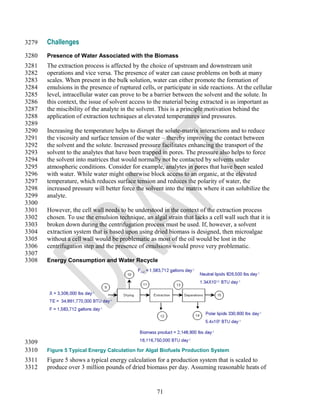
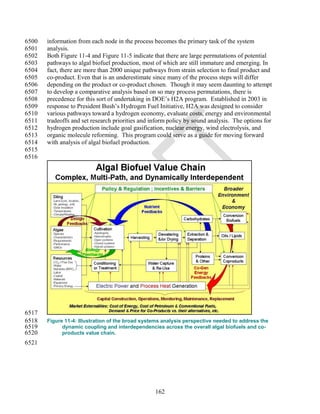
  • 179.
    6717 participants specifically suggested that the following areas be addressed in the modeling 6718 and analysis. 6719 6720  Determine the current state of technology 6721  Identify critical path elements that offer opportunities for cost reduction 6722  Identify research areas most in need of support 6723  Identify external factors that will impact cost 6724  Provide plan for entry of algal biofuel into a renewable fuel portfolio 6725  Inform and perhaps guide formation and/or modifications to public policy 6726  Incorporate appropriate insights and benefit from alliances with industry 6727 associations 6728 6729 The Techno-Economic Analysis can accomplish this by: 6730  Stressing dynamics over detail 6731  Employing modular modeling, e.g. ISBL and OSBL approaches* 6732  Establishing interface requirements between sub-systems 6733  Leveraging university resources 6734  Maintaining industry standard notation, units, etc. 6735 6736 To process the above suggestions with sufficient fidelity to inform R&D investment and 6737 guide technology risk management, an concentrated effort to construct a useful system 6738 analysis model is recommended. While we initially provided an illustrative system 6739 dynamics framework, a more comprehensive, phased approach is outlined in Table 11-6. 6740 * ISBL – Inside Boundary (or Battery) limits, OSBL – Outside Boundary Limits 170
  • 180.
    6741 Table 11-6: Phased approach with capability targets and deliverables as guidelines and 6742 suggestions set by Roadmap participants. Phase Tasks Deliverable Capability 1 Develop the framework to Model 0.1 Beta – Model runs with include the entire algal biofuel dynamics notional data and or life cycle. This would include accounted for data ranges. constraints on algae production, Rudimentary user processing technology, and interface production cost estimates. 2 Populate the model with data Model 1.0 Beta Model runs with obtained from commercial firms commercial data. including an estimate of the Ability to see bounds technology‘s Technology on parameters and the Readiness Level. resulting life cycle uncertainty. 3 Confidence building and model Model 1.0 – Completed user sensitivity runs. Probable re- detail accounted interface, populated work to include any changes to for with vetted and the algal biofuel system. protected data sets. Ability to run policy scenarios and determine investment priorities. 6743 6744 Throughout the Workshop, significant algae to biofuel process uncertainties were 6745 identified along all steps of the process. These have been noted in earlier sections. 6746 Addressing these uncertainties in a systematic and integrated modeling assessment could 6747 help speed the deployment of an algal biofuels industry. 6748 6749 References 6750 Chisti, Y., ―Biodiesel from Microalgae,‖ Biotechnology Advances 25 (2007) 294-306. 6751 Molina Grima, E., E.-H. Belarbi, F.G. Acien Fernandez, A.R. Medina, Y. Chisti, 6752 ―Recovery of microalgal biomass and metabolites: process options and economics,‖ 6753 Biotechnology Advances, 20 (2003) 491-515. 6754 Lundquist, T.J., ―Engineering & economic Assessment of algae biofuel production,‖ 6755 Algae Biomass Summit 2008. 6756 Tapie, P and A. Bernard, ―Microalgae production: technical and economic evaluations,‖ 6757 Biotechnology and Bioengineering,‖ 32, (1988) 873-885. 6758 Huntley, M.E. and D.G. Redalje, ―CO2 mitigation and renewable oil from photosynthetic 6759 microbes: a new appraisal,‖ Mitigation and Adaptation Strategies for Global Change, 6760 2006. 171
  • 181.
    6761 Ringer, M., R. Wallace, P. Pienkos, NREL Techno-economic analysis, private 6762 communications, 2008. 6763 Starbuck, M. and P. Lammers, Techno-economic analysis, private communication, 2008. 6764 Willson, B., ―Low cost photobioreactors for algal biofuel production & carbon capture,‖ 6765 2nd Bundes-Algen-Stammtisch, Hamburg, 2008. 6766 Weyer, K., D. Bush, A. Darzin, B. Willson, ―Theoretical maximum algal oil production,‖ 6767 Algae Biomaass Summit, 2008. 6768 Steiner, U. ―Biofuels‘ cost explosion necessitates adaptation of process concepts,‖ 6769 European White Biotechnology Summit, Frankfurt, Germany, 2008. 6770 Benemann J.R. and W.J.S. Oswald, ―Systems and economic analysis of microalgae ponds 6771 for conversion of CO2 to biomass,‖ Final Report to the DOE-PETC under Grant #DE- 6772 FG22-93PC93204, 1996. 6773 Hazlebeck, D. ―General Atomics Algae Biofuel Program,‖ October, 2008. 6774 Wu, B. and R. Pate, ―Algal oil production notional ―Baseline‖ scale-up assessment,‖ 6775 Sandia presentation, 2007. 6776 The Greenhouse Gas, Regulated Emissions, and Energy Use in Transportation (GREET) 6777 model. http://www.transportation.anl.gov/modeling_simulation/GREET/ 6778 Overview of the Lifecycle Emissions Model (LEM) 6779 http://pubs.its.ucdavis.edu/publication_detail.php?id=305 6780 Forrester, Jay W. 1961. Industrial Dynamics. The M.I.T. Press. 6781 6782 Attra (2006). ―Biodiesel: The Sustainability Dimensions‖, National Sustainable 6783 Agriculture Information Service, National Center for Appropriate Technology, 2006 6784 http://www.attra.ncat.org 6785 Ben-Amotz, Ami (2007). ―Production of Marine Unicellular Algae on Power Plant Flue 6786 Gas: An approach toward bioenergy and global warming‖, Algal Biomass Summit, 6787 San Francisco, CA, November 15-16, 2007. 6788 Ben-Amotz, Ami (2008). ―Biofuel and CO2 Capture by Marine Microalgae‖, Algal 6789 Biomass Summit, Seattle, WA, October 24-24, 2008. 6790 Benneman, J.; Oswald, W. (1996). ―Systems and Economic Analysis of Microalgae 6791 Ponds For Conversion of CO2 to Biomass‖. Report prepared for the Pittsburg Energy 6792 Technology Center under Grant No. DE-FG22-93PC93204. 6793 Benemann, J.R. (2002). ―A Technology Roadmap for Greenhouse Gas Abatement with 6794 Microalgae.‖ Report to the U.S. Department of Energy, National Energy Technology 6795 Laboratory, and the International Energy Agency Greenhouse Gas Abatement 6796 Programme. Prepared for the International Network on Biofixation of CO2 and 6797 Greenhouse Gas Abatement with Microalgae. 6798 Bill A., Griffin T, Marion, J. and Nsakala ya Nsakala (2001). "Controlling Power Plant 6799 CO2 Emissions: A Long range View", Conference Proceedings, Power Gen. Europe 6800 2001, Brussels, Belgium. 6801 www.netl.doe.gov/publications/proceedings/01/carbon_seq/1b2.pdf 172
  • 182.
    6802 Bryan, P. and Miller, S. (2008). ―Algal and Terrestrial Second-Generation Biofuels – 6803 Chevron and the New Energy Equation,”Chevron Biofuels, Chevron ETC, 6804 Presentation at Scripps Institution of Oceanography, March 26, 2008. 6805 http://spg.ucsd.edu/algae/pdf/2008-03-26-Scripps.pdf 6806 Campbell, Peter, Tom Beer, David Batten (2009). ―Greenhouse Gas Sequestration by 6807 Algae – Energy and Greenhouse Gas Life Cycle Studies‖, Transport Biofuels Stream, 6808 CSIRO Energy Transformed Flagship PB1, Aspendale, Vic. 3195, Australia 2009. 6809 http://www.csiro.au/org/EnergyTransformedFlagship.html 6810 Chisti, Y. (2007). ―Biodiesel from microalgae.‖ Biotechnology Advances. (25); pp. 294- 6811 306. 6812 Kadam, K.L. (1997). ―Power Plant Flue Gas as a Source of CO2 for Microalgae 6813 Cultivation: Economic Impact of Different Process Options‖, Energy Convers. 6814 Mgmt, v.38, Suppl., pp. S505-S510, 1997. 6815 Kadam, K.L. (2002). ―Environmental implications of power generation via coal- 6816 microalgae cofiring‖, Energy v.27, pp. 905-922, 2002. 6817 Massingill, Michael, James Carlberg, Gregory Schwartz, Jon Van Olst, James Levin, and 6818 David Brune (2008). ―Sustainable Large-Scale Microalgae Cultivation for the 6819 Economical Production of Biofuels and Other Valuable By-Products‖, Algal Biomass 6820 Summit, Seattle, WA, October 24-24, 2008. 6821 McKinsey&Company (2008). Warren Campbell, et.al., ―Carbon Capture & Storage: 6822 Assessing the Economics‖, Report prepared under the McKinsey Climate Change 6823 Initiative, September 22, 2008. http://www.mckinsey.com/clientservice/ccsi 6824 ORNL (2003). ―Bioenergy Conversion Factors‖, 6825 http://bioenergy.ornl.gov/papers/misc/energy_conv.html 6826 http://www.localenergy.org/pdfs/Document%20Library/Bioenergy%20conversion%2 6827 0factors.pdf 6828 Pate, R. (2008). ―Algal Biofuels Techno-Economic Modeling and Assessment: Taking a 6829 Broad Systems Perspective‖, Plenary presentation at DOE Algae Biofuels 6830 Technology Roadmap Workshop, University of MD Inn and Conference Center, 9-10 6831 December 2008. 6832 Rubin, E. (2005). ―Carbon Dioxide Capture and Storage.‖ IPCC Technical Summary. 6833 Schenk, Peer., Skye R. Thomas-Hall, Evan Stephens, Ute C. Marx, Jan H. Mussgnug, 6834 Clemens Posten, Olaf Kruse, and Ben Hankamer (2008). ‖Second Generation 6835 Biofuels: High-Efficiency Microalgae for Biodiesel Production‖, Bioenerg. Res. 6836 v1:20–43 Published online: 4 March 2008. 6837 Sheehan, J., T. Dunahay, J. Benemann, and P. Roessler (1998). ―A Look Back at the 6838 U.S. DOE‘s Aquatic Species Program – Biodiesel from Algae‖, NREL/TP-580- 6839 24190, July 1998. 6840 Sun, Sally, and Raymond Hobbs (2008). ―Power Plant Emissions to Biofuels‖, 6841 Presentation by Arizona Public Service Company at NREL-AFOSR Workshop on 6842 Algal Oil for Jet Fuel Production, Washington, DC, 19-21 February 2008. 6843 Tyson, K.S.; Bozell, J.; Wallace, R.; Peterson, E.; Moens, L. (2004). Biomass Oil 6844 Analysis: Research Needs and Recommendations. NREL/TP-510-34796. Golden, 6845 CO: National Renewable Energy Laboratory. 6846 USDA (2006). ―Major Uses of Land in the United States, 2002‖, USDA Economic 6847 Research Service, Economic Information Bulletine Number 14, May 2006. 173
  • 183.
    6848 USDA (2009a). ―Land Use, Value, and Management: Major Uses of Land‖, USDA 6849 Economic Research Service On-Line Briefing Room 6850 http://www.ers.usda.gov/Briefing/LandUse/majorlandusechapter.htm 6851 USDA (2009b). ―United States Census of Agriculture 2007: Summary and State Data‖, 6852 v.1, Geographic Area Series, Part 51, Issued February 2009 by the USDA National 6853 Agricultural Statitics Service. 6854 http://www.agcensus.usda.gov/Publications/2007/Full_Report/usv1.pdf 6855 Van Harmelen, T.; Oonk, H. (2006). ―Microalgae Biofixation Processes: Applications 6856 and Potential Contributions to Greenhouse Gas Mitigation Options.‖ Prepared by 6857 TNO Built Environment and Geosciences for the International Network on 6858 Biofixation of CO2 and Greenhouse Gas Abatement with Microalgae. Available from 6859 jbenemann@aol.com. 6860 Weyer, Kristina, Daniel Bush, Al Darzins, Bryan Willson (2008). ―Theoretical 6861 Maximum Algal Oil Production‖, Algal Biomass Summit, Seattle, WA, October 24- 6862 24, 2008. 6863 6864 Surface Evaporation Map of US - Evaporation for the United States," NOAA Technical 6865 Report NWS 34, Washington, D.C., 82 p. 6866 Farnsworth, R.K., E.S. Thompson, and E.L. Peck (1982). "Evaporation Atlas for the 6867 Contiguous 48 United States," NOAA Technical Report NWS 33, Washington, D.C. 6868 Produced Water Quality Map of US - The produced water map shows locations of 6869 brackish water generated during oil and gas recovery. Water quality, date sample was 6870 collected, sample depth, geologic formation samples was collected from, and wellname 6871 are examples of data included in this dataset. It is available at 6872 http://energy.cr.usgs.gov/prov/prodwat/dictionary.htm 6873 6874 CO2 Source Map of US - CO2 sources were compiled by NATCARB as part of the 6875 national Carbon Sequestration Program. An example of some of the sources included in 6876 the database are power generating facilities, refineries, manufacturing, natural gas 6877 transmission and cement plants. http://www.natcarb.org/Atlas/data_files.html 6878 6879 Saline aquifer data was compiled by NATCARB as part of the national Carbon 6880 Sequestration Program. Information includes geologic basin and formation, as well as 6881 formation surface area. http://www.natcarb.org/Atlas/data_files.html 6882 6883 174
  • 184.
    6884 6885 12. Public-Private Partnerships 6886 Introduction 6887 As noted several times throughout this document, the participants of the Roadmap 6888 Workshop voiced a strong consensus regarding the need and opportunity for the 6889 continued development of algal biofuels. Of equal importance was the participants‘ 6890 agreement regarding the need for leadership from DOE in several areas including: 6891 1) coordinating with other federal agencies to support fundamental and applied research, 6892 infrastructure development, technology deployment, and information management at 6893 a national level, and 6894 2) promoting the development of enabling policy, regulations, and standards for the 6895 emerging algal biofuels industry. 6896 6897 The Workshop participants emphasized the critical need for DOE and other federal 6898 agencies to partner with national laboratories, academia, and most importantly, with 6899 industry. The participants, however, also noted the uniqueness of the partnerships 6900 environment in algal biofuels development, given the fact that the algal biofuels industry 6901 is still in its infancy. More specifically, given the current state of this industry, the 6902 business strategies of many existing companies are focused on some aspect of algae, but 6903 not necessarility producing transporation biofuels from cultivated algal biomass at scale. 6904 Some would advance the view that no recognized ―industry‖ at all given that there are no 6905 profitable concerns current producing algal biofuels. Given this situation, the framework 6906 and leadership needed to carry out the fundamental R&D needed to help launch a US 6907 algal biofuels industry is considerable yet still in the formative stages. 6908 6909 With concerns over intellectual property (IP) rights and future earnings, most companies 6910 in this emerging industry have not adopted the openness found in other industries in 6911 terms of sharing data and science learnings with the larger international research 6912 community (including US national laboratories and universities). At the same time, value 6913 proposition presented by algal biofuels is widely recognized by the nation‘s top scientists 6914 and engineerings, environmentalists, and entrepreneurs; many believe that algae holds 6915 significant—if longer term—promise to address nation‘s energy challenges, especially in 6916 an anticipated carbon-constrained world . Given this landscape, overcoming the technical 6917 challenges to realizing the potential of algal biofuels will require inspired and empowered 6918 leadership and strategic partnerships. 6919 6920 This section discusses the rationale for public-private partnerships in general and 6921 specifically, as related to algal biofuels. Further, various models for such partnerships 6922 employed in past efforts are discussed in the context of applicability to the algal biofuels 6923 challenge, including criteria for formation of public-private partnerships (i.e., 6924 characteristics for membership), and in particular, intellectual property models. In 6925 addition, several options for action and anticipated timelines are presented and discussed. 6926 175
  • 185.
    6927 Building Successful Public-Private Partnerships 6928 People and organizations partner when they believe it is in their best interest to do so 6929 rather than ―going it alone.‖ They recognize that some characteristic of the challenges 6930 they face (financial investment, risk, technical capability, etc.) present a significant 6931 barrier to their success and that the odds of success can be attractively enhanced if 6932 tackled with partners. 6933 6934 However, deciding to partner is one thing; building a successful partnership is another 6935 entirely. At the highest level, successful partnerships have several key attributes (J. 6936 Micheau, 2008): 6937  The partners collaborate on the basis of common interest. 6938  The benefits of partnership outweigh the cost of collaboration. 6939  The partners can achieve more through collaboration than they can individually. 6940  The benefits received from the partnership should be proportional to the value of 6941 the contribution. 6942  The partnership should not openly conflict with the interest of other groups. 6943 6944 As ideas to encourage and enable partnerships to advance algal biofuels across private 6945 and public organizations are contemplated, it is important to keep these attributes in 6946 mind. 6947 6948 Partnerships may bring together parties that have not worked together before, which 6949 could both be a benefit (new complimentary capability) and a challenge (the 6950 understanding of how to work together). Finding a basis of common interest for an algal 6951 biofuels partnership is possible, as this industry has many needs where multiple players 6952 can benefit, especially when teams are formed around the unique, differentiating, and yet 6953 complimentary strengths of their members. Implicit in the concept of collaborating on a 6954 common basis is the sharing of pre-competitive research results, which allows the 6955 advancement of technology and know-how to levels far beyond the capability of any 6956 individual entity. Generally, this need is met via public funding for research institutions 6957 (e.g. universities and national laboratories) for whom this kind of work is particularly 6958 aligned with both their missions and strengths. Networking events such as workshops, 6959 conferences, and seminars are important tools for creating such a collaborative 6960 environment. 6961 6962 From the taxpayer‘s perspective, the government is the steward of taxpayer funds and its 6963 role in a national public-private partnership should be to ensure that access to the 6964 partnership is open to all who can contribute so as not to benefit only a few industrial 6965 players while at the same time catalyzing commercialization of technology derived from 6966 the fundamental and applied science and engineering advances achieved via public 6967 funding. For this reason, efforts to matriculate and enable national public-private 6968 partnerships be open and inclusive, and encourage generating and sharing ideas from 6969 every corner of the algal biofuels industry, formulating new approaches that will benefit 6970 all and aid industry growth towards addressing the US agenda for sustainable 6971 transportation energy security. At the same time, these efforts must respect and enable 176
  • 186.
    6972 investment aimed at building commercial-scale for-profit industry ultimately required to 6973 meet U.S. needs in sustainable transportation energy. 6974 6975 The Benefits of Algal Biofuels Public-Private Partnerships 6976 The algal biofuels industry is evolving with numerous players, many focusing on their 6977 specialty along one to a few elements in algal biofuels value chain. Partnerships, based on 6978 sharing of knowledge and capabilities for mutual benefit, are needed to pull together the 6979 expertise and facilities, accelerating growth and enabling the development of a 6980 sustainable, algal biofuels system for this industry. Figure 11 shows the benefits of 6981 collaboration between private entities (e.g. industry) and public entities (e.g. national 6982 laboratories and universities) for development of the algal biofuels.* While benefiting 6983 both private and public entities from shared investment toward mutual objectives, public- 6984 private partnerships have the potential to accelerate commercialization of algal biofuel 6985 technology, leading to rapid industry growth and a stable market. 6986 6987 6988 Figure 11: Benefits of algal biofuels public-private partnerships 6989 6990 Industry benefits from public-private partnerships from the exposure to fundamental 6991 science and engineering R&D through collaboration, thereby quickening the pace of 6992 innovation. This, in turn, increases the capital efficiency of commercial firms, many of 6993 which may be investor-backed and pre-revenue as well as reduces the risk of to private 6994 investment. 6995 * In this situation, academia can be either public or private, realizing benefits in both categories. 177
  • 187.
    6996 Partnership Environment in the Algal Biofuels Industry 6997 The algal biofuels industry ecosystem includes a broad cross-section of parties from 6998 multiple segments of industry and venture-backed investment, academia, government 6999 agencies, and national laboratories. As this industry moves forward, each of these entities 7000 will play a vital role in fundamental science and engineering R&D, technology 7001 development, addressing technical and regulatory hurdles, and creating jobs and a labor 7002 pool of talent. 7003 7004 The algal biofuels industry is currently comprised primarily of small technology-rich 7005 firms. These players are focused on various aspects of the algal biofuels value chain from 7006 algal growth to harvesting, extraction, and ultimately to refining and conversion to fuels. 7007 Some larger players, with experience from other industries, also contribute in the refining 7008 element, although many relevant larger companies appear to be following the algal 7009 biofuels industry without yet aggressively engaging. The product users include larger 7010 companies across the petrochemical (and it‘s feedstock customers) industry, agriculture, 7011 and the aviation industry. 7012 7013 Additionally, this industry is characterized by limited sharing of information, as industry 7014 players strive to protect their intellectual property. Given that no single player is yet 7015 ready to work the entire the algal biofuels value chain, an approach of limited 7016 commercial collaboration, combined with relative little federal investment as yet for pre- 7017 competitive R&D results in slower progress with higher risk for all. Rather, in all 7018 likelihood, the algal biofuels industry will be built by those who figure out how to work 7019 together, sharing information and allowing multiple links in the value chain to work in 7020 concert. Collaborations between publically and privately funded researchers are key to 7021 enabling the formation of these partnerships. Carefully conceived partnerships that 7022 promote sharing of information and technology while at the same time ensuring for-profit 7023 companies to provide a return to their investors through the commercialization and 7024 application of the resulting technology represent the best hope for accelerating the 7025 establishment of this industry. 7026 7027 Challenges for Algal Biofuels Public-Private Partnerships to Address 7028 The key challenges that partnerships must address for the algal biofuels to become viable 7029 include the following: 7030  Technology development in algal biology, growth and harvesting, oil extraction, 7031 and fuel conversion; 7032  Pre-commercial-scale user facilities that are accessible to researchers and 7033 developers to evaluate their technologies; 7034  Clear regulations allowing for siting of algal facilities and production of 7035 acceptable algal products; 7036  Labor force and intellectual talent to draw upon; and 7037  An open environment that stimulates the sharing of ideas and technology across 7038 the entire algal biofuels value chain. 7039 178
  • 188.
    7040 Challenges that are particularly pertinent to be addressed by a public-private partnership 7041 are highlighted below, loosely sorted according to the earlier sections in this document. 7042 7043 Algal Biology 7044 The Workshop participants identified several areas that could benefit from some form of 7045 public-private partnership(s): 7046 7047 i) Share Understanding of Existing Current Strains & Coordinate Efforts to Identify 7048 New Strains 7049 IP issues currently exacerbate the slow flow of relevant strain data. To optimize the 7050 investment of resources from both the public and private sector and accelerate progress in 7051 the industry, large-scale sampling and isolation activities for new strains of algae need to 7052 be conducted with careful coordination of the publically funded activities. Such efforts 7053 must account for the temporal success of microalgae in natural habitats and allow results 7054 to be assembled into a culture collection serving as a bioresource for further biofuels 7055 research. Given the phylogenetic diversity of microalgae, a large number of model 7056 systems could be studied; however, in a practical sense, the number to be studied in depth 7057 should be limited because a critical mass of researchers is required on a given species to 7058 make progress. A public-private partnership would be useful to fund, develop, and 7059 maintain a central strain, open access repository; perhaps, such a capability could be 7060 located at the culture collection centers at University of Texas at Austin (UTEX) and/or 7061 in West Boothbay Harbor, Maine (CCMP). 7062 7063 ii) Assist in Development of Basic Methods & Standards 7064 It is often difficult to compare data generated by different labs. This is especially true in a 7065 new field where basic methods and standards have not yet been established. There is a 7066 need for a common database for global information on the characteristics of currently 7067 available algal strains. Of particular importance is the need to establish voluntary or 7068 otherwise common units of biomass productivity (e.g., gm dry weight/L/day). The 7069 central strain, open access repository noted above would assist by using common units of 7070 measurement. 7071 7072 iii) Coordinate Genome Sequencing Efforts between Public Sector & Private Industry 7073 To accelerate progress and minimize duplication, efforts between the public-sector 7074 genome sequencing capabilities (e.g. DOE‘s JGI) and the efforts of the private sector 7075 might be coordinated so that taxpayer funds would be leveraged to those strains that the 7076 scientific community (spanning both the public and private sectors) concur as showing 7077 the most promise. A public-private partnership would be a useful vehicle to identify the 7078 criteria for selection and then prioritizing the organisms for genome sequencing and 7079 annotation. Clearly, while private concerns interested in particular strains will fund the 7080 sequencing of whatever strains present a value proposition for their interests, the issue 7081 here is one of overall leveraging of taxpayer dollars. With this in mind, the need for 7082 validated data and the consensus of the scientific community should be used to determine 7083 a prioritized list of target strains for public sequencing. In some sense, this would serve 179
  • 189.
    7084 as a ―master plan for genome analysis,‖ described earlier in the Algal Biology section 7085 (page 15). 7086 7087 iv) Develop a Robust Bioinformatics Infrastructure 7088 A bioinformatics infrastructure that facilitates shared understanding and communication 7089 across the scientific community with respect to algal biofuels is non-existent. The 7090 absence of such a resource thwarts progress, but so too would the creation of such an 7091 infrastructure if ill-conceived. Quality standards and appropriate training should be 7092 developed and established to ensure consistent and useful annotation thus ensuring that 7093 the resulting annotated sequence data is usable by the larger scientific community. A 7094 standardized set of analysis approaches should be decided upon and implemented, 7095 particularly in the areas of transcriptomics, proteomics, metabolomics, lipidomics, and 7096 integrated data analysis. By its very nature, the development of such an infrastructure 7097 demands that stakeholders from all key customer, user, sponsoring groups, etc. come 7098 together to address the corresponding issues and chart a path forward to development. 7099 7100 v) Develop Key Facilities that are too capital intensive, risky, or both for either party 7101 As described earlier, sustained RD&D efforts at the necessary scale will promote 7102 significant capital investment. Such investment is frequently too risky or simply out of 7103 the question (in terms of acquiring such capital) for the average start-up firm. Further, 7104 much of the RD&D needed is in areas that are sufficiently pre-competitive, and as such, 7105 no single entity in private industry will dare to bear the effort and risk to gain insight or 7106 overcome a challenge that will benefit the entire industry overall. Moreover, technologies 7107 developed in the laboratory have traditionally not translated well to the field, since the 7108 environment has a significant impact on algae performance. Open, collaborative facilities 7109 that allow precompetitive R&D and new technologies to be tested would accelerate 7110 technology development. Feedback from the Roadmap Workshop suggest that a core 7111 ―omics‖ facility dedicated to algal biofuels and a facility devoted to the development of 7112 genetic manipulation tools that have application across multiple species would 7113 significantly reduce the development time for individual strains. The investment required 7114 to develop and maintain such a facility for some period of time is most appropriately 7115 within the purview of the government. 7116 7117 To leverage government investment (taxpayer funds), however, both the development of 7118 facilities for RD&D efforts and the efforts conducted therein should be coordinated. The 7119 suggestion of such coordination, however, may strike a disconcerting chord with many 7120 who perceive that in general, quasi-government and/or government performed research 7121 takes longer to accomplish particular milestones than if the same R&D were performed 7122 outside of the government environment. Consequently, a public-private partnership with 7123 mechanisms (paths) for both precompetitive R&D as well as private R&D could be 7124 envisioned to generate the IP necessary to establish and capitalize for-profit commercial 7125 entities. Such a partnership would be particularly useful in establishing the functional 7126 requirements so that ultimately the design, implementation, use and maintenance of such 7127 a facility meet the requirements of a broad user base. 7128 180
  • 190.
    7129 Algal Cultivation and Processing 7130 For the same reasons as above, public-private partnership(s) are also the most viable 7131 means to fund, design, develop, start up, operate and maintain joint-use, open-access 7132 facility(ies) for large-scale R&D that address cultivation and downstream processes. 7133 Dynamic pond monitoring will be important for both wild-type and genetically modified 7134 algae whose competitiveness in the field cannot be accurately predicted. This effort will 7135 require a significant investment toward basic research in multi-trophic, molecular-level 7136 algal ecology, the costs and risks of which are perhaps best borne by a public-private 7137 partnership. 7138 7139 Further, algal biomass suffers from a lack of well-defined and demonstrated industrial- 7140 scale methods of extraction and fractionation. Inextricably linked with the processing 7141 subsystems are the significant issues of energy requirements and the associated costs 7142 (with cultivation, harvesting, etc.). Sharing of the costs and insights gained would be 7143 particularly useful in focusing further investments in preferred methods, and process and 7144 tool development, and in providing critical data to techno-economic modeling efforts. 7145 7146 Conversion to Fuels “Fit for Use”, Distribution & Utilization 7147 Today, all of the petroleum feedstock that enters a conventional petroleum refinery must 7148 leave as marketable products, and this conservation law also must hold true for the algae 7149 biorefineries of the future if they are to achieve significant market penetration and 7150 displace fossil fuels. The feedstock, conversion process, and final fuel specifications are 7151 highly interdependent and must be considered together if an optimal process is to be 7152 identified. However, the greatest challenge in algal fuel conversion is likely to be how to 7153 best use the algal remnants after the lipids or other desirable fuel precursors have been 7154 extracted. Accurate and detailed feedstock characterization (including both composition 7155 and variability) is essential, since this is an upstream boundary condition for the entire 7156 downstream fuel-conversion process. Lifecycle analysis of energy and carbon will be a 7157 key tool in selecting the winning fuel conversion technologies. 7158 7159 Resources & Siting, Regulations & Policy, and Systems Analysis & Techno- 7160 Economic Modeling 7161 Resources and siting, regulations and policy, and systems analysis and techno-economic 7162 modeling are highly interdependent topics. Singly and together, they may perhaps 7163 represent the loudest cry-out for public-private partnerships as all other efforts associated 7164 with research, technology development, processing systems, proof of pathways, etc., 7165 must be undertaken within the context and framework associated with these systems 7166 issues. 7167 7168 Resources and siting issues for algal biofuels scale-up are dominated by land use, water 7169 supplies, nutrient supplies, required energy inputs, and related regulatory policies, some 7170 of which are outside the purview of DOE. Given U.S. needs in sustainable transportation 7171 energy, the potential presented by algal biofuels, and the current state of knowledge and 7172 commercial activity, the birth of a new industry ―from the ground up,‖ is anticipated. 7173 Hence, the existing regulatory processes that potentially impact this industry, including 181
  • 191.
    7174 the role of federal, state and local agencies that presently regulate one or more aspects of 7175 growing or processing algae, need to be identified. Future potential roles for agencies that 7176 will become essential as the industry develops need to be anticipated and addressed. 7177 7178 The challenges ahead for large-scale cultivation and processing of algae for biofuels are 7179 significant and R&D teams should include techno-economic assessment efforts. The 7180 economic viability of sustainable microalgal cultivation enterprise is a very 7181 interdependent equation involving multiple interfaces between technical research, 7182 integration and optimization research, and the changing world of regulatory and incentive 7183 policies (e.g. carbon credits). At the Workshop, there were repeated calls from various 7184 stakeholders for life cycle analyses and environmental impact studies to be used to guide 7185 regulatory and policy decisions. Such studies are inextricably linked to technoeconomic 7186 analyses, which for now must be based on an assortment of assumptions and data 7187 extrapolated from small-scale laboratory work or from the cultivation of algae for higher- 7188 value products, as an algal biofuel industry does not presently exist anywhere in the 7189 world. For example, when trying to model a subsystem level (e.g., large-scale cultivation 7190 process), the modelers will require input in terms of assumed values or ranges (for 7191 production unit costs, etc.). Without a fully developed industry, standards therein and any 7192 model likely to be useful to many must be non-proprietary and include data based on 7193 average or assumed values. 7194 7195 A feasible algae-to-fuel strategy must consider the energy costs and siting issues 7196 associated with each subsystem (e.g., cultivation, harvesting, dewatering, etc.). Cost 7197 estimates for lifecycle modeling of a particular process will be needed, but lacking any 7198 public-private partnership, it will be difficult to validate enough cost data points for a 7199 particular process to know that the model has much validity at all. 7200 7201 Lastly, systems analysis and techno-economic modeling will also be complicated by the 7202 requirement to cover many potential process options, as it is not yet clear which ones 7203 have the most commercial potential. One or more public-private partnerships could serve 7204 valuable roles as the interface/broker to provide data, feedback, and to ensure 7205 accountability and coordination along these fronts. 7206 7207 Various Roles Anticipated by Stakeholders 7208 Government 7209 Government, including DOE, its national laboratories, and other agencies (e.g, USDA, 7210 DOD, NASA, and FAA), can bring significant value to public-private partnerships for 7211 algal biofuels. They can conduct unique research requiring multidisciplinary approaches 7212 and differentiating R&D infrastructure. Further, government laboratories house world- 7213 class user facilities. Government can also bridge knowledge gaps across the algal 7214 biofuels value chain and through technology development, from foundational research to 7215 commercialization. Working with algal trade organizations, government can also help 7216 disseminate critical information to facilitate sharing of research, helping to advance the 7217 algal biofuels industry. 7218 182
  • 192.
    7219 There is a role for government at each stage of the process from fundamental research to 7220 pilot-scale testing and cost-sharing of first-generation algal-based biorefineries. As the 7221 algal biofuels industry does not yet have a product in any meaningful quantity in the 7222 biofuels market, requiring matching funding from this nascent industry would likely 7223 possible primarily in a research context. Government should seek to disseminate pre- 7224 competitive research towards accelerating industry growth and decreasing the time 7225 required for the industry to bring product to market and becoming economically 7226 sustainable. 7227 7228 Federal leadership and investment towards developing a successful algal-based biofuels 7229 industry has several advantages. Through this process, the federal government can 7230 leverage both funding and cross-cutting collaborative efforts to fulfill the gaps in 7231 scientific knowledge, provide support for novel approaches and pilot demonstrations that 7232 will reduce risk for investors and speed deployment of algal biofuels. 7233 Government can play the following roles in advancing the algal biofuels industry, serving 7234 the interests of society, nation, as well as business: 7235  encourage the formation of partnerships and successful technology transfers; 7236  provide funding, taking on early high risk in the development of critical, 7237 sustainable technologies; 7238  establish clear regulations (discussed in greater detail in the Policy section); 7239  implement unbiased assessments of technology advancements and the associated 7240 societal benefits (e.g. sustainability) in the form of publicly available reports; 7241  commission national resources to advance algal biofuels, including unique areas 7242 of research and environmental impact studies; and 7243  coordinate policymaking and funding for algal biofuels research, development, 7244 demonstration and deployment (RDD&D) initiatives among U.S. government 7245 agencies. 7246 One way to implement interagency coordination is to adapt existing policy instruments 7247 that foster collaborations across agencies for producing lignocellulosic biofuels to also 7248 include algal biomass. Among these, the Biomass R&D Board, whose appointees include 7249 both federal agency leadership as well as external experts, is a good example of 7250 interagency coordination. Setting up clear and transparent funding guidelines will be 7251 important to ensure government-funded research is unique and relevant 7252 7253 Algal-based biofuel development can leverage the lessons learned from DOE‘s cellulosic 7254 ethanol biofuels program and apply many of the same tools and insights that have led 7255 toward funding cross-cutting research leading to new insights and achieving technical 7256 targets needed to bringing cellulosic-based ethanol closer to fruition. 7257 7258 Individual Companies within the Private Sector 7259 Given the present state of the industry, the role that individual companies might play is 7260 unclear and best left to market-driven evolution. Rather, the government‘s interest must 7261 lie in ensuring that public-private partnerships receiving taxpayer funds serve the national 7262 interest as well as individual commercial concerns. 7263 183
  • 193.
    7264 Emerging Trade Organizations 7265 As discussed in the Regulatory & Policy section, the Algal Biomass Organization (ABO), 7266 a 501C-6 trade association formed in 2007, has begun an effort to establish a 7267 comprehensive list of standards to cover the entire algal biomass value chain, from raw 7268 materials to finished product modeled after the IEEE Standards Association.* Other 7269 collaborative efforts related to one or more subsystems of the overall algae-to-fuel 7270 lifecycle already exist (e.g., California Biomass Collaborative, Southwestern Biofuels 7271 Association, San Diego Center for Algae Biotechnology, etc.). Participation of trade 7272 organizations in public-private partnership model would be highly valuable. 7273 Academia 7274 Universities and community colleges have an important role to play in the development 7275 of this industry. Academic training will be critical to prepare scientists, engineers, 7276 operators, economists, and technology managers who will make up the intellectual 7277 workforce for algal biofuels. Universities also function as a place to stimulate the 7278 exchange of ideas by enabling an open environment for scientific exchanges, conducting 7279 high quality research, especially at the individual investigator scale, and serving as 7280 environments to develop and implement new tools, analyses and processes (such as 7281 genomic information, highly sensitive imaging and chemical detection technologies, 7282 high-throughput devices, catalysts, supercomputers, modeling software, and separation 7283 technologies). The means of transitioning IP from academia to industry should be 7284 enhanced to quicken the pace of commercialization for the benefit of both academia and 7285 industry. As such, members of academic institutions should be encouraged to join 7286 appropriate public-private partnerships. 7287 7288 Partnership Models 7289 There are many models for public-private partnerships but none specific to the unique 7290 space occupied by the algal biofuels industry. The problem with four illustrative models 7291 presented below (Table 5) and many others that exist is that they were all formed relative 7292 to an existing industry, not one where the goal is to develop the industry from its 7293 emergence stage. Therefore, it should not be expected that any one specific model will 7294 meet all of the needs of the algal biofuels industry. 7295 7296 Nevertheless, one approach that might prove useful to conceptualizing the various models 7297  for public-private partnerships is to think in terms of the five attributes of 7298 successful partnerships discussed earlier within the context of particular scenarios 7299 (e.g. particular algal strain, dewatering pathway, conversion process, etc.) or end 7300 goals (specific intended use, performance aspects of the fuel, etc.). Doing so may 7301 help define the boundary problem(s) for focus by the public-private partnership 7302 and bring clarity to the composition, requirements, and expected contributions of 7303 the membership 7304 * IEEE Standards Association: A unit of the Institute of Electrical and Electronics Engineers, an international non-profit, professional organization for the advancement of technologies related to electricity. 184
  • 194.
    7305 A model may be evaluated for applicability against the following criteria: 7306  Openness – How inclusive is the membership to its industry (or segment thereof)? 7307  Technology Commercialization – Is it structured to develop and commercialize 7308 new technology? 7309  Industry Growth – Does it seek to grow the industry? 7310  Shared Investment – Does it share investment equitably? 7311 7312 Table 5 compares several existing public-private partnership models against these four 7313 external characteristics and other characteristics (e.g., number of members, type of legal 7314 entity, etc.) The models presented are intended to serve only as examples of these four 7315 external characteristics for the algal biofuels industry and to prompt members of a would- 7316 be algal biofuels public-private partnership to consider these attributes and models, 7317 discuss and debate the merits of each, and select the best or optimal combination of 7318 attributes to meet the specific mission of their partnership. 7319 7320 Models for Openness 7321 AGATE, CITRIS, NINE, and SEMATECH were all examples of partnership models with 7322 a high degree of openness in terms of membership and sharing of knowledge through 7323 various kinds of activities. AGATE, CITRIS, and NINE each had over 60 participants in 7324 their organizations, while SEMATECH had over 50% of the global semiconductor 7325 production through its 16 members. With the high-level of participation from their 7326 sectors, these organizations can effectively represent and address critical needs for their 7327 industry. These organizations facilitate new approaches to address critical needs through 7328 periodic technical meetings and forums that foster cross-collaboration amongst 7329 participants. The open-membership aspect of these models allows for new ideas to be 7330 injected into the collaborative environment, accelerating technology development. These 7331 four organizations varied in the type of entity they created (501c6, consortium, and 7332 university institute), the lead organization (DOE, NASA, DARPA, and the University of 7333 California), and the funding they received; but all of them had a common objective to 7334 maximize industry involvement within their organization. 7335 7336 Models for Technology Commercialization 7337 SEMATECH and AGATE offer the best models for technology commercialization. 7338 Commercialization is more likely to occur when industry collaborates in research and 7339 development; this is absent in the models for NINE and CITRIS. DOE‘s Bioenergy 7340 Research Centers offered reasonable approaches for technology commercialization, but 7341 industry involvement is small as compared to SEMATECH and AGATE. SEMATECH 7342 has the most sophisticated process for technology commercialization; collaborative pre- 7343 competitive research is selected and conducted by the membership, ensuring that the 7344 membership perform work of common interest and benefit and avoid competing interests; 7345 the results are transferred by publication and/or the member-only website. Further 7346 development to a commercially viable solution occurs with external partners maintained 7347 by SEMATECH; SEMATECH provides non-exclusive, royalty-free licenses to its 7348 members and preserves the ability to license technology to outside parties for 7349 commercialization. Moreover, with over 40 industrial members from the general aviation 185
  • 195.
    7350 industry, the AGATE consortium was able to successfully focus on critical needs in 7351 lightweight, affordable jet engine design, multifunction display for navigation and power 7352 control, streamlined flight training curriculum, real-time weather data link technology, 7353 and lightning protection. Recognizing the importance of IP issues, AGATE members 7354 agreed to cross-license background IP, as well as newly developed IP, at reasonable rates, 7355 avoiding roadblocks in commercialization. Facilitated through the AGATE consortium, 7356 these technologies moved from research concepts to adoption into the marketplace. Both 7357 of these examples indicate how many partners were able to come together and determine 7358 in what areas they can collaborate to their mutual benefit, while reducing IP concerns so 7359 that technologies can be effectively commercialized. 7360 7361 Models for Industry Growth 7362 The Bioenergy Research Centers, AGATE, and SEMATECH offer the best models for 7363 industry growth. Each of these organizations was designed to attack specific technical, 7364 operational, or regulatory hurdles limiting industry growth. SEMATECH was organized 7365 to increase competitiveness of U.S. semiconductor industry as a result of the market 7366 threat from Japanese semiconductor firms. AGATE, the largest industrial consortium of 7367 its time with both large established firms and small businesses in the general aviation 7368 market, was designed to develop technology and standards that would create operational 7369 efficiencies for all market firms, which had seen a dramatic decrease in small aviation 7370 market demand. The Bioenergy Research Centers were conceived to address high risk, 7371 game-changing technical challenges that need to be resolved to make the cellulosic 7372 biofuels industry economically and environmentally sustainable. While each has been 7373 successful in aiding industry growth, the Bioenergy Research Centers are more closely 7374 aligned with the needs of the algal biofuels industry in terms of the maturity of the market 7375 and the overwhelming number of start-ups in the industry. 7376 7377 Models for Shared Investment 7378 The partnership models shown in Table 6 indicate varying degrees of shared investment 7379 between the government and its partners. The Bioenergy Energy Centers, NINE, and 7380 CITRIS were funded predominately by government with some participation by industry. 7381 SEMATECH and AGATE are models based on significant government funding and 7382 matching funding from industry; SEMATECH and AGATE were designed to support 7383 industries with an existing market. The algal biofuels industry does not yet enjoy such 7384 investment. 7385 7386 Recommendations and Timeline 7387 The challenges that seem most amenable to being addressed through public-private 7388 partnership are aligned with DOE‘s mission but are not solely within its mission space. 7389 As such, the Workshop participants agreeably felt that a lead agency such as DOE would 7390 need to serve as the ―sponsor‖ or ―lead‖ public organization to ensure clarity in terms of 7391 relative authority within a public-private partnership. Several key efforts that might be 7392 sponsored by the government within the context of some public-private partnership(s) are 7393 highlighted below. The government should support each to varying degrees: 186
  • 196.
    7394 7395 1. Commercialization of algal cultivation facilities co-located with industrial CO2 7396 sources and/or wastewater treatment facilities. 7397 2. Establishment of national algae biomass production test-beds to conduct research 7398 at the pilot scale (5-10 acres). These testbeds could be located at power plants, 7399 wastewater treatment facilities, and agricultural drainage/water body restoration 7400 sites to allow for adequate investigation of the role of these input groups in the 7401 overall economic viability of production processes. This effort could involve a 7402 consortium of R&D organizations, universities, algal cultivation companies, algal 7403 technology companies, refiners, distributors, and other participants coordinated by 7404 DOE at the national level. 7405 3. Independent evaluation of any given technology‘s TRL (Technology Readiness 7406 Level) so that government agencies can fund in the earlier stages with the 7407 knowledge and ―interest and pull‖ of other industrial entities who would assume 7408 the handoff to further the TRL and commercialize. 7409 4. Education and development programs to grow the specific labor pool needed to 7410 run algal-biofuels related operations, develop new algae-based fuels and co- 7411 products, and innovate new cost-cutting measures. 7412 5. Clarification of pertinent regulations and development of a comprehensive list of 7413 standards to eliminate the uncertainties in commercialization of algae-based 7414 technologies, thus encouraging investment and promoting partnering 7415 opportunities. DOE cannot be expected to take a lead on this effort because only a 7416 small subset of standards will relate directly to biofuel production. Nonetheless 7417 DOE could be instrumental in supporting this effort by providing funding for the 7418 accumulation of data needed to craft the standards. It could also help by 7419 promoting cooperation of federal regulatory agencies (e.g. USDA, EPA, and 7420 FDA) that will have jurisdiction over various aspects of the algal biomass 7421 industry. 7422 6. Development of computer models of algae production facilities that will aid in: 7423 rapid and consistent engineering design; techno-economic analyses; LCA/GHG 7424 abatement analysis; the evaluation of economies of scale vs. advantages of 7425 decentralized production considering parasitic losses of CO2 transport, etc.; the 7426 evaluation of temperature control (power plant cooling and algae pond heating); 7427 and the development of efficiently designed and operated test-bed facilities. 7428 187
  • 197.
    7429 Table 5: Comparison of Public-Private Partnership Models Openness of PPP Model Entity Type Technology Commercialization Industry Growth Shared Investment PPP  Open membership  Collaborate on pre-competitive  Designed to increase  16 members, R&D selected by membership competitiveness of 50% of global  Transfer of technology by existing US firms in the semiconductor publication or member-website semiconductor  Government funding: $500M over production Non-Profit data transfer marketplace 5 years  Forums inspiring Corporation  Technology further developed to  Provides  Industry: Match government 1, 2 cross SEMATECH (501c6) with two manufacturing solutions with commercialization funding collaboration facilities and three external partners; then adopted network that drives  Now funded solely by industry amongst subsidiaries  SEMATECH owns created IP and economic development members provides non-exclusive, royalty-  Develops coordinated  Public free license to members industry roadmap to conferences  SEMATECH can also license IP to focus R&D and spur on through third parties economic growth Knowledge Series  Initial partners defined;  JBEI has partner  Research conducted at BRC, other slots open  Address significant  Government funding: $125M over DOE facilities, or partner facilities  BRCs have 1 or 2 by DOE and/or partners technical game-changing, 5 years DOE BIOENERGY industrial high-risk barriers for  Significant funding from State of RESEARCH DOE Center -  Few industry partners to partners, with cellulosic biofuels Wisconsin and private sources for CENTERS (BRCs): Not a separate commercialize developed IP 3 several university  Industry growth supported GLBRC JBEI , legal entity with  IP licensed to interested parties with 4 partners through education  Significant funding from State of GLBRC , employees an evaluation of commercialization BESC 5  Public  Limited industry Tennessee for BESC potential conferences and involvement to address  Potential cash and in-kind  Transfer of technology by workshops at issues on industry growth contributions for JBEI publication GLBRC create opportunity for collaboration NATIONAL Non-Profit  Open membership  Pre-competitive research selected  Government funding approved for  Industry growth through INSTITUTE FOR Corporation  Consortium of 60 by all NINE members $10M over 5 years; not yet education NANOTECHNOLOGY (501c6) industry, academic  Research conducted by Sandia and appropriated  Technology only licensed EDUCATION with one host and national lab member universities  Founding member commitment of 6 to members - NINE facility partners;  NINE provides non-exclusive, $300K over 3 years 188
  • 198.
     Technical paid-up license to industry workshops members technical, business, and social issues inspire cross collaboration amongst members  Collaborative research amongst  Technology development consortium members designed to  Open and standardization reduce technical, operational, and membership, designed to reduce regulatory bottlenecks  Consortium of operational costs and  IP licensed exclusively or non- Industry 76 industry, increase general ADVANCED exclusively  Government funding of $100M consortium with academic and aviation market, GENERAL AVIATION  Commercialization afforded as over 8 years NASA & FAA - government including large TRANSPORT members agree to cross license  Industry match of $100M over 8 Not a separate partners, established firms and EXPERIMENTS - background and newly developed years 7, 8 legal entity with including more small businesses AGATE IP non-exclusively to each other employees than 40  Significant industry royalty-free representatives involvement provides  Transfer of technology by from industry; market focus and publication, and transfer of commercialization knowledge through member-only network database  Donor-driven model  Institute involving over  Research conducted by four CENTER FOR 60 IT industry University of California campuses  Industry growth supported University of INFORMATION partners and 4  Software is open source licensed through education California Institute  Funding of $200M over 4 years TECHNOLOGY UC campuses  Other IP is either licensed non-  Limited industry - provided by State of California, UC RESEARCH IN THE Not a separate  Numerous exclusively, royalty-free basis or involvement through Campus funds, and industry gifts INTEREST OF Forums inspiring exclusively, royalty basis as needed Advisory committee to legal entity with  No Federal funding SOCIETY cross to achieve the widest possible address issues on 9 employees - CITRIS collaboration dissemination. industry growth amongst researchers and inaction with industry 7430 189
  • 199.
    7431 Appendix: 7432 Scenarios Illustrating Preliminary Consequence Assessment: 7433 Land, Water, and CO2 Demand for Algal Biofuels Scale-up 7434 7435 Establishing the Basis for Initial Algal Production Scale-up Assessments 7436 7437 Autotrophic algal productivity is typically measured in terms of dry weight biomass produced 7438 per day per unit of illuminated cultivation system (open pond, closed photobioreactor, or hybrid 7439 combination of open and closed systems) surface area. Typical units of measure include annual 7440 average grams/meter2-day, metric-tonnes/hectare-year, or tons/acre-year of dry-weight- 7441 equivalent biomass. Neutral lipid (oil) content in algae is typically measured in terms of 7442 percentage of dry weight biomass, resulting in oil productivity typically being measured in terms 7443 of metric-tonnes/hectare-year or gallons/acre-year. 7444 7445 Unit conversion factors useful for translation among the various units of measure can be found at 7446 the end of this Appendix. 7447 7448 The high energy density neutral lipid oils of immediate interest as biofuel feedstock from algae, 7449 as well as from other more conventional oil crops and waste oil sources (Tyson, et.al. 2004), 7450 consists largely of triacylglycerol (TAG). The volumetric density of TAG vegetable oils is ~ 7451 0.92-grams/ml, which is equivalent to about 7.6-lbs/gal. 7452 7453 Assuming an annual daily average algal biomass productivity of PBD [grams/m2-day] and an 7454 annual average oil content of L [%] produced over the period of a full 365-day year, the resulting 7455 annual average biomass production PBA [mt/ha-yr] and annual average oil production POA 7456 [gal/ac-yr] is be given by: 7457 7458 PBA [mt/ha-yr] = 3.65 [mt-m2-d/g-ha-yr] x PBD [gram/m2-day] (Eq B-1) 7459 7460 POA [gal/ac-yr] = 1.17 [gal-ha/mt-ac] x L [%] x PBA [mt/ha-yr] (Eq B-2) 7461 7462 POA [gal/ac-yr] = 1.17 x 3.65 x L [%] x PBD [g/m2-d] 7463 7464 = 4.27 [gal-m2-d/g-ac-yr] x L [%] x PBD [g/m2-d] (Eq B-3) 7465 7466 As an example, if we assume PBD = 30 g/m2-day and L= 25 % oil content, using the above 7467 equations gives (without specifying the units on the leading coefficient 4.27): 7468 7469 POA [gal/ac-yr] = 4.27 x 25 [%] x 30 [g/m2-day] ~ 3200 gal/ac-yr. 7470 7471 Figure B-1 provides a parametric mapping of annual average algal oil production, POA, in gal/ac- 7472 yr as a function of annual average daily biomass productivity, PBD, in g/m2-day and annual 7473 average neutral lipid content L in percent of dry weight algal biomass, as described in above 7474 equations. The example calculation above is also plotted in Figure B-1 for illustration. The 190
  • 200.
    7475 simple conversion equations given above, and the parametric plot in Figure B-1, provide a quick 7476 means of translating annual average daily algal biomass productivities and oil content into 7477 annual production projections on a gallons per acre basis. 7478 7479 A key attraction of algae for biofuel feedstock production is the potential for high annual oil 7480 productivity per unit of area (i.e., POA). Projections for achievable annual average productivities 7481 for large commercial scale operations have ranged widely in the public domain and continue to 7482 be the subject of uncertainty and debate. Table B-0 includes the results of productivity 7483 calculations assuming Weyer‘s (Weyer, et.al. 2008) theoretical maximum (red row) as well as 7484 more moderate assumptions of productivity (green row). 7485 7486 g/m2/day percent lipids gal/acre/year liter/ha/year 15 10 633 5929 25 25 2639 24705 25 50 5278 49410 50 50 10556 98821 100 50 21113 197642 180 70 53204 498057 7487 7488 Table B-0: Algae Productivity Calculations 7489 7490 Figure B-2 presents the results of Weyer‘s recent analysis (Weyer, et.al. 2008) suggesting an 7491 upper theoretical limit on the order of 50,000-gal/ac-yr and perhaps a practical limit on the order 7492 of 5000-6500 gal/ac-yr, based on the assumptions made in the analysis (high solar insolation 7493 consistent with lower latitudes and/or high percentage of clear weather conditions, 50 % oil 7494 content). An interesting feature of the assessment is the comparison with other projections from 7495 the open literature noted in Figure B-2. 191
  • 201.
    7496 7497 Figure B-1. Mapping of estimated annual algal oil production in gallons per acre as a function of 7498 annual average algal biomass productivity, in grams per square-meter per day, and algal 7499 neutral lipid (oil) content as a percentage of dry weight biomass. (Adapted from Massingill 7500 2008). … Place-holder figure… need to re-do. 7501 7502 7503 For the sake of the preliminary consequence assessments presented here, we assume that algal oil 7504 productivities at scale under high solar resource and suitable temperature conditions will have a 7505 practical upper limit on the order of 6500-gal/ac-yr. We also assume that this may be achieved 7506 without specifying cultivation system details or configuration, other than to allow that it may be 7507 possible with open systems subject to maximum evaporative water loss, as will be discussed 7508 later. As noted above, the critical drivers for overall algal oil productivity will be the tradeoff 7509 between the achievable annual average daily biomass productivity and the average oil content, 7510 which can be expected to depend on the complex combination of algal strain, cultivation system, 7511 and local growing conditions, as discussed at length in other sections of this report. For the 7512 simple scaling assessments presented here, we simply ignore the complexities and details that 7513 will ultimately need to be addressed, and generally acknowledge that affordable and reliable 7514 optimization of the combination of these two critical production metrics will be key to favorable 7515 techno-economics for algal biofuels. 7516 192
  • 202.
    7517 7518 Figure B-2. Projected maximum theoretical and practical limits for algal oil production at nominal 7519 20-degree latitude under high solar insolation conditions; compared with estimates reported 7520 from other open sources (Weyer, et.al. 2008). 7521 7522 Scenario-1: Projected Land Requirements for Algae as Compared to Corn and Soy Oils 7523 7524 As a first scenario example, it is instructive to compare the projected land footprint requirement 7525 among corn, soy, and algae for producing the volume of bio-oil feedstock needed to displace half 7526 of the roughly 44 billion gallons of petroleum diesel fuel currently used annually in the U.S. for 7527 transporation. Table B-1 provides a list of numerous conventional oil crops and representative 7528 yields (Attra 2006). Corn and soy do not have particularly high oil productivities on average, but 7529 they are interesting from the standpoint of being major U.S. commodity crops, with large 7530 acreages in production and yields that vary depending on geographic location and whether 7531 irrigation is used (USDA 2009b). Corn has relatively low average oil productivity on the order 7532 of about 18-gal/ac-yr, while soy has somewhat higher average oil productivity on the order of 7533 about 48-gal/ac-yr, as noted in Table B-1. For algae, we will assume a productivity on the order 7534 of 5000-gal/ac-yr, which is consistent with the practical limits discussed earlier. 7535 7536 The production target for this scenario is to displace 50% of the petroleum-based diesel fuel 7537 currently used for transportation, or 22-billion gallons, with biofuel in the form of biodiesel or 7538 green diesel derived from the corn, soy, or algae derived vegetable oil. We will assume that the 7539 volumetric conversion efficiency (gallons of biofuel produced per 7540 7541 Table B-1. Conventional Oil Crops and Yield Estimates (Attra, 2006). 193
  • 203.
    7542 7543 7544 gallon of input vegetable oil feedstock) will be about 80%, regardless of the final type of fuel, 7545 with the understanding that there will also be other by-product fractions. This requires that 7546 22/0.8 (=27.5) billion gallons of vegetable oil feedstock must be produced annually. 7547 7548 Corn, at 18-gal/ac, would require just over 1.5-billion acres of land (~ 2.3-million square miles), 7549 which is about 80 % of the total land area of the lower-48 states (~ 1.9-billion acres), is about 7550 factor of three and a half times greater than the entire cropland of the U.S. (~ 440-million acres) 7551 and is about a factor of eighteen higher than the current U.S. corn acreage of about 86-million 7552 acres (USDA 2006; USDA 2009b). Soy, at 48-gal/ac, would require about 570-million acres 7553 (slightly below 0.9-million square miles), which is 130 % of all U.S. cropland and is over a 7554 factor of seven greater than the current U.S. soy acreage 7555 194
  • 204.
    7556 Figure B-3. Land footprint and oil production tradeoffs of corn, soy, and algae(adapted from 7557 Bryan, et.al. 2008). 7558 7559 (about 80-million acres). Algae, at 5000-gal/ac, would require 5.5-million acres (about 8500 7560 square miles), which is about 7.6 % and 7.0 %, respectively, of the land area of the 7561 State of AZ and the State of NM. Figure B-3, adapted from Chevron (Bryan, et.al. 2008), 7562 provides illustration of this scenario. 7563 7564 Scenario-2. Land Area for Commercial Scale Algae Biofuel Feedstock Production 7565 7566 If we assume that a commercial scale algal biofuel feedstock production operation would be on 7567 the order of 10-million gal/yr to 50-million gal/yr of oil feedstock output, then with an area 7568 productivity target of 5000-gal/ac-yr, this would require from 2000-ac to 10,000-ac of algal 7569 cultivation area. A glance at the parameter map in Figure B-1 suggests that 7570 this productivity target could be achieved, for example, with an annual average 20-gram/m2-d at 7571 60% oil content, or with 40-g/m2-day at 30% oil content. 7572 7573 Basis for Order-of-Magnitude Projections of CO2 Utilization with Algae Production 7574 Autotrophic algae growth and biomass production can be enhanced with CO 2 from stationary 7575 sources, such as flue gas from fossil-fired power plants (Kadam, 1997; Kadam, 2002; Sun, et.al, 7576 2008; ben-Amotz 2007; ben-Amotz 2008). Rough estimates of CO2 utilization are discussed 7577 here as a useful exercise to gain insight and appreciation for the opportunities and challenges for 7578 carbon capture in algae biomass and reuse in the form of algal based transportation fuels. 7579 7580 The carbon mass balance for algal biomass growth using the metabolic breakdown and 7581 conversion of CO2 during photosynthesis results in approximately 1.6 to 2 mass units of CO2 7582 being consumed for every mass unit (dry weight equivalent) of biomass produced (Van 7583 Harmelen, et.al, 2006; Chisti, 2007; Schenk, et.al. 2008; Sun, et.al. 2008). This ―CO2 utilization 7584 factor‖ depends on algae type, growth conditions, and relative percentage of carbon partition 7585 within the biomass. The process of bio-fixation of CO2 takes place only during sunlight hours 7586 when photosynthesis is active. In the absence of storage, only the CO2 emitted during the 7587 sunlight hours can be captured and incorporated into the algal biomass. 7588 7589 The efficiency with which CO2 will actually be taken up by the algae will be a function of the 7590 algae, the growth system size and configuration, and the dynamic operational conditions. The 7591 resulting efficiency will be less than 100%. Efficiencies in excess of 90% have been reported 7592 (Sheehan, et.al. 1998; Van Harmelen, et.al. 2006), but for this discussion we will assume that an 7593 efficiency of ~ 80% can be achieved on an annual average basis during sunlight hours. The 7594 remaining fraction of CO2 not taken up by the algae will escape into the environment, unless 7595 other measures are taken. 7596 7597 A simple way to view this ―capture efficiency‖ is to think of the cultivated algae as a ―sponge‖ or 7598 ―sink‖ that has the capability to absorb and consume the CO2. The size or capacity of the 7599 ―sponge/sink‖ must be appropriately matched to the volume of CO2 being made available to 7600 maximize the capture and consumption of the CO2. For algae under cultivation, this means that 7601 the productive area of the algae farm and the algae culture density and growth rates must be such 195
  • 205.
    7602 that maximum use can be made of the available CO2. If the ―sponge/sink‖ is too small, less of 7603 the CO2 can be effectively utilized and the capture/consumption efficiency will be lower. Here, 7604 we assume that the algae ―sponge/sink‖ can be made large enough to capture/consume 80% of 7605 the CO2 delivered. For simplicity, we ignore the details that involve the design of the cultivation 7606 system, the way the CO2 is distributed and injected into the system, and the measures that must 7607 be taken to assure the appropriate maintenance of other key nutrient levels and growing 7608 conditions, all of which will can contribute to achieving higher CO2 use efficiency. 7609 7610 The effective sunlight hours per day at any given site will vary as a function of latitude and 7611 season, and will also be modulated by weather conditions such as cloud cover. We assume for 7612 simplicity that the effective annual average daily sunlight period when photosynthesis is active 7613 will be 8-hours, or one third of the 24-hour day. The rate of CO2 emissions from fossil-fired 7614 power plants will vary with the type of plant technology and type of fuel used. Figure B-4 7615 provides representative CO2 emission rates for typical coal, oil, and gas fired plants in units of 7616 kg-CO2 per MWh of power generation (Bill, et.al. 2001). 7617 7618 Natural gas fired power plants emit about 450-kg of CO2 per MWh of operation, while coal-fired 7619 power plants emit about 920-kg of CO2 per MWh of operation, roughly a factor of two greater. 7620 A simplified illustration of the CO2 mass flows and use by algae that is assumed in this 7621 discussion is shown in Figure B-5. 7622 7623 Using these assumptions, we consider several scenarios that provide simplified projections for 7624 CO2 utilization by algae. 7625 7626 7627 196
  • 206.
    7628 Figure B-4. Average estimates of CO2 Emission Rates in kg per MWh 7629 from Fossil-Fired Electric Power Generation Plants (Bill, et.al. 2001). 7630 7631 Figure B-5. Process diagram and assumptions used for utilizing CO 2 from stationary emission 7632 sources, such as fossil-fired power plants, to enhance algae growth while capturing carbon 7633 emissions for re-use in algae-based biofuels and other co-products. 7634 Scenario-3. Capture of CO2 emissions from a 200-MW natural gas power plant 7635 7636 This scenario focuses on a 200-MW natural gas fired power plant operating 24-hours per day (a 7637 plant this size would more realistically be a ―peaker‖ plant that only operates at peak periods). 7638 We‘ll use the rule of thumb (see above) that 2 mass units of CO2 will be consumed for every 7639 mass unit of dry weight equivalent biomass grown. As noted earlier, the actual number will 7640 vary, depending on algae type and growth conditions, which is where a lot of complications 7641 come in that we will conveniently ignore is this discussion. 7642 7643 From Figure B-4, we have natural gas power plant emissions of 450-kg per MWh = 990 lbs CO2 7644 per MWh = 0.495 U.S. tons CO2 per MWh. For a 200-MW power plant operating at rated 7645 capacity, that gives 99-tons of CO2 per hour of operation. Assuming an average of 8-hours per 7646 day of sunlight-enabled algae biomass production, this gives 792 tons CO2 per day that could 7647 potentially be utilized for algal biomass production. The other 2/3 of a day worth of CO2 7648 emission from the power plant (1585 tons CO2) would be emitted to the atmosphere unless 7649 something else were done to capture and store the CO2. Assuming that of the 792 tons of CO2 7650 emitted during sunlight hours, 80% can be utilized by the algae (factoring in less than perfect 7651 capture and uptake by the algae, as discussed earlier), this gives about 633 tons of CO2 per day 7652 actually metabolized by the algae. With two mass units of CO2 consumed for every mass unit of 7653 algae biomass grown, this would support production of about 316 tons of algae biomass per day. 197
  • 207.
    7654 7655 Assuming average algae cultivation yields of 20-grams of biomass per square meter per day, that 7656 would mean a yield per hectare (10,000-square meters) of 200-kg = 440-lbs = 0.22-tons/ha-day. 7657 Converting to acres (2.47-acres/ha) gives 0.089-tons of algal biomass per acre per day. At this 7658 level of biomass productivity, 316 tons of algae per day would consume about 633-tons of CO2 7659 emissions per day. This would require  3550-acres of algae farm. Achieving higher algae 7660 productivities or higher CO2 uptake efficiencies would clearly reduced the required algae farm 7661 size accordingly. Coal plants emit about twice the amount of CO2 as natural gas plants on a per 7662 energy unit generated basis, as noted earlier. Thus, using an algae farm to capture an equivalent 7663 fraction of CO2 emissions from a coal power plant would require approximately twice the farm 7664 size as required for a natural gas plant. 7665 7666 Scenario-4. Capture & use of 1-billion metric tonnes of CO2 for algal oil production 7667 7668 Using the rough rule-of-thumb (see references and discussion above) that two mass units of CO2 7669 will be used and consumed in the production of one mass unit of algae biomass, it follows that 7670 one billion metric tonnes of CO2 could be captured through the production of 0.5-billion metric 7671 tones of algae biomass. At 2200 pounds per metric tonne, this gives 1100-billion pounds of algal 7672 biomass (dry weight equivalent). For algae biomass with 30% oil content, this would yield 330- 7673 billion pounds of oil. Assuming oil density of 7.6-lb/gal, the result would be 43.5-billion gallons 7674 of algal oil. This volume of algal oil feedstock converted to biodiesel or green diesel (assuming 7675 a volumetric conversion factor of about 80% for either fuel, as discussed earlier) would yield 7676 about 35-billion gallons of diesel-type biofuel, which could displace approximately 80% of the 7677 total petroleum-based diesel fuel currently used annually in the U.S. for transportation. 7678 7679 Scenario-5. Notional scale-up scenarios to assess land, CO2, & water consequences 7680 7681 As a final example we consider a preliminary analysis of algal biofuel scale-up that investigates 7682 the projected requirements and consequences for land, water, and CO2 supply. The scenario 7683 consists of assuming the scale-up of algal oil production, in each of three different regions of the 7684 country, to the levels of 20-billon, 50-billion, and 100- billion gallons per year. We assume 7685 production scale-up within each of three multi-state groups located in three different regions of 7686 the United States: Southwest (California, Arizona, New Mexico), Midwest (Nebraska, Kansas, 7687 Iowa, and Missouri), and Southeast 7688 198
  • 208.
    7689 7690 Figure B-6. Acreage needed in three different regions of the U.S., as a percentage of multi-state 7691 areas shown, for algae production with the assumed productivities shown based on available 7692 solar resource. 7693 7694 (Alabama, Geogia, and Florida). Algal oil productivity of 6500 gallons/acre-yr is assumed for 7695 the highest solar resource conditions, as discussed earlier. This maximum level of productivity is 7696 assumed for the SW region. Productivities for the other two regions are reduced in proportion to 7697 the average annual solar resource available in those regions as an average across the states in 7698 each group. Figure B-6 illustrates the scenario and shows the results and productivity 7699 assumptions used. The number of acres required to achieve the three algal oil production target 7700 levels in each of the three geographic regions is represented by the areas of the rectangles 7701 associated with each production level. 7702 7703 The projections of land required for the SW region scenario are shown in Figure B-7, along with 7704 the actual land use profile by category for those states based on USDA estimates of land use by 7705 class. This information is also presented in Table B-2. Using the algae CO2 utilization 7706 assumptions discussed earlier, the projections for CO2 required for the SW region scenario are 7707 shown in Figure B-8, along with the profile of CO2 emissions from stationary sources in those 7708 states reported in the NATCARB data base. 7709 7710 199
  • 209.
    7711 7712 Figure B-7. Profile of land usage in the SW region states compared with the projected land 7713 required for algal oil production scale-up to 20, 50, and 100-billion gallons per year. 7714 7715 Figure B-9 shows the projected evaporative water loss from open systems in the SW region 7716 scenario, along with a profile of actual water use in those states. This water loss is expected to 7717 be a significant over-estimate, due to factors that are discussed at greater length in Section 10 of 7718 this report and further assumes no mitigating strategies for reducing evaporative water loss from 7719 open ponds. The projected CO2 and water usage impacts for the three scale-up scenarios in all 7720 three geographic regions is summarized in Table B-4. 7721 7722 7723 Table B-3: Land availability by class and land requirements for algae production Southwest (CA, AZ, NM) Percent of land class required Estimated acreage * 20 BGY 50 BGY 100 BGY Land class ( „000 acre) Percent (3,077,000 acre) (7,692,000 acre) (16,385,000 acre) Urban 6659 2.66% NA NA NA Cultivated 10675 4.27% 28.82% 72.06% 153.49% Cropland as pasture 2396 0.96% 128.42% 321.04% 683.85% Pasture 113938 45.54% 2.70% 6.75% 14.38% Idle 1490 0.60% 206.51% 516.24% 1099.66% 200
  • 210.
    Grazed forest 33261 13.29% 9.25% 23.13% 49.26% Non-grazed forest 33103 13.23% NA NA NA Defense and industrial 6426 2.57% NA NA NA Rural transportation 2063 0.82% NA NA NA Miscellaneous farm 528 0.21% NA NA NA Other 9304 3.72% 33.07% 82.67% 176.11% Parks 30364 12.14% NA NA NA * thousands of acres 7724 7725 7726 7727 Figure B-8. Profile of stationary CO2 emissions in the SW region states compared with the 7728 projected CO2 required for algal oil production scale-up to 20, 50, and 100-billion gallons 7729 per year (Pate, et.al. 2008). 7730 7731 Table B-4. Preliminary assessment of potential CO2 demand and evaporative water loss for three 7732 hypothetical algal oil production volume scale-up scenarios implemented separately in three 7733 multi-state regions of the U.S.: Southwest (CA, AZ, NM), 7734 Midwest ( NE, KS, IA, MO), and Southeast (Al, GA, FL) (Pate, et.al., 2008) 201
  • 211.
    CO2 Usage 20 BGY 50 BGY 100BGY 20 BGY 50 BGY 100BGY % of 2008 CO2 emission from % of 2008 total CO2 emission electricity generation Southwest 176% 440% 880% 144% 361% 722% Midwest 161% 404% 807% 128% 320% 640% Southeast 94% 235% 470% 45% 112% 223% Water Evaporation 20 BGY 50 BGY 100BGY 20 BGY 50 BGY 100BGY as % of 1995 total irrigation as % of 1995 total water use Southwest 26% 585% 108% 12% 266% 49% Midwest 70% 162% 304% 25% 56% 106% 7735 Southeast 48% 119% 239% 12% 31% 62% 7736 7737 7738 Figure B-9. Profile of water use in the SW region states compared with projected water loss from 7739 open ponds for oil production scale-up to 20, 50, and 100-billion gallons per year (Pate, et.al. 7740 2008). Pan evaporation data for fresh water was used, which is worst-case and will likely be 7741 a significant over-estimate. 7742 The data in Table 3-4 reinforces the necessity of developing a model with the required data to 7743 address the uncertainty in production constrained by input resource availability. A preliminary 7744 system dynamics model of algal biofuel production was built to examine the land availability 7745 issue by looking at land class, sunlight hours, location of CO2 point sources, and land limitations 7746 around point sources of CO2 (see section 11 of this report). 7747 202
  • 212.
    7748 7749 References 7750 Attra (2006). ―Biodiesel: The Sustainability Dimensions‖, National Sustainable Agriculture 7751 Information Service, National Center for Appropriate Technology, 2006 7752 http://www.attra.ncat.org 7753 Ben-Amotz, Ami (2007). ―Production of Marine Unicellular Algae on Power Plant Flue Gas: An 7754 approach toward bioenergy and global warming‖, Algal Biomass Summit, San Francisco, 7755 CA, November 15-16, 2007. 7756 Ben-Amotz, Ami (2008). ―Biofuel and CO2 Capture by Marine Microalgae‖, Algal Biomass 7757 Summit, Seattle, WA, October 24-24, 2008. 7758 Benneman, J.; Oswald, W. (1996). ―Systems and Economic Analysis of Microalgae Ponds For 7759 Conversion of CO2 to Biomass‖. Report prepared for the Pittsburg Energy Technology 7760 Center under Grant No. DE-FG22-93PC93204. 7761 Benemann, J.R. (2002). ―A Technology Roadmap for Greenhouse Gas Abatement with 7762 Microalgae.‖ Report to the U.S. Department of Energy, National Energy Technology 7763 Laboratory, and the International Energy Agency Greenhouse Gas Abatement Programme. 7764 Prepared for the International Network on Biofixation of CO2 and Greenhouse Gas 7765 Abatement with Microalgae. 7766 Bill A., Griffin T, Marion, J. and Nsakala ya Nsakala (2001). "Controlling Power Plant CO2 7767 Emissions: A Long range View", Conference Proceedings, Power Gen. Europe 2001, 7768 Brussels, Belgium. www.netl.doe.gov/publications/proceedings/01/carbon_seq/1b2.pdf 7769 Bryan, P. and Miller, S. (2008). ―Algal and Terrestrial Second-Generation Biofuels – Chevron 7770 and the New Energy Equation,”Chevron Biofuels, Chevron ETC, Presentation at Scripps 7771 Institution of Oceanography, March 26, 2008. 7772 http://spg.ucsd.edu/algae/pdf/2008-03-26-Scripps.pdf 7773 Campbell, Peter, Tom Beer, David Batten (2009). ―Greenhouse Gas Sequestration by Algae – 7774 Energy and Greenhouse Gas Life Cycle Studies‖, Transport Biofuels Stream, CSIRO Energy 7775 Transformed Flagship PB1, Aspendale, Vic. 3195, Australia 2009. 7776 http://www.csiro.au/org/EnergyTransformedFlagship.html 7777 Chisti, Y. (2007). ―Biodiesel from microalgae.‖ Biotechnology Advances. (25); pp. 294-306. 7778 Kadam, K.L. (1997). ―Power Plant Flue Gas as a Source of CO2 for Microalgae Cultivation: 7779 Economic Impact of Different Process Options‖, Energy Convers. Mgmt, v.38, Suppl., pp. 7780 S505-S510, 1997. 7781 Kadam, K.L. (2002). ―Environmental implications of power generation via coal-microalgae 7782 cofiring‖, Energy v.27, pp. 905-922, 2002. 7783 Massingill, Michael, James Carlberg, Gregory Schwartz, Jon Van Olst, James Levin, and David 7784 Brune (2008). ―Sustainable Large-Scale Microalgae Cultivation for the Economical 7785 Production of Biofuels and Other Valuable By-Products‖, Algal Biomass Summit, Seattle, 7786 WA, October 24-24, 2008. 7787 McKinsey&Company (2008). Warren Campbell, et.al., ―Carbon Capture & Storage: Assessing 7788 the Economics‖, Report prepared under the McKinsey Climate Change Initiative, September 7789 22, 2008. http://www.mckinsey.com/clientservice/ccsi 7790 ORNL (2003). ―Bioenergy Conversion Factors‖, 7791 http://bioenergy.ornl.gov/papers/misc/energy_conv.html 203
  • 213.
    7792 http://www.localenergy.org/pdfs/Document%20Library/Bioenergy%20conversion%20factor 7793 s.pdf 7794 Pate, R. (2008). ―Algal Biofuels Techno-Economic Modeling and Assessment: Taking a Broad 7795 Systems Perspective‖, Plenary presentation at DOE Algae Biofuels Technology Roadmap 7796 Workshop, University of MD Inn and Conference Center, 9-10 December 2008. 7797 Rubin, E. (2005). ―Carbon Dioxide Capture and Storage.‖ IPCC Technical Summary. 7798 Schenk, Peer., Skye R. Thomas-Hall, Evan Stephens, Ute C. Marx, Jan H. Mussgnug, 7799 Clemens Posten, Olaf Kruse, and Ben Hankamer (2008). ‖Second Generation Biofuels: 7800 High-Efficiency Microalgae for Biodiesel Production‖, Bioenerg. Res. v1:20–43 Published 7801 online: 4 March 2008. 7802 Sheehan, J., T. Dunahay, J. Benemann, and P. Roessler (1998). ―A Look Back at the U.S. 7803 DOE‘s Aquatic Species Program – Biodiesel from Algae‖, NREL/TP-580-24190, July 1998. 7804 Sun, Sally, and Raymond Hobbs (2008). ―Power Plant Emissions to Biofuels‖, Presentation by 7805 Arizona Public Service Company at NREL-AFOSR Workshop on Algal Oil for Jet Fuel 7806 Production, Washington, DC, 19-21 February 2008. 7807 Tyson, K.S.; Bozell, J.; Wallace, R.; Peterson, E.; Moens, L. (2004). Biomass Oil Analysis: 7808 Research Needs and Recommendations. NREL/TP-510-34796. Golden, CO: National 7809 Renewable Energy Laboratory. 7810 USDA (2006). ―Major Uses of Land in the United States, 2002‖, USDA Economic Research 7811 Service, Economic Information Bulletine Number 14, May 2006. 7812 USDA (2009a). ―Land Use, Value, and Management: Major Uses of Land‖, USDA Economic 7813 Research Service On-Line Briefing Room 7814 http://www.ers.usda.gov/Briefing/LandUse/majorlandusechapter.htm 7815 USDA (2009b). ―United States Census of Agriculture 2007: Summary and State Data‖, v.1, 7816 Geographic Area Series, Part 51, Issued February 2009 by the USDA National Agricultural 7817 Statitics Service. 7818 http://www.agcensus.usda.gov/Publications/2007/Full_Report/usv1.pdf 7819 Van Harmelen, T.; Oonk, H. (2006). ―Microalgae Biofixation Processes: Applications and 7820 Potential Contributions to Greenhouse Gas Mitigation Options.‖ Prepared by TNO Built 7821 Environment and Geosciences for the International Network on Biofixation of CO 2 and 7822 Greenhouse Gas Abatement with Microalgae. Available from jbenemann@aol.com. 7823 Weyer, Kristina, Daniel Bush, Al Darzins, Bryan Willson (2008). ―Theoretical Maximum Algal 7824 Oil Production‖, Algal Biomass Summit, Seattle, WA, October 24-24, 2008. 7825 7826 NOAA (????). ―Surface Evaporation Map of US‖ - Evaporation for the United States," NOAA 7827 Technical Report NWS 34, Washington, D.C., 82 p. 7828 Farnsworth, R.K., E.S. Thompson, and E.L. Peck (1982). "Evaporation Atlas for the Contiguous 7829 48 United States," NOAA Technical Report NWS 33, Washington, D.C. 7830 Produced Water Quality Map of US - The produced water map shows locations of brackish 7831 water generated during oil and gas recovery. Water quality, date sample was collected, sample 7832 depth, geologic formation samples was collected from, and wellname are examples of data 7833 included in this dataset. It is available at http://energy.cr.usgs.gov/prov/prodwat/dictionary.htm 7834 7835 NATCARB (2008a). CO2 Source Map of US - CO2 sources were compiled by NATCARB as 7836 part of the national Carbon Sequestration Program. An example of some of the sources included 204
  • 214.
    7837 in the database are power generating facilities, refineries, manufacturing, natural gas 7838 transmission and cement plants. http://www.natcarb.org/Atlas/data_files.html 7839 7840 NATCARB (2008b). Saline aquifer data was compiled by NATCARB as part of the national 7841 Carbon Sequestration Program. Information includes geologic basin and formation, as well as 7842 formation surface area. http://www.natcarb.org/Atlas/data_files.html 205